
A few months ago, I met a middle-class family searching for affordable 2 BHK apartments in Koba. They had already visited seven residential projects in just two weekends. Every builder promised the same things:
- “Best investment opportunity”
- “Future-ready township”
- “Luxury lifestyle at economical pricing”
- “Only a few units left”
By the end of those visits, they were more confused than confident.
The husband was worried about loan pressure. The wife wanted a peaceful and family-friendly neighborhood. Their parents preferred a secure gated community with good connectivity to hospitals and daily essentials. Meanwhile, brokers kept creating urgency and pushing booking amounts.
This is the real problem with today’s property market.
Most online articles talk about premium amenities, modern architecture, and high appreciation, but very few explain:
- Which mistakes buyers regret later
- Which affordable projects are actually overpriced
- How to identify trusted builders
- Whether Koba genuinely offers long-term value
In my experience advising buyers in the Ahmedabad–Gandhinagar corridor, most costly mistakes happen because people buy emotionally, not practically.
This guide is written to help real buyers make informed decisions — not to sell projects.

Why Koba Is Becoming Popular Among Homebuyers
Koba has slowly evolved into a strategically connected residential-zone between Ahmedabad and Gandhinagar. Its location advantage is one of the biggest reasons buyers are considering affordable and modern 2 BHK apartments here.
The area offers:
- Better connectivity to SG Highway
- Access to Gandhinagar infrastructure
- Growing residential and commercial development
- Improving urban planning
- Access to schools, hospitals, and workplaces
For many middle-income families, Koba feels like a balance between affordability and future growth.
But buyers need to understand something clearly:
Not every project in Koba offers the same value.
Some projects are genuinely comfortable and well-developed. Others are marketed aggressively despite weak construction quality, poor neighborhood planning, or unrealistic pricing.
Real Buyer Problems In Koba Market
1. Price Confusion Is Everywhere
One project may quote ₹48 lakh while another asks ₹67 lakh for a similar-looking 2 BHK apartment.
Why?
Because actual value depends on:
- Construction quality
- Carpet efficiency
- Builder reputation
- Infrastructure access
- Possession timeline
- Community planning
Many buyers focus only on super built-up area and ignore usable living space.
I’ve personally seen buyers purchase “spacious” apartments that later felt cramped because of poor layout planning.
Affordable pricing does not always mean good value.
2. Fake Urgency Creates Wrong Decisions
This is extremely common in Koba’s residential property market.
Typical sales lines include:
- “Price revision from Monday”
- “Investor inventory sold out”
- “Last few premium units remaining”
In reality, many builders maintain negotiation flexibility.
The goal is often to emotionally pressure buyers before they properly verify:
- Legal approvals
- Registry records
- Builder track record
- Future maintenance costs
Never rush into paying booking amounts after only one site visit.
3. Builder Trust Matters More Than Fancy Amenities
Many buyers get impressed by:
- Elegant entrance lobbies
- Stylish sample flats
- Clubhouse marketing
- Luxury branding
But long-term living depends more on:
- Water management
- Structural quality
- Maintenance systems
- Construction durability
- Possession reliability
A trusted builder with practical construction standards is usually safer than a flashy developer focused only on marketing.
4. Wrong Location Selection Becomes A Daily Problem
Some projects in Koba look attractive online but have practical issues like:
- Narrow access roads
- Traffic bottlenecks
- Waterlogging risks
- Weak public transport access
- Isolated surroundings
A connected location matters more than brochure promises.
Especially for families, daily convenience matters far more than speculative appreciation stories.
5. End-Use Buyers And Investors Need Different Strategies
This is where many buyers get confused.
If you are buying for self-use:
- Comfort
- Ventilation
- Neighborhood quality
- Secure environment
- Family-friendly surroundings
…should matter more.
If you are buying as an investment:
- Rental demand
- Future infrastructure
- Entry pricing
- Long-term appreciation potential
…become more important.
Mixing these goals usually creates disappointment.
Step-By-Step Buyer Action Plan
Step 1: Location Selection
What To Do
Visit the location multiple times:
- Morning
- Evening
- Weekend
- Peak traffic hours
Check:
- Road conditions
- Daily convenience
- Connectivity
- Nearby commercial activity
- Noise levels
Why It Matters
A peaceful environment today can become overcrowded after future high-rise development.
Mistakes To Avoid
- Buying based only on future promises
- Ignoring neighborhood quality
- Choosing isolated projects because they are cheaper
Pro Tip
A slightly smaller apartment in a better-connected area usually performs better long term.
Step 2: Budget & Price Validation
Before finalizing any property decision, it is important to carefully evaluate your budget against current market pricing trends and ensure transparency in cost breakdowns. This step helps buyers avoid overpaying and identify genuine value-for-money opportunities. Always compare multiple listings and verify whether the pricing aligns with location advantages and construction quality.
Using Budget-Friendly 2 BHK Flats in Koba as a reference point, buyers can better filter options that match their financial plan while still meeting essential lifestyle and investment needs.
What To Do
Calculate complete ownership cost:
- Base price
- GST
- Registration
- Stamp duty
- Parking charges
- Maintenance deposits
Why It Matters
Many affordable housing projects become expensive after hidden charges.
Mistakes To Avoid
- Stretching EMI beyond comfort
- Ignoring future maintenance burden
- Using all savings for down payment
Pro Tip
Keep emergency funds separate even after booking.
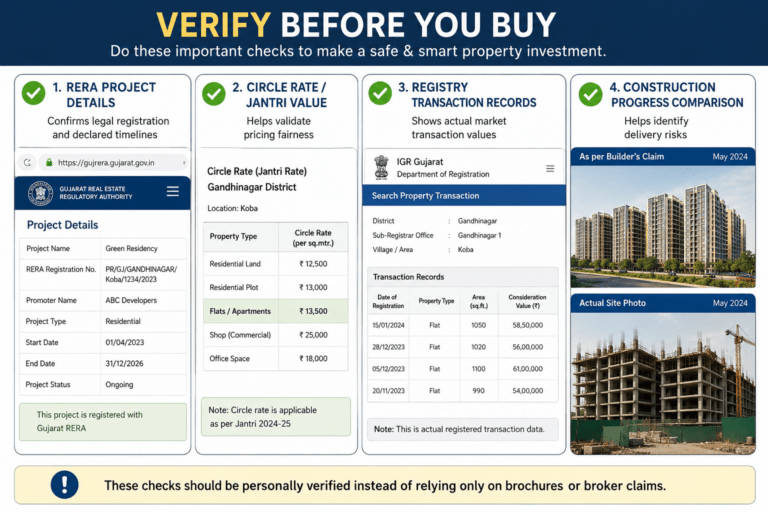
Step 3: Builder & RERA Verification
What To Do
Verify:
- RERA registration
- Builder history
- Past project delivery
- Construction quality
- Litigation records
Why It Matters
Builder credibility directly impacts:
- Possession timelines
- Resale value
- Stress levels during construction
Mistakes To Avoid
- Trusting only sales teams
- Ignoring delayed projects
- Assuming all branded builders are reliable
Pro Tip
Speak to residents of the builder’s older projects before buying.
Step 4: Site Visit Checklist
What To Do
Check:
- Ventilation
- Sunlight
- Lift quality
- Parking design
- Water pressure
- Room dimensions
- Construction finishing
Why It Matters
Modern interiors can distract buyers from practical flaws.
Mistakes To Avoid
- Falling for decorative sample flats
- Ignoring actual carpet area
- Not checking nearby construction activity
Pro Tip
Spend at least 15 minutes quietly inside the flat before deciding.
Step 5: Legal & Registry Checks
What To Do
Verify:
- Land title
- Approvals
- NA permissions
- Registry trends
- Encumbrance status
Why It Matters
Legal clarity protects future resale and financing.
Mistakes To Avoid
- Depending entirely on brokers
- Skipping independent legal review
- Ignoring registry data
Pro Tip
A legal verification expense today can prevent years of future problems.
Step 6: Negotiation Strategy
What To Do
Negotiate:
- Floor-rise charges
- Parking costs
- Modular fittings
- Payment flexibility
- Maintenance waivers
Why It Matters
Builders usually keep negotiation margins.
Mistakes To Avoid
- Showing emotional attachment
- Paying token amounts immediately
- Negotiating only on headline price
Pro Tip
Quarter-end periods often create better negotiation opportunities.
Real Case Studies
Case Study 1: End-User Family
Buyer Profile
IT professional couple with parents
Budget
₹60 lakh
Property
2 BHK apartment in a gated residential community in Koba
Purchase Price
₹56 lakh
Current Estimated Value
₹64–66 lakh
Outcome
The family prioritized:
- Peaceful surroundings
- Connectivity
- Construction quality
- Daily convenience
Instead of chasing luxury branding.
Lesson Learned
Practical living value matters more than marketing language.
Case Study 2: Investor
Investor Profile
Ahmedabad-based businessman
Entry Price
₹47 lakh during under-construction stage
Rental Yield
Approx. 3%
Appreciation
Moderate but stable
Exit Strategy
Long-term holding linked to infrastructure growth
What Worked
- Early entry pricing
- Trusted builder
- Strategic location
What Didn’t
Expected appreciation was slower than projected.
Lesson Learned
Real estate wealth creation in Koba requires patience, not speculation.
Real Buyer Testimonials
“We almost booked a cheaper apartment, but after checking road access and actual carpet space, we changed our decision. That saved us from a poor investment.”
— Hitesh IT employee, Ahmedabad
“The biggest shock was hidden charges. The final price was very different from the advertised pricing.”
—Ramesh PSU employee relocating near Gandhinagar
“We initially focused only on investment returns, but eventually realized comfortable family living mattered more.”
— John NRI buyer
Market Context & Ground-Level Reality
Koba’s property market has benefited from:
- Infrastructure development
- Improved urban connectivity
- Residential expansion
- Demand from professionals working near Gandhinagar and GIFT City
However, buyers should understand:
- Supply is increasing
- Not every project will appreciate equally
- Interest rate changes affect affordability
- Under-construction risks still exist
Real estate decisions are highly cycle-dependent.
Buying at the wrong price can delay returns for years.
Proofs & Verification
Who This Guide Is NOT For
This guide is not for:
- Short-term flippers
- Speculative investors chasing rumors
- Buyers expecting instant appreciation
- Emotion-driven buyers ignoring financial planning
You should reconsider buying now if:
- EMI pressure feels uncomfortable
- Job stability is uncertain
- You may relocate within a few years
- Emergency savings are weak
In some situations, renting is financially smarter than buying immediately.
Especially when:
- Prices feel overheated
- Market supply is excessive
- Lifestyle needs are uncertain
This guide is also not designed for:
- Insider investment deals
- Quick-profit expectations
- Speculative property gambling
If I Were Buying Today
If I were personally buying an affordable 2 BHK apartment in Koba today:
- I would prioritize a trusted builder over luxury branding
- I would choose practical connectivity over oversized layouts
- I would negotiate hard on hidden charges
- I would avoid projects heavily dependent on future promises
Would I buy now?
If I had:
- Stable income
- Long-term holding intention
- Genuine end-use need
…then yes, selectively.
But if my goal was only fast appreciation, I would remain cautious.
One red flag I would never ignore:
Poor builder execution history.
No discount compensates for delayed possession or poor construction quality.
Conclusion
Affordable 2 BHK apartments in Koba can offer:
- Comfortable family living
- Strategic connectivity
- Modern residential infrastructure
- Long-term growth potential
But buyers must stay practical.
The smartest buyers are not the fastest buyers.
They are the buyers who:
- Verify everything
- Compare carefully
- Understand compromises
- Think long term
- Ignore emotional pressure
A property purchase is not just an investment decision.
It is a lifestyle decision, a financial commitment, and often a family decision for the next 10–15 years.
Take your time before choosing.
Affordable 2 BHK Apartments In Koba: FAQs
Is Koba genuinely affordable today?
Is buying under-construction risky?
Are luxury amenities worth paying extra for?
Is Koba good for family living?
What is the biggest mistake first-time buyers make?
Reference
About the Author

Mitesh Vyas
Hello My Name is Mitesh Vyas i am a Real Estate content writer and Property Market Enthusiast I shares practical insights on buying, selling, investing, and understanding real estate trends. With a strong focus on residential and commercial properties, My aims to help readers make informed property decisions through clear, research-based, and easy-to-understand content.