
Koba vs Raysan: Which Area Is Better for Buying Flats: Last year, I met a buyer working in GIFT City who was stuck between buying a 3 BHK in Koba or a slightly larger flat in Raysan. Every broker told him the same thing:
“Sir, prices will double in 2 years.”
“Last few units left.”
“Book today or inventory gone.”
He almost paid a token amount without checking three critical things:
- Actual registry rates in the area
- Future supply pressure
- Whether the builder had delayed earlier projects
After reviewing the numbers, we discovered the “limited inventory” project had over 40 unsold units quietly available through channel partners.
That buyer eventually purchased in Raysan — not because Raysan was universally better, but because his priorities were:
- larger carpet area,
- lower EMI stress,
- long-term self-use,
- and school access.
Another buyer I advised made the opposite decision and chose Koba because he valued:
- shorter Ahmedabad commute,
- stronger rental liquidity,
- and better resale confidence.
This is exactly why most online property blogs fail real buyers.
They treat every location like a brochure.
Real buying decisions are about trade-offs, compromises, timing, and risk management.
In my experience advising buyers across Gandhinagar micro-markets, Koba and Raysan attract very different buyer profiles — and choosing the wrong one can lock you into years of regret, poor resale, or unnecessary financial pressure.
This guide is designed to help you avoid that mistake.
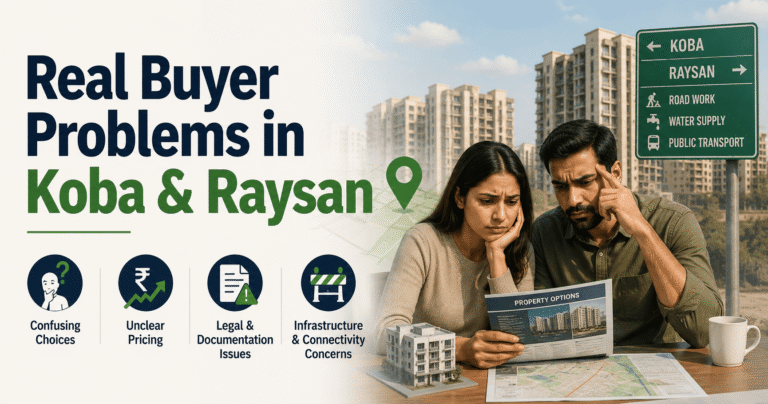
Real Buyer Problems in Koba & Raysan
1. Buyers Confuse “Future Potential” With Guaranteed Appreciation
This is the biggest trap.
Both Koba and Raysan are marketed aggressively because of:
- GIFT City influence
- Gandhinagar infrastructure growth
- expanding road connectivity
- premium township launches
But buyers often assume:
“Every project here will appreciate.”
That is simply not true.
I’ve seen projects in the same locality show completely different outcomes because of:
- builder reputation,
- maintenance quality,
- density,
- unsold inventory,
- and connectivity gaps.
A good location cannot save a badly executed project.
2. Hidden Cost Inflation Is Very Common
Many buyers compare only base price per sq.ft.
That is a mistake.
In actual transactions, buyers underestimate:
- floor rise charges,
- PLC,
- GST,
- maintenance deposits,
- parking,
- legal charges,
- possession expenses.
A ₹75 lakh quote can quietly become ₹86–90 lakh.
This happens frequently in premium Koba projects.
Raysan projects usually offer slightly better carpet-area efficiency, but some builders compensate by inflating amenities pricing.
Always compare:
- final agreement value,
- carpet efficiency,
- and total acquisition cost.
Not brochure price.
3. Wrong Buyer-Type Selection
This is where many people fail.
Koba typically suits:
- Ahmedabad-working professionals
- premium buyers
- higher-budget end users
- buyers prioritizing commute convenience
Raysan typically suits:
- long-term family buyers
- budget-conscious upgraders
- larger-family requirements
- buyers wanting lower entry pricing
The mistake happens when:
- investors buy oversized self-use inventory,
- or families overpay for prestige locations they don’t fully need.
4. Builder Trust Matters More Than Location
When choosing between areas for property growth, long-term value depends not only on location but also on the credibility and delivery track record of the builder. A strong developer ensures timely possession, better construction quality, and sustained demand—often impacting appreciation more than micro-location alone.
This is why understanding Which area offers better flat appreciation? goes beyond geography; it also includes evaluating builder trust, project execution history, and buyer confidence in future resale value.
I’ve seen buyers choose a weaker builder in a “hot” area and regret it badly.
Common issues:
- delayed possession,
- poor finishing quality,
- maintenance disputes,
- parking conflicts,
- legal documentation gaps.
A mid-tier project from a reliable builder often performs better than a flashy project from an aggressive marketer.
Especially in developing corridors.
Koba vs Raysan: The Real Comparison
| Factor | Koba | Raysan |
|---|---|---|
| Connectivity to Ahmedabad | Stronger | Moderate |
| Access to SG Highway | Faster | Slightly longer |
| GIFT City Access | Good | Very good |
| Pricing | Higher | More affordable |
| Rental Demand | Better currently | Growing |
| Luxury Projects | More established | Emerging |
| Plot Availability | Limited | More expansion potential |
| Traffic Density | Increasing | Relatively calmer |
| Family Living Value | Good | Strong |
| Investor Speculation | Higher | Moderate |
My Honest Observation After Multiple Site Visits
Koba feels more mature today.
Raysan feels like an area still shaping itself.
That distinction matters.
If you want:
- immediate livability,
- stronger resale liquidity,
- and easier Ahmedabad connectivity,
Koba has an edge.
If you want:
- lower entry cost,
- larger configurations,
- and longer-term family comfort,
Raysan often offers better practical value.
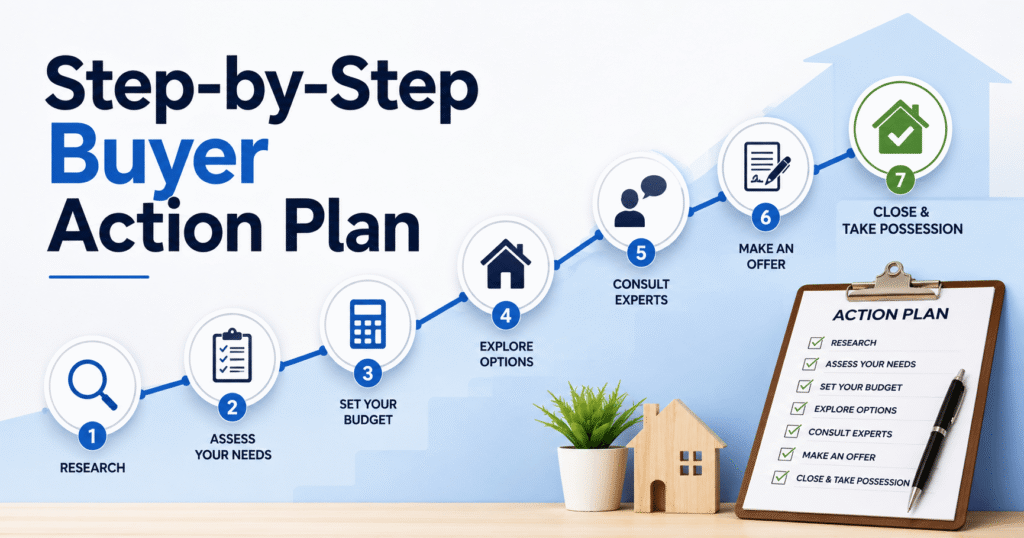
Step-by-Step Buyer Action Plan
Step 1: Location Selection
What To Do
Choose based on daily life — not future marketing narratives.
Track:
- office commute,
- school access,
- traffic at peak hours,
- nearby essentials,
- future road execution reality.
Why It Matters
Buyers underestimate how exhausting poor daily connectivity becomes after possession.
Mistakes To Avoid
- buying only because “prices will rise,”
- ignoring actual travel routes,
- choosing isolated projects.
Pro Tip
Visit both areas:
- weekday morning,
- evening peak traffic,
- and weekend.
Locations feel very different at different times.
Step 2: Budget & Price Validation
What To Do
Check:
- registry transactions,
- nearby resale deals,
- circle rates,
- unsold inventory pressure.
Why It Matters
Quoted pricing and actual market-clearing pricing are often very different.
Mistakes To Avoid
- comparing only launch prices,
- ignoring possession timelines,
- stretching EMI beyond comfort.
Pro Tip
If a builder offers “special discount valid today only,” assume negotiation margin still exists.
Especially in slower-moving inventory.
Step 3: Builder & RERA Verification
What To Do
Verify:
- RERA registration,
- litigation history,
- previous possession timelines,
- construction quality of older projects.
Why It Matters
Builder execution risk is real.
Mistakes To Avoid
- trusting sample flats blindly,
- relying only on broker claims,
- ignoring online complaint patterns.
Pro Tip
Talk to existing residents of previous projects.
That conversation is usually more valuable than the sales presentation.
Step 4: Site Visit Checklist
What To Check
- natural light,
- ventilation,
- lift waiting time,
- parking turning radius,
- waterlogging signs,
- construction density,
- noise exposure.
Why It Matters
Many premium-looking projects age badly because of poor planning.
Mistakes To Avoid
- visiting only decorated show units,
- ignoring lower floors,
- overlooking nearby future construction.
Pro Tip
Stand silently in the unit for 5 minutes.
You notice things brochures hide:
- highway noise,
- smell,
- ventilation issues,
- cramped spacing.
Step 5: Legal & Registry Checks
What To Do
Verify:
- title clarity,
- NA permission,
- approved plans,
- mortgage status,
- agreement clauses.
Why It Matters
Legal shortcuts create future resale and financing problems.
Mistakes To Avoid
- signing without independent legal review,
- trusting verbal commitments,
- ignoring penalty clauses.
Pro Tip
Never depend entirely on builder-appointed legal teams.
Hire your own property lawyer.
Step 6: Negotiation Strategy
What To Do
Negotiate:
- floor rise,
- parking,
- maintenance waiver,
- payment schedule flexibility.
Why It Matters
Negotiation is easier than most buyers realize.
Mistakes To Avoid
- appearing emotionally committed too early,
- paying token before document review.
Pro Tip
Month-end and quarter-end often improve negotiation leverage.
Especially in inventory-heavy projects.
Read More:- Property Appreciation In Koba Gandhinagar
Real Case Studies
Case Study 1 — End User Family (Raysan)
Buyer Profile
PSU employee family relocating from Chandkheda.
Budget
₹82 lakh all-inclusive.
Purchase
3 BHK in Raysan.
Purchase Price
₹74 lakh agreement value.
Current Estimated Value
₹88–92 lakh after several years.
Why It Worked
- Larger carpet area
- Lower financial pressure
- Better family-focused environment
Lesson Learned
The buyer initially wanted Koba for “prestige,” but realized daily affordability mattered more than location branding.
That decision reduced long-term EMI stress significantly.
Case Study 2 — Investor Purchase (Koba)
Buyer Profile
Ahmedabad-based investor targeting rental demand from GIFT City professionals.
Entry Price
₹68 lakh for 2 BHK.
Rental Yield
Approximately 3–3.5%.
Appreciation
Moderate but stable over holding period.
Exit Strategy
Planned resale after infrastructure maturation.
What Worked
- Better tenant demand
- Stronger connectivity perception
- Easier resale inquiries
What Didn’t
- Maintenance costs rose faster than expected
- Supply competition limited aggressive appreciation
Key Lesson
Koba offers stronger liquidity than speculative upside.
That distinction matters for investors.
Realistic Buyer Testimonials
We chose Raysan because we needed a bigger home within budget. Initially we worried about future growth, but after two years, the lifestyle value has been worth more than speculative appreciation.”
— Nilesh IT professional family
“I almost booked in a project only because the broker said prices would jump after GIFT expansion. After checking registry values, I realized the quoted rate was already aggressively priced.”
—David NRI buyer
“Koba worked for us because daily Ahmedabad travel mattered more than getting extra square footage.”
— Parth Senior banking professional
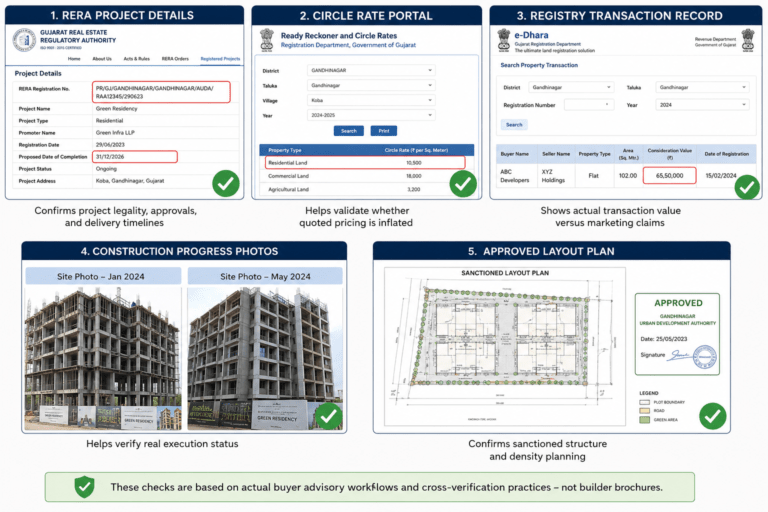
Verified Data & Market Context
During buyer advisory work, these are the sources I typically cross-check before giving recommendations:
- Gujarat RERA registrations
- Sub-registrar transaction data
- Circle rate references
- Local development authority approvals
- On-ground construction progress
- Existing resident feedback
Current market reality:
- Premium micro-markets near GIFT influence zones have seen price increases,
- but inventory supply has also expanded,
- which means not every project will appreciate equally.
Interest rate sensitivity also matters now more than it did a few years ago.
Buyers stretching budgets aggressively should be cautious.
Proofs & Screenshot
Who This Guide Is NOT For
This guide may NOT help you if:
- you want quick speculative flipping,
- you expect unrealistic short-term appreciation,
- you rely on rumor-based investing,
- you are purchasing only because friends or brokers pressured you.
You should probably delay buying if:
- your EMI would exceed safe affordability,
- your job stability is uncertain,
- you may relocate within 3–5 years,
- you are buying purely from fear of “missing out.”
In some cases, renting is financially smarter than forcing ownership at stretched valuations.
Especially for uncertain short-term stays.
If I Were Buying Today
If I personally had to choose between Koba and Raysan today:
For self-use:
I would lean toward Raysan if:
- I wanted a larger family home,
- planned to stay 7–10 years,
- and preferred lower financial pressure.
For investment:
I would still prefer select projects in Koba because:
- tenant movement is stronger,
- resale conversations are easier,
- and location familiarity remains an advantage.
What I Would Negotiate Hardest
- all-inclusive pricing,
- maintenance structure,
- parking allocation,
- possession-linked payment terms.
One Red Flag I Would Never Ignore
A builder with repeated possession delays.
No location premium compensates for execution failure.
And if pricing feels disconnected from actual resale transactions, I would wait instead of forcing a purchase.
Conclusion
Koba and Raysan are both viable residential markets — but for very different buyers.
Koba offers:
- better present-day maturity,
- stronger Ahmedabad linkage,
- and better liquidity.
Raysan offers:
- larger living value,
- relatively better affordability,
- and stronger long-term family practicality.
The smarter decision is not choosing the “hotter” area.
It is choosing the area that fits:
- your holding period,
- your financial comfort,
- your lifestyle needs,
- and your risk tolerance.
A wrong property decision usually doesn’t fail immediately.
It fails slowly over years through:
- financial stress,
- poor resale,
- weak livability,
- or unmet expectations.
That’s why careful due diligence matters more than excitement.
If you are evaluating projects in either location, create a comparison sheet before paying any token amount:
- total acquisition cost,
- builder track record,
- actual carpet efficiency,
- legal verification,
- and resale reality.
That single exercise prevents many costly mistakes.
Koba vs Raysan: Which Area Is Better for Buying Flats? :FAQs
Is Koba overpriced right now?
Is Raysan too early for investment?
Which area is safer for families?
Which has better resale potential?
Should I buy under-construction or ready-to-move?
References
About the Author

Mitesh Vyas
Hello My Name is Mitesh Vyas i am a Real Estate content writer and Property Market Enthusiast I shares practical insights on buying, selling, investing, and understanding real estate trends. With a strong focus on residential and commercial properties, My aims to help readers make informed property decisions through clear, research-based, and easy-to-understand content.