
Buying a flat in Gandhinagar is rarely as simple as comparing the property price with your eligible home loan.
A buyer may see a ₹70 lakh flat, get told by a bank that a ₹55 lakh home loan is possible, and assume the remaining amount is simply ₹15 lakh. That assumption can become expensive very quickly.
The actual cash requirement can include the down payment, home loan processing fee, legal verification charges, technical valuation charges, documentation or administrative charges, mortgage-related expenses, insurance if applicable, stamp duty and registration costs, and other property-purchase expenses.
I have seen buyers focus so heavily on getting the lowest interest rate that they forget to ask one basic question:
“What will this loan and property actually cost me from application to registration?”
That is the question this guide is designed to answer.
Most online articles explain home loans as if the only number that matters is the interest rate. For a real buyer purchasing a flat in Gandhinagar, that is incomplete. A slightly lower interest rate does not automatically mean a cheaper loan if the lender has higher upfront or service charges.
The Reserve Bank of India requires regulated lenders to provide transparent information about applicable loan charges, and the Key Facts Statement framework is specifically intended to help borrowers understand the overall cost of credit.
So, before you pay a token amount to a builder or sign a booking form, understand the complete cost structure.
The Real Buyer Problem: The Flat Is ₹70 Lakh — But Is It Really ₹70 Lakh?
Imagine a family looking for a 3 BHK flat in Gandhinagar.
They find a property advertised at ₹70 lakh.
The broker says:
“Sir, your loan is approved. You only need to arrange the margin money.”
The family feels relieved.
Then the actual paperwork starts.
There is a home loan processing fee.
The lender may require property legal verification and technical valuation.
There may be documentation or administrative charges.
There are property-side expenses such as stamp duty and registration.
If it is an under-construction property, the payment schedule may also affect the interest burden.
Suddenly, the family realises that the amount they need in cash is substantially higher than the ₹15 lakh they originally calculated.
This is one of the biggest mistakes I would warn a Gandhinagar buyer against:
Do not calculate affordability using only the flat price and EMI. Calculate the entire acquisition cost.
That is especially important because advertised property prices and actual transaction costs are two different things.
What Are Home Loan Charges in Gandhinagar?
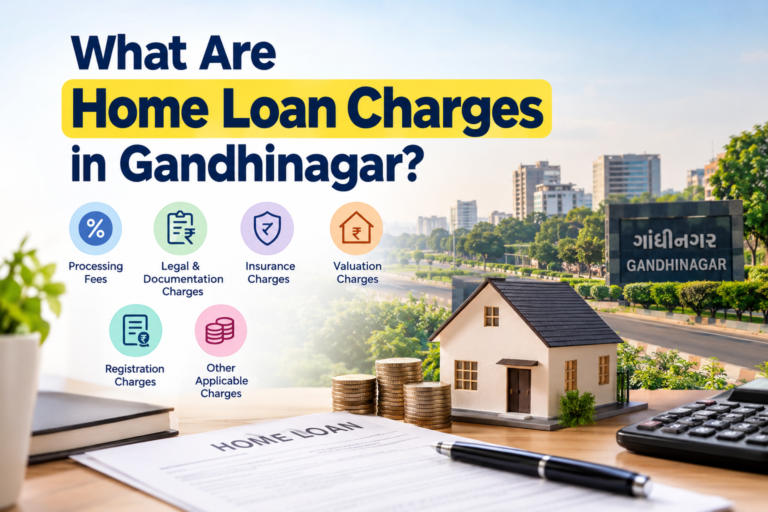
The phrase home loan charges in Gandhinagar usually refers to the fees and expenses associated with obtaining, processing, maintaining, changing or closing a home loan.
The exact charges depend on the lender, loan product, borrower profile and property.
Common categories include:
| Charge | What it means | When you may pay |
|---|---|---|
| Processing fee | Lender's charge for processing the loan | Application/sanction stage |
| Legal verification fee | Cost associated with checking property documents/title | Before sanction/disbursement |
| Technical valuation fee | Property valuation/technical assessment | During loan processing |
| Documentation/admin charges | Loan documentation and administrative work | Sanction/disbursement |
| Mortgage/security-related charges | Costs connected with creating security over property | Depending on lender/process |
| CERSAI-related charge | Charge associated with security-interest registration where applicable | Loan/security creation |
| Stamp/documentation costs | Depends on the applicable transaction/document | Property/loan documentation |
| Insurance | Optional or product-specific depending on circumstances | During loan |
| Prepayment/foreclosure charge | Charge, if legally/applicably permitted under the loan terms | Loan closure/prepayment |
| Penal charges | Charges for specified defaults/non-compliance | During loan tenure |
| Conversion charges | May apply when changing certain loan-rate structures | During tenure |
Important: There is no single government-fixed “home loan charges in Gandhinagar” rate card that applies identically to every lender.
A bank and a housing finance company may have different fee structures.
Even the same lender may run different products or offers.
That is why copying a processing-fee percentage from another website and assuming it is your final cost is a mistake.
Home Loan Processing Fee: The First Charge Buyers Notice
The home loan processing fee is one of the most commonly advertised loan charges.
It is usually charged for processing and assessing your loan application.
But there is an important point buyers often miss:
Do not ask only, “How much is the processing fee?”
Ask:
- Is it a fixed amount or percentage?
- Is GST applicable?
- Is it refundable if the loan is rejected?
- Is it refundable if the property fails legal verification?
- Does it include technical valuation?
- Does it include legal verification?
- Are there separate administrative charges?
- Are there charges payable before sanction?
- Are there charges payable again at disbursement?
RBI guidance has long required lenders to transparently disclose applicable fees and charges, including processing-related charges and other costs that affect the borrower.
Example
Suppose a lender quotes a processing charge of 0.50% on a ₹50 lakh loan.
That would be ₹25,000 before considering any applicable taxes or other separate charges.
Another lender might advertise a higher interest rate but offer a substantially lower upfront fee.
So don’t compare:
Bank A = 8.00%
against
Bank B = 8.10%
and immediately conclude that Bank A is cheaper.
Compare the total cost of borrowing.
Legal Verification Charges
When you purchase a flat using a home loan, the lender has an interest in ensuring that the property can legally serve as security for the loan.
That means the property documents may be examined.
Depending on the property and lender, legal due diligence can involve documents relating to:
- Title
- Previous ownership
- Sale deeds
- Development rights
- Encumbrances
- Approved plans
- RERA registration
- Land-related documents
- Permissions
- Building approvals
- Possession-related documents
- Other property-specific records
A legal verification charge may therefore appear in your loan cost.
But here is the important distinction:
A bank’s legal approval is not a substitute for your own independent property lawyer.
A lender primarily wants to establish that the property is acceptable as security for its loan.
Your objective is broader:
You want to know whether you should buy the property at all.
Those are not exactly the same question.
Technical Valuation Charges
The lender may also need a technical assessment of the property.
The purpose is generally to determine whether the property and its value are acceptable for the proposed loan.
This becomes particularly important when the seller’s asking price is significantly above comparable properties.
For example:
A seller says the flat is worth ₹80 lakh.
Comparable properties suggest around ₹72–75 lakh.
If the lender’s valuation comes in lower, your financing requirement may change.
That can create a cash-flow problem for the buyer.
The mistake to avoid
Never assume:
“The bank will finance whatever percentage of the builder’s price I agree to.”
The lender’s assessment and loan-to-value conditions can affect the amount actually available.
Loan Documentation and Administrative Charges
Some lenders may charge for administrative or documentation-related work.
These charges may appear small individually.
The problem is that buyers often don’t notice them because they are buried inside a long sanction letter or fee schedule.
This is precisely why the Key Facts Statement (KFS) and written fee disclosure matter.
RBI’s framework requires lenders to communicate key information about the cost of loans, including applicable charges.
My practical advice
Before signing:
Ask the lender for a written “all charges payable” statement.
Don’t rely on:
“Sir, these are standard charges.”
There is nothing wrong with asking for the exact amount in writing.
CERSAI and Mortgage-Related Costs
Home loans involve creation of security over the property.
Depending on the lender and transaction structure, there can be charges connected with registering or creating the lender’s security interest and completing the mortgage-related formalities. These are among the Home loan expenses buyers should know before finalising their financing, as they can add to the overall cost of purchasing a property.
The exact amount and mechanism depend on the lender and applicable rules.
This is another reason not to build your budget using a generic internet calculator alone.
Ask the lender:
“Please give me every charge connected with creation and release of the mortgage/security.”
Also ask what happens when you completely repay the loan.
Stamp Duty and Registration: Don't Confuse These With the Home Loan
This is one of the most important distinctions in this entire article.
Stamp duty and property registration expenses are not simply “home loan charges.”
They are connected to the property transaction and applicable documentation.
So if someone says:
“The flat is ₹70 lakh and your loan is ₹55 lakh, so arrange ₹15 lakh.”
you should immediately ask:
“What about the property transaction costs?”
Your actual cash requirement can be:
Down payment + property transaction costs + loan-related charges + other purchase expenses
rather than simply:
Property price − loan amount
The applicable amount depends on the transaction, property and prevailing Gujarat rules.
For the latest applicable rates and valuation rules, buyers should verify the official Gujarat registration/stamp-duty system and applicable Jantri/valuation information before calculating the final amount.
Jantri Value Matters When Buying a Flat in Gandhinagar
Buyers frequently focus only on the negotiated market price.
But government valuation mechanisms such as Jantri are important when evaluating a property transaction.
You should not assume that the seller’s asking price, negotiated price and government valuation are automatically identical.
For a serious purchase, compare:
Quoted price
vs.
Negotiated price
vs.
Comparable market prices
vs.
Applicable government valuation/Jantri considerations
This helps you understand whether you are paying a reasonable price rather than simply accepting the broker’s “current rate.”
Interest Is the Biggest Cost — Not the Processing Fee
This is where many buyers make a strange mistake.
They negotiate ₹10,000 off the processing fee but don’t negotiate or compare the structure of a ₹50 lakh, 20-year loan carefully.
Interest can become the largest cost associated with borrowing.
For example, an illustrative ₹50 lakh loan over 20 years at 8% would have an EMI of roughly ₹41,822.
Over the full scheduled tenure, the total repayment would be approximately ₹1 crore.
That does not mean you will necessarily pay that exact amount, because actual rates can change and borrowers may prepay or restructure the loan.
The point is simply this:
A small difference in interest rate can matter much more than a small one-time processing fee.
Floating Interest Rate: What Buyers Should Understand
Most borrowers focus on the starting rate.
I would focus on what happens after the starting rate changes.
For a floating-rate loan, changes in the benchmark or lending rate can affect your EMI and/or loan tenure depending on the lender’s mechanism.
RBI requires relevant information about the annualised rate/APR and the impact of benchmark-rate changes to be communicated to borrowers.
So ask:
- What is the benchmark?
- What is the spread?
- How often can the rate reset?
- What happens if rates increase?
- Does the EMI increase?
- Does the tenure increase?
- Can I make part-prepayments?
- Are there any conversion charges?
Don’t select a loan based solely on today’s EMI.
Prepayment and Foreclosure Charges
This is an area where buyers should know their rights instead of relying on verbal statements.
For individual borrowers with eligible floating-rate term loans for non-business purposes, RBI rules restrict lenders from charging foreclosure/prepayment penalties in specified circumstances. RBI materials also distinguish treatment depending on loan type and rate structure.
That does not mean every possible loan structure has identical treatment.
Before signing, ask:
“If I receive ₹10 lakh in two years and want to reduce my outstanding principal, exactly what will you charge me?”
Get the answer in writing.
Penal Charges: Understand Them Before You Need Them
Missing an EMI or violating a material term can result in penal charges under the lender’s policy.
RBI has directed regulated entities to disclose the quantum and reason for applicable penal charges and not structure such charges as additional penal interest.
This matters because buyers often plan their EMI around their current income.
I recommend maintaining an emergency reserve instead of stretching the budget to the maximum loan amount approved by the bank.
Loan eligibility is not the same thing as affordability.
Step-by-Step Buyer Action Plan
Step 1: Location Selection
What to do
Before worrying about the home loan, decide whether the location makes sense for your actual life.
In Gandhinagar, compare the locality based on:
- Daily commute
- Road connectivity
- Schools
- Hospitals
- Employment access
- Public transport
- Future development
- Water and drainage
- Neighbourhood quality
- Resale demand
- Rental demand
Areas such as Sargasan, Raysan, Randesan, Koba and other developing residential pockets can behave differently.
Current listing-based market data illustrates this variation. For example, Magicbricks’ Jul–Sep 2026 data shows average listed flat prices around ₹4,658/sq ft in Raysan and ₹4,837/sq ft in Randesan, while its Gandhinagar-wide average is around ₹4,302/sq ft. These are listing-based indicators, not registered transaction prices, so they should be used for comparison rather than treated as guaranteed market value.
Mistake to avoid
Don’t buy because:
“This area will become the next big thing.”
If you cannot explain why the location works for your family today, future appreciation should not rescue the decision.
Pro tip
Visit the property twice:
Once during normal daytime and once during peak traffic.
The second visit often reveals more than the first.
Step 2: Budget & Price Validation
What to do
Prepare this calculation:
Property price
- stamp duty/registration and applicable property transaction costs
- home loan charges
- interior/furnishing
- maintenance/deposits
- moving expenses
- emergency reserve
= real purchase budget
Mistake to avoid
Do not use your maximum bank eligibility as your personal budget.
If the bank says:
“You can get ₹60 lakh.”
that doesn’t mean you should borrow ₹60 lakh.
Pro tip
Keep a cash reserve after the purchase.
A home should not consume every rupee you have.
Step 3: Builder & RERA Verification
For a new or under-construction project, check the project on the Gujarat RERA portal.
GujRERA provides public search access to registered projects, agents and professionals, along with project-related regulatory information.
Check:
- RERA registration
- Promoter details
- Approved project information
- Completion timeline
- Project progress
- Litigation/complaint information where available
- Changes/extensions
- Uploaded documents
- Unit details
Mistake to avoid
Do not treat:
“RERA approved”
as meaning:
“Everything about this project is risk-free.”
RERA registration is important, but it does not eliminate construction, delay, quality, pricing or personal affordability risk.
Step 4: Site Visit Checklist
During your site visit, don’t spend the entire time looking at the sample flat.
Check the things that will affect your life after purchase.
Inspect:
- Actual flat orientation
- Natural light
- Ventilation
- Road noise
- Lift location
- Parking
- Water supply
- Drainage
- Common areas
- Fire-safety arrangements
- Construction quality
- Nearby development
- Future obstruction possibilities
- Mobile network
- Internet availability
Ask the builder:
- What is included in the quoted price?
- What is excluded?
- Is parking included?
- What maintenance deposit applies?
- What are possession terms?
- What happens if possession is delayed?
- Which specifications are contractual?
Red flag
If the salesperson refuses to put an important promise in writing, treat that promise as unreliable.
Step 5: Legal & Registry Checks
Before paying a large non-refundable amount, conduct legal due diligence.
For a resale property, examine:
- Previous sale deeds
- Title chain
- Encumbrance-related records
- Property tax records
- Society documentation
- Existing loan status
- Seller identity
- Outstanding dues
- Building permissions where relevant
- Occupancy/possession documentation where applicable
For new construction, examine the developer’s project documents and approvals.
Mistake to avoid
Don’t assume:
“The bank approved my loan, so the property is legally perfect.”
The bank’s legal process and your independent due diligence serve different purposes.
Step 6: Negotiation Strategy
Don’t negotiate only on the headline property price.
Negotiate the total acquisition cost.
Ask whether the seller/builder can adjust:
- Base price
- Floor-rise charges
- Parking
- Maintenance deposit
- Clubhouse charges
- Documentation-related charges
- Other add-ons
- Payment schedule
The strongest negotiation is not:
“Give me your best price.”
It is:
“Here is my total budget. These are the comparable properties. These are the additional charges. If the complete cost comes within this number, I can proceed.”
That gives you a much stronger negotiating position.
Read More :- Home Loan Eligibility for a Flat in Gandhinagar
How Much Should You Keep Aside for Home Loan Charges?
There is no universal amount because lender fees vary.
Instead of relying on a generic percentage, create a loan-charge worksheet.
| Cost | Illustrative Amount |
|---|---|
| Processing fee | ₹5,000 |
| GST/taxes on applicable services | ₹900 |
| Legal verification | ₹3,000 |
| Technical valuation | ₹2,500 |
| Documentation/admin | ₹1,500 |
| Security/mortgage-related costs | ₹5,000 |
| CERSAI or similar applicable charge | ₹100 |
| Insurance, if applicable | ₹8,000 |
| Conversion charges, if applicable | ₹2,000 |
| Prepayment/foreclosure terms | ₹0* |
| Penal-charge terms | As per lender terms* |
| Other charges | ₹2,000 |
Then ask:
“Is this the complete list of charges I may have to pay from application through loan closure?”
This single question can prevent unpleasant surprises.
Realistic Case Studies
Case Study 1 — End-User Family
The following is an illustrative case study, not a claim about a specific real customer.
A family with a combined stable income was considering a 3 BHK flat in the Gandhinagar residential market.
Budget
₹80 lakh total property budget.
Purchase price
₹72 lakh.
Loan
Approximately ₹52 lakh.
Initial mistake
The family calculated:
₹72 lakh − ₹52 lakh = ₹20 lakh.
They assumed ₹20 lakh would be sufficient for their own contribution.
After preparing the complete purchase budget, they realised they also needed to account for applicable property transaction costs, loan-related charges, interiors and an emergency reserve.
Outcome
They chose a slightly less expensive property rather than exhausting their savings.
Lesson
The better property is not always the more expensive property.
For an end-user, financial breathing room after purchase is often more valuable than an extra bedroom, premium floor or luxury amenity.
Case Study 2 — Investor
Again, this is an illustrative scenario rather than a real customer testimonial.
An investor purchases a flat for approximately ₹55 lakh with a substantial loan component.
Suppose the property generates ₹18,000 per month in rent.
Annual rent:
₹18,000 × 12 = ₹2.16 lakh.
Gross rental yield:
₹2.16 lakh ÷ ₹55 lakh × 100
≈ 3.9%
That sounds reasonable until the investor considers:
- Maintenance
- Vacancy
- Repairs
- Property tax where applicable
- Loan interest
- Brokerage on tenant changes
- Opportunity cost
If the property appreciates by 5% in a year, that does not automatically mean the investor earned a 5% cash return.
What worked
The investor selected a location with actual rental demand rather than buying purely on future-development rumours.
What didn’t work
The investor initially assumed appreciation would compensate for a weak rental yield.
Exit strategy
The investment becomes more attractive if there is both:
reasonable rental demand + realistic resale demand
rather than appreciation alone.
What About Current Gandhinagar Market Conditions?
The Gandhinagar residential market is not one uniform market.
Prices differ significantly between localities, configurations, project quality and possession status.
Current listing-based data from Magicbricks shows an average Gandhinagar multistorey-apartment price of about ₹4,302/sq ft for Jul–Sep 2026, with reported quarterly movement of around 3%. Its locality data also shows differences between areas such as Koba, Randesan, Raysan and Zundal.
But I would strongly caution buyers against interpreting this as:
“Prices will definitely rise.”
Listing prices are not the same as registered transaction prices.
More importantly, even if Gandhinagar prices rise, that does not make an overpriced property a good purchase.
Buying at the right price matters more than predicting the market perfectly.
Social Proof: What Genuine Buyer Feedback Should Look Like
I would not publish invented testimonials as if they were genuine customers.
For a real estate website, fabricated testimonials create the appearance of trust without the substance behind it.
Instead, genuine customer feedback can be presented in this format after obtaining permission.
Example format — IT Professional
“I was initially focused only on the EMI. The biggest help was understanding the total purchase cost before finalising the flat.”
Buyer type: IT professional
Location: Gandhinagar
Outcome: Understood complete acquisition cost before purchase
Example format — PSU Employee
“The legal-document checklist made me slow down before paying the booking amount. That was more useful than another property brochure.”
Buyer type: PSU employee
Location: Gandhinagar
Outcome: Completed document verification before committing
Example format — NRI
“I wanted to buy remotely, but the document and RERA checks gave me a better process for evaluating the property.”
Buyer type: NRI
Location: Gandhinagar
Outcome: Used independent verification before purchase
For publication, replace these illustrative formats with actual customer statements, names/initials and permissions.
The Documents I Would Want Before Paying a Large Token
For a serious purchase, I would want to see as much relevant documentation as applicable to the property.
New project
- RERA registration
- Project details
- Approved plans
- Builder/promoter information
- Construction status
- Payment schedule
- Agreement terms
- Possession commitments
- Unit specifications
- Applicable charges
Resale flat
- Previous sale deed
- Title documents
- Society records
- Existing loan status
- Property tax records
- Maintenance dues
- Seller identity
- Relevant permissions
- Possession/occupancy documents where applicable
The exact document list should be confirmed with a qualified property lawyer because the requirements differ by property type and transaction.
Screenshot & Proof Placements

Who This Guide Is NOT For
This guide is not designed for someone looking for a quick speculative trade.
It is not designed for someone who wants to:
- Buy today and flip within a few months
- Depend on broker rumours
- Bet everything on future infrastructure announcements
- Buy only because “prices are going up”
- Take the maximum possible loan simply because a bank approves it
- Ignore legal verification
- Ignore the complete cost of borrowing
You should seriously consider waiting if:
- Your emergency fund would disappear after the purchase.
- Your EMI would consume an uncomfortable portion of your income.
- Your income is unstable.
- You are buying mainly because someone says prices will rise.
- You haven’t verified the property documents.
- You are uncomfortable with the project’s delivery risk.
- You have not compared alternative properties.
Sometimes the best property decision is:
Don’t buy yet.
Renting for another year can be financially smarter than entering a 15–20 year loan under pressure.
If I Were Buying This Property Today
I would not rush simply because the builder or broker says the offer expires today.
I would buy only if four things aligned:
- The location works for my actual lifestyle.
- The property is legally and technically acceptable.
- The negotiated price is reasonable compared with comparable properties.
- The EMI remains comfortable even if my expenses increase.
Which configuration would I choose?
For an end-user, I would generally favour a practical configuration with strong resale and rental demand rather than paying a large premium for unnecessary luxury specifications.
If a well-planned 3 BHK meets the family’s needs, I would not automatically stretch to a much more expensive 4 BHK simply because the larger property appears more prestigious.
What would I negotiate hardest?
I would negotiate the total acquisition cost, not only the advertised base price.
I would specifically examine:
- Base price
- Parking
- Floor-rise charges
- Maintenance deposit
- Other mandatory charges
- Payment schedule
- Possession terms
The one red flag I would not ignore
A seller or builder who creates urgency before allowing proper document verification.
“Book today or lose the price” is not a substitute for legal due diligence.
If the property is genuinely good, it should survive reasonable questions.
My Biggest Warning About Home Loans
Don’t let the phrase “low EMI” make an expensive property look affordable.
A long tenure can reduce the monthly EMI while substantially increasing the total interest paid.
Likewise, don’t let:
“Processing fee waived”
distract you from:
- Higher interest
- Unfavourable reset terms
- Expensive conversion charges
- Poor prepayment flexibility
- Other disclosed fees
The cheapest loan is not necessarily the loan with the lowest advertised processing fee.
The better question is:
“What is my total financial cost and how flexible is this loan if my circumstances change?”
The Simple Home Loan Comparison Method I Recommend
Before selecting a lender, create a one-page comparison.
| Factor | Lender A | Lender B | Lender C |
|---|---|---|---|
| Loan amount | ₹50,00,000 | ₹50,00,000 | ₹50,00,000 |
| Interest rate | 8.35% | 8.50% | 8.25% |
| Processing fee | ₹5,000 | ₹7,500 | ₹4,999 |
| Legal charges | ₹3,000 | ₹2,500 | ₹3,500 |
| Technical valuation | ₹2,500 | ₹2,000 | ₹2,500 |
| Documentation | ₹1,500 | ₹2,000 | ₹1,500 |
| Other charges | ₹2,000 | ₹3,000 | ₹1,500 |
| EMI | ₹43,079 | ₹43,544 | ₹42,828 |
| Rate reset | As per lender benchmark | As per lender benchmark | As per lender benchmark |
| Prepayment terms | As per loan terms | As per loan terms | As per loan terms |
| Conversion charges | ₹2,000 | ₹2,500 | ₹1,500 |
| Penal charges | As per lender terms | As per lender terms | As per lender terms |
Then compare the total, not just the headline interest rate.
Conclusion:
Buying a flat in Gandhinagar can be a sensible long-term decision.
But the decision should not begin with:
“How much home loan can I get?”
It should begin with:
“What is the complete cost of owning this property, and can I comfortably carry it?”
Understand the home loan charges in Gandhinagar before signing the loan documents.
Check the processing fee.
Check legal and technical charges.
Read the KFS.
Understand the interest-rate mechanism.
Ask about prepayment.
Check penal charges.
Separately calculate stamp duty, registration and other property-purchase expenses.
Verify the property.
Verify RERA where applicable.
Compare the actual market.
Then negotiate.
And if the numbers do not make sense, walk away.
There will always be another property.
There may not be another opportunity to undo an expensive financial mistake easily.
A useful next step
Before paying a booking amount, create a simple three-column sheet:
Property Cost | Loan Cost | Other Purchase Costs
Put every known expense into it.
If you cannot explain every number, you are not ready to sign.
FAQ: Real Buyer Doubts
What documents should I ask the lender for before accepting a home loan?
Are legal and technical verification charges the same for every lender?
Can property legal issues increase my home loan costs?
Does the loan amount include registration and other property-buying costs?
What should I check in the home loan interest-rate reset clause?
References
About the Author