
Residential Projects In Vavol Gandhinagar: A few months ago, I met a homebuyer family in Gandhinagar who had already visited 6–7 “premium residential projects” in Vavol. Every builder told them the same thing:
- “Limited units left”
- “Price will increase next month”
- “Best investment near Gandhinagar corridor”
On paper, everything looked perfect—new township layouts, clubhouse, garden, gymnasium, wide roads, and promises of future metro connectivity. But the confusion was real.
The couple asked me one simple question:
“If everything is so good in Vavol, why do we feel something is missing?”
That’s exactly where most online blogs fail.
They show you amenities and connectivity terms, but they don’t tell you:
- What actually gets delivered vs what is shown in brochures
- Which projects struggle with occupancy even after possession
- Whether pricing is genuinely justified or inflated by marketing cycles
In my experience advising buyers in this micro-market, Vavol is not a “bad” location—but it is a misunderstood one. And misunderstanding real estate is where people lose money, not in the buying itself.
This guide is not about selling Vavol. It is about helping you decide:
“Should I actually buy a residential project in Vavol Gandhinagar—or wait?”
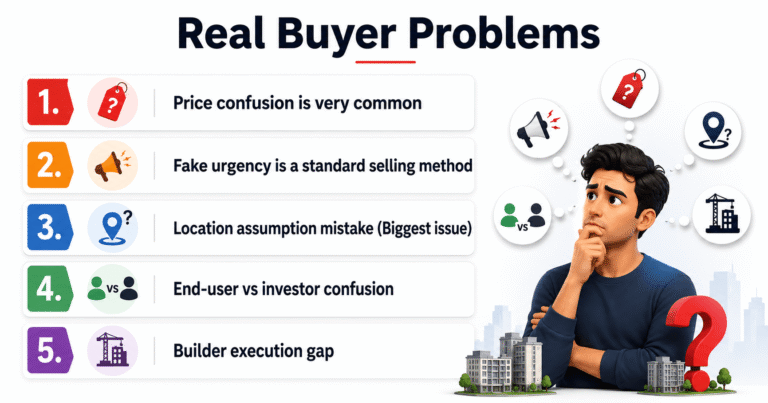
Real Buyer Problems
1. Price confusion is very common
In Vavol residential projects, the same flat is often quoted at multiple price points like early-bird rates, limited-time discounts, or broker-specific deals.
Without verifying official records, buyers may assume they are getting a special deal.
In reality, prices fluctuate due to marketing tactics rather than real value differences.
In Vavol’s residential projects, I’ve seen the same flat quoted at different prices:
- Early booking rate
- “Today-only” discount price
- Broker special pricing
Without checking registry data, buyers often assume they got a deal—when in reality, they are just entering a fluctuating pricing cycle.
2. Fake urgency is a standard selling method
Buyers are often pressured with claims like “only a few units left” or “price will increase in the next phase.”
These statements are commonly used to encourage faster purchase decisions. While some projects may experience genuine demand, buyers should independently verify the actual inventory status before making a commitment, especially when evaluating residential properties with modern amenities in rapidly developing areas.
Common pressure lines in this locality include:
- “Only 3 flats left in this tower”
- “Next phase will be 10–15% higher”
- “RERA revision is coming”
However, the ground reality can be quite different:
- Many projects still have unsold inventory even after possession.
- Demand is not uniform across all towers, unit types, or layouts.
- Some “hot-selling” projects are driven more by marketing campaigns than actual buyer demand.
Rather than relying solely on sales narratives, buyers should compare inventory availability, pricing trends, and project specifications before making a final decision.
3. Location assumption mistake (Biggest issue)
Many assume Vavol is highly livable just because it is near Gandhinagar.
But proximity does not guarantee strong connectivity or daily convenience.
Several areas still depend on developing infrastructure and future promises.
People assume:
“Vavol is close to Gandhinagar, so it must be highly livable.”
But proximity is not connectivity.
Some projects in outer pockets of Vavol still depend heavily on:
- Underdeveloped internal roads
- Future infrastructure promises
- Limited daily convenience stores and services
4. End-user vs investor confusion
Buyers often expect metro-like appreciation and rapid growth in returns.
However, rental demand and appreciation vary by micro-location and project quality.
Not all projects deliver strong investment performance consistently.
Many buyers enter Vavol thinking:
- “I will get strong appreciation like metro cities”
But reality is:
- Rental demand exists, but is not explosive everywhere
- Appreciation depends heavily on project micro-location and execution quality
5. Builder execution gap
There is often a difference between brochure promises and actual delivery.
Amenities like clubhouses or gyms may be delayed or scaled down.
In some cases, final construction quality differs from showroom expectations.
I’ve personally seen cases where:
- Show flat quality ≠ delivered flat quality
- Amenities like gymnasium or clubhouse are delayed or scaled down
- Landscaping and common areas differ from brochure rendering
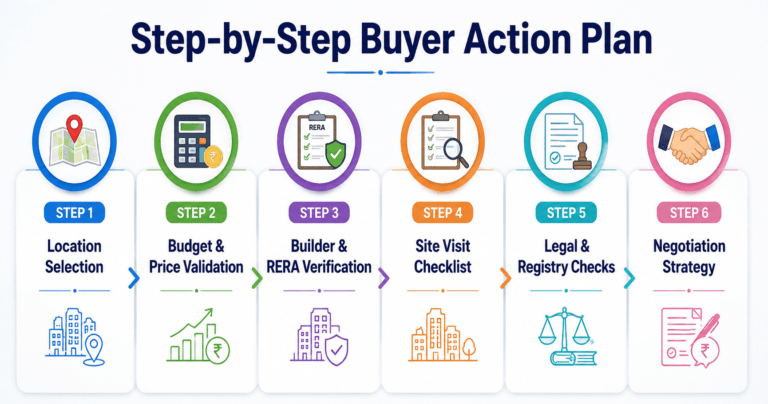
Step-by-Step Buyer Action Plan
Step 1: Location Selection
What to do:
Don’t just select “Vavol”—select the exact pocket and surrounding infrastructure.
Why it matters:
Two projects 1 km apart can have completely different livability.
Mistakes to avoid:
- Buying only based on highway proximity
- Ignoring daily convenience radius (school, hospital, market)
Pro tip:
Check evening-time livability, not just daytime site visits.
Step 2: Budget & Price Validation
What to do:
Compare:
- Circle rate
- Registry records
- Nearby resale flats
Why it matters:
True value is what people actually paid—not what builder is quoting.
Mistake:
Assuming “discounted price” is always a deal.
Step 3: Builder & RERA Verification
What to do:
- Check project on RERA Gujarat portal
- Verify timeline, approvals, and complaint history
Why it matters:
Many delays are not construction issues—they are compliance or funding issues.
Red flag:
Repeated project extensions or frequent name changes.
Step 4: Site Visit Checklist
What to observe:
- Actual construction progress (not just tower skeleton)
- Worker activity level
- Surrounding infrastructure development
Mistake:
Only visiting sample flat and ignoring surroundings.
Step 5: Legal & Registry Checks
What to verify:
- Title clearance
- Encumbrance status
- Past sale transactions
Pro tip:
Ask for previous registry values in same tower or phase.
Step 6: Negotiation Strategy
What works in Vavol:
- Comparing multiple towers within same project
- Negotiating payment plan flexibility instead of just price
Avoid:
- Emotional buying due to urgency pressure
Real Case Studies
Case 1: End-User Family
- Location: Vavol near developing residential cluster
- Budget: ₹58 lakh
- Property: 2 BHK apartment
- Purchase Price: ₹55 lakh
Current Value (after ~2–3 years): ₹57–60 lakh range
Lesson learned:
- Value growth was slow but stable
- Livability improved only after nearby shops and roads developed
- Primary regret: did not check evening connectivity before buying
Case 2: Investor Buyer
- Entry price: ₹42 lakh (under-construction)
- Rental yield: ~2.8–3.2%
- Current valuation: ₹48–50 lakh
Exit strategy:
Holding longer term instead of quick flip
What worked:
- Buying early in a good micro-location pocket
What didn’t:
- Rental demand was lower than expected initially
Social Proof
- “I’m an IT professional working near Infocity. I bought in Vavol expecting quick appreciation, but I realized location selection within Vavol matters more than I thought.”
— Resident, near Infocity corridor - “We shifted from rented accommodation thinking township lifestyle will be ready. It took almost 2 years for full livability to improve.”
— Jitesh PSU employee family, Vavol - “Builder promised clubhouse facilities in Phase 1, but actual completion was delayed.”
—Joze NRI buyer returning from UAE
Credibility, Verified Data & Market Context
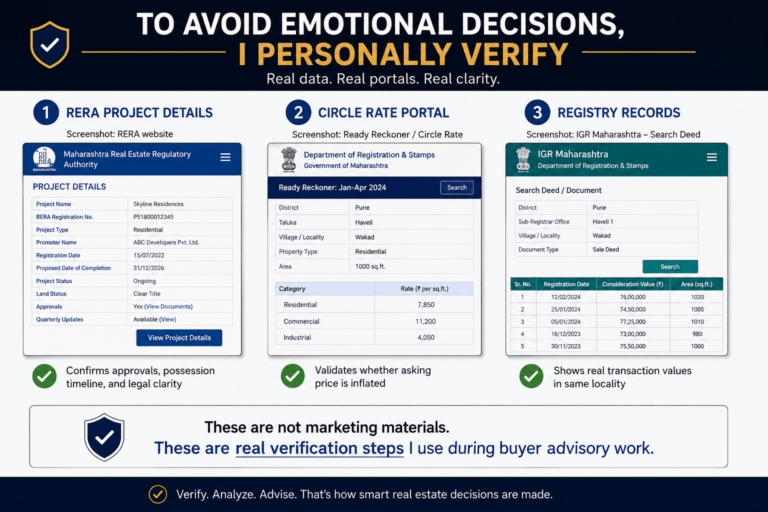
Any serious buying decision in Vavol should be cross-checked with:
- RERA Gujarat project records
- Sub-registrar registry transactions (actual sale values)
- Circle rate benchmarks (government valuation baseline)
- Local Gandhinagar development plans (roads, metro influence, infrastructure expansion near GIFT City corridor impact)
Market Reality Note (Important)
Vavol is a development-stage residential micro-market, not a fully stabilized mature market.
That means:
- Prices do not rise uniformly
- Livability improves in phases
- Investment returns depend heavily on entry timing
Proof & Screenshot
Who This Guide Is NOT For
This guide is NOT for:
- People looking for quick resale profit in 6–12 months
- Speculative investors chasing rumors or “hot deals”
- Buyers relying only on broker suggestions without verification
You should also reconsider buying if:
- You expect fully developed urban infrastructure immediately
- You cannot wait for 2–4 years of locality maturation
- You are uncomfortable with construction-stage uncertainty
In some cases, renting near Gandhinagar core may be smarter than buying in developing pockets of Vavol.
If I Were Buying Today
If I were buying a residential property in Vavol today:
- I would not buy in outer developing pockets expecting fast appreciation
- I would only consider projects closer to established infrastructure and main access corridors
- I would negotiate hard on:
- Payment schedule flexibility
- Final possession timeline clarity
- Hidden maintenance costs
One red flag I would not ignore:
Projects that rely heavily on “future development promises” without current livability strength.
I would personally prefer slower, verified growth over hype-driven pricing.
Conclusion
Vavol Gandhinagar is not a shortcut to wealth, nor is it a risky trap.
It is a transitioning residential micro-market where:
- Some pockets are genuinely livable
- Some are still evolving
- And some are over-marketed
The right decision depends entirely on micro-location, builder credibility, and your time horizon.
If you are confused, don’t rush.
A wrong real estate decision is not expensive only in money—it is expensive in years of stress.
Residential Projects In Vavol Gandhinagar: FAQs
Q1: Is Vavol good for end-use living?
Q2: Will prices increase quickly?
Q3: Is it safe to invest in under-construction flats?
Q4: What is the biggest mistake buyers make?
Q5: How important is metro or highway proximity?
Reference
About the Author

Mitesh Vyas
Hello My Name is Mitesh Vyas i am a Real Estate content writer and Property Market Enthusiast I shares practical insights on buying, selling, investing, and understanding real estate trends. With a strong focus on residential and commercial properties, My aims to help readers make informed property decisions through clear, research-based, and easy-to-understand content.