
RERA Approved Flats in Vavol Gandhinagar : A few months ago, I met a couple from Ahmedabad who were seriously considering a “RERA approved 2 BHK in Vavol.” They had already visited three projects in a single weekend. Each builder told them the same thing in different words:
- “Prices will increase next month”
- “Only a few units left”
- “This is the best time to book”
By the third site visit, they were more confused than convinced.
One project looked premium in brochures but felt isolated on-ground. Another had decent construction but unclear possession timelines. The third was “RERA approved,” but the buyer had no idea what that actually protected them from.
In my experience advising buyers in this market, most people don’t lose money because they pick the wrong flat — they lose money because they don’t understand what they are actually buying into.
And that’s the real gap online blogs rarely cover. They talk like everything is safe, everything is “good investment,” and everything is “fast appreciating.”
Real estate doesn’t work like that in places like Vavol, where development is still uneven and buyer awareness is still catching up.
Real Buyer Problems
1. “RERA Approved” is misunderstood
RERA approval is often mistaken as a guarantee of safety, but it only ensures registration and disclosures, not timely delivery, quality, or appreciation.
Buyers must still verify builder history and on-ground execution before trusting it fully.
Many buyers assume RERA approval means:
- No delays
- No legal issues
- Guaranteed possession
That’s not true.
RERA only ensures the project is registered and certain disclosures are made. It does NOT guarantee quality, future appreciation, or even stress-free execution.
2. Price confusion is intentional
In Vavol, flat prices vary widely for the same unit due to hidden negotiations, broker tactics, and shifting “limited-time” offers.
This makes it difficult for buyers to know the real market value without proper comparison.
In Vavol, I’ve personally seen:
- Different prices for same flat on same floor
- “Today offer” pricing that disappears tomorrow
- Broker-driven artificial demand spikes
Most buyers don’t realize that there is rarely a fixed price in under-construction projects.
3. Fake urgency is standard practice
Builders often create pressure using “few units left” or “price hike soon” claims, even when inventory is not actually scarce.
This tactic pushes buyers into emotional decisions instead of rational evaluation.
Common lines:
- “Only 3 units left”
- “Next phase will be 10–15% higher”
- “Rates will increase after booking closure”
In reality, inventory rarely moves that fast in mid-stage projects.
4. Location illusion problem
Being close to Gandhinagar doesn’t automatically mean good connectivity or long-term livability, as many projects still lack daily convenience and strong rental demand. On-ground visits often reveal gaps that maps and brochures hide.
Many buyers exploring Verified Residential Projects in Vavol assume proximity to the city guarantees a better lifestyle, but that is not always the case. Vavol is close to Gandhinagar, yet “close” does not necessarily mean “connected.”
Some projects may look attractive on Google Maps but can still be:
• Poorly connected to schools, hospitals, and daily essentials
• Dependent on future infrastructure promises that may take years to materialize
• Located in pockets with weak rental demand and limited tenant activity
This is why physical site visits remain one of the most important steps before making a purchase decision.
5. End-use vs investment confusion
Buyers often fail to separate living needs from investment expectations, leading to wrong decisions driven by speculation instead of practicality.
Clear intent is essential before even shortlisting any property.
Many buyers don’t ask:
- “Will I live here comfortably for 5–10 years?”
- “Or am I hoping the price will go up quickly?”
These are two completely different decisions. Mixing them is the biggest mistake I see.
Step-by-Step Buyer Action Plan (What Actually Works On Ground)
Step 1: Location Selection
What to do:
Check actual livability, not brochure location.
Why it matters:
Vavol has pockets that are developing fast and pockets that still feel semi-remote.
Mistakes to avoid:
- Trusting only Google Maps distance
- Ignoring daily commute reality
- Assuming future metro/road plans will fully solve current issues
Pro tip:
Visit the site at 8–9 AM and 6–7 PM. That’s when you see real traffic, noise, and accessibility.
Step 2: Budget & Price Validation
What to do:
Compare at least 3 projects with similar specifications.
Why it matters:
Pricing in Vavol is highly inconsistent due to builder segmentation.
Mistakes to avoid:
- Booking based on “pre-launch discount hype”
- Ignoring hidden costs (PLC, parking, maintenance corpus)
Pro tip:
Ask for full cost sheet including possession-stage charges before even considering booking.
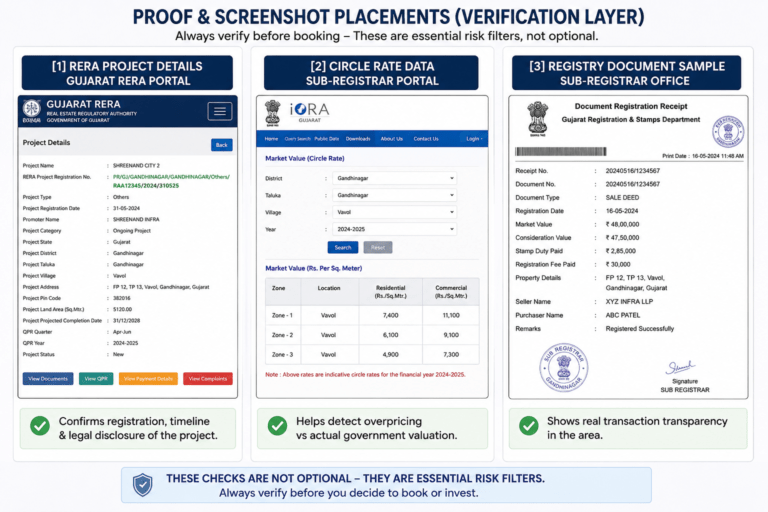
Step 3: Builder & RERA Verification
Check project on official Gujarat RERA portal:
Gujarat RERA
What to do:
- Verify registration number
- Check completion timeline
- Review past project history
Why it matters:
A RERA number without execution track record is just paperwork.
Mistakes to avoid:
- Assuming “RERA approved = safe builder”
- Ignoring delayed past projects
Pro tip:
Always check if the builder has delivered at least 1–2 projects on time.
Step 4: Site Visit Checklist
What to do:
- Visit actual construction site (not just sample flat)
- Check road access
- Observe surrounding development
Why it matters:
Brochures hide reality; sites reveal it.
Mistakes to avoid:
- Visiting only sample flats
- Not checking drainage, roads, connectivity
Pro tip:
Talk to nearby shop owners — they give the most honest feedback.
Step 5: Legal & Registry Checks
What to do:
- Verify title clearance
- Ask for NA (Non-Agricultural) status
- Check encumbrance details
Why it matters:
Legal clarity protects long-term resale value.
Mistakes to avoid:
- Relying only on builder legal team
- Skipping document verification due to “trust”
Step 6: Negotiation Strategy
What to do:
- Negotiate total cost, not per sq ft rate
- Ask for waiver of PLC/parking if possible
Why it matters:
Builders have hidden flexibility, especially near unsold inventory cycles.
Mistakes to avoid:
- Accepting first quoted price
- Falling for “limited-time offer” pressure
Real Case Studies
Case 1: End-User Family
- Buyer: Government employee family
- Location: Vavol, Gandhinagar
- Budget: ₹55 lakh
- Purchase: 2 BHK in under-construction project
- Current market value: ₹58–60 lakh
Outcome:
They gained stability but underestimated commute difficulty for daily Ahmedabad travel.
Lesson:
Comfort of home improved, but lifestyle adjustment was harder than expected.
Case 2: Investor Buyer
- Entry price: ₹48 lakh
- Rental income: ₹12,000/month
- Yield: ~3%
- Current value: ₹52 lakh
Exit strategy: Still holding
What worked:
Early entry in developing phase
What didn’t:
Rental demand lower than expected due to limited working population density
Lesson:
Vavol is not a high-yield rental market yet — it is a long-cycle appreciation zone.
Social Proof
Ramesh IT Professional, Ahmedabad
“We booked in Vavol thinking commute will be easy. It’s manageable but not as smooth as we thought. Planning matters more than price.”
piyush PSU Employee, Gandhinagar
“RERA gave confidence, but actual possession delays still happen. We learned to check builder history properly.”
Salt NRI Buyer
“We invested for future, not rental. The area is still developing but looks stable long-term.”
Credibility & Market Context
This guide is based on:
- Gujarat RERA project data verification
- Local registry and circle rate comparisons
- On-ground site visits in Vavol & nearby Gandhinagar sectors
- Buyer advisory interactions over multiple transactions
Market reality (2025–2026):
- Prices are stabilizing, not rapidly rising
- End-user demand is stronger than investor demand
- Infrastructure growth is gradual, not explosive
- Interest rates are affecting affordability decisions
Real estate in this region is highly cycle-dependent. Timing matters more than most buyers realize.
Proof & Screenshot
Who This Guide Is NOT For
This guide is NOT for:
- People looking for quick 6–12 month flipping profit
- Buyers relying on rumors or “hot deals”
- Investors expecting guaranteed high rental returns
- Anyone not willing to verify legal and pricing details
You should consider waiting or renting if:
- Your job requires frequent relocation
- You are unsure about long-term stay in Gandhinagar region
- You are buying purely on emotional urgency
If I Were Buying Today
If I were buying in Vavol right now:
- I would not rush into early-phase projects
- I would prefer ready or near-possession units only
- I would negotiate aggressively on total cost, not discounts
- I would avoid projects far from main road connectivity
One red flag I would NOT ignore:
Poor surrounding infrastructure despite “premium pricing”
Right now, this is a market where patience often saves more money than negotiation.
Conclusion:
RERA approved flats in Vavol Gandhinagar are not inherently good or bad.
They are context-dependent decisions.
If you are buying:
- For long-term living → possible fit
- For short-term profit → risky assumption
- Without on-ground verification → high chance of regret
If this guide has helped you think more critically, that itself is the real value.
RERA Approved Flats in Vavol Gandhinagar :FAQs
Q1: Is RERA approved flat completely safe?
Q2: Is Vavol good for investment?
Q3: Will prices double quickly?
Q4: Is it better than Ahmedabad outskirts?
Q5: What is the biggest risk?
Reference
About the Author

Mitesh Vyas
Hello My Name is Mitesh Vyas i am a Real Estate content writer and Property Market Enthusiast I shares practical insights on buying, selling, investing, and understanding real estate trends. With a strong focus on residential and commercial properties, My aims to help readers make informed property decisions through clear, research-based, and easy-to-understand content.