
Imagine finding a 2 BHK flat in Gandhinagar that fits your family’s needs. The location looks convenient, the builder promises an attractive offer, and the monthly EMI initially appears affordable. You start imagining your life in the new home.
Then the bank checks your salary, existing EMIs, credit history and the property’s documents. Suddenly, the loan amount you expected is lower than anticipated. The bank may also require a larger down payment than you planned.
This is where many first-time homebuyers face a difficult decision: should they arrange more money, choose a cheaper flat, or abandon the purchase?
The problem is not always a low salary. Sometimes, buyers misunderstand how home loan eligibility works, underestimate the total cost of buying a property, or assume that a bank’s loan approval means the purchase is financially safe.
In my experience of researching residential property decisions, one of the most important distinctions buyers must understand is that loan eligibility and actual affordability are not the same thing. A bank may approve a loan that meets its lending criteria, but the EMI could still leave your family with too little money for everyday expenses, emergencies and future responsibilities.
This guide explains home loan eligibility for a flat in Gandhinagar, how lenders assess first-time buyers, what salary you may need, how much down payment to prepare, and which property-related checks to complete before paying a booking amount.
The objective is simple: help you understand what you can reasonably afford before you commit your savings.

Why Home Loan Eligibility Can Become a Problem for First-Time Buyers
Buying a home involves more than choosing a property and applying for a loan. In Gandhinagar, buyers may compare apartments in Kudasan, Sargasan, Raysan, Randesan, Koba and Vavol, where property prices, commuting requirements and the availability of completed homes can differ.
The same monthly salary can support very different purchase decisions depending on the buyer’s existing loans, family expenses, savings and the property’s price.
The bank approves less than the expected loan amount
Suppose you earn ₹75,000 per month and want to purchase a flat priced at ₹65 lakh.
You may assume that your salary automatically qualifies you for a substantial home loan. However, the bank considers several factors:
- Monthly income and employment stability.
- Existing personal loans, car loans and other EMIs.
- Credit history and repayment behaviour.
- Age and proposed loan tenure.
- The bank’s internal eligibility and affordability criteria.
- The property’s valuation and legal documentation.
If you already pay ₹15,000 every month towards a car loan and personal loan, your borrowing capacity may be considerably lower than that of someone earning the same salary without existing debt.
What to do: Obtain a preliminary eligibility assessment before selecting a property based on an assumed loan amount.
The flat is affordable on paper, but the down payment is not
A common mistake is to calculate only the difference between the property price and the expected home loan.
For example, if a flat costs ₹50 lakh and you expect a loan of ₹40 lakh, you might assume that ₹10 lakh in savings is sufficient.
However, you may also need money for stamp duty, registration, applicable taxes, loan processing charges, legal expenses, moving costs and essential furnishing.
These expenses vary according to the transaction, property type and applicable rules. Some charges may be excluded from the amount financed by the lender.
What to do: Calculate your total cash requirement before paying a booking amount. Do not use your entire emergency fund to complete the purchase.
The builder pressures you to book before loan approval
Buyers sometimes hear statements such as:
- The offer is valid only today.
- Only one flat remains at this price.
- The bank will easily approve your loan.
- You can arrange the down payment later.
Such statements are not evidence of loan eligibility or a property’s legal safety.
Even if a project is associated with a bank or has received some form of lender assessment, you should not assume that your individual loan is guaranteed.
My recommendation: Never book a flat solely because a salesperson says the bank will approve your loan. Obtain a preliminary assessment, examine the booking terms and understand the consequences if financing is delayed or refused.
The property price is lower, but the location creates hidden costs
A flat farther from your workplace may initially look attractive because its purchase price is lower. However, additional commuting expenses, travel time and dependence on private transport can affect your household budget for years.
For example, a family saving ₹4 lakh on a property but spending an additional ₹5,000 per month on transport would spend ₹3 lakh over five years, before considering inflation or the time cost of commuting.
This does not automatically make the cheaper property a bad purchase. It means you should compare the complete cost of living in the location rather than the advertised property price alone.
End-use and investment decisions require different calculations
If you are buying a home for your family, convenience, school access, commute, usable space and long-term suitability may matter more than immediate rental income.
If you are buying for investment, vacancy risk, realistic rent, maintenance costs, resale demand and the possibility of holding the property for several years become important.
A property that suits your family may not generate a strong rental return. Equally, a property that looks attractive to an investor may not be suitable for your daily needs.
Before applying for a home loan, be clear about your purpose. Your borrowing decision should reflect how you intend to use the property.
What Is Home Loan Eligibility?
Home loan eligibility is the amount a lender is willing to consider lending to you after assessing your income, existing obligations, credit profile, repayment capacity and the property being purchased. Before committing to a flat, it is important to Check your home loan eligibility to understand how much you may be able to borrow and whether the expected EMI fits comfortably within your budget.
For first-time homebuyers in Gandhinagar, eligibility generally depends on two separate assessments.
Borrower eligibility: Can you reasonably repay the proposed loan?
Property eligibility: Does the property satisfy the lender’s valuation, documentation and legal requirements?
You may qualify financially but encounter a problem with the property documents. Alternatively, the property may be acceptable to the lender while your income supports a smaller loan than you need.
Both assessments matter.
Factors that influence home loan eligibility
| Factor | Why It Matters |
|---|---|
| Monthly Income | Helps the lender assess repayment capacity. |
| Employment Stability | Provides evidence of income continuity. |
| Existing EMIs | Reduces the income available for another loan. |
| Credit Score and Repayment History | Helps the lender evaluate past credit behaviour. |
| Age | Influences the permissible repayment tenure. |
| Loan Tenure | A longer tenure generally reduces the EMI but increases the total interest payable. |
| Down Payment | Determines how much you need to borrow. |
| Property Valuation | May limit the loan amount against the property. |
| Legal Documents | Help establish whether the property meets the lender's legal and documentation requirements. |
| Co-applicant Income | May improve eligibility when the lender accepts the income and the applicant meets its conditions. |
Home Loan for First-Time Homebuyers in Gandhinagar: How Much Can You Borrow?
The most useful starting point is your monthly income after considering existing financial commitments.
Lenders commonly examine the relationship between income and total monthly debt obligations. The exact calculation differs by lender, income level, loan amount and other circumstances.
The examples below are illustrative calculations, not bank-approved eligibility estimates.
Example 1: Buyer earning ₹50,000 per month
Assume the following circumstances:
- Monthly take-home income: ₹50,000.
- Existing EMIs: ₹5,000.
- Illustrative total EMI budget: ₹20,000.
- Amount remaining for a home loan EMI: ₹15,000.
At an illustrative interest rate of 8.5% per year over 20 years, an EMI of approximately ₹15,000 supports a loan of around ₹17 lakh.
This is a mathematical estimate based on the assumed rate and tenure. A lender may offer a different amount.
Buyer lesson: If you earn ₹50,000 per month, do not automatically assume you can afford a ₹40 lakh home loan. Your existing debt, household expenses, down payment and actual lending terms may make that purchase unsuitable.
Example 2: Buyer earning ₹75,000 per month
Assume:
- Monthly take-home income: ₹75,000.
- Existing EMIs: ₹5,000.
- Illustrative total EMI budget: ₹30,000.
- Amount available for the home loan EMI: ₹25,000.
At 8.5% annual interest over 20 years, an EMI of ₹25,000 supports a loan of approximately ₹29 lakh.
If the buyer has no existing EMIs, a lender may consider a different amount. However, using every available rupee for the EMI would leave little flexibility for emergencies or future expenses.
Buyer lesson: A loan amount that appears possible under a calculator may still be too high for your actual household budget.
Example 3: Couple earning ₹1.2 lakh per month together
Suppose a couple has a combined monthly take-home income of ₹1.2 lakh.
They have no existing loans and are considering a joint home loan. If the lender accepts both incomes and the applicants satisfy its requirements, combining incomes may improve their borrowing capacity.
However, they should not simply double the EMI budget because two people are earning.
They must consider childcare, future family expenses, career breaks, parental responsibilities and whether one income could temporarily stop.
Buyer lesson: Joint eligibility can help, but the household should remain financially comfortable even if its income falls for a period.
How to calculate your approximate EMI
A home loan EMI depends on three main variables:
- Principal amount borrowed.
- Annual interest rate.
- Loan tenure.
The standard EMI formula is:
EMI = P × r × (1 + r)ⁿ ÷ [(1 + r)ⁿ − 1]
Where:
- P = principal loan amount.
- r = monthly interest rate expressed as a decimal.
- n = total number of monthly instalments.
For a ₹40 lakh loan at an illustrative annual interest rate of 8.5% over 20 years, the EMI is approximately ₹34,700 per month.
Over the full 20 years, assuming the interest rate remains unchanged and all instalments are paid as scheduled, the total repayment would be approximately ₹83.3 lakh, including about ₹43.3 lakh in interest.
Actual repayment may differ because floating interest rates can change, and loan charges or other costs may apply.
Important: Do not select a 25- or 30-year tenure merely to make the EMI appear comfortable. A longer tenure generally increases the total interest paid if the loan remains outstanding for the full period.
How Much Salary Do You Need to Buy a Flat in Gandhinagar?
There is no universal minimum salary for purchasing a flat. The answer depends on the property price, your savings, the loan amount, other EMIs and the lender’s assessment.
The following examples demonstrate how the numbers can work.
| Illustrative Property Price | Assumed Down Payment | Illustrative Loan | Approximate EMI at 8.5% for 20 Years |
|---|---|---|---|
| ₹30 lakh | ₹6 lakh | ₹24 lakh | ₹20,800 |
| ₹40 lakh | ₹8 lakh | ₹32 lakh | ₹27,800 |
| ₹50 lakh | ₹10 lakh | ₹40 lakh | ₹34,700 |
| ₹60 lakh | ₹12 lakh | ₹48 lakh | ₹41,700 |
| ₹70 lakh | ₹14 lakh | ₹56 lakh | ₹48,600 |
These examples assume a 20% down payment purely for illustration. Actual lender loan-to-value limits and the amount financed can differ according to the property, borrower and applicable rules.
The table excludes stamp duty, registration, other purchase costs and any expenses that cannot be financed through the loan.
A practical affordability rule
As a personal budgeting guideline, consider keeping your total monthly EMIs around 30–35% of take-home income where practical, particularly if you have dependants or an uncertain income.
This is not a bank rule or a guarantee of affordability. Some households can comfortably manage a higher proportion, while others need a much lower commitment.
For example, a ₹40 lakh loan with an EMI of approximately ₹34,700 could be burdensome for a household taking home ₹75,000 per month, particularly if it has children, existing debt or significant family responsibilities.
Instead of asking only, “Will the bank approve this loan?” ask:
“After paying the EMI, will I still have enough money to live comfortably, save and manage an unexpected expense?”
If the answer is no, choose a less expensive property or postpone the purchase.
Step-by-Step Action Plan Before Applying for a Home Loan
Step 1: Select a location that suits your daily life
What to do
Compare suitable residential areas in Gandhinagar, including Kudasan, Sargasan, Raysan, Randesan, Koba and Vavol, based on your budget and practical requirements.
Check:
- Distance and travel time to work.
- Access to schools, healthcare and essential shops.
- Public transport and road connectivity.
- Parking and building access.
- Water supply, drainage and monsoon conditions.
- Construction activity and noise in the surrounding area.
- Whether the neighbourhood suits your needs after five to ten years.
Visit the location at different times of day rather than relying on one daytime inspection.
Why it matters
The EMI remains a monthly obligation even when traffic becomes frustrating, a workplace changes or a family member needs regular medical access.
A convenient location may justify paying more, but only if the extra cost remains affordable.
Mistakes to avoid
- Buying because a broker claims an area will become the next major investment destination.
- Assuming every property in a popular locality is fairly priced.
- Ignoring the actual route to your workplace.
- Choosing a remote property only because the EMI is lower.
Practical tip
Calculate the expected monthly cost of transport, maintenance and utilities alongside the EMI. Compare properties on total household cost rather than purchase price alone.
Step 2: Validate the budget and total purchase price
What to do
Ask for a written cost sheet that identifies the basic property price and all additional charges.
Check the treatment of:
- Parking.
- Maintenance deposits.
- Clubhouse or amenity charges.
- Stamp duty and registration.
- Applicable GST, where relevant.
- Legal and loan processing charges.
- Electricity, water and utility connections.
- Interior work and moving expenses.
The applicable charges depend on the property and transaction. For example, GST treatment differs between eligible under-construction residential purchases and completed properties, subject to the applicable rules and circumstances.
Why it matters
A property advertised at ₹50 lakh may require a significantly higher total cash outlay.
If your savings are just sufficient for the down payment, additional charges could force you to borrow elsewhere or exhaust your emergency reserves.
Mistakes to avoid
- Treating the booking amount as the entire initial cash requirement.
- Assuming every purchase expense will be covered by the home loan.
- Relying on verbal promises about discounts or waived charges.
- Ignoring the financial difference between a ready property and an under-construction flat.
Practical tip
Prepare three separate figures:
- Total property acquisition cost.
- Cash needed before and during registration.
- Monthly household expenses after moving in.
Do not proceed until all three are realistic.
Step 3: Verify the builder and project registration
What to do
For a project covered by the applicable requirements of Gujarat RERA, verify its registration and relevant disclosures on the official Gujarat RERA portal.
Review:
- Project registration details.
- Declared completion date and any recorded extensions.
- Approved project information and disclosures.
- Promoter details.
- Construction progress information, where available.
- Complaints, orders or other publicly available records relevant to the project.
For an existing or completed property, additional checks may be needed to establish its completion and legal status.
Why it matters
A home loan does not eliminate project risk. A buyer can face delays, unexpected expenses or legal complications even after making a substantial financial commitment.
Mistakes to avoid
- Assuming a RERA registration guarantees timely completion.
- Treating a builder’s brochure as proof of approvals.
- Assuming a bank’s willingness to finance a project proves every aspect of the property is legally sound.
- Ignoring differences between advertised amenities and approved plans.
Practical tip
Match the exact project name, phase and relevant unit information. If the builder cannot clearly explain a discrepancy in the documents, pause the purchase until an independent professional reviews it.
Step 4: Inspect the property before committing
What to do
During a site visit, inspect:
- Wall cracks, dampness and visible leakage.
- Natural light and ventilation.
- Water pressure and drainage.
- Lift availability and maintenance.
- Fire safety provisions and access routes.
- Parking allocation and usability.
- Common areas and construction quality.
- Noise, road access and surrounding development.
For an under-construction flat, compare the unit and project information with the applicable approved plans and contractual specifications.
Why it matters
The property you finance is the property you must live in or maintain. Cosmetic finishes can hide problems that become expensive after possession.
Mistakes to avoid
- Visiting only a decorated sample flat.
- Inspecting only during office hours.
- Assuming a promise about repairs is equivalent to a written commitment.
- Paying a non-refundable amount before understanding the booking conditions.
Practical tip
Take photographs, prepare a written inspection list and record every promised repair or change. For a significant purchase, consider engaging an independent building professional.
Step 5: Complete legal and registration checks
What to do
Before making a substantial payment, arrange an independent legal review appropriate to the property.
Depending on the transaction, the review may cover:
- Title documents and ownership history.
- Encumbrances and existing charges.
- Relevant land records and revenue entries.
- Approved building plans and permissions.
- Applicable completion or occupancy documentation.
- Agreement for sale and payment terms.
- RERA disclosures, where applicable.
- Pending litigation or other material legal issues.
- Whether the proposed transaction and seller have the necessary authority.
For land-related checks in Gujarat, the appropriate records may include GARVI registration information, relevant revenue records and other records accessible through the relevant authorities. The precise checks depend on the property type.
Why it matters
A bank’s legal assessment is not a substitute for understanding your own contractual rights and the risks of the transaction.
Mistakes to avoid
- Assuming the seller’s name on a document resolves every title question.
- Treating a property tax receipt as conclusive proof of ownership.
- Skipping independent legal review because the bank has appointed a lawyer.
- Ignoring clauses about possession, cancellation, delayed completion or refunds.
Practical tip
Do not make a large payment simply because registration is scheduled soon. Have the documents reviewed and ensure the agreement accurately reflects the property, price, payment schedule and remedies available to you.
Step 6: Negotiate after checking affordability and documentation
What to do
Once you understand the property and your finances, negotiate the complete transaction rather than focusing only on the advertised discount.
Possible negotiation points include:
- Base price.
- Parking charges.
- Maintenance deposits.
- Payment milestones.
- Written commitments for repairs.
- Included fixtures or other specified items.
- Cancellation and refund conditions.
- Handover timelines and contractual remedies.
Why it matters
A discount may be less valuable than a clear agreement, a realistic payment schedule or a property with fewer unresolved risks.
Mistakes to avoid
- Accepting an artificially high starting price followed by a dramatic discount.
- Paying a booking amount to secure a verbal offer.
- Agreeing to an aggressive payment schedule before checking loan disbursement requirements.
- Signing a document without understanding cancellation clauses.
Practical tip
Obtain the final offer in writing and compare the total acquisition cost across properties. If the seller refuses to document important promises, treat that refusal as a warning sign.
How to Improve Your Home Loan Eligibility
If your desired loan amount is higher than the preliminary estimate, there are several legitimate ways to improve your application.
Maintain a healthy credit profile
Review your credit report and correct genuine reporting errors through the relevant lender or credit bureau.
Pay existing EMIs and credit card bills on time. Avoid applying for numerous loans or credit facilities in a short period without a clear reason.
A strong credit history can help a lender assess your application, but it does not guarantee approval or a particular interest rate.
Reduce existing debt
Outstanding personal loans, car loans and other EMIs can reduce your home loan capacity.
If you have enough savings to repay an expensive existing loan, compare the benefits of reducing that debt with the need to retain emergency funds and make the property down payment.
Do not empty your savings merely to improve the eligibility calculation.
Increase your down payment
A larger down payment reduces the amount you need to borrow and may improve the overall affordability of the purchase.
However, do not use every rupee of savings to reduce the loan. You still need money for emergencies, moving expenses and unexpected home repairs.
Consider an eligible co-applicant
A spouse or another eligible co-applicant may help strengthen an application if the lender accepts their income and the relevant ownership and repayment arrangements satisfy its policies.
Before applying jointly, understand the legal responsibilities of the co-borrower. A joint loan is a financial commitment, not merely a way to increase eligibility.
Choose a suitable tenure
A longer tenure generally lowers the monthly EMI, which may improve the lender’s repayment-capacity calculation.
However, it usually increases total interest if the loan remains outstanding for the full period.
Choose a tenure that balances current affordability with the total cost of borrowing. Do not use a longer tenure to justify buying a property that is otherwise beyond your means.
Compare offers from multiple lenders
Compare the interest rate, processing charges, loan terms, prepayment conditions and other relevant costs.
Ask whether the quoted rate is fixed or floating and how rate changes affect the EMI or tenure.
Use a written sanction letter and the lender’s official terms to understand the final offer. A broker’s verbal estimate is not a substitute for formal approval.
Realistic Case Studies: How Home Loan Decisions Affect Buyers
Case Study 1: A Family Buying Its First Home
Buyer profile: A couple purchasing a home for their own use.
| Detail | Illustrative Figures |
|---|---|
| Combined Monthly Take-Home Income | ₹1,00,000 |
| Target Property | 2 BHK Flat |
| Illustrative Location | Kudasan, Gandhinagar |
| Purchase Price | ₹48 lakh |
| Assumed Down Payment | ₹10 lakh |
| Illustrative Home Loan | ₹38 lakh |
| Interest Rate Used for Calculation | 8.5% per year |
| Loan Tenure | 20 years |
| Approximate EMI | ₹33,000 per month |
The family initially focuses on the advertised property price. After calculating registration-related expenses, moving costs, essential furnishing and the need for emergency savings, they realise that their original budget leaves little flexibility.
They compare another property with a lower purchase price and a more convenient commute. The cheaper option reduces the amount they need to borrow and leaves more savings available after registration.
Outcome: The family chooses the lower-cost option because it better fits its monthly budget and daily requirements.
Lesson learned: The best home is not necessarily the property with the most amenities. It is the property that meets the family’s needs without making its finances fragile.
No current property value or appreciation is claimed here because that would require verified, property-specific transaction evidence.
Case Study 2: An Investor Considering a Rental Property
Buyer profile: A salaried investor considering a flat for rental income.
| Detail | Illustrative Figures |
|---|---|
| Entry Price | ₹55 lakh |
| Annual Gross Rent | ₹2.16 lakh |
| Monthly Gross Rent | ₹18,000 |
| Gross Rental Yield | Approximately 3.9% |
| Assumed Annual Operating Costs and Vacancy Allowance | ₹36,000 |
| Illustrative Annual Net Rent Before Financing and Tax | ₹1.80 lakh |
| Net Operating Yield Before Financing and Tax | Approximately 3.3% |
The investor initially believes rental income will cover a substantial portion of the EMI. However, the annual rent is considerably lower than the total annual repayment on a typical long-term loan of this size.
The investor then compares the expected net rent with maintenance expenses, vacancy risk, loan interest, taxes and the possibility of selling the flat later.
What worked: Calculating net rent instead of relying on advertised rental figures reveals the actual cash-flow position.
What did not work: Assuming property appreciation would automatically compensate for weak rental cash flow.
Exit strategy: The investor should define acceptable holding costs, likely resale demand and a realistic time horizon before purchasing. If the property only appears attractive under an optimistic appreciation assumption, walking away may be the better financial decision.
Lesson learned: A property can appreciate and still be a poor investment if the purchase price, financing cost and rental income do not support the investor’s financial objectives.
Neither case establishes a current market price or guaranteed return for Gandhinagar.
Read More :- Home Loan Guide For Raysan Properties In 2026
What First-Time Homebuyers Should Verify in Gandhinagar
A buyer’s eligibility is only one part of a safe purchase. Local property checks are equally important because different types of residential properties can involve different documentation requirements.
Gujarat RERA
Use the official Gujarat RERA portal to check applicable project registration details and publicly available disclosures.
Do not assume registration guarantees construction quality, timely possession or financial returns.
GARVI and registration records
Use the relevant Gujarat registration resources to understand applicable registration processes and access available records.
Where legally accessible, registered transaction information can help contextualise property pricing. However, a registered transaction is useful only when the property, transaction date, area measurement and relevant characteristics are sufficiently comparable.
Jantri and applicable stamp duty
Jantri information can help buyers understand the applicable government valuation framework for relevant transactions.
However, a Jantri rate is not automatically the property’s fair market price. A flat’s actual value can differ according to location, condition, floor, building quality, legal status and market demand.
Confirm the applicable valuation and charges through the relevant official resources or a qualified local professional before budgeting.
Land and planning records
Depending on the property, review relevant revenue records, approved plans, development permissions and applicable local authority documentation.
For properties in or around Gandhinagar, do not assume every project follows the same approval process. Identify the relevant authority and documents for the specific property.
Actual market comparisons
Property portals and broker quotations can help identify asking prices, but they do not necessarily establish completed sale prices.
Compare several properties with similar configurations and conditions. Where possible, obtain reliable transaction evidence and confirm that the compared areas use the same measurement basis.
For home loan eligibility, the lender’s valuation also matters. If its valuation is below the agreed purchase price, you may need to fund a larger difference from your own savings.
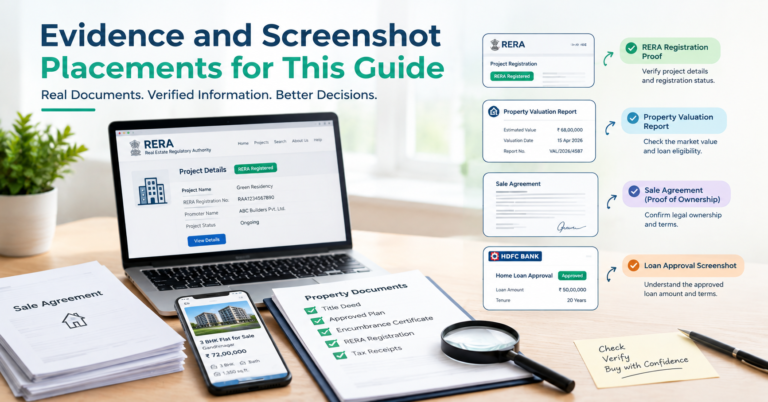
Evidence and Screenshot Placements for This Guide
Who Should Not Buy a Flat Yet?
Buyers with insufficient savings
If you can arrange the down payment only by exhausting your savings, reconsider the timing.
A home requires maintenance, repairs and unexpected spending. Having no emergency reserve can turn an otherwise manageable EMI into a financial problem.
Buyers whose EMI leaves no monthly flexibility
If the proposed EMI prevents you from covering household expenses, saving regularly or meeting existing commitments, choose a less expensive property or wait.
A bank’s approval does not remove your responsibility to assess your own budget.
Buyers with unstable income
If your employment or business income is uncertain, taking on a large long-term repayment may increase financial stress.
You may benefit from waiting until your income becomes more predictable or selecting a property that requires a smaller loan.
Buyers planning to sell quickly for a profit
Short-term property flipping involves transaction costs, potential taxes, market uncertainty and resale risks.
A purchase that works only if prices rise quickly is not a sound basis for a long-term financial commitment.
Buyers relying on rumours
Do not purchase solely because someone claims a new road, metro connection, commercial development or government project will increase property prices.
Verify the relevant project status through official sources and evaluate the property without assuming the proposed development will automatically produce appreciation.
Buyers who have not checked the documents
If the seller cannot provide the required documents or material discrepancies remain unresolved, do not proceed until those issues have been reviewed by an appropriate professional.
Waiting is not a failure. Sometimes it is the most financially responsible decision available.
If I Were Buying a Flat in Gandhinagar Today
If I were buying a flat in Gandhinagar today, I would decide the affordable loan amount first and shortlist properties second. I would not start with the most attractive project and then try to make its price fit my finances.
My decision would follow four priorities.
I would prioritise affordability over the maximum loan amount
I would calculate my household expenses, existing EMIs, down payment and emergency savings before approaching builders.
I would prefer a property whose EMI remains manageable without relying on a salary increase, a bonus or rental income that has not yet materialised.
If the numbers only work under optimistic assumptions, I would wait or choose a less expensive flat.
I would choose a practical 2 BHK or 3 BHK based on actual needs
For a first-time buyer, I would not purchase a larger configuration simply because a salesperson says it has better appreciation potential.
I would compare usable space, commute, maintenance costs and the number of people living in the home.
A well-located 2 BHK that meets the family’s needs can be a better financial decision than an oversized 3 BHK that creates unnecessary debt.
I would consider a 3 BHK only if the additional space serves a clear purpose and the higher purchase price does not weaken the household budget.
I would negotiate the total cost, not just the advertised price
I would request a written, itemised quotation and negotiate the base price, applicable additional charges, parking, payment schedule and written commitments.
I would compare the final acquisition cost with similar properties and verify that the proposed loan amount and payment milestones are realistic.
I would not treat a large advertised discount as proof of a good deal.
I would never ignore a documentation problem
If the property’s title, approvals, applicable RERA disclosures or contractual terms raised an unresolved concern, I would stop the purchase process until the issue had been properly examined.
A lower price is not sufficient compensation for a legal problem that could affect ownership, financing or resale.
My final judgment: I would buy now only if the property met my family’s needs, the legal checks were satisfactory, the purchase remained affordable after all expenses and I could retain an adequate financial reserve. Otherwise, I would wait.
There is no prize for buying a home before you are financially ready.
Conclusion:
Understanding home loan eligibility for a flat in Gandhinagar is not just about discovering how much a bank might lend you. It is about understanding how much debt your household can carry without sacrificing financial stability.
Before buying your first home:
- Calculate your realistic EMI budget.
- Check your credit report and existing liabilities.
- Obtain preliminary eligibility assessments from lenders.
- Prepare the down payment and additional purchase expenses.
- Compare locations based on everyday needs.
- Verify project details and legal documents.
- Negotiate using a written cost breakdown.
- Keep emergency savings separate from your purchase budget.
If your preferred property is beyond your current budget, you have not failed. You have identified a financial boundary before making a long-term commitment.
Your next step: Before paying a booking amount, prepare a simple home-buying worksheet containing your monthly take-home income, existing EMIs, available savings, expected down payment, additional purchase expenses and estimated EMI. Take it to a lender for a preliminary assessment, then compare the result with your actual household budget.
A little preparation now can help you avoid years of unnecessary financial pressure.
FAQs :- About Home Loan Eligibility in Gandhinagar
1. How much home loan can I get for a ₹50 lakh flat in Gandhinagar?
2. Do banks check the property before approving a home loan?
3. Can I get a home loan for an under-construction flat in Gandhinagar?
4. What documents are required to apply for a home loan in Gandhinagar?
5. Does the bank provide a loan for the full price of a flat?
References
About the Author