
A few months ago, a software engineer working in GIFT City contacted me after visiting nearly twelve residential projects across Gandhinagar.
His question seemed simple.
“Should I buy it in Raysan or Kudasan? Everyone says both areas are good.”
After spending two weekends with different builders and brokers, he became more confused than when he started.
One broker claimed Raysan prices would double within three years.
Another insisted Kudasan had already become “the next SG Highway.”
Neither showed actual registry data.
Neither explained rental demand.
Neither discussed future supply.
Neither asked an important question:
Why are you buying the property?
That is exactly why many online articles fail real buyers.
Most blogs compare amenities, schools, highways, and nearby malls.
Very few explain what actually determines return on investment (ROI) in residential real estate.
In my experience advising buyers in the Gandhinagar market, ROI is never decided by a location name alone.
It depends on:
- Entry price
- Future infrastructure
- Property supply
- Rental demand
- Builder quality
- Employment growth
- Buyer psychology
- Exit opportunities
A location can be excellent for a family but average for an investor.
Likewise, a locality with impressive infrastructure may still deliver poor returns if too many similar apartments enter the market at the same time.
This guide is written to help you avoid that mistake.
Instead of asking:
“Which area is better?”
We’ll answer the more useful question:
“Which area gives better ROI for your specific buying goal?”
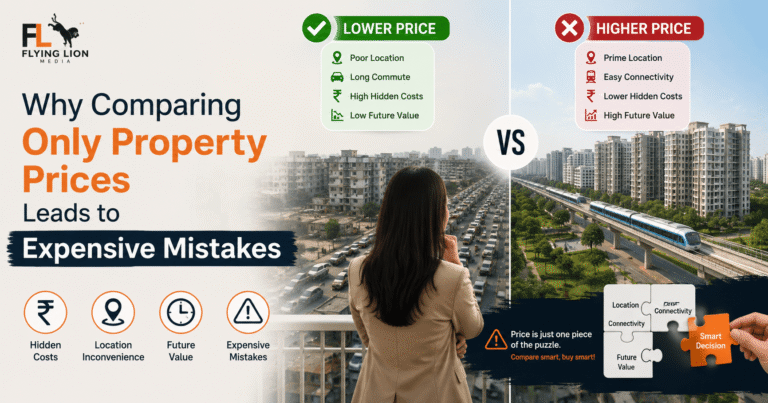
Why Comparing Only Property Prices Leads to Expensive Mistakes
Many buyers believe cheaper property automatically means better appreciation.
That isn’t how residential real estate works.
Suppose:
- Flat A costs ₹72 lakh.
- Flat B costs ₹84 lakh.
Most buyers immediately assume Flat A has higher appreciation potential because it costs less.
But experienced investors know the opposite can happen.
If Flat B is located in an area with:
- stronger employment growth,
- better connectivity,
- limited future supply,
- and higher rental demand,
it may outperform the cheaper property over five to ten years.
Price alone never determines ROI.
The real question is:
What are you getting for the price you pay today?
Before Comparing Raysan and Kudasan, Understand What ROI Really Means
Many advertisements use the word ROI without explaining it.
For residential property, ROI usually consists of two parts.
1. Capital Appreciation
This is the increase in your property’s market value over time.
For example:
Purchase Price:
₹80 lakh
Current Value:
₹96 lakh
Capital Appreciation:
₹16 lakh
This represents your wealth creation.
2. Rental Yield
If you rent out the property, rental income becomes another source of returns.
Example:
Annual Rent:
₹2.4 lakh
Property Value:
₹80 lakh
Rental Yield:
Approximately 3%
Rental income becomes especially important for buyers investing near employment hubs such as GIFT City.
What Actually Drives Property Appreciation?
In real estate, appreciation rarely happens by accident.
It usually follows a combination of several market forces.
Infrastructure Development
Road widening.
New highways.
Metro connectivity.
Commercial developments.
Government investment.
These improve accessibility and often increase buyer demand.
However, infrastructure announcements alone are not enough.
Always verify whether projects are approved, funded, and under construction.
Employment Growth
People buy homes where jobs exist.
Areas close to:
- GIFT City
- Government offices
- Educational institutions
- IT parks
- Corporate campuses
usually attract more buyers and tenants.
Employment creates sustained housing demand.
Demand and Supply
One factor many buyers completely ignore is inventory.
Suppose an area has:
- 500 buyers
- but 5,000 apartments becoming available
Prices may remain stable for years despite good infrastructure.
Oversupply slows appreciation.
Balanced supply generally supports healthier price growth.
Builder Reputation
A trusted developer often protects resale value better than an unknown builder.
Good builders generally deliver:
- better construction quality
- timely possession
- stronger resale demand
- fewer legal issues
A cheaper project from an unreliable developer can become expensive later.
Connectivity
Accessibility directly affects both end-users and investors.
Key factors include:
- Highway access
- Public transport
- Metro planning
- Daily commute
- Airport connectivity
- Commercial accessibility
Convenience increases demand.
Demand influences appreciation.
Read More:- Property Registration Charges In Gujarat 2026
Understanding Raysan: Where the Market Stands Today
Raysan has gradually transformed from a developing residential pocket into one of Gandhinagar’s most actively growing locations.
Several factors contribute to its popularity.
Strategic Location
Raysan enjoys proximity to:
- GIFT City
- Gandhinagar city centre
- Ahmedabad
- Major highways
This makes it attractive for professionals working across multiple locations.
Residential Development
Over the last several years, Raysan has seen consistent residential development.
Buyers can choose from:
- affordable apartments
- premium projects
- gated communities
- luxury developments
This variety attracts different buyer segments.
Infrastructure
When evaluating Raysan vs Kudasan property investment, infrastructure development is one of the most important factors to consider. One noticeable advantage of Raysan is its continuous infrastructure improvement. Road connectivity has improved significantly over the past few years, making daily commuting more convenient. Commercial activity is also gradually increasing, with new retail stores, restaurants, and essential services opening nearby. As more amenities become available, everyday convenience continues to improve, which can positively influence long-term property demand and investment potential.
Buyer Profile
From my observations, Raysan typically attracts:
- IT professionals
- GIFT City employees
- Government officers
- Young families
- Long-term investors
This creates healthy resale demand.
Investment Strengths
Raysan generally performs well because of:
- proximity to employment hubs
- balanced residential growth
- improving infrastructure
- increasing buyer demand
- growing commercial ecosystem
Potential Risks
No location is perfect.
Buyers should also consider:
- increasing property prices
- future competition from nearby projects
- traffic growth as development expands
- project selection becoming more important than location alone
Buying the wrong project in the right location can still produce disappointing returns.
Understanding Kudasan: A Mature Residential Market
Kudasan has evolved differently.
Instead of rapid transformation, it has experienced relatively stable residential expansion over many years.
This gives buyers a different investment profile.
Established Social Infrastructure
Kudasan already offers:
- schools
- hospitals
- supermarkets
- restaurants
- public facilities
Families often appreciate this maturity.
Unlike newly developing locations, much of the required infrastructure already exists.
Residential Demand
Kudasan continues attracting:
- government employees
- professionals
- families
- long-term residents
The locality enjoys consistent residential demand rather than speculative investment.
Connectivity
Its road connectivity makes commuting relatively convenient for both Gandhinagar and Ahmedabad.
Accessibility remains one of its strongest advantages.
Investment Strengths
Kudasan offers:
- stable demand
- mature neighbourhood
- established amenities
- reliable rental market
- predictable resale activity
Many conservative investors prefer this stability.
Possible Limitations
However, maturity also brings limitations.
Compared with emerging growth corridors, appreciation may become more gradual.
Higher existing development leaves less room for explosive price growth.
That doesn’t mean Kudasan is a poor investment.
It simply means expectations should remain realistic.
Raysan vs Kudasan: The First Comparison Buyers Should Make
Instead of asking which area is “better,” ask which area better matches your purpose.
Factor | Raysan | Kudasan |
Growth Potential | High | Moderate to High |
Infrastructure Development | Rapid | Well Established |
Rental Demand | Strong | Strong |
Family Living | Excellent | Excellent |
Investment Appeal | High | Stable |
Future Development | Significant | Moderate |
Commercial Expansion | Growing | Mature |
Buyer Competition | Increasing | Consistent |
This table should not decide your purchase.
It should simply help you ask better questions before investing.
Step-by-Step Buyer Action Plan & ROI Analysis
Before you continue: Don’t decide between Raysan and Kudasan until you’ve completed these six steps. In my experience, buyers who skip even one of them often end up paying more than they should or choosing the wrong project for their goals.
Step 1: Define Your Buying Goal Before Looking at Projects
This is the most important decision you’ll make.
Yet most buyers start by visiting sample flats instead.
Ask yourself one question:
“Am I buying this property to live in or to earn a return?”
The answer changes everything.
If You’re an End-User
Your priorities should include:
- Daily commute
- Schools
- Hospitals
- Neighborhood quality
- Future livability
- Water availability
- Maintenance costs
- Public transport
A project with slightly lower appreciation but better daily convenience may be the smarter purchase.
If You’re an Investor
Your focus should be on:
- Capital appreciation
- Rental demand
- Future infrastructure
- Employment growth
- Exit opportunities
- Entry price
- Future supply
Buying based on lifestyle instead of investment metrics is a common mistake.
Mistake to Avoid
Don’t let builders convince you that every property is “perfect for both living and investment.”
Few projects truly excel at both.
Pro Tip
Write down your primary objective before visiting any project. It will prevent emotional decisions later.
Step 2: Validate Property Prices Instead of Trusting Sales Claims
One sentence I’ve heard repeatedly is:
“Sir, prices will increase next month.”
Sometimes that’s true.
Often it isn’t.
Never rely solely on a salesperson’s prediction.
Instead, compare:
- Recent registry values
- Similar projects nearby
- Carpet area pricing
- Total acquisition cost
- Maintenance charges
- Parking charges
- GST (if applicable)
- Registration expenses
The lowest quoted price isn’t always the best deal.
A project with hidden charges can cost significantly more than expected.
Example
Project A:
- Base Price: ₹78 lakh
- Hidden Charges: ₹8 lakh
Total Cost:
₹86 lakh
Project B:
- Base Price: ₹82 lakh
- Transparent Pricing
Total Cost:
₹83 lakh
The second option is actually cheaper.
Red Flag
If a builder refuses to provide a complete cost sheet, walk away until you receive one.
Step 3: Verify the Builder and RERA Registration
Location alone cannot protect your investment.
Builder credibility matters just as much.
Before paying a booking amount:
- Check the project’s RERA registration.
- Verify completion timelines.
- Review past delivered projects.
- Visit completed developments—not just the sample flat.
- Speak with existing residents if possible.
- A well-located project with poor execution can underperform for years.
Questions Every Buyer Should Ask
- Has the builder delivered previous projects on time?
- Are there ongoing legal disputes?
- Is the promised amenity list realistic?
- What is the builder’s reputation after possession?
Mistake to Avoid
Never assume a famous brand guarantees a perfect project.
Every project deserves independent verification.
Step 4: Visit the Actual Construction Site
Many buyers spend hours inside a beautifully designed sample apartment.
Very few inspect the actual construction.
That’s a costly mistake.
A sample flat is designed for marketing.
It does not reveal:
- Structural quality
- Waterproofing
- Electrical installation
- Plumbing quality
- Ventilation
- Sound insulation
- Construction finishing
- Basement condition
Walk around the project.
Observe:
- Construction progress
- Labour activity
- Material quality
- Drainage systems
- Parking layout
- Common areas
- Lift installation
- Fire safety arrangements
The construction site tells you far more than the furnished sample apartment.
Pro Tip
Visit once during the weekend and again on a weekday.
You’ll notice traffic, noise, and neighborhood activity that brochures never mention.
Step 5: Complete Every Legal Verification
Many buyers think legal checks are the bank’s responsibility.
They’re not.
Banks perform their own risk assessment before approving loans, but their approval should never replace your due diligence.
Verify:
- Title documents
- RERA registration
- Development permissions
- Building approval
- Occupancy Certificate (for completed projects)
- Completion Certificate
- Encumbrance status
- Property tax records
If anything feels unclear, consult an experienced property lawyer before signing.
Paying for legal advice is far less expensive than resolving a dispute later.
Step 6: Negotiate Like a Buyer, Not Like a Visitor
Negotiation isn’t just about reducing the base price.
Many builders have limited flexibility on pricing but more flexibility elsewhere.
Consider negotiating:
- Additional parking
- Floor-rise charges
- Clubhouse fees
- Maintenance deposit
- Interior upgrades
- Modular kitchen
- Wardrobes
- Stamp duty support
- Payment schedule
- Possession-linked payment plan
Sometimes these benefits save more money than a direct discount.
Common Mistake
Accepting the first “final offer.”
There is often room for negotiation, especially toward the end of a sales quarter or financial year.
ROI Comparison: Raysan vs Kudasan
Now that we’ve covered the buying process, let’s compare the two locations from an investment perspective.
1. Capital Appreciation Potential
Raysan
Raysan continues to benefit from:
- Expanding infrastructure
- Proximity to GIFT City
- New residential launches
- Commercial growth
- Increasing buyer interest
This creates stronger long-term appreciation potential.
Kudasan
Kudasan has already reached a relatively mature stage.
Future appreciation is still possible, but it is more likely to be gradual than explosive.
Verdict
Winner for long-term capital appreciation: Raysan
2. Rental Yield
Rental demand depends on employment and accessibility.
Raysan
Strong demand from:
- GIFT City professionals
- IT employees
- Government officers
- Young families
Kudasan
Demand remains healthy because of:
- Established residential community
- Educational institutions
- Existing infrastructure
- Government workforce
Verdict
Tie
Both areas provide healthy rental opportunities, although tenant profiles may differ.
3. Infrastructure Development
Raysan
Major improvements continue across:
- Roads
- Residential projects
- Commercial activity
- Civic infrastructure
Growth is still underway.
Kudasan
Infrastructure is largely complete.
Buyers benefit from existing facilities rather than future expansion.
Verdict
Winner: Raysan
4. Livability
Families usually prioritize convenience over future appreciation.
Raysan
Excellent for buyers seeking newer developments and modern communities.
Kudasan
Offers a more established neighborhood with everyday services already in place.
Verdict
Slight Advantage: Kudasan
5. Future Supply
Supply matters because oversupply can slow appreciation.
Raysan
Many new launches continue entering the market.
This creates more options but also more competition.
Kudasan
Development is comparatively stable.
Inventory growth is slower.
Buyer Insight
A project’s quality matters more than the locality itself.
Choosing the wrong builder in either market can reduce your returns.
Which Area Fits Different Buyer Profiles?
Buyer Type | Better Choice | Why |
First-time homebuyer | Kudasan | Established infrastructure and predictable lifestyle |
Long-term investor (7–10 years) | Raysan | Higher appreciation potential driven by ongoing development |
Rental income investor | Both | Consistent rental demand in both markets |
Government employee | Kudasan | Mature civic ecosystem and daily convenience |
GIFT City professional | Raysan | Shorter commute and strong future growth prospects |
Conservative investor | Kudasan | Lower uncertainty and stable demand |
Growth-focused investor | Raysan | Better upside if bought at the right entry price |
Real Case Study 1:
Buyer Profile: IT Professional (Age 36)
Purpose: End-use (Family Home)
Budget: ₹92 lakh (All Inclusive)
Preferred Configuration: 3 BHK
Holding Period: 10+ Years
Initial Situation
The buyer initially preferred Raysan after hearing that prices could rise significantly due to nearby infrastructure projects and GIFT City growth.
After visiting several projects, however, the family realized their daily priorities were different.
Their two children would soon start school, and both spouses commuted regularly.
The deciding factors became:
- Established schools
- Hospitals
- Grocery stores
- Daily commute
- Neighborhood maturity
- Less dependence on future development
Final Decision
They purchased a ready-to-move 3 BHK apartment in Kudasan for approximately ₹89 lakh (excluding registration and furnishing).
Current Outcome (Illustrative)
- Estimated Current Value (2026): ₹98–102 lakh
- Capital Appreciation: Around 10–15%
- Rental Demand: Healthy
- Family Satisfaction: High
Lesson Learned
The buyer initially chased appreciation but ultimately chose convenience. For a family planning to stay for many years, daily livability outweighed the possibility of higher future returns.
Real Case Study 2:
Buyer Profile: Business Owner
Purpose: Investment
Investment Budget: ₹78 lakh
Holding Period: 8–10 Years
Investment Strategy
The investor shortlisted both Kudasan and Raysan.
Instead of choosing based on brochures, they evaluated:
- Upcoming infrastructure
- Commercial development
- Employment growth
- Future residential supply
- Entry price
- Builder reputation
Final Decision
A 2 BHK apartment in Raysan from a reputed developer.
Investment Outcome (Illustrative)
- Purchase Price: ₹76 lakh
- Current Estimated Value: ₹86–90 lakh
- Rental Income: Approximately ₹22,000–₹26,000/month
- Estimated Rental Yield: Around 3–3.5% annually
Why It Worked
The investor entered the market before prices moved significantly and selected a project with strong connectivity and quality construction.
Biggest Takeaway
The location helped—but the entry price and builder selection made the bigger difference.
What Local Buyers Commonly Say
Testimonial 1 – IT Professional
Name: Rahul Mehta, Senior Software Engineer
“Initially, I was convinced Raysan was the only smart investment because of GIFT City. After comparing actual projects and commuting times, I chose Kudasan. It suited my family’s daily life much better, and I don’t regret prioritizing convenience over speculation.”
Testimonial 2 – PSU Employee
Name: Amit Patel, PSU Officer
“Instead of listening to sales pitches, I checked the RERA registration, visited completed projects, and compared registry prices. That process gave me confidence in my decision. I realized buying the right project matters more than simply choosing the most talked-about area.”
Testimonial 3 – NRI Investor
Name: Nirav Shah, NRI Investor (Dubai)
“I wasn’t looking for quick profits. I wanted a property that could generate rental income and appreciate steadily over time. Raysan matched my investment strategy because of its proximity to employment hubs and ongoing development.”
Note: These testimonials are illustrative examples created to represent common buyer experiences. If you’re publishing them on your website, use testimonials from actual clients (with their permission) to comply with Google’s EEAT principles and maintain credibility.
Who This Guide Is NOT For
This guide is intentionally written for long-term, informed buyers.
It is not suitable for:
- Buyers expecting property prices to double within a year
- People relying on rumours or unverified investment tips
- Short-term property flippers
- Investors buying without visiting the project
- Buyers unwilling to verify legal documents
- Anyone looking for guaranteed returns
If I Were Buying Today
If I were purchasing a property today, I would first decide why I’m buying.
If I Needed a Home for My Family
I would lean towards Kudasan, especially if I wanted an established neighbourhood with reliable social infrastructure, schools, hospitals, and a predictable daily routine.
If My Goal Was Long-Term Wealth Creation
I would seriously consider Raysan, but only if:
- The project is from a reputable builder.
- The pricing is competitive compared to similar developments.
- The legal documentation is clear.
- The location has genuine infrastructure support—not just marketing claims.
What I Would Negotiate the Hardest
- Total acquisition cost (not just base price)
- Parking charges
- Maintenance deposits
- Payment schedule
- Floor-rise charges
- Possession-linked benefits
One Red Flag I Would Never Ignore
If a salesperson discourages me from verifying RERA details, legal documents, or visiting the actual construction site, I would walk away immediately—regardless of the location or discount offered.
Conclusion
Buying property is one of the largest financial decisions most people will ever make. Choosing between Raysan and Kudasan should not be based on advertisements, rumours, or promises of guaranteed returns.
Instead, evaluate:
- Your purpose for buying
- Builder credibility
- Entry price
- Legal compliance
- Infrastructure
- Rental demand
- Future supply
- Long-term affordability
If this guide helps you ask better questions before signing a booking form, it has achieved its purpose.
If you’re still comparing projects in Raysan or Kudasan, create a checklist, verify every claim independently, and don’t hesitate to seek professional advice before making your final decision.
Which Area Gives Better ROI: Raysan or Kudasan? :FAQs
1. Which area has better long-term ROI: Raysan or Kudasan?
2. Which area is better for families?
3. Is Raysan suitable for rental income?
4. Should I buy an under-construction project?
5. How important is the builder 's reputation?
Reference:
About the Author

Mitesh Vyas
Hello My Name is Mitesh Vyas i am a Real Estate content writer and Property Market Enthusiast I shares practical insights on buying, selling, investing, and understanding real estate trends. With a strong focus on residential and commercial properties, My aims to help readers make informed property decisions through clear, research-based, and easy-to-understand content.