
What Is The Difference Between RERA Approval and Building Approval?: A few months ago, I met a first-time homebuyer who had almost finalized a flat after visiting the project three times. The builder confidently said, “The project is approved. You don’t need to worry about anything.”
The buyer didn’t ask a single follow-up question.
He assumed that “approved” meant every legal formality had already been completed.
Fortunately, before paying the booking amount, he asked me to review the project documents.
Within thirty minutes, we discovered something important.
The project had a building plan approval, but the RERA registration was still pending.
That single difference completely changed the buying decision.
The buyer postponed the booking, waited until the project received its RERA registration, and avoided investing in a project that still had legal and compliance uncertainties.
In my experience advising property buyers, this misunderstanding is incredibly common.
Many people believe that if a building has government approval, it automatically becomes a legally safe investment.
Unfortunately, that isn’t how Indian real estate works.
A project can have one approval without the other.
Understanding this difference can protect you from delayed possession, incomplete disclosures, legal disputes, and unnecessary financial risk.
This guide is written to help buyers understand what each approval actually means, why both matter, and how to verify them before paying even a single rupee.

Why Most Online Articles Fail to Explain the Difference
Most blogs simply define both approvals.
They rarely explain how these approvals affect your buying decision.
As a result, buyers leave with information—but not clarity.
Real estate isn’t about collecting legal terms.
It’s about understanding which documents actually protect your investment.
Throughout this guide, I’ll explain these approvals the same way I explain them during buyer consultations—not from a legal textbook, but from practical experience helping people avoid expensive mistakes.
Understanding the Two Approvals in Simple Words
Before comparing them, let’s understand what each approval actually means.
What Is Building Approval?
Building Approval is the permission granted by the local government authority allowing a developer to construct a project according to approved building plans and development regulations.
Depending on the city, this approval may come from:
- Municipal Corporation
- Urban Development Authority
- Town Planning Department
- Development Authority
- Gram Panchayat (where applicable)
This approval focuses primarily on whether construction can legally begin.
Authorities verify factors such as:
- Land use
- Plot dimensions
- Floor Space Index (FSI)
- Building height
- Road setbacks
- Structural planning
- Fire safety provisions
- Parking requirements
- Environmental compliance (where applicable)
In simple words,
Building Approval gives permission to build.
It does not guarantee transparency in sales, buyer protection, or project delivery.
What Is RERA Approval?
Many buyers use the term “RERA Approval.”
Technically, RERA does not approve a project.
Instead, the project is registered with the State RERA Authority after the developer submits prescribed documents under the Real Estate (Regulation and Development) Act, 2016.
This registration ensures that the developer:
- Provides accurate project details
- Discloses approvals
- Shares completion timelines
- Updates construction progress
- Maintains financial discipline as required by law
- Becomes accountable to homebuyers
In simple words,
RERA Registration protects buyers after the project enters the market.
It increases transparency and provides a legal framework for addressing delays or misinformation.
RERA Approval vs Building Approval: The Biggest Difference
Many people compare these two approvals as if one replaces the other.
That is incorrect.
They serve completely different purposes.
Building Approval | RERA Registration |
Allows construction to begin | Allows the project to be marketed under RERA rules (where applicable) |
Issued by local planning authority | Issued by the State RERA Authority |
Focuses on construction legality | Focuses on buyer protection and transparency |
Checks technical construction compliance | Checks project disclosures and regulatory compliance |
Based on approved building plans | Based on project registration requirements |
Doesn’t guarantee timely delivery | Requires declared timelines and periodic updates |
Primarily protects urban planning | Primarily protects homebuyers |
Neither approval replaces the other.
A legally compliant project generally requires both, subject to the applicable laws and project category.
Why This Difference Matters to Buyers
Imagine buying a car.
One document says the manufacturer is allowed to build cars.
Another ensures the car has been properly registered, documented, and sold according to regulations.
Would you ignore either one?
The same principle applies to real estate.
Building Approval tells you the developer received permission to construct according to approved plans.
RERA Registration tells you the project has entered a regulatory framework designed to improve transparency and buyer accountability.
Buying without understanding both can expose you to unnecessary risk.
Can a Project Have Building Approval Without RERA Registration?
Yes.
This happens more often than buyers realize.
For example:
- Newly launched projects may receive construction approvals before completing RERA registration.
- Certain project categories may not require RERA registration depending on applicable legal thresholds and exemptions.
- Some developers delay project registration even after obtaining local construction permissions.
This is why you should never assume that one document automatically confirms the existence of the other.
Always verify independently.
Can a Project Have RERA Registration Without Building Approval?
In practice, developers are generally required to submit relevant approvals while registering projects under RERA, depending on applicable regulations.
However, buyers should never rely solely on assumptions.
Instead of asking,
“Is this project RERA approved?”
Ask:
- Has the building plan been sanctioned?
- Which authority issued the building approval?
- Is the project registered under the State RERA Authority?
- Can I verify both online?
These questions immediately reveal how transparent the developer is.
The Biggest Myth Buyers Believe
One statement I hear repeatedly is:
“The project is RERA approved, so everything is legal.”
That statement is incomplete.
RERA registration improves transparency, but it is not a substitute for independent due diligence.
A prudent buyer should still verify:
- Land ownership
- Building approvals
- Encumbrances
- Approved layout
- Construction status
- Loan approvals (where relevant)
- Utility permissions
- Occupancy and completion status (for ready properties)
RERA is an important layer of protection—not the only one.
Real Buyer Problems I See Again and Again
After interacting with hundreds of buyers, certain mistakes repeat themselves regardless of budget.
1. Buyers Trust Marketing Brochures More Than Official Documents
Brochures highlight lifestyle amenities, clubhouse images, and payment plans.
Very few buyers ask to see:
- Approved plans
- Registration certificates
- Construction permissions
- Legal documents
A brochure sells dreams.
Documents reveal facts.
2. Buyers Assume Bank Approval Means Everything Is Safe
Banks conduct their own evaluation before financing projects.
However, bank approval should never replace your own verification. If you want to learn the difference before buying a property, understand that bank approval is not the same as verifying a project’s RERA registration and building approval.
Different banks may assess projects differently, and lending decisions are based on their internal policies.
Always perform your own due diligence before making any property investment.
3. Buyers Don't Verify the Version of the Building Plan
Sometimes buyers view marketing layouts that differ from the officially sanctioned plans.
Before booking,
Ask for the approved building layout.
Compare:
- Towers
- Parking
- Open space
- Amenities
- Number of floors
Small differences today can become major disputes later.
4. Buyers Ignore Timeline Disclosures
Many buyers focus only on launch prices.
Few pay attention to declared completion schedules, construction milestones, or project updates.
Delays often become expensive because buyers continue paying rent and EMIs simultaneously.
Step-by-Step Buyer Action Plan
Buying property isn’t about trusting the builder.
It’s about verifying every important detail yourself.
Here’s the process I recommend.
Step 1: Start With the Location—Not the Project
Many buyers first fall in love with a sample flat.
That’s the wrong starting point.
Instead, begin by evaluating the location.
Ask yourself:
- Is this area growing because of real demand or only because of marketing?
- Are schools, hospitals, workplaces, and public transport actually nearby?
- Are infrastructure projects completed or merely announced?
- Will this location still be attractive five years from now?
A good builder cannot compensate for a poor location.
Why This Matters
Location directly affects:
- Future resale value
- Rental demand
- Daily commute
- Quality of life
- Long-term appreciation
Mistakes to Avoid
- Buying only because of launch discounts.
- Believing future infrastructure promises without verification.
- Ignoring flood zones or traffic bottlenecks.
- Choosing an area solely because friends invested there.
Practical Tip
Visit the location:
- During weekdays.
- On weekends.
- During peak traffic hours.
- At night.
You’ll often discover issues that marketing presentations never mention.
Step 2: Validate Your Budget Before Falling in Love With a Project
One of the biggest financial mistakes I see is buyers stretching beyond what they can comfortably afford because of attractive payment plans or limited-time offers.
Before discussing approvals or paperwork, calculate your true purchase cost, not just the apartment price.
Include:
- Stamp duty
- Registration charges
- GST (if applicable)
- Maintenance deposits
- Parking fees
- Clubhouse charges
- Legal verification costs
- Interior and furnishing expenses
- Loan processing fees
- Emergency contingency fund
A project that appears affordable at first glance may become significantly more expensive once these costs are added.
Why This Matters
Financial stress after booking often forces buyers to compromise elsewhere or delay payments, which can attract penalties.
A realistic budget gives you stronger negotiating power and helps you choose a property you can comfortably own over the long term.
Step 3: Builder & RERA Verification
If I had to choose one verification that has saved buyers from costly mistakes the most, it would be this one.
Many buyers spend weeks comparing floor plans, amenities, and payment plans.
Yet they spend less than ten minutes verifying the developer.
That is exactly the opposite of what you should do.
A beautiful sample flat can be built in three months.
A builder’s reputation takes years to earn.
Before paying the booking amount, verify both the developer and the project independently.
What You Should Verify
- RERA Registration Number
- Builder’s previous projects
- Delivery history
- Construction progress
- Pending litigation (if any)
- Approved project timeline
- Land ownership details
- Financial disclosures available on the RERA portal
- Customer complaints recorded with the RERA authority (where available)
Remember, RERA Registration is not just a certificate—it is a source of information.
Many buyers download the certificate and stop there.
Instead, review:
- Project completion timeline
- Number of towers
- Carpet area details
- Approved plans
- Quarterly progress updates
- Promoter details
These disclosures often reveal whether the project is progressing as promised.
Why This Matters
Builders with a history of repeated delays deserve additional scrutiny.
Past performance does not guarantee future outcomes, but it often provides useful context.
If several previous projects were delayed by years, ask the builder to explain what has changed in the current project.
Mistakes to Avoid
- Trusting only advertisements.
- Believing verbal promises.
- Ignoring previous delivery history.
- Booking on the launch day without verification.
- Assuming celebrity endorsements guarantee credibility.
Practical Advice
I usually recommend searching for the builder’s completed projects before visiting the new one.
Speak with existing residents if possible.
Ask simple questions:
- Was possession delivered on time?
- Were promised amenities completed?
- Were there unexpected charges?
- How responsive was the builder after possession?
Current residents often provide more useful information than marketing brochures.
Step 4: Site Visit Checklist
Never purchase a property after seeing only the sample apartment.
The sample flat is designed to highlight the best aspects of the project.
The actual construction site tells a much more complete story.
Whenever I accompany buyers, I insist that they spend more time walking around the project than inside the sales office.
What to Observe
Construction Progress
Compare actual construction with the promised timeline.
Is work actively progressing?
Or does the site appear unusually quiet?
Building Quality
Look for visible warning signs such as:
- Uneven plastering
- Water seepage
- Poor finishing
- Cracked walls
- Exposed reinforcement
- Improper drainage
These observations don’t replace a technical inspection, but they can indicate the overall quality of workmanship.
Parking Arrangement
Check whether parking appears practical.
Some layouts look generous on paper but become difficult to use after construction.
Common Areas
Inspect:
- Lift lobbies
- Staircases
- Fire exits
- Internal roads
- Open spaces
- Visitor parking
These are the spaces you’ll use every day.
Surrounding Neighborhood
Walk outside the project.
Observe:
- Traffic
- Noise
- Waterlogging
- Nearby industries
- Commercial activity
- Public transport
- Schools
- Hospitals
A good apartment in a poor location may become difficult to resell later.
Why This Matters
Many buying decisions change after a proper site inspection.
Marketing creates expectations.
Reality confirms them.
Mistakes Buyers Make
- Visiting only during weekends.
- Never visiting after sunset.
- Ignoring nearby developments.
- Relying entirely on virtual tours.
- Skipping under-construction site visits.
Practical Tip
Visit at least twice.
One scheduled visit.
One unannounced visit.
Builders prepare extensively before official customer visits.
Unexpected visits often provide a more realistic picture.
Step 5: Legal & Registry Checks
This is where many expensive mistakes can be avoided.
Legal verification should never begin after paying the booking amount.
It should begin before signing any document.
Even if a project appears trustworthy, verify the paperwork independently.
Essential Documents to Review
- Title documents
- Approved building plan
- RERA Registration details
- Land ownership records
- Commencement Certificate
- Completion Certificate (if completed)
- Occupancy Certificate (if ready for possession)
- Encumbrance Certificate
- Applicable NOCs
- Sale Agreement draft
Depending on the project and state regulations, additional approvals may also be relevant.
Registry Verification
Where possible, review previous sale transactions and publicly available registry information.
This helps you understand:
- Actual transaction values
- Market trends
- Ownership history
- Price consistency
Never assume that advertised prices reflect actual sale values.
Why This Matters
A legal review costs far less than resolving a property dispute later.
Independent verification is an investment—not an expense.
Mistakes Buyers Make
- Signing documents without reading them.
- Depending only on the builder’s legal team.
- Ignoring restrictive clauses.
- Not checking penalty clauses for delayed possession.
- Overlooking maintenance obligations.
Practical Tip
If a document cannot be shared before booking, ask why.
Reasonable confidentiality is understandable.
Complete secrecy is not.
Step 6: Negotiation Strategy
Negotiation is not just about reducing the apartment price.
In many cases, negotiating the terms provides greater long-term value.
Experienced buyers negotiate:
- Payment schedules
- Floor-rise charges
- Parking charges
- Clubhouse fees
- Interior modifications
- Possession conditions
- Delay compensation clauses
- Maintenance deposits
Sometimes builders cannot reduce the headline price but may offer value elsewhere.
What I Would Negotiate First
If I were buying today, my priorities would be:
- Total purchase cost
- Possession commitments
- Payment schedule
- Additional charges
- Upgrade options
The apartment price is only one part of the overall financial commitment.
Mistakes to Avoid
- Accepting the first offer.
- Feeling pressured by “today only” discounts.
- Believing inventory scarcity without verification.
- Comparing projects only by price.
Real Case Study 1 – End-User Family
Buyer Profile
A family of four working in Ahmedabad wanted a home with better connectivity while remaining within their financial limits.
Budget
₹82 lakh
Preferred Location
Raysan, Gandhinagar
Purchase Price
₹79 lakh
Current Estimated Value
Approximately ₹92 lakh after several years, reflecting local market movement.
What They Did Right
- Compared multiple builders.
- Verified RERA registration.
- Reviewed sanctioned building plans.
- Visited the site several times.
- Negotiated parking charges.
- Confirmed possession timelines before booking.
Lesson Learned
Their biggest success wasn’t buying the cheapest apartment.
It was avoiding projects with uncertain documentation.
Real Case Study 2 – Investor
Budget
₹1.15 crore
Location
Kudasan
Entry Price
₹1.08 crore
Rental Income
Approximately ₹28,000 per month during the initial rental period.
Exit Strategy
Long-term holding based on infrastructure development rather than quick resale.
What Worked
- Purchased near an established employment corridor.
- Verified approvals before booking.
- Selected a reputed developer with a history of completed projects.
What Didn’t
Rental growth was slower than expected during the first two years.
Lesson
Real estate should not be evaluated only by appreciation.
Cash flow, location quality, and holding capacity matter equally.
What These Case Studies Teach
Notice that neither buyer selected a project because of marketing offers.
They relied on:
- Documentation
- Independent verification
- Financial planning
- Practical site inspections
Those habits often matter more than finding the “lowest price.”
What I Notice in Today's Market
While every city behaves differently, several patterns are becoming increasingly common.
Many buyers today:
- Compare projects online before visiting.
- Pay greater attention to legal documentation.
- Verify RERA details independently.
- Focus on connectivity and infrastructure.
- Prefer reputed developers over speculative discounts.
Interest rates, supply levels, and local infrastructure development can influence buying decisions.
Therefore, always evaluate current market conditions rather than relying on outdated advice.
Buyer Testimonials
Rahul Mehta – IT Professional, Ahmedabad
“I almost booked another project because of a festival discount. Verifying both the building approval and RERA registration helped me identify important differences. That gave me confidence before investing.”
Prakash Patel – PSU Employee, Gandhinagar
“The legal checklist completely changed the way I evaluated projects. I realized brochures never mention many of the documents buyers actually need. Spending time verifying approvals was absolutely worth it.”
Nilesh Shah – NRI Buyer, Dubai (Originally from Gujarat)
“Being overseas made verification difficult. Learning how to independently check approvals gave me far more confidence before transferring funds. It also helped me ask the builder the right questions before making a commitment.”
Note: These testimonials are illustrative examples based on common buyer experiences and are intended to demonstrate typical situations buyers may encounter.
Credibility, Verified Data & Market Context
One of the biggest problems in Indian real estate is that buyers often rely on marketing material instead of official records.
Whenever I research a residential project, I don’t begin with the brochure—I begin with publicly available records.
This habit has helped identify projects with delayed approvals, changes in layouts, and possession timelines that differed from what was being advertised.
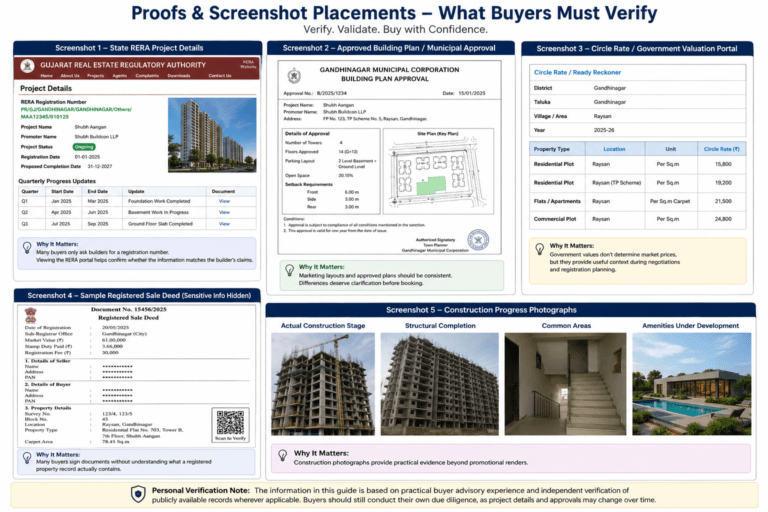
Before making a buying decision, I recommend cross-checking information from trusted sources such as:
- State RERA Portal – Verify project registration, promoter details, approved plans, quarterly progress reports, and declared completion timelines.
- Municipal Corporation / Development Authority – Confirm sanctioned building plans, commencement permissions, and planning approvals.
- Sub-Registrar Office – Review previous sale transactions where legally available.
- Circle Rate / Jantri / Ready Reckoner Portal – Compare government guidance values with quoted market prices.
- Local Town Planning Authority – Verify zoning, land use, and approved layouts where applicable.
Remember, no single document tells the complete story. A safe buying decision comes from verifying multiple records together.
Screenshot
Red Flags I Would Never Ignore
Certain warning signs deserve immediate attention.
If I encounter any of these, I pause the buying process until I receive satisfactory clarification.
Red Flag 1
The builder refuses to share approval documents.
Red Flag 2
The sanctioned plan differs significantly from the marketing brochure.
Red Flag 3
Construction progress is substantially behind the declared timeline without a clear explanation.
Red Flag 4
Sales representatives avoid answering legal questions and repeatedly redirect the conversation to discounts or offers.
Red Flag 5
Promises are made verbally, but important commitments are missing from written agreements.
Red Flag 6
Pressure tactics such as:
- “Only one flat left.”
- “Offer ends today.”
- “Price increases tonight.”
Urgency is common in sales.
Verification should never be rushed.
Who This Guide Is NOT For
Not every buyer should purchase property immediately.
This guide is not intended for:
Buyers Looking for Quick Profits
If your goal is to buy today and sell within a few months for a large gain, this guide won’t help.
Real estate is generally a long-term asset, not a guaranteed short-term trade.
Buyers Without Financial Stability
If booking a property would leave you without emergency savings or make your monthly finances unmanageable, it may be wiser to wait.
Owning property should create security—not financial stress.
Buyers Depending Entirely on Verbal Promises
If you’re unwilling to verify documents independently, you’re accepting unnecessary risk.
Documentation matters more than conversations.
Buyers Chasing Rumours
Investment decisions based solely on:
- Future metro announcements
- Proposed infrastructure
- Social media claims
- WhatsApp forwards
should always be verified through official sources.
If I Were Buying This Property Today
If I were purchasing an apartment today, I would not make my decision based on advertisements, launch prices, or limited-time offers.
I would shortlist only those projects where:
- Building Approval is available from the competent authority.
- RERA Registration (where applicable) is complete and verifiable.
- The builder has a satisfactory delivery history.
- Construction progress aligns reasonably with declared timelines.
- Legal documents can be reviewed without unnecessary resistance.
Would I Buy Immediately?
Only if the project met my legal, financial, and practical expectations.
Otherwise, I would wait.
Missing one opportunity is better than owning the wrong property for the next twenty years.
Which Property Would I Prefer?
I generally prefer projects in established or steadily developing locations with:
- Good road connectivity
- Everyday infrastructure
- Sustainable demand
- Strong livability
Marketing claims are temporary.
Location quality lasts much longer.
What Would I Negotiate the Hardest?
- Total purchase cost
- Payment schedule
- Hidden charges
- Possession commitments
- Delay-related clauses
- Parking costs
One Red Flag I Would Never Ignore
If a builder hesitates to provide important approvals or legal documents, I walk away until I receive complete clarity.
No discount is worth compromising on transparency.
Conclusion
Understanding the difference between RERA Registration and Building Approval is one of the most important lessons for any homebuyer.
Building Approval confirms that construction has received permission under applicable planning regulations.
RERA Registration improves transparency by requiring disclosures, timelines, and regulatory accountability where the law applies.
Neither replaces the other.
The safest buying decisions come from verifying both, along with title documents, construction progress, financial planning, and independent legal advice.
Property purchases are usually among the largest financial decisions people make.
Taking a few extra days to verify documents is far less costly than spending years resolving avoidable disputes.
What Is The Difference Between RERA Approval and Building Approval? :FAQS
1. What is the difference between RERA Registration and Building Approval?
2. Is RERA Registration mandatory for every real estate project?
3. Can a project have Building Approval but no RERA Registration?
4. Does RERA Registration guarantee timely possession?
5. Who issues Building Approval?
Reference
About the Author

Mitesh Vyas
Hello My Name is Mitesh Vyas i am a Real Estate content writer and Property Market Enthusiast I shares practical insights on buying, selling, investing, and understanding real estate trends. With a strong focus on residential and commercial properties, My aims to help readers make informed property decisions through clear, research-based, and easy-to-understand content.