
Imagine a family looking for a 3 BHK flat in Sargasan, Gandhinagar. Both parents work, their child needs a comfortable study space, and they want nearby shops, reliable transport and a peaceful residential environment. Their budget is ₹90 lakh, but every property they visit seems to offer something different.
One builder highlights a clubhouse and landscaped garden. A broker says the price will increase next week. Another apartment looks spacious in the sample flat but feels much smaller when the family examines the actual usable area. Meanwhile, the advertised price excludes several charges that could push the total purchase cost beyond their budget.
This is where homebuyers need more than a list of attractive apartments.
Many online property articles focus on amenities, location advantages and promotional offers without explaining how families should compare the actual cost, construction quality, neighbourhood conditions and legal documents. A home can look impressive during a site visit and still be the wrong choice for everyday living.
When evaluating family-friendly apartments in Sargasan, the real question is not simply which project has the most amenities. It is which flat offers a suitable layout, dependable documentation, manageable ownership costs and convenient access to the places your family visits regularly.
This guide takes a buyer-first approach to help you assess the available options, identify hidden expenses and decide whether purchasing a 3 BHK flat in Sargasan makes sense for your circumstances.
Important note: This is a research-based buyer guide, not a claim of personally completed property inspections. Market figures are indicative published listing data, and the illustrative case studies below are not represented as verified transactions.

Real Problems Buyers Face When Searching for 3 BHK Flats in Sargasan
Price confusion and hidden costs
A buyer may see one 3 BHK apartment advertised at ₹80 lakh and another at ₹95 lakh and assume that the cheaper option is automatically better value. That conclusion can be misleading.
The apartments might differ in carpet area, balcony space, parking arrangements, building age, floor level, construction stage and included facilities. One quoted price might include certain charges that another excludes.
Before comparing properties, request an itemised cost sheet covering:
- Basic apartment price and applicable floor-rise charges.
- Parking charges, if separately payable.
- Maintenance deposits and society-related charges.
- Stamp duty and registration expenses.
- Applicable GST on an under-construction property.
- Legal documentation, utility connections and other disclosed charges.
- Interior work, wardrobes, kitchen fittings and essential appliances.
The important figure is the total cost of acquiring a liveable home, not the headline price in an advertisement.
Artificial urgency and misleading offers
Statements such as “only two units left” or “prices increase tomorrow” should never replace your own financial and legal checks.
An attractive payment plan does not compensate for an unsuitable floor plan, unclear approvals or a possession date that creates problems for your family. Ask for the offer and its conditions in writing, including its validity, exclusions and refund terms.
If a seller refuses to give you enough time to examine the documents, be prepared to walk away.
Builder reliability and possession risk
A beautifully presented project does not prove that the developer will deliver the property on schedule or maintain the promised quality.
Check the developer’s previous projects, actual possession history, quality of common areas, complaint patterns and the status of the current project’s approvals. For an under-construction flat, compare the declared completion date with the latest available progress information.
Gujarat RERA provides a public search facility for registered projects, agents and professionals. However, registration alone does not guarantee timely delivery, construction quality or investment returns.
Choosing the wrong location within Sargasan
A property can carry a Sargasan address without being equally convenient for every family.
The practical experience depends on the exact approach road, traffic conditions, distance to daily necessities, access to public transport and the route you take to work. When comparing 3 BHK flats with good connectivity in Sargasan, consider how easily you can reach your workplace, schools, healthcare facilities and nearby markets. A flat near a busy road may reduce commuting time but introduce noise, while an apartment deeper inside a residential pocket may feel quieter but require more driving for everyday errands.
Visit the property during morning and evening peak hours. Check the road after dark and, if possible, after rain. Do not rely entirely on a broker’s estimated travel time.
End-use versus investment confusion
Families buying a home for their own use should prioritise daily comfort, financial stability and the likelihood of staying in the property for several years.
Investors need a different calculation involving achievable rent, vacancy, maintenance, taxes, transaction expenses and resale demand.
A premium apartment with a clubhouse and landscaped surroundings may suit an end-user who values those facilities. It may not provide the best rental yield if the purchase price is substantially higher than comparable properties.
Do not justify an expensive home as an investment simply because you like living in it.
Why Sargasan Can Suit Families — and Where It May Not
Sargasan is an established residential choice in Gandhinagar’s wider urban market, with apartments across different price points and configurations. Its appeal to families depends on the exact project and its connection to work, education, healthcare and daily shopping.
Connectivity and everyday convenience
When assessing modern 3 BHK apartments in Sargasan, map the journeys that matter to your household:
- Daily travel to offices in Gandhinagar, GIFT City or Ahmedabad.
- School drop-offs and after-school activities.
- Access to medical facilities and pharmacies.
- Grocery shopping and other routine errands.
- Public transport connections and the availability of reliable last-mile travel.
A location that saves 15 minutes on a regular commute can be more valuable to a family than a rarely used recreational facility. However, do not assume that a nearby main road guarantees a short journey at peak times.
What makes an apartment genuinely family-friendly?
Look beyond the brochure’s list of amenities. A practical family home should provide:
- Three bedrooms with usable dimensions and sensible furniture placement.
- Adequate natural light and ventilation.
- Bathrooms and kitchen layouts that suit the household.
- Safe access to lifts, staircases and common areas.
- Reliable water supply, drainage and power backup where required.
- Secure entry and clearly managed visitor access.
- Reasonable maintenance charges and a functioning residents’ association.
- Safe spaces for children without exposing them unnecessarily to moving vehicles.
A children’s play area is useful only if it is maintained and safely designed. A large clubhouse is less important than reliable lifts, functioning drainage and a building that is properly maintained.
Is Sargasan suitable for every budget?
No. Buyers should compare Sargasan with nearby localities such as Kudasan, Raysan and Randesan rather than assuming one area is always superior.
The best choice depends on the actual apartment, total cost, travel requirements and the quality of the immediate neighbourhood. A slightly less expensive flat in a better-maintained building can be a stronger family purchase than a costlier unit in a project with unresolved practical issues.
What Do 3 BHK Flats in Sargasan Cost?
Published property portals show a broad range of asking prices, reflecting differences in apartment size, project specifications, building age and possession status.
Magicbricks’ October 2026 locality information reports an average price of approximately ₹4,600 per sq. ft. for multistorey apartments in Sargasan, while its 3 BHK listings show a wide advertised price range. Housing.com also displays substantial variation between projects and individual listings. These are portal-based market indicators, not verified registered transaction prices.
Indicative advertised prices
| Property Category | Indicative Asking-Price Consideration |
|---|---|
| Lower-priced 3 BHK options | Some listings are advertised around ₹70–85 lakh |
| Mid-range 3 BHK apartments | Many options fall around ₹85 lakh–₹1.10 crore |
| Larger or premium 3 BHK apartments | Some listings exceed ₹1.10 crore |
| Under-construction apartments | Compare the payment schedule, delivery risk and total cost |
| Ready-to-move apartments | Check building condition, title documents and actual possession status |
These are broad search-budget bands based on observed listing ranges, not guaranteed prices, current offers or a valuation of any specific flat. Confirm live availability and the actual quote before making a decision.
How to compare price per square foot correctly
Do not compare two flats using the quoted square-foot rate until you confirm that both rates use the same area definition.
A listing may refer to carpet area, built-up area or super built-up area. These measurements are not interchangeable.
For example, a 3 BHK advertised at ₹90 lakh may appear cheaper per square foot if the quoted area includes a large proportion of common areas. Another apartment may have a higher quoted rate but offer more usable living space.
Ask for the carpet area specified in the agreement and calculate the effective cost using the same area basis for every shortlisted property.
Budget for the purchase, not just the booking
Suppose a flat has a basic price of ₹90 lakh. The amount you need to arrange may be higher after applicable stamp duty, registration, legal costs, maintenance deposits, interiors and other charges.
Request a written estimate of the full acquisition cost before applying for a home loan or paying a booking amount. Applicable taxes and charges depend on the property and transaction; do not assume that every under-construction or ready-to-move flat has the same tax treatment.
If the full cost exhausts your savings or leaves you without an emergency fund, choose a less expensive property or postpone the purchase. A home should improve your family’s stability, not create permanent financial stress.
Step-by-Step Buyer Action Plan
Step 1: Choose the right location within Sargasan
What to do:
Identify your regular destinations and test actual travel routes from each shortlisted apartment. Check road access, public transport, nearby shops, schools, healthcare and the immediate surroundings.
Why it matters:
A convenient address on paper can still create daily problems if the approach road is congested, essential services are distant or the building is exposed to excessive traffic noise.
Mistakes to avoid:
Selecting a property only because the broker describes it as centrally located, or paying extra for a future infrastructure improvement that has not been officially confirmed.
Practical tip:
Visit the location at least twice, including during a weekday commute. Speak with residents about water supply, parking, security, maintenance and noise. Treat their comments as useful leads to investigate, not as substitutes for documentary checks.
Step 2: Fix your budget and validate the price
What to do:
Establish your maximum total purchase budget, comfortable monthly EMI, emergency reserve and expected interior expenses. Obtain written quotations for comparable apartments.
Why it matters:
A family may qualify for a large home loan and still struggle with school fees, transport, healthcare and routine household expenses after the EMI begins.
Mistakes to avoid:
Comparing only the basic flat price, assuming future salary increases will cover a stretched EMI, or treating a builder’s claimed discount as proof of market value.
Practical tip:
Compare similar flats in the same locality, then check recent registered transactions where reliable records are available. Portal asking prices help you understand competition, but they do not establish what buyers actually paid.
Step 3: Verify the builder and RERA details
What to do:
Search for the project on the official Gujarat RERA portal. Match the project name, promoter, registration number, phase, completion date and available progress disclosures with the property being offered.
Why it matters:
A project name in a brochure may not identify the exact phase or block you intend to purchase. The legal status and construction progress must relate to the correct project.
Mistakes to avoid:
Assuming that registration proves every approval is in place, that the project cannot be delayed, or that a broker’s screenshot is sufficient evidence.
Practical tip:
Download or retain the relevant official documents and ask an independent property lawyer to review them. For a ready-to-move flat, verify the applicable Building Use (BU) permission and completion-related documents rather than relying on a verbal claim that the building is ready.
Step 4: Inspect the actual apartment and building
What to do:
Visit the specific unit, not only the sample flat. Measure usable spaces, check windows and ventilation, examine bathrooms and kitchen connections, and inspect common areas, lifts, parking and access routes.
Why it matters:
A good floor plan can improve everyday comfort for years, while poor ventilation, inconvenient bedroom placement or inadequate storage can be difficult and expensive to correct.
Mistakes to avoid:
Ignoring water seepage, damp patches, cracks that require professional assessment, lift downtime, poor drainage or an awkward parking arrangement.
Practical tip:
If construction is complete, inspect the flat after the water systems have been tested where feasible. For an occupied building, ask residents about recurring maintenance issues and review available records. Use a qualified technical inspector if you are uncertain about structural or building defects.
Step 5: Complete legal and registry checks
What to do:
Have a property lawyer verify the title chain, ownership, applicable land-use permissions, encumbrances, sanctioned plans, agreement terms and relevant registration documents.
Why it matters:
A property’s attractive appearance does not resolve ownership defects, restrictions, unpaid dues or discrepancies between approved plans and actual construction.
Mistakes to avoid:
Paying a substantial non-refundable amount before the legal review, relying solely on a bank’s loan approval, or assuming the Jantri value is the market value.
Practical tip:
Check the relevant records through official Gujarat revenue and registration services. The state’s iORA service provides access to land-record and document-registration services. Use the applicable official Jantri information to understand the government valuation benchmark, and compare it with suitable market evidence. Jantri is not proof that a flat is worth the asking price.
Step 6: Negotiate using evidence, not emotion
What to do:
Compare at least three genuinely comparable properties and prepare a list of issues that affect value, such as the apartment’s condition, parking, possession timing, included fittings and documented charges.
Why it matters:
Buyers who become emotionally attached to a particular flat often accept a price or payment schedule without testing whether the deal is financially sensible.
Mistakes to avoid:
Negotiating only on the advertised discount, paying a booking amount under pressure, or accepting vague promises about future amenities and repairs.
Practical tip:
Request written clarification of every concession and the conditions attached to it. In a resale transaction, negotiate with evidence of comparable properties and repair requirements. In a new project, verify that any change to the agreed terms is properly documented.
If the seller will not disclose the full cost or allow reasonable legal checks, do not treat the refusal as a normal part of negotiation. Treat it as a reason to pause.
Realistic Buyer Case Studies: What the Numbers Teach Us
The following examples are hypothetical scenarios designed to demonstrate decision-making. They are not actual client records, verified sales or independently measured investment returns.
Case Study 1: An end-user family
Situation: A family wants a three-bedroom apartment close to its daily commuting routes and has a maximum acquisition budget of ₹95 lakh.
| Item | Illustrative figures |
|---|---|
| Basic apartment purchase price | ₹86 lakh |
| Estimated additional acquisition and setup expenses | ₹8 lakh |
| Total initial outlay | ₹94 lakh |
| Illustrative later market value | ₹96 lakh |
| Illustrative change in property value | ₹10 lakh |
The additional ₹8 lakh is a planning assumption, not a standard fee estimate. Actual expenses vary by transaction.
What happened: The family prioritised a functional floor plan, reasonable maintenance and a suitable commute over a larger clubhouse. It checked the legal documents and inspected the actual apartment before committing.
Lesson learned: A property that fits the household’s everyday needs and leaves a financial buffer can be more suitable than a more expensive flat with impressive amenities. The illustrative increase in market value is not guaranteed, and it should not be treated as a realised profit.
Case Study 2: A rental-property investor
Situation: An investor considers a 3 BHK apartment with the intention of renting it to a family or working professionals.
| Item | Illustrative figures |
|---|---|
| Purchase price | ₹90 lakh |
| Initial additional costs | ₹7 lakh |
| Total initial investment | ₹97 lakh |
| Assumed monthly rent | ₹30,000 |
| Annual gross rent | ₹3.60 lakh |
| Gross rental yield on purchase price | 4.0% |
| Illustrative later market value | ₹99 lakh |
The gross rental yield is calculated as annual rent divided by the ₹90 lakh purchase price. It excludes vacancy, maintenance, taxes, repairs, property management and financing costs. The assumed rent and later value are examples, not verified market figures.
What worked in the model:
The investor assessed rent against the purchase price instead of assuming that a higher-priced apartment would automatically attract proportionately higher rent.
What did not:
If the apartment remains vacant, maintenance increases or the eventual sale price is lower than expected, the investor’s overall return can deteriorate. The ₹2 lakh illustrative increase in market value does not represent net profit after transaction expenses.
Exit strategy:
Before purchasing, the investor should compare likely resale demand, holding costs and rental alternatives. If the expected net return does not compensate for the risk and lack of liquidity, keeping the money in a more suitable alternative may be the better decision.
Buyer Feedback and Testimonials: Use Only Verified Accounts
Real testimonials can help readers understand the practical experience of buying and living in a residential project. However, publishing invented quotations as genuine customer feedback would mislead prospective buyers.
For this reason, the following are illustrative feedback scenarios, not real testimonials. Replace them with actual buyer comments only after obtaining permission and confirming the facts.
- IT professional — Sargasan: “The commute mattered more to us than a large clubhouse. We checked the route at peak hours before deciding.”
- PSU employee — family apartment: “We compared the full cost, including the loan and maintenance, rather than choosing the flat with the lowest advertised price.”
- NRI buyer — resale apartment: “We wanted the documents checked independently before transferring a large amount. That step gave us a clearer picture of what we were buying.”
For a published testimonial section, record the buyer’s consent, approximate purchase period, property type and the factual basis for the statement. Do not imply that a particular project or builder has been endorsed unless the person genuinely made that endorsement.
Verified Data and Market Context: What Buyers Should Trust
The property market is time-sensitive. Asking prices, rents, financing costs and the number of available apartments can change, so buyers should record the date and source of every important figure.
Property portal data
Magicbricks and Housing.com can help you identify asking-price ranges, available configurations and competing listings. Their figures are useful for shortlisting but may reflect duplicate listings, different area measurements, negotiation expectations or outdated advertisements.
Do not present a portal’s average price as the registered transaction rate for Sargasan.
Gujarat RERA records
Use the official to investigate the project’s registration and available disclosures. Review the declared completion date, extensions, progress reports and relevant project documents.
A registration entry is one part of due diligence, not a guarantee of delivery or quality.
Jantri and registration records
Use official Gujarat registration and revenue services to check the applicable government valuation benchmark and relevant property records. Ask a lawyer which certified documents, title searches and encumbrance checks are appropriate for the specific flat.
Where comparable registered transactions are available, confirm that they relate to properties of similar location, age, configuration and area. A registered transaction is stronger evidence of a completed deal than an advertised price, but one transaction alone may not establish the current market value of another property.
Local planning and building approvals
Ask for the relevant sanctioned plans, land-use permissions, parking details and completion or BU documentation as applicable. Check that the actual building and apartment correspond to the approved documents.
Do not value a property on the assumption that a proposed road, commercial development or transport improvement will definitely be completed on a particular date. Confirm official status before assigning any financial benefit to future infrastructure.
How current market conditions affect the decision
Published Sargasan listing data shows a broad range of asking prices, with meaningful differences between individual properties. That variation makes apartment-level comparison more useful than relying on a single locality average.
Interest rates also affect affordability. A buyer should calculate the EMI using an actual lender quotation, including the possibility of rate changes if the loan has a floating rate.
There is no universally correct month to buy a home. A suitable purchase depends on the household’s financial readiness, the property’s documentation, the negotiated price and the expected holding period. If these factors do not align, waiting can be a sound decision.
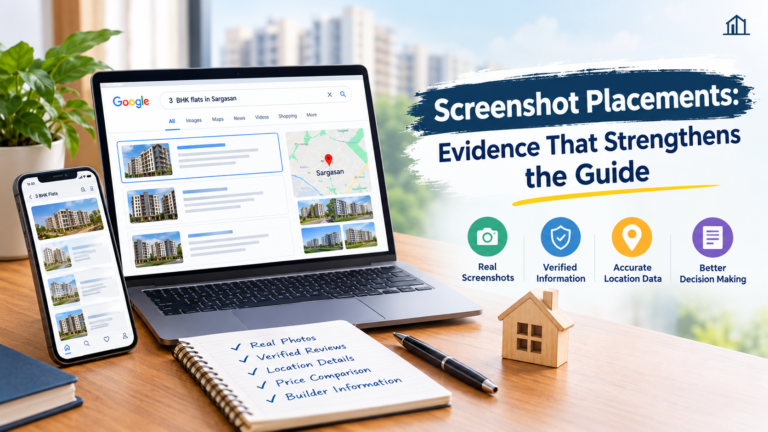
Screenshot Placements: Evidence That Strengthens the Guide
Who This Guide Is Not For
This guide is intended for people who want to make a considered residential purchase. It is not a promise of returns or a shortcut around legal and financial checks.
Who should reconsider buying now?
You should pause if:
- The EMI would leave insufficient money for essential expenses and emergencies.
- You are buying mainly because a broker says prices will rise immediately.
- You have not verified the property’s ownership and applicable approvals.
- You need guaranteed short-term appreciation to make the purchase worthwhile.
- You cannot comfortably manage potential repairs, vacancy or other ownership costs.
- Your employment, city or family requirements may change significantly in the near future.
Who may be better off renting?
Renting may be more suitable if you expect to move within a few years, are still learning the local market or would need to use most of your savings for the down payment and purchase expenses.
A home purchase involves transaction costs and can take time to sell. Renting can provide flexibility while you build a larger deposit, understand commuting patterns and compare residential areas.
Who should not rely on this guide?
This article does not provide a strategy for short-term flipping, speculative quick-profit deals or investments based on rumours and unconfirmed infrastructure announcements.
It also does not replace a qualified property lawyer, technical inspector, tax professional or financial adviser. The right decision depends on the specific documents, property condition and personal finances.
If I Were Buying This Property Today
If I were buying a 3 BHK flat in Sargasan today, I would not pay a premium simply because a project is described as modern, premium or well-connected. I would first compare the actual apartment, its documents and its total cost against alternatives.
Would I buy now or wait?
I would buy only if the apartment met my family’s practical needs, the legal review was satisfactory and the price was defensible against comparable properties. I would wait if the seller refused to provide documents, if the quoted price depended on unconfirmed future infrastructure or if the EMI left too little financial breathing room.
I would not attempt to predict a short-term market bottom. My decision would be based on affordability and property quality rather than fear of missing out.
Which configuration would I choose?
I would look for a genuinely usable 3 BHK layout with three functional bedrooms, adequate ventilation, sensible storage, practical bathrooms and a manageable maintenance burden. I would prefer a well-maintained building with dependable everyday services over a project whose main attraction was a long list of amenities.
The exact floor, orientation and building position would depend on noise, natural light, heat exposure, accessibility and the family’s requirements.
What would I negotiate hardest?
I would negotiate the total acquisition cost and written terms, not just the headline price. I would ask for a detailed cost sheet, clarification of parking and maintenance charges, a realistic payment schedule and written confirmation of every promised inclusion.
For a resale apartment, I would also factor in the cost of repairs, renovation and any outstanding dues identified during due diligence.
Which red flag would I never ignore?
I would walk away from unexplained discrepancies between the property being sold and its legal documents, or from pressure to make a substantial payment before the necessary checks were completed.
A seller’s willingness to lose a buyer rather than provide basic documentation is not a reason to hurry. It is a reason to investigate more carefully or choose another property.
Conclusion:
Choosing among the top 3 BHK flats in Sargasan, Gandhinagar is not about finding the apartment with the most impressive brochure. It is about finding a property that works for your family’s daily routine, fits your total budget and stands up to legal, technical and financial scrutiny.
Before booking, remember these five priorities:
- Test connectivity and the immediate neighbourhood yourself.
- Compare carpet area and total acquisition cost, not just advertised prices.
- Verify the project’s registration, applicable approvals and the builder’s record.
- Inspect the actual apartment, building services and maintenance arrangements.
- Make the decision only when the financial and legal checks support it.
Your next step: Prepare a shortlist of three apartments and compare them using the same checklist. Record the quoted price, carpet area, possession status, monthly maintenance, commute time and outstanding legal questions. If any important detail remains unclear, resolve it before paying a booking amount.
A home purchase should give your family greater security and comfort. There is no disadvantage in taking an extra week to verify a property, and there is no shame in walking away from a deal that does not make sense.
Frequently Asked Questions About Family-Friendly Apartments in Sargasan
Q1. Are family-friendly apartments in Sargasan suitable for families?
Q2. What is the price of a 3 BHK flat in Sargasan, Gandhinagar?
Q3. Is a ready-to-move apartment better for families?
Q4. What should families check before buying an apartment in Sargasan?
Q5. Are apartments in Sargasan suitable for families with children?
References
About the Author