
Buying a flat is not just about choosing a good location or negotiating a price. It is about committing a significant part of your savings to a property that should remain legally sound, financially manageable and suitable for your family for years to come.
If you are searching for RERA approved projects in Gandhinagar, you have probably already seen advertisements promising modern amenities, attractive prices, convenient possession dates and excellent future appreciation. A broker may tell you that only two flats remain. A builder may show you a registration certificate. Another salesperson may insist that prices will increase next month.
But there is a more important question to ask before paying a booking amount:
Have you verified that the specific flat and project are suitable, legally documented and financially sensible for you?
In this guide, we will explain how to evaluate RERA registered residential projects in Gandhinagar, verify important documents, compare the actual cost of buying, and identify risks that a sales brochure may not reveal.
The objective is simple: help you make an informed decision, even if the right decision is to wait.
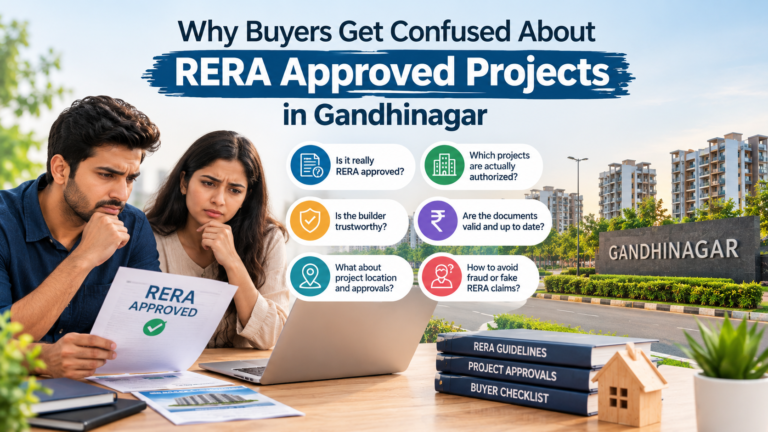
Why Buyers Get Confused About RERA Approved Projects in Gandhinagar
Imagine a family looking for a 3 BHK flat in Gandhinagar. Their budget is ₹80 lakh, including registration, interiors and other purchase expenses.
They visit a residential project in Kudasan. The salesperson presents a well-designed sample flat, explains the amenities and shows a GujRERA registration number. The family feels reassured because the project appears professional and the builder has provided official-looking documents.
A second project in Sargasan offers a similar configuration at a slightly higher price. A third option in Raysan is still under construction but promises a more attractive payment schedule.
The family now faces three different questions:
- Is the first project legally and practically suitable just because it is RERA registered?
- Is the second project worth paying more for because of its location or construction progress?
- Is the third project a sensible choice when the family needs possession within a year?
A registration number alone cannot answer all three questions.
The Real Estate (Regulation and Development) Act, 2016, establishes a framework for project registration, disclosures and buyer protection. However, buyers must still evaluate property title, applicable approvals, construction progress, the agreement, the total cost and their own financial position.
Many online property articles fail buyers because they focus on project names, amenities and advertised prices. They rarely explain what to verify independently, what a registration entry actually establishes, or when a buyer should walk away.
The more useful approach is to treat RERA registration as the starting point of due diligence, not the final approval of every aspect of a property.
Ground Reality: The Problems Buyers Should Understand
The advertised price may not be the final price
A property advertised at ₹72 lakh may cost considerably more once you include applicable taxes, stamp duty, registration, parking charges where lawful, maintenance deposits, interiors, appliances and loan-related expenses.
Not every project charges every item separately. The important point is to obtain a written, itemised cost sheet rather than assume that the headline price represents the full purchase cost.
For example, if your total budget is ₹80 lakh, buying a flat for ₹78 lakh may leave insufficient money for transaction costs and basic furnishing.
Buyer lesson: Set your maximum all-inclusive budget before visiting projects. Do not let the advertised base price determine your spending limit.
Fake urgency can lead to poor decisions
Statements such as “the price increases tomorrow,” “the last unit is available” or “this offer is valid only today” are not evidence that a property is a good investment.
Genuine inventory constraints and price changes can occur. Nevertheless, buyers should ask for written details and compare alternatives before making a commitment.
Request the exact unit number, carpet area, total price, payment schedule and offer conditions. If the salesperson refuses to provide these details in writing, pause the process.
Buyer lesson: Never transfer a booking amount simply because you fear losing an opportunity. A missed deal is usually less expensive than a poorly investigated purchase.
RERA registration does not guarantee a trouble-free property
This is one of the most important distinctions in residential property buying.
RERA registration is a significant compliance and disclosure mechanism. Depending on the project and its circumstances, buyers may be able to examine information about the promoter, project phase, declared completion timeline, approvals and other disclosures.
However, registration is not an unconditional government guarantee of:
- Clear and undisputed ownership of the land.
- Every required permission being valid and current.
- Construction quality meeting your expectations.
- Possession on the date promised by a salesperson.
- Future resale value or rental demand.
- The absence of disputes, financial stress or practical defects.
A buyer must examine the relevant documents and verify the information rather than relying exclusively on the registration number.
Buyer lesson: Verify the project on the official GujRERA portal, then carry out separate legal, financial and physical checks.
The wrong location can undermine a good property
Gandhinagar has several residential areas worth comparing, including Sargasan, Kudasan, Raysan, Randesan, Vavol and Koba. Each location can offer a different combination of connectivity, housing stock, services and price.
But a neighbourhood’s reputation is not enough.
A property may look close to an office on a map while the actual commute depends on the approach road, traffic, available transport and access to major routes. A developing neighbourhood may offer newer construction but require compromises in nearby services or everyday convenience, so it is equally important to know How to check a project’s RERA registration before making a purchase decision.
Before choosing a location, check the actual route to work, schools, hospitals, grocery shops and public transport at the times you would use them.
Buyer lesson: Evaluate the specific building and its surroundings, not merely the locality’s name.
End-use buyers and investors need different answers
A family buying a home may value a practical layout, nearby schools, reliable water supply, lift maintenance and a manageable commute.
An investor may place more weight on tenant demand, rental income, vacancy risk, resale liquidity and the total amount of capital tied up in the property.
The best home for an end user is not automatically the best investment.
Similarly, a property advertised as suitable for investment may produce a modest rental return once maintenance, vacancy, repairs, taxes and transaction costs are considered.
Buyer lesson: Write down your primary objective before comparing projects. Do not use expected appreciation to justify a purchase that does not meet your actual needs.
Step-by-Step Buyer Action Plan
Step 1: Choose the location before choosing the project
What to do
Shortlist two or three locations based on your daily routine and financial capacity. For example:
- Sargasan: Compare commute convenience, nearby services, building access and the total cost of comparable flats.
- Kudasan: Check the specific street, residential surroundings, building condition and access to your regular destinations.
- Raysan: Assess actual connectivity, daily amenities and whether the property suits your intended use.
- Randesan: Compare commute routes, the surrounding development and the practical suitability of the building.
- Vavol: Examine the approach road, access to services and the condition of the individual project.
- Koba: Consider your commute, access to employment areas and the local facilities available around the exact property.
These are starting points for comparison, not rankings or guarantees about any neighbourhood.
Why it matters
A flat can be attractive inside the building yet inconvenient in everyday life. Over time, travel, access to services and building management can matter more than decorative amenities.
Mistakes to avoid
- Choosing a location only because a broker predicts appreciation.
- Assuming every project within the same locality offers equal convenience.
- Ignoring traffic, construction activity or the condition of the approach road.
- Buying near a proposed infrastructure project without verifying its official status and likely relevance to your commute.
Practical tip
Visit the property at least twice, including once during a normal commuting period. Check the route yourself and speak to residents or nearby shopkeepers about water supply, traffic, construction disruption and building maintenance.
Step 2: Validate the budget and the actual purchase price
What to do
Ask the seller for a written, unit-specific cost sheet. Separate the base property price from all additional expenses.
Use this framework:
| Cost component | What to verify |
|---|---|
| Base price | Exact unit, carpet area and included specifications |
| Stamp duty and registration | Applicable charges based on the transaction and prevailing rules |
| GST | Whether applicable to the specific transaction |
| Parking | Availability, allocation and lawful charges |
| Maintenance | Advance maintenance and recurring charges |
| Society or common-area deposits | Purpose, amount and refund conditions |
| Interiors | Kitchen, wardrobes, electrical work and other essentials |
| Loan expenses | Processing, valuation and related charges |
| Contingency | Funds for unexpected expenses |
Illustrative budget example
Suppose a family has a maximum purchase budget of ₹80 lakh and is considering a flat advertised at ₹72 lakh.
| Item | Illustrative amount |
|---|---|
| Advertised base price | ₹72,00,000 |
| Transaction and other applicable charges | ₹4,00,000 |
| Essential interiors and appliances | ₹3,00,000 |
| Emergency reserve | ₹1,00,000 |
| Total | ₹80,00,000 |
These amounts are planning assumptions, not a verified quotation or a statement of current statutory rates. Actual expenses depend on the transaction, project and buyer’s requirements. Obtain a current written estimate before deciding.
Why it matters
A purchase that consumes every available rupee leaves little room for job changes, medical expenses, delayed possession or unexpected repairs.
Mistakes to avoid
- Calculating affordability from the EMI alone.
- Assuming a bank’s loan approval means the purchase is financially sensible.
- Forgetting furnishing, moving and recurring maintenance expenses.
- Using emergency savings for the down payment.
Practical tip
Keep your emergency reserve separate from the property budget. Stress-test your finances against a higher-than-expected monthly expense, a temporary reduction in income and a possible increase in household costs.
If the purchase works only under perfect financial conditions, consider a less expensive property or postpone the decision.
Step 3: Verify the builder and RERA registration
What to do
Search for the project using its name or registration number. Match the record against the exact project being offered to you.
Check:
- The registered project name and location.
- The promoter or developer’s identity.
- The registration number and current status.
- The relevant phase or building, where applicable.
- The declared completion or possession-related timeline.
- Disclosed approvals and sanctioned plans.
- Available progress updates and project disclosures.
- Any listed complaints, orders or other relevant records accessible through the portal.
Save the relevant project details and note the date you checked them. If the project has multiple phases, verify the phase containing your proposed flat rather than assuming that registration for one phase covers the entire development.
Why it matters
A similarly named project, a registration number belonging to another phase or an outdated sales brochure can create confusion. Matching the official record to the actual unit helps identify these inconsistencies before money changes hands.
Mistakes to avoid
- Accepting a registration number from WhatsApp without checking the official portal.
- Assuming a registered project has every separate approval required for your transaction.
- Treating a promised possession date in an advertisement as equivalent to the registered timeline.
- Ignoring changes to the promoter, project status or declared schedule.
Practical tip
Compare the official record with the booking form, draft agreement and the documents supplied by the builder. If the names, phase, unit details or dates do not match, ask for a written explanation and obtain independent legal advice before proceeding.
Also examine the promoter’s previous projects. Where information is available, compare declared and actual completion dates, construction quality, handover experience and ongoing maintenance arrangements. Do not judge reliability solely by a showroom or sample flat.
Remember: RERA registration is not a substitute for title verification or a complete legal review.
Step 4: Conduct a site visit that goes beyond the sample flat
What to do
Inspect the actual flat, building and surroundings. If the unit is under construction, visit the site and compare visible progress with the registered disclosures and contractual specifications.
Use this checklist:
- Is the approach road convenient and usable?
- Is the actual carpet area consistent with the documents?
- Does the layout provide usable bedrooms, storage and circulation space?
- Is there sufficient natural light and ventilation?
- Are there visible signs of dampness, leakage or poor finishing?
- Is the lift installed and operational, where applicable?
- Are fire-safety provisions and common areas consistent with the applicable requirements?
- What are the water supply and drainage arrangements?
- Is parking clearly identified and documented?
- Are common areas maintained?
- Is nearby construction likely to affect light, noise or access?
- What are the monthly maintenance charges and services included?
For an occupied project, speak to residents about water pressure, lift downtime, maintenance, security and the builder’s response to complaints.
Why it matters
A sample flat is designed to present the property attractively. It may not reflect the exact unit, the unfinished common areas or the experience of living in the building after possession.
Mistakes to avoid
- Visiting only the sample flat.
- Accepting verbal promises about amenities that are not reflected in the relevant documents.
- Ignoring dampness, drainage or common-area issues.
- Assuming that an unfinished building will automatically be completed to the standard shown in the brochure.
Practical tip
Take dated photographs of the actual unit and common areas where permitted. Record questions and ask the builder to respond in writing. For significant construction or structural concerns, seek an independent qualified professional rather than relying on a salesperson’s reassurance.
Step 5: Complete the legal and registry checks
What to do
Before signing a binding agreement or making a substantial payment, have a qualified property lawyer review the documents relevant to the transaction.
Depending on the property, these may include:
- Title documents and the chain of ownership.
- Applicable land-use and development permissions.
- Sanctioned building plans and commencement-related permissions.
- Encumbrances, mortgages, litigation or other claims affecting the property.
- RERA registration details and disclosed project documents.
- Draft agreement for sale and payment schedule.
- Unit number, carpet area, specifications and possession terms.
- Applicable completion or occupancy certificates for completed buildings.
- Conveyance, deed execution and registration requirements.
- Any society, association or common-area documentation relevant to the transaction.
For a ready-to-move flat, verify the applicable completion and occupancy documentation rather than relying on the phrase “ready possession” in an advertisement.
For an under-construction flat, confirm the status of required permissions, the contractual completion terms and what happens if possession is delayed.
Why it matters
The registration of a project under RERA and the legal transfer of ownership are different matters. A project may have a RERA record, but the buyer still needs to establish that the particular transaction can proceed on a sound legal basis.
Mistakes to avoid
- Relying exclusively on the builder’s lawyer for independent advice.
- Treating a bank’s technical or legal review as a complete substitute for your own counsel.
- Assuming a property tax receipt proves clear ownership.
- Paying the full amount before the required documentation and contractual conditions are satisfied.
Practical tip
Ask your lawyer to explain any unresolved title issue, mortgage, restriction or discrepancy in plain language. Do not proceed simply because the issue is described as routine.
If an important document is missing, inconsistent or cannot be independently verified, delay the purchase until the issue is resolved. If it cannot be resolved satisfactorily, walk away.
Step 6: Negotiate using evidence, not emotion
What to do
Once you have shortlisted a suitable property, negotiate the total transaction rather than only the advertised base price.
Ask for:
- A final written price for the exact unit.
- A clear payment schedule.
- Written confirmation of included specifications and amenities.
- Details of maintenance and other applicable charges.
- The terms for cancellation, refund and forfeiture.
- Any proposed price concessions or included items.
- The contractual possession timeline and remedies for delay.
Compare the offer with similar units in the same project and genuinely comparable properties nearby. Differences in floor, orientation, carpet area, construction progress, parking and building condition can materially affect the comparison.
Why it matters
A small reduction in the headline price may be less valuable than a clear agreement, a manageable payment schedule or the resolution of an important documentation issue.
Mistakes to avoid
- Paying a non-refundable amount before reviewing the booking terms.
- Comparing a ready-to-move flat directly with an under-construction unit without adjusting for risk and timing.
- Treating free furniture or an amenity package as equivalent to a price reduction.
- Accepting verbal assurances that are absent from the contract.
Practical tip
Negotiate calmly and retain written evidence. If the seller will not clarify an important financial or legal condition, do not let the prospect of a discount distract you from the risk.
The strongest negotiation position is being financially prepared and genuinely willing to choose another property.
Illustrative Buyer Case Studies: What the Numbers Teach Us
The following examples use hypothetical figures to demonstrate how a buyer should evaluate a purchase. They are not represented as actual client transactions, verified local sales or confirmed current market valuations.
Case Study 1: An end-user family buying a 3 BHK flat
Situation
A family wants a 3 BHK home in Gandhinagar. Both adults work, and they want a manageable commute, a practical layout and predictable household expenses.
| Factor | Illustrative scenario |
|---|---|
| Total available budget | ₹85 lakh |
| Location shortlisted | Kudasan |
| Purchase price | ₹74 lakh |
| Additional transaction costs and essential interiors | ₹7 lakh |
| Initial reserve retained | ₹4 lakh |
| Total planned allocation | ₹85 lakh |
Suppose the family initially considers a newer project because the sample flat looks attractive. During further checks, they discover that another property better suits their commute and has more complete common facilities.
They compare the actual carpet area, monthly maintenance, water arrangements, legal documents and total purchase cost before making a decision.
For this illustration, assume that a later independent valuation estimates the property’s value at ₹79 lakh. That figure is hypothetical and is not a verified market valuation.
The difference between ₹74 lakh and ₹79 lakh is ₹5 lakh, or approximately 6.8% of the original purchase price. It should not be treated as realised profit: selling expenses, taxes where applicable, transaction costs and inflation have not been accounted for.
What worked
- The family compared the actual unit rather than the sample flat.
- It considered commute and everyday needs before amenities.
- It retained an emergency reserve.
- It checked documents before committing.
What the family should learn
For an end user, a property can be a sensible purchase even if its appreciation is modest, provided it meets long-term needs and remains financially manageable.
The family should not stretch its budget merely to buy in a fashionable location or a project with more amenities.
Case Study 2: An investor evaluating rental income
Situation
An investor is considering a 2 BHK flat in Gandhinagar. The objective is to earn rental income while retaining the option to sell later.
| Factor | Illustrative scenario |
|---|---|
| Purchase price | ₹55 lakh |
| Initial transaction and furnishing costs | ₹4 lakh |
| Total initial investment | ₹59 lakh |
| Assumed monthly rent | ₹18,000 |
| Annual gross rent | ₹2,16,000 |
The gross rental yield is:
₹2,16,000 ÷ ₹59,00,000 × 100 = approximately 3.66% per year.
This is a hypothetical calculation, not a verified rental yield for Gandhinagar.
Now suppose the property has annual maintenance, repairs, vacancy and other owner-borne expenses totalling ₹36,000. The resulting annual income before financing costs, income tax and other applicable expenses would be ₹1,80,000.
The illustrative net operating yield would therefore be approximately 3.05% of the initial investment, before financing and tax.
Suppose the investor later receives an offer of ₹63 lakh. That is a hypothetical increase of ₹8 lakh over the purchase price, but the investor must still account for selling expenses and any applicable taxes before determining the actual outcome.
What worked
- The investor assessed rental income before purchasing.
- The calculation included initial costs rather than using the property price alone.
- The investor considered vacancy and maintenance expenses.
- The exit decision was based on actual offers and financial needs, not just a forecast.
What did not automatically work
The property did not guarantee a high return simply because it was in a developing area. If rent remained weak, vacancies increased or resale demand softened, the investment could underperform.
Exit strategy
An investor should set clear conditions for reviewing or selling the property. These may include persistent vacancy, poor net rental returns, a change in personal liquidity needs or a realistic resale offer that meets the investment objective.
Do not assume that a future buyer will pay a premium simply because infrastructure or employment activity is expected to grow.
Read More :- RERA Approved Projects in Koba Gandhinagar
Testimonials and Social Proof: Use Only Verifiable Experiences
Trust matters in real estate, but invented testimonials damage it. The following are fictional example scenarios, not genuine client statements. They should not be published as actual testimonials.
Example 1: IT professional considering a home near work
“I was comparing two flats mainly on price. I later realised the commute and the actual carpet area mattered more to my family. I would rather spend more time checking the details than rush into a booking.”
Example 2: PSU employee buying a family home
“The important thing for us was knowing the total cost and keeping enough savings after the down payment. We wanted a home we could afford comfortably, not the most expensive home the bank would finance.”
Example 3: Investor comparing rental opportunities
“The advertised rent looked attractive, but I started calculating maintenance, vacancy and furnishing costs. The numbers helped me compare properties on income rather than promises of appreciation.”
For genuine social proof, request permission from actual buyers and publish their accurate words, transaction context and relevant details only after obtaining consent. Never create a false impression that a fictional example represents a real client.
Credibility, Official Records and Gandhinagar Market Context
A reliable property decision requires evidence from sources that are independent of the sales pitch.
Official sources every buyer should use
1. Gujarat RERA portal
Use the official portal to search for RERA registered residential projects, verify project and promoter details, review disclosed timelines and examine available project information.
The Real Estate (Regulation and Development) Act, 2016, addresses project registration and disclosures, promoter obligations and buyer protections. Section 3 deals with prior project registration, subject to the statutory framework and applicable exemptions. Section 4 addresses the application and supporting disclosures. Buyers should consult the Act and relevant Gujarat rules when a legal question arises.
2. India Code — the RERA Act
This is a government legal source for the central Act. It helps buyers understand the statutory framework rather than relying on simplified marketing descriptions of RERA.
3. Gujarat GARVI registration and valuation services
Use the relevant official services to investigate applicable Jantri information and property registration-related requirements.
Jantri is useful when examining government-assessed property values and the basis for applicable stamp-duty calculations. It is not a direct substitute for a comparison of actual market transactions. A property’s sale price can differ from its Jantri value because of location, condition, configuration, demand and other factors.
4. Relevant local authority and planning records
Depending on the property’s exact location and jurisdiction, check the competent local authority or planning body for applicable development permissions, sanctioned plans, land-use details and completion-related documentation.
Do not assume that every property marketed as being in Gandhinagar falls under the same approval authority. Verify the jurisdiction for the particular survey number and project.
5. Sub-registrar and transaction records
Where accessible and relevant, review registered deeds and other official records to understand ownership history, recorded interests and comparable transactions. A lawyer can help determine which records are needed and how to interpret them.
A registered deed or tax receipt alone does not establish every aspect of a property’s legal status.
What do current market conditions mean for buyers?
Residential property markets are time-dependent. Prices, available inventory, borrowing costs, rental demand and buyer preferences can change.
For Gandhinagar, it is sensible to compare individual properties in areas such as Sargasan, Kudasan, Raysan, Randesan, Vavol and Koba. But a general statement that one area is appreciating faster than another should not be treated as verified evidence without recent, comparable data.
Before publishing a specific price range or appreciation figure, establish:
- The date of the data.
- Whether it represents asking prices or registered transactions.
- The property type and configuration.
- Whether the comparison includes new or resale properties.
- Whether the price is based on carpet area, built-up area or another measurement.
- Whether the figure includes transaction costs.
Interest rates also affect affordability. A buyer should assess the EMI, total interest over the loan period and the possibility of changes in income or expenses, rather than assuming that property appreciation will offset the cost of borrowing.
My recommendation: Do not buy solely because someone predicts that Gandhinagar prices will rise. Buy when the specific property is suitable, the documents are satisfactory, the total cost is manageable and the decision still makes sense without an optimistic appreciation forecast.
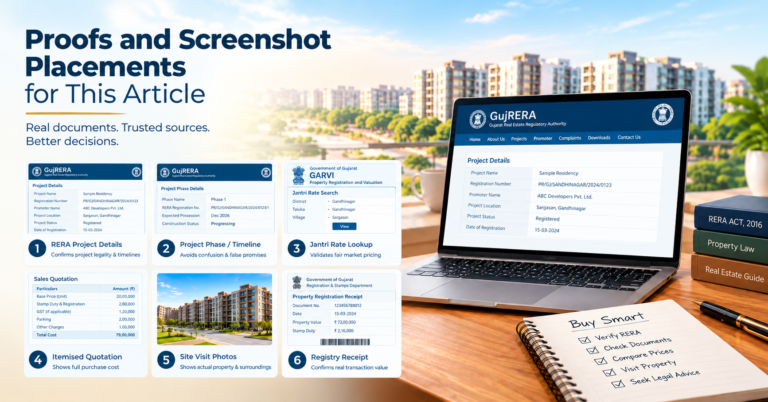
Proofs and Screenshot Placements for This Article
Who This Guide Is Not For
This guide is intended for buyers who want to understand a property before making a long-term commitment. It is not a shortcut to guaranteed returns.
You should reconsider buying if:
- You have not calculated the complete purchase cost.
- You would use your entire emergency fund for the down payment.
- Your income is unstable and the EMI would consume too much of it.
- You have not verified the relevant documents.
- You are buying only because a salesperson predicts an imminent price increase.
- You expect guaranteed appreciation or rental income.
- You are uncomfortable with the construction or possession risks of an under-construction project.
Renting may be better for you if:
Your employment location may change, you expect to relocate soon, or buying would create financial pressure. Renting can provide flexibility while you learn more about the local market and build savings.
There is no universal rule that buying is always better than renting. The answer depends on your expected length of stay, rental costs, borrowing terms, maintenance, transaction expenses and alternative uses for your savings.
This guide is not designed for:
- Short-term property flipping.
- Speculative deals based on rumours.
- Insider-information trading or unverified infrastructure announcements.
- Buyers seeking a guaranteed appreciation percentage.
- Anyone expecting a RERA registration number to eliminate all property risks.
If the numbers do not work or a critical legal issue remains unresolved, waiting is a legitimate decision—not a failure to invest.
If I Were Buying This Property Today
If I were buying a residential property in Gandhinagar today, I would not begin with the question, “Which project will appreciate the most?”
I would begin with three questions:
- Can I comfortably afford the full purchase and ongoing ownership costs?
- Have I independently verified the documents and the actual property?
- Would I still be happy with this home if its value remained broadly unchanged for several years?
Would I buy now or wait?
I would buy now only if I found a suitable property at a defensible price, with satisfactory documentation and a total cost that did not compromise my financial security.
If the seller relied on urgency, withheld material documents or expected me to accept an unclear possession commitment, I would wait or walk away.
I would not try to time the market using rumours about future infrastructure or a prediction that prices must rise.
Which configuration would I choose?
For an end-use family, I would shortlist a practical 2 BHK or 3 BHK based on the household’s actual needs, not its maximum loan eligibility.
I would prioritise usable carpet area, ventilation, storage, access to everyday services and a manageable commute. I would avoid paying a large premium for amenities that my family was unlikely to use.
For an investor, I would choose a configuration only after comparing realistic rent, total acquisition cost, vacancy risk and likely resale demand. A bigger flat is not automatically a better investment.
What would I negotiate hardest?
I would insist on a complete written cost sheet, clear payment terms, accurate unit specifications and contractually documented commitments.
I would also negotiate the overall deal rather than focus exclusively on a small reduction in the base price. Unclear charges and weak contractual protection can cost more than a modest discount saves.
One red flag I would never ignore
A material mismatch between the official project record, the documents and the seller’s claims.
If the phase, promoter, unit details, approvals or possession commitments do not match, I would not proceed until the discrepancy had been independently resolved.
No sample flat, discount or predicted appreciation would justify ignoring that issue.
Conclusion:
Searching for RERA approved projects in Gandhinagar is a useful starting point, but it is only one part of buying a home responsibly.
A good decision requires more than a registration number. It requires a suitable location, a realistic budget, independently checked documents, a physical inspection, a clear agreement and an honest assessment of your ability to manage the purchase.
Remember these principles:
- Verify the exact project and phase on the official GujRERA portal.
- Compare the complete purchase cost, not only the advertised price.
- Examine the actual flat and surrounding area.
- Obtain independent legal advice where needed.
- Distinguish a property’s suitability for end use from its investment potential.
- Never let sales pressure replace proper due diligence.
- Be willing to wait when the numbers or documents do not make sense.
A practical next step
Before paying a booking amount, prepare a checklist covering RERA verification, title and approvals, total cost, site inspection, agreement terms and possession risk.
If you are comparing residential projects in Gandhinagar, you can use this guide to organise your questions and identify which documents need further review. For a specific property, verify the records and seek qualified professional advice rather than relying on a general article.
The objective is not to buy the first attractive property you find. It is to make a decision you can defend financially and legally long after the sales conversation has ended.
FAQs :- About RERA Registered Projects in Gandhinagar
1. Is buying a RERA registered flat in Gandhinagar safe?
2. Can I buy an under-construction RERA registered flat?
3. Does RERA registration guarantee possession on time?
4. What should I do if a builder refuses to share property documents?
5. Is a RERA registered project better than a resale flat?
References
About the Author



Right here is the right site for anybody who would like to find out about this topic. You realize a whole lot its almost tough to argue with you (not that I actually will need to…HaHa). You certainly put a fresh spin on a subject which has been written about for decades. Great stuff, just wonderful!