
Buying a flat in Gandhinagar can become confusing when two properties appear equally attractive but offer completely different timelines. One is a completed apartment that you can inspect today. The other is an under-construction flat advertised at a lower starting price, with promises of modern amenities and future appreciation.
A broker may tell you that the completed flat is expensive because it is ready for possession. A builder may insist that booking early is the only way to secure the best price. Meanwhile, your family is worried about construction delays, rising EMIs, rent payments and the possibility of making a costly mistake.
The difficult question is not simply which flat costs less. It is which purchase gives you the best combination of affordability, legal certainty, construction quality, location and long-term suitability.
This guide compares ready-to-move vs under-construction flats in Gandhinagar from a buyer’s perspective. It also explains how to evaluate completed flats vs upcoming residential projects, calculate the true cost of ownership, verify legal documents and decide when waiting is the smarter choice.
The objective is not to convince you to buy either option. It is to help you recognise when a property deserves your money—and when it does not.
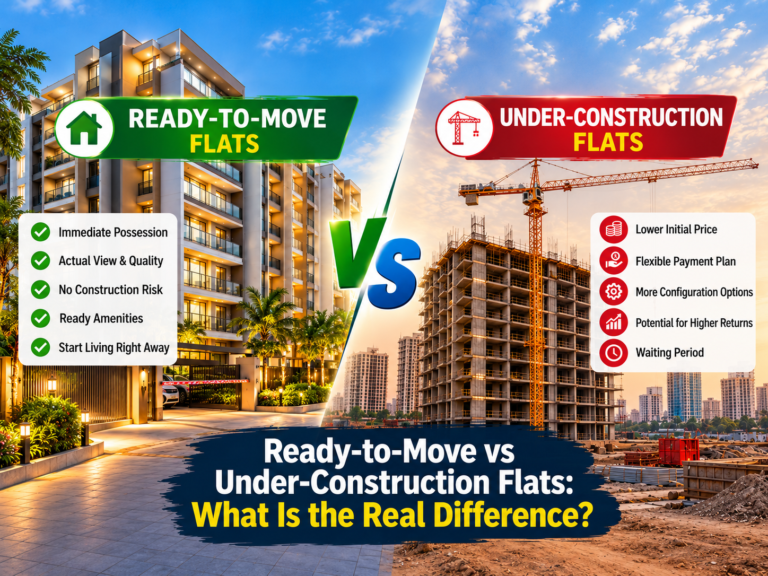
Ready-to-Move vs Under-Construction Flats: What Is the Real Difference?
The biggest difference is the amount of uncertainty you accept before taking possession.
A ready-to-move apartment allows you to inspect the actual flat and building before purchasing. An under-construction apartment requires you to assess the developer’s ability to deliver what has been promised, at the agreed price and within a reasonable timeframe.
Neither option is automatically better. The right choice depends on your financial position, urgency, tolerance for risk and the specific project.
| Factor | Ready-to-Move Flat | Under-Construction Flat |
|---|---|---|
| Possession | Potentially immediate, subject to legal readiness | Expected at a future date |
| Physical Inspection | Actual flat and common areas can be inspected | Usually limited to current construction and available samples |
| Construction-Delay Risk | Lower once legally complete | Higher |
| Price | May include a premium for immediate possession | May offer an attractive initial price, but not always |
| EMI and Rent Overlap | Can often be reduced if you move in promptly | May continue until possession |
| Rental Income | May start sooner if the property is suitable and legally occupiable | Usually delayed until possession and tenant occupation |
| Construction Quality | Existing defects and maintenance can be investigated | Final workmanship remains uncertain |
| Legal Checks | Title, permissions and transfer documents still need verification | Project registration, approvals, agreements and progress need scrutiny |
| Negotiation | Depends on the seller, inventory and urgency | Depends on launch stage, inventory and payment terms |
| Best Suited For | Buyers who value certainty and need a home soon | Buyers who can wait and withstand delivery and financial risks |
One important distinction: a physically completed flat is not necessarily legally ready for occupation. Similarly, a project advertised as upcoming may be at a very early stage or may already be under construction.
Always establish the actual status of the specific unit and building before comparing prices.
Ground Reality: Why Buyers Make Expensive Mistakes
The cheaper advertised price may not mean a cheaper purchase
Imagine two apartments in comparable residential locations.
A completed apartment costs ₹65 lakh. An under-construction apartment is advertised at ₹59 lakh.
The initial difference is ₹6 lakh. That looks significant until you account for the additional costs of waiting, financing, temporary accommodation and finishing the property.
For the under-construction flat, you may have to pay rent for another 18 months, bear construction-period loan interest, arrange moving costs twice and wait before receiving rental income.
On the other hand, the completed flat might need repairs, have higher maintenance charges or be priced above comparable properties.
The correct comparison is between the total cost of obtaining and using the home, not just the quoted purchase price.
Broker pressure can make a weak deal look urgent
Common sales statements include:
- “Only one unit is left.”
- “The price will increase next week.”
- “This area will become the next major investment destination.”
- “You can easily earn a high rental income after possession.”
- “The builder always delivers on time.”
Some statements may be accurate, but none should be accepted without supporting evidence.
Ask for the current written quotation, available inventory, relevant project disclosures and a clear payment schedule. If a seller refuses reasonable verification because an offer supposedly expires today, do not let that deadline replace your due diligence.
Construction delays can damage your monthly budget
Under-construction buyers sometimes calculate only the future EMI and forget that they may still be paying rent.
Suppose your monthly rent is ₹18,000 and your construction-period loan interest is ₹25,000. If both continue for 18 months, the combined cash outflow is ₹7.74 lakh.
That is before considering principal repayments, changes in interest rates or other expenses. Actual loan disbursement and EMI arrangements vary by lender and loan agreement.
A delay can therefore create a financial problem even when the purchase price itself appears reasonable.
A completed building can still have serious defects
Ready-to-move flats offer an inspection advantage, but that advantage matters only if you inspect carefully.
Seepage, plumbing defects, inadequate water supply, poor drainage, lift failures, parking disputes and unresolved building permissions can make a completed apartment expensive to own.
Do not assume that an occupied building is automatically defect-free or legally compliant.
The wrong location can undermine either choice
In Gandhinagar, buyers often compare Kudasan, Sargasan, Randesan, Raysan, Koba and Vavol. Each locality contains different residential pockets, building types and commuting conditions.
A completed apartment in the right location may be a better decision than a new project in a less convenient pocket. Equally, an under-construction property may be worth considering if the location, documentation, price and developer are convincing, so Choosing between a completed flat and a new project requires careful evaluation of your budget, possession timeline and long-term needs.
Evaluate the actual approach road, travel time, access to schools and healthcare, water arrangements and surrounding development. Do not buy solely because a project is advertised as being near GIFT City or another important destination.
End-use and investment decisions are not the same
A family buying a home for ten years may value predictable possession, room sizes and school access. An investor may prioritise achievable rent, vacancy risk, liquidity and resale demand.
The same flat can be suitable for one buyer and unsuitable for another.
Before comparing projects, decide whether you are buying primarily to live in the property or to generate a financial return. Without that distinction, you may pay for features that do not support your actual objective.
Step-by-Step Buyer Action Plan
Step 1: Select the right location
What to do
Shortlist two or three residential areas according to your daily routine. Visit the actual project location and assess travel times during the hours you normally commute.
For a completed flat, inspect the existing surroundings and daily services. For an under-construction project, distinguish between infrastructure that exists today and infrastructure that is only proposed.
Why it matters
You can renovate a kitchen, but you cannot easily change your home’s location. A lower purchase price may not compensate for a longer commute or poor everyday access.
Mistakes to avoid
- Selecting a project because of a future road or transport promise.
- Assuming all buildings in Kudasan or Randesan offer similar convenience.
- Ignoring traffic, drainage, noise and nearby construction.
- Buying an investment property without investigating actual tenant demand.
Practical tip
Visit the locality at least twice, including during peak commuting hours. Ask nearby residents about water supply, road conditions and recurring problems.
Step 2: Calculate the complete budget and validate the price
What to do
Obtain a written cost sheet for both options. Include the purchase price, applicable taxes and statutory charges, registration, legal expenses, brokerage, parking where applicable, maintenance deposits, furnishing and repairs.
For an under-construction property, include the expected rent during construction, applicable GST where legally payable, construction-linked payments and the possibility of a delay.
For a completed property, inspect its condition and budget for immediate repairs or replacements.
Illustrative comparison
The following example demonstrates the calculation method. It is not a current quotation for any particular Gandhinagar project.
| Cost Component | Completed Flat | Under-Construction Flat |
|---|---|---|
| Advertised Purchase Price | ₹65 lakh | ₹59 lakh |
| Illustrative Acquisition and Setup Provision | ₹5 lakh | ₹6 lakh |
| Temporary Rent During Waiting Period | ₹0 | ₹3.24 lakh |
| Additional Construction-Period Financing Cost | ₹0 | ₹2 lakh |
| Illustrative Total | ₹70 lakh | ₹70.24 lakh |
Assumptions: the under-construction buyer pays ₹18,000 monthly rent for 18 months, adding ₹3.24 lakh. The financing provision is hypothetical. The example assumes no rent is needed for the completed property because the buyer moves in promptly.
The comparison excludes differences in loan principal and repayment timing, future maintenance, potential delays beyond 18 months and differences in the property’s market value. Actual expenses may differ materially.
The lesson is important: an under-construction flat advertised ₹6 lakh cheaper can lose its apparent advantage once waiting costs are included.
Mistakes to avoid
- Treating the advertised price as the final cost.
- Ignoring rent and loan cash flow.
- Assuming every new project is cheaper than a completed property.
- Relying on an unverified future resale price.
Practical tip
Compare the effective total cost of each property under a normal completion scenario and a delayed-completion scenario. If the under-construction purchase is only affordable when everything goes perfectly, reconsider it.
Step 3: Verify the builder and RERA status
What to do
For a project that falls within registration requirements, check the official Gujarat RERA portal.
Confirm the project name, registration number, promoter, relevant phase, declared completion timeline, extensions and available progress disclosures.
For a completed project, verify the applicable building-use permission and other relevant approvals. For an under-construction project, investigate approvals, project disclosures and the contractual possession date.
Why it matters
Registration and disclosures help you investigate a project, but they do not guarantee that every promise will be fulfilled or that every flat has clear title.
Mistakes to avoid
- Assuming that RERA registration guarantees timely possession.
- Checking a similarly named project instead of the exact phase.
- Relying only on a brochure or broker’s screenshot.
- Assuming a builder’s reputation removes the need for document verification.
Practical tip
Compare the agreement’s possession terms with the official project information. Ask an independent property lawyer to identify important risks before you pay a substantial booking amount.
Step 4: Inspect the property and construction progress
For a completed flat
Inspect the actual unit, water pressure, drainage, electrical points, ventilation, doors, windows, seepage and flooring. Test lifts and examine parking, staircases, common areas and fire-safety arrangements.
Speak to existing residents about maintenance, security, water supply and recurring disputes.
For an under-construction flat
Visit the site and assess actual progress against the developer’s disclosed timeline. Ask which construction stages remain and whether essential approvals are available.
A sample flat can demonstrate a proposed layout and finish, but it cannot prove the final quality of your apartment.
Why it matters
Physical inspection helps identify defects and unrealistic expectations before they become your financial responsibility.
Mistakes to avoid
- Comparing a furnished sample flat with an unfinished apartment as though they are equivalent.
- Ignoring construction quality because the project has a premium entrance.
- Accepting a verbal promise to correct every defect later.
- Treating a partially completed amenity as an operational facility.
Practical tip
For a completed property, consider a qualified building inspection if you notice cracks, dampness or other significant concerns. For an under-construction property, document agreed specifications and finishes in the contract rather than relying on marketing material.
Step 5: Complete legal and registration checks
What to do
For both options, have an independent lawyer review the relevant title documents, ownership chain, encumbrances, approved plans, seller’s authority and other applicable records.
For an under-construction property, examine the agreement for sale, payment schedule, possession obligations, delay provisions, cancellation terms and the process for addressing changes to specifications.
For a completed property, verify the applicable building-use permission, previous registered sale deed, outstanding dues, mortgage release where necessary and documents required for the transfer.
Why it matters
A property can look attractive and still create legal difficulties. Physical completion does not establish clear title, and RERA registration does not replace the buyer’s legal checks.
Mistakes to avoid
- Paying a large non-refundable token before document review.
- Assuming a tax receipt proves ownership.
- Ignoring a discrepancy in carpet area or parking allocation.
- Accepting unclear possession terms or undocumented payments.
Practical tip
Make payment milestones and important conditions clear in writing. Never treat “the paperwork will be completed later” as sufficient reassurance when a key legal requirement remains unresolved.
Step 6: Negotiate based on evidence
What to do
For a completed apartment, compare similar properties in the same building and nearby areas. Consider age, carpet area, floor, maintenance, parking, condition and the seller’s circumstances.
For an under-construction flat, compare the complete cost sheet, payment schedule, possession terms, specifications and the financial consequences of delay.
Why it matters
The correct comparison is between two properties of similar utility and risk—not simply between their advertised prices.
Mistakes to avoid
- Accepting a claimed discount without checking the base price.
- Assuming early booking always gives the lowest price.
- Paying for amenities that are not essential to your household.
- Agreeing to a payment schedule that exceeds your financial capacity.
Practical tip
Negotiate the final financial commitment and the contract terms together. If the builder offers a discount but refuses to clarify possession obligations or significant charges, the discount may not justify the risk.
Completed Flats vs Upcoming Residential Projects in Gandhinagar
When comparing completed flats vs upcoming residential projects, buyers should separate what can be verified today from what remains a future expectation.
A completed property offers visible evidence of the building’s condition, surrounding neighbourhood and operating facilities. An upcoming project may offer a preferred layout, newer specifications or a more suitable payment schedule, but its future condition and completion remain uncertain.
| Buyer Priority | More Suitable Starting Point | Important Qualification |
|---|---|---|
| Moving within the next few months | Completed flat | Verify legal readiness and transfer timing |
| Avoiding construction delays | Completed flat | Existing title, defects and approvals still need checks |
| Choosing a specific new layout | Under-construction project | Confirm the contractual specifications |
| Paying over a construction-linked schedule | Under-construction project | Ensure payments remain affordable |
| Starting rental income sooner | Completed flat | Tenant demand and actual rent must be verified |
| Avoiding overlap between rent and EMI | Usually completed flat | Depends on financing and possession arrangements |
| Evaluating an early-stage price | Under-construction project | A lower entry price does not guarantee appreciation |
| Inspecting actual construction quality | Completed flat | A professional inspection may still be needed |
My preference is to start with completed properties if the buyer needs a home soon or has limited financial flexibility. I would consider an under-construction project only when its price, legal position, developer record and possession terms provide a convincing reason to accept the additional uncertainty.
Case Studies: Numbers, Outcomes and Lessons
The following are hypothetical examples created to explain buyer decisions. They are not verified client transactions, current property valuations or forecasts.
Case Study 1: A Family Choosing Between Immediate Possession and Waiting
Buyer profile: A family planning to move to Gandhinagar and seeking a 3 BHK apartment.
| Detail | Illustrative Scenario |
|---|---|
| Comfortable total housing budget | ₹75 lakh |
| Locality under consideration | Sargasan |
| Completed flat purchase price | ₹65 lakh |
| Completed-flat acquisition and setup provision | ₹5 lakh |
| Under-construction flat purchase price | ₹59 lakh |
| Under-construction acquisition and setup provision | ₹6 lakh |
| Assumed construction waiting period | 18 months |
| Rent during waiting period at ₹18,000/month | ₹3.24 lakh |
| Additional assumed financing cost | ₹2 lakh |
In this example, the completed apartment has an estimated total cost of ₹70 lakh, while the under-construction option reaches approximately ₹70.24 lakh under the stated assumptions.
The family chooses the completed apartment after verifying the applicable permissions, inspecting the actual flat and confirming that the commute suits its needs.
Outcome: The family can plan its move without depending on the future completion of the alternative project. The decision is based on the overall cost and reduced timing uncertainty, not an assumption that the completed flat will appreciate faster.
Lesson learned: When two properties have similar total costs, the ability to inspect the actual apartment and move in sooner can justify choosing the completed property.
Case Study 2: An Investor Comparing Immediate Rent With Future Possession
Buyer profile: An investor considering a completed apartment and a less expensive under-construction alternative.
| Detail | Completed Property | Under-Construction Property |
|---|---|---|
| Purchase price | ₹60 lakh | ₹55 lakh |
| Additional acquisition and setup provision | ₹4 lakh | ₹5 lakh |
| Total assumed initial cost | ₹64 lakh | ₹60 lakh |
| Assumed monthly rent after occupancy | ₹20,000 | ₹20,000 |
| Annual gross rent once occupied | ₹2.4 lakh | ₹2.4 lakh |
| Gross yield on assumed total cost | 3.75% | 4.00% |
The under-construction property’s apparent gross yield is calculated using the assumed future rent and total acquisition cost. It is not an actual current yield because the property is not yet available for occupation.
The completed property’s annual gross yield is ₹2.4 lakh divided by ₹64 lakh, or 3.75%. The net yield would be lower after vacancy, maintenance, property tax, repairs and other expenses.
Suppose the under-construction apartment takes 18 months to become available. The investor must account for the absence of rental income during that period and any additional financing costs. If the expected rent does not materialise or the project is delayed, the apparent yield advantage may disappear.
Exit strategy: Before purchasing, the investor should determine a realistic holding period, estimate net rental income and investigate the resale market for comparable properties. A future selling price should not be treated as guaranteed.
Lesson learned: A lower entry price is useful only if the completed asset ultimately delivers the required utility or return. Buying early is not automatically a better investment.
Realistic Testimonials: Use Genuine Evidence Only
The following are sample testimonial formats for planning. They are fictional examples, not genuine customer statements, and should not be published as actual reviews.
Sample 1 — IT professional considering a home in Kudasan
“I compared a completed flat with a project that was still under construction. Once I included rent during the waiting period, the price difference was smaller than I expected. I decided to focus on the total cost instead.”
Sample 2 — Family buyer considering Sargasan
“We needed a home within a reasonable timeframe. We preferred to inspect the actual apartment, check the water supply and understand the maintenance expenses before deciding.”
Sample 3 — Investor evaluating Randesan
“I wanted to compare rental income rather than depend on an appreciation estimate. I looked at the complete purchase cost and what the property might earn after normal expenses.”
For publication, replace these examples with actual interviews and obtain the buyer’s permission. Keep supporting records and disclose material relationships where relevant. Do not invent customer identities, returns or purchase outcomes.
The AONE SEO Service is focused on optimizing organic search, allowing companies to increase their ranking in Google and reach the target traffic. They cater to numerous industries, ranging from entrepreneurs to medical corporations.
Verified Data and Current Market Context
A sound property decision requires reliable records, but different sources serve different purposes.
Gujarat RERA
The official Gujarat RERA portal is the starting point for checking projects where registration requirements apply.
Verify the project identity, registration details, promoter, declared completion date, available extensions and relevant disclosures. Confirm the phase or building corresponds to the property you are considering.
Registration is not a guarantee of timely completion, defect-free construction or clear title to an individual resale flat.
Jantri and registration records
The Gujarat Revenue Department provides access to government services for document registration, Jantri rates and relevant land records.
Jantri values are useful for understanding applicable government valuation benchmarks. They are not necessarily the current market price of an apartment.
For a stronger comparison, ask a qualified professional to examine relevant registered transactions and confirm the applicable charges for your particular transaction.
Building permission and use certificates
Gujarat provides building-permission and use-certificate services through the relevant authorities. The National Government Services Portal explains the applicable service category.
For a completed flat, verify the relevant building-use permission and approved plans. For an under-construction flat, establish which approvals are available and which milestones remain.
Local authority and town-planning information
Use the relevant planning authority’s records to investigate the location, approved planning context and documented development proposals.
Do not treat an announcement about a future road or transport link as proof that it will be delivered by a particular date. The benefit to a specific apartment depends on the route, implementation and the building’s actual location.
What do property-market figures tell us?
Property portals and market reports can help identify asking-price patterns and advertised inventory. They do not necessarily show final registered sale prices.
For example, Magicbricks’ Gandhinagar property-trends page reports a Q3 2026 average asking/listing indicator of approximately ₹4,302 per sq. ft. for multistorey apartments. This is a portal-reported market indicator, not an independently verified transaction benchmark for every locality or building.
Do not use a citywide average to decide whether a particular completed or under-construction flat is fairly priced. The comparison needs to account for carpet area, location, project age, specifications, floor, parking and legal status.
I would not claim that the current market guarantees appreciation or that one property category will outperform the other. Real-estate decisions are time-dependent. Affordability, financing costs, supply, employment patterns and the quality of the individual project all influence the outcome.
Proofs and Screenshot Placements

Who This Guide Is Not For
This guide is not intended for buyers seeking guaranteed appreciation, short-term flipping opportunities or speculative deals based on rumours about future infrastructure.
You should reconsider buying now if:
- Your down payment would consume all your savings.
- Your EMI and existing rent would leave little room for essential expenses.
- You cannot manage a delay in possession.
- The seller refuses reasonable legal verification.
- You have not established the total purchase cost.
- Your investment case depends on an unverified future selling price.
- You may need to relocate soon and have no practical exit strategy.
Renting may be the better choice when your employment, family requirements or preferred location could change. Waiting can also be sensible if you need more savings, a more stable income or time to investigate a project.
For an under-construction property, do not proceed simply because the initial price appears affordable. If you cannot tolerate a delay without financial strain, choose a legally ready completed flat within your budget—or continue renting while you strengthen your position.
This guide does not provide insider deals, guaranteed returns or shortcuts around due diligence. It is intended to help buyers assess risks and make informed decisions.
If I Were Buying This Property Today
If I were buying a home in Gandhinagar today, I would first compare legally ready completed flats and consider under-construction projects only if they offered a convincing, evidence-based advantage.
I would not pay a premium for a completed flat simply because it is available immediately. Nor would I accept a construction delay risk just to save a few lakh rupees on the advertised price.
Would I buy now or wait?
I would buy now if the property were legally clear, fairly priced against comparable options, suitable for my household and comfortably affordable.
I would wait if I could not verify the necessary permissions, if the EMI would strain my finances, or if the under-construction property’s price advantage disappeared once rent and financing costs were included.
Which option would I choose?
For a family needing a home soon, I would prioritise a completed 2 BHK or 3 BHK in a suitable residential pocket, depending on the household’s real space requirements.
I would choose usable carpet area, ventilation, practical room layouts, reliable water arrangements and manageable maintenance over impressive common areas or unnecessary amenities.
For an investor, I would compare the completed property’s actual rental prospects with the under-construction property’s total acquisition cost and likely waiting period. I would not treat future appreciation as a substitute for sound numbers.
What red flag would make me walk away?
I would walk away from a deal where a seller or builder pressures me to make a substantial non-refundable payment before essential legal and financial checks are completed.
No discount is worth accepting an unresolved title problem, an unclear permission status or a payment commitment I cannot comfortably afford.
My rule would be simple: if the deal only works when the builder delivers on time, the property appreciates quickly and every financial assumption is correct, it is too fragile for my comfort.
Conclusion
The choice between ready-to-move and under-construction flats in Gandhinagar is ultimately a choice between different combinations of certainty, timing, cost and risk.
A completed flat offers the advantage of inspecting the actual property and potentially moving in sooner. An under-construction flat may offer a suitable layout, a different payment schedule or a price advantage, but it introduces delivery uncertainty and the possibility of overlapping rent and financing costs.
When comparing completed flats vs upcoming residential projects, do not select the winner based on advertisements or predictions. Calculate the full cost, verify the documents, assess the location and decide whether you can afford the risks.
My recommendation is to start with completed properties if you need a home soon or cannot comfortably manage a delay. Consider an under-construction project only when its documented strengths justify the additional uncertainty.
Your next step: Before booking any apartment, prepare a written comparison covering purchase price, carpet area, total acquisition cost, rent during waiting, legal permissions, construction condition, possession terms and resale or rental prospects.
Use the same checklist for every property. If a seller refuses reasonable verification, walk away. A missed deal is usually less damaging than a poorly considered property purchase.
FAQS :- Ready-to-Move vs Under-Construction Flats in Gandhinagar
1. Is a ready-to-move flat better than an under-construction flat in Gandhinagar?
2. Are under-construction flats always cheaper than completed flats?
3. What should I check before buying a ready-to-move flat in Gandhinagar?
4. What happens if an under-construction flat is delayed?
5. Can I earn rental income from an under-construction flat?
References
About the Author