
Ready To Move Property In Vavol Gandhinagar last month, I was advising a family working in Infocity. Budget: ₹75–85 lakh. Requirement: 3BHK, ready-to-move.
They were stuck between Vavol, Kudasan, and Raysan.
A broker took them to Vavol and said:
“Sir, last 2 flats left. Possession ready. Prices will increase next month.”
Builder showed a beautiful sample flat — perfect lighting, modular kitchen, premium finish.
But when I visited the actual unit, reality was different:
- Poor ventilation
- Average finishing
- Society half-empty
- Drainage line not properly finished
This is exactly where most buyers make a mistake.
They buy based on sample flat + urgency pressure, not actual livability.
And honestly, most blogs you read online won’t tell you this. They’ll just say:
“Vavol is a fast-growing location.”
But growth doesn’t equal good decision.

REAL BUYER PROBLEMS IN VAVOL
Let me be very direct — Vavol is not a bad location, but it is also not as straightforward as brokers make it sound.
Problem 1: Price Confusion
In the same area:
- One 3BHK = ₹65 lakh
- Another = ₹85 lakh
Buyers assume higher price = better project.
Reality:
Many overpriced flats are just better marketed, not better built
Problem 2: “Ready Possession” = Hidden Costs
You’re told: “Everything included”
But actual costs:
- Maintenance deposit
- Clubhouse charges
- Legal + documentation
- Parking premium
Adds ₹4–8 lakh easily
Problem 3: Construction Quality Gap
Sample flat:
- Premium tiles
- Smooth finish
Actual flat:
- Hollow tiles
- Poor door alignment
- Leakage risk in bathrooms
I’ve seen buyers regret this within 6 months.
Problem 4: Water & Drainage Issues
In some pockets of Vavol:
- Low water pressure in upper floors
- Drainage smell in internal roads
- Rainwater logging in inner streets
This is a daily life problem, not a small issue.
Problem 5: Rental Demand Reality
Builders say: “₹18,000 rent easily”
Reality:
₹12,000–15,000 for most 3BHKs
And even that takes time unless:
- Fully occupied society
- Good connectivity
Problem 6: Micro-Location Matters More Than You Think
Not all Vavol is equal:
Better areas:
- Near Raysan side
- Closer to main roads
- Near Infocity connectivity
Risky areas:
- Deep interior pockets
- Poor road access
- Low occupancy societies
Same Vavol, totally different

STEP-BY-STEP BUYER ACTION PLAN
Step 1: Location Selection Inside Vavol
Before project, select micro-location:
- Check road access at night
- Ask locals about water issues
- Observe occupied vs empty flats
Never buy in a dead society just because it’s cheaper.
Step 2: Budget & Price Validation
Compare with:
- Kudasan (better developed)
- Raysan (premium growth)
If Vavol price ≈ Kudasan price
Walk away. You’re overpaying.
Step 3: Builder & RERA Verification
Check:
- Project status on Gujarat RERA
- Completion timeline
- Past delivery quality
Red flags:
- Multiple delayed projects
- Poor resale demand
- Too many unsold units
Step 4: Site Visit Checklist
Don’t just see sample flat.
Check:
- Actual flat (same stack & floor if possible)
- Water pressure (open taps)
- Ventilation (cross airflow)
- Lift condition
- Society cleanliness
- Occupancy rate (VERY IMPORTANT)
If less than 40% occupied → Think twice
Step 5: Legal & Registry Checks
Verify:
- Title clarity
- OC / BU permission
- Registry value vs deal value
If builder pushes “cash component” → Walk away
Step 6: Negotiation Strategy
In Vavol:
- 5–10% negotiation is possible
- More if inventory is unsold
Best time to negotiate:
- Month-end
- Financial year closing
If builder refuses small negotiation:
That’s ego pricing, not market pricing

REAL CASE STUDIES
Case 1: End-User Family
- Budget: ₹80 lakh
- Bought: 3BHK in Vavol
- Final deal: ₹76 lakh
After 1 year:
Good: Spacious, peaceful
Issues
- Low occupancy (only 30%)
- Maintenance burden high
- Water pressure inconsistent
Their mistake:
Bought early in an under-occupied society
Case 2: Investor
- Bought at ₹70 lakh
- Expected rent: ₹18,000
Reality:
Got ₹13,500 after 3 months
Tenant turnover high
After 2 years:
- Price appreciation: Minimal
- Resale interest: Low
Lesson:
Vavol is NOT a strong rental investment market yet

WHAT REAL BUYERS ARE SAYING
IT Employee (Infocity):
“Connectivity is okay, but I regret choosing a low-occupancy society. Feels isolated.”
Government Employee:
“Good for long-term living, but only if you pick the right project. Otherwise daily issues start.”
Ahmedabad Investor:
“I expected appreciation, but market is slow. Rental yield is average.”

REAL MARKET DATA & CONDITION
Current Property Prices vs Registry Rates:
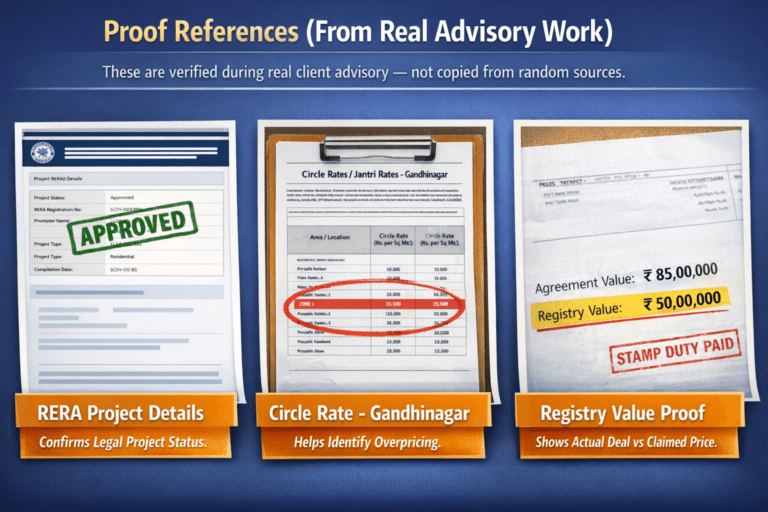
In many cases, the actual selling price of properties is significantly higher than the government-defined registry (jantri) rates. Builders often quote market prices based on demand, location, and project positioning, while registry values remain outdated or conservative. This gap can directly impact your stamp duty, loan approval, and overall cost calculation, especially when evaluating options like ready-to-move flats in Vavol Gandhinagar, where actual deal values may differ from official rates. Buyers should always compare both figures to understand the true transaction value and avoid overpaying. A clear awareness of this difference helps in better negotiation and smarter decision-making.
Real Demand vs Builder Hype
In many projects, the demand shown by builders is often amplified through marketing tactics, bulk bookings, or investor-driven activity. What looks like strong sales may not always reflect genuine end-user demand. In reality, many units remain unsold or get resold multiple times before actual possession. Buyers should verify on-ground activity, occupancy levels, and real transactions rather than relying only on sales claims. Understanding this difference helps avoid getting influenced by artificial scarcity and hype.
Rental Yield & End-User Demand Analysis
Rental yield in many residential projects remains relatively low, especially when compared to the high property prices quoted by builders. In most cases, the actual return ranges between 2–3%, which may not justify the investment purely from a rental income perspective. End-user demand depends heavily on location, connectivity, and nearby infrastructure rather than just project branding. Many areas with new supply still struggle with consistent tenant demand. Buyers should evaluate real rental trends and occupancy before assuming steady income.
Inventory Levels & Unsold Units Situation
In many micro-markets, a significant number of units remain unsold, especially in newly launched or investor-driven projects. This high inventory level indicates that supply often exceeds real end-user demand. Builders may still market projects as “fast selling,” but actual absorption can be slow on the ground. Unsold stock can lead to price stagnation or heavy discounts in later stages. Buyers should assess inventory levels carefully, as it directly impacts future price growth and resale potential.

WHO THIS GUIDE IS NOT FOR
This is NOT for:
- Short-term investors
- People expecting quick appreciation
- Buyers blindly trusting brokers
You Should WAIT if:
- You’re unsure about job location
- You want rental income immediately
- You’re stretching budget
Renting in Gandhinagar may be smarter right now.
Proof References
CONCLUSION
Vavol is:
Decent for end-users
Weak for investors
Risky if you choose the wrong project
The biggest mistake buyers make:
Choosing project before checking livability reality
Ready To Move Property In Vavol Gandhinagar : FAQ
Is Vavol better than Kudasan?
Is this the right time to buy?
Are ready-to-move flats overpriced?
What is real rental demand?
Which builders should I avoid?
References
About the Author