
Property Price Trends In Randesan: A few months ago, I met a mid-level IT professional from Ahmedabad who was planning to buy a 2 BHK in Randesan. He had already visited three projects in a single week. Every builder and broker told him the same story:
“Prices are going up fast… if you don’t book now, you will miss the appreciation.”
He was confused, slightly pressured, and emotionally stuck between fear and urgency.
In my experience advising buyers in this market, this is not an isolated case — this is the standard buying pattern in Randesan.
Most buyers are not actually studying property price trends, valuation patterns, or market cycles. They are reacting to:
- Fear of missing out
- Artificial urgency
- Half-verified pricing information
- Emotional pressure from marketing narratives
The problem is not Randesan itself — the problem is how decisions are being made without understanding appreciation, demand-supply behavior, infrastructure impact, and affordability limits.
This guide is written to fix that.
Not to sell you a property. Not to push investment. But to help you understand whether buying now is even a rational decision based on real valuation, growth, stability, and market cycle behavior.
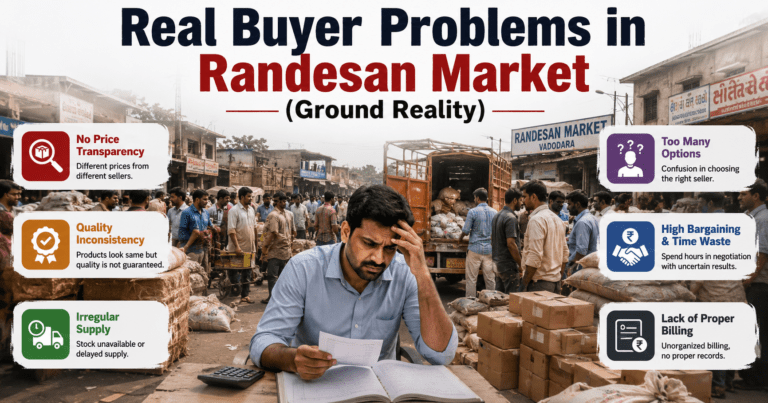
Real Buyer Problems in Randesan Market (Ground Reality)
Let’s break down what buyers actually face on the ground — not what brochures show.
1. Price Confusion Driven by Marketing
Most buyers compare only base price per sq.ft. But actual pricing includes:
- GST
- Parking charges
- PLC (Preferential Location Charges)
- Maintenance deposits
- Floor rise charges
This creates a false sense of affordability and distorts real valuation.
2. Artificial Demand & Urgency Pressure
Many buyers face pressure tactics like “only a few units left” or “prices will rise tomorrow” while exploring property options. Instead of making rushed decisions, smart buyers should properly compare projects, verify market rates, and carefully evaluate before they decide to buy 2 BHK flats in Randesan.
A common tactic in this market is “limited inventory left” messaging.
But actual demand and supply dynamics do not always match urgency claims. Many projects maintain artificial scarcity to influence momentum-based buying decisions.
3. Builder Risk & Delivery Uncertainty
Not all projects move at the same pace. Delays impact:
- Capital blocking
- Expected appreciation
- Emotional stress for end-users
A delayed possession can completely change your return calculation.
4. End-Use vs Investment Confusion
Many buyers expect investment-level yield and return, but purchase as end-users.
These two goals require completely different decision frameworks:
- End-user = stability, livability, connectivity
- Investor = cycle timing, exit strategy, rental demand
Mixing both leads to poor decisions.
5. Market Cycle Misjudgment
Real estate moves in cycles:
- Expansion (fast appreciation)
- Momentum (peak pricing pressure)
- Stability (slow movement)
- Correction (price stagnation or adjustment)
Most buyers enter during momentum — not realizing that fluctuation and slowdown often follow.
Step-by-Step Buyer Action Plan (Practical Decision Framework)
Step 1: Location Selection (Most Important Factor)
Do not choose based on price alone.
Focus on:
- Connectivity to Gandhinagar/Ahmedabad
- Infrastructure development pipeline
- Social ecosystem (schools, hospitals, retail)
Why it matters:
Location directly drives long-term appreciation and capital growth.
Mistake to avoid:
Choosing only based on “lowest entry price”.
Step 2: Budget & Price Validation (Avoid Overvaluation Trap)
Compare:
- Nearby projects
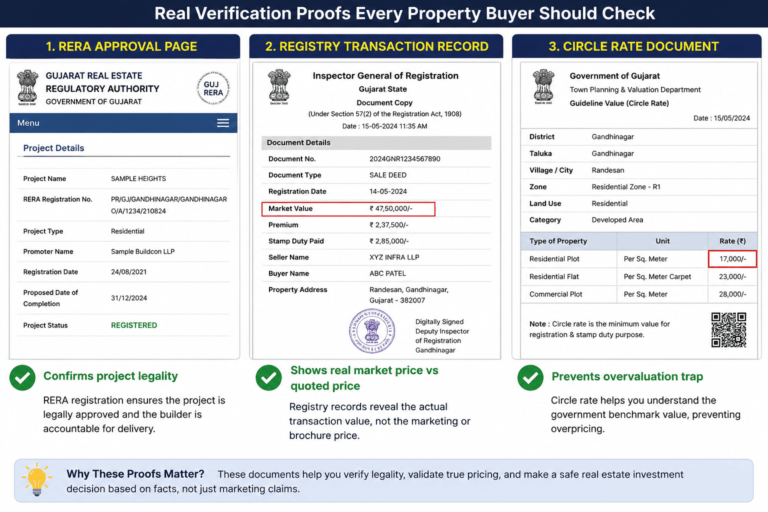
- Circle rate data
- Past registry transactions
Why it matters:
Prevents overpaying during high market sentiment phases.
Mistake:
Assuming every new project justifies premium pricing.
Step 3: Builder & RERA Verification
Always check:
- RERA registration
- Past delivery history
- Litigation or delay records
Why it matters:
Protects your investment from delivery risk.
Pro tip:
A completed project history is more important than ongoing marketing claims.
Step 4: Site Visit (Reality Check Step)
Visit at multiple times:
- Morning
- Evening
- Weekend
Check:
- Actual construction pace
- Surrounding infrastructure
- Accessibility and road quality
Why it matters:
Prevents illusion-based buying.
Step 5: Legal & Registry Validation
Always verify:
- Title clearance
- Registry value vs quoted price
- Encumbrance status
Step 6: Negotiation Strategy (Most Ignored Step)
Never accept first price.
Real estate pricing includes negotiation room influenced by:
- Demand pressure
- Builder inventory levels
- Market sentiment
Why it matters:
Can reduce cost by 5–12% depending on timing.
Mistake:
Believing quoted price is final.
Real Case Studies
Case 1: End-User Family Purchase
- Budget: ₹48 Lakhs
- Location: Randesan peripheral zone
- Purchase Price: ₹45 Lakhs
- Current Market Value: ₹45–47 Lakhs (stable phase)
- Holding Period: 2.5 years
Outcome:
No major appreciation, but strong livability and connectivity satisfaction.
Lesson:
They bought during a stability phase, not growth phase. Good for living, not for fast capital gain.
Case 2: Investor Buyer Strategy
- Entry Price: ₹40 Lakhs
- Rental Yield: ~2.5–3%
- Current Value: ₹43–44 Lakhs
- Exit Strategy: Holding for infrastructure maturity
Outcome:
Moderate growth and yield, but no sharp appreciation spike.
Lesson:
Returns came from long-term holding, not timing the market.
Social Proof
Rakesh Software Engineer (Ahmedabad):
“I realized most price hikes are announcement-driven, not demand-driven.”
David NRI Buyer (USA):
“Local advisory helped me avoid overpaying during peak builder marketing phase.”
Vikram Government Employee:
“I waited six months and bought at a better valuation instead of rushing.”
Market Context
Current Randesan market behavior shows:
- Moderate stability phase with selective demand pockets
- Infrastructure development ongoing but not fully matured
- Price movement influenced more by launches than organic demand
- Interest rate cycles impacting loan affordability and buying momentum
Trusted sources:
- Gujarat RERA database
- Sub-registrar office records
- Circle rate government portal
- Local planning authority data
Proof & Transparency Checks
Who This Guide Is NOT For
This guide is NOT useful for:
- Short-term flipping investors
- Speculative buyers expecting quick returns
- Buyers depending only on broker recommendations
- People chasing “guaranteed appreciation” narratives
You should delay buying if:
- Your EMI burden is already high
- You expect rapid capital appreciation within 1–2 years
- You have not verified builder credibility
If I Were Buying Today
If I were buying in Randesan today:
- I would NOT chase hype-based appreciation claims
- I would focus only on infrastructure-backed locations
- I would negotiate aggressively (minimum 8–10%)
- I would prioritize builder credibility over marketing
- I would avoid projects dependent on “future development promises”
One red flag I would not ignore:
Artificial urgency combined with unclear valuation justification.
Honestly, I would only buy if my holding period is 5–7 years.
Conclusion
Property price trends in Randesan are shaped by:
- Demand cycles
- Infrastructure development
- Buyer sentiment
- Affordability pressure
- Market momentum shifts
There is no guaranteed upward curve.
If you understand this, you make better decisions.
If you ignore this, you risk overpaying during peak sentiment phases.
The goal is not to buy fast — the goal is to buy correctly.