
A few months ago, I spoke with an NRI living in Toronto who wanted to purchase a property in Gandhinagar for his parents while also keeping it as a long-term investment.
He had already paid a booking amount after watching a polished online presentation. The builder promised that prices would increase by 30% within two years and insisted that “only two units were left.”
When I reviewed the documents, several concerns became obvious.
The project had approvals in place, but the promised infrastructure around it was years away. Comparable properties nearby were selling for less. The expected rental demand was much lower than what the sales team projected.
He cancelled the booking before paying the remaining amount.
That single decision saved him several lakhs.
I have seen similar situations repeatedly while advising buyers, especially NRIs who cannot visit every project personally. Distance creates information gaps, and unfortunately, not everyone in the market works in the buyer’s best interest.
Most blogs simply say things like:
- Gandhinagar is a Smart City.
- Property prices are rising.
- It is a good investment.
- Buy now before prices increase.
That advice doesn’t help someone spending ₹80 lakh or ₹1.5 crore.
Real buyers need answers to different questions.
- Is this location likely to appreciate?
- Can the builder actually deliver?
- Is the price justified?
- Will the property generate steady yield?
- What legal checks should an NRI complete before transferring money?
This guide is written to answer those questions honestly.
If I believe waiting is the better decision in certain situations, I’ll say so.
If a project looks overpriced, I’ll explain why.
The goal isn’t to convince you to buy.
The goal is to help you avoid an expensive mistake.

Why NRIs Are Increasingly Looking at Gandhinagar
Over the last several years, Gandhinagar has changed from being viewed mainly as Gujarat’s administrative capital into a city attracting professionals, families, entrepreneurs, and long-term investors.
Several factors have contributed to this shift.
Better Infrastructure Is Changing Buyer Confidence
Road expansion, improved connectivity, metro developments, and the Ahmedabad-Gandhinagar growth corridor have made commuting significantly easier than it was a decade ago.
For NRIs planning to return to India after retirement or after completing overseas assignments, this matters.
Living in Gandhinagar no longer means sacrificing accessibility.
Instead, many buyers now see it as offering a better balance between planned development and everyday convenience.
Good infrastructure often influences long-term growth more than temporary market hype.
Employment Is Supporting Genuine Housing Demand
Unlike markets that depend mainly on speculation, Gandhinagar benefits from multiple employment drivers.
These include:
- Government offices
- Educational institutions
- IT companies
- Financial services
- Research organizations
- GIFT City
- Corporate offices expanding from Ahmedabad
Employment creates genuine housing demand.
And genuine demand usually supports healthier property valuation over time than markets driven only by investors.
Planned Urban Development
One reason many overseas buyers prefer Gandhinagar is its organized layout.
Compared to many rapidly expanding cities, Gandhinagar offers:
- Better road planning
- Wider streets
- Lower congestion
- Green spaces
- Modern township developments
- Better public amenities
For families planning eventual relocation, overall lifestyle often becomes just as important as future returns.
Increasing Interest from NRIs
NRIs generally buy property for one of four reasons.
1. Future Relocation
Many families intend to return within five to ten years.
Buying today allows them to secure ownership before prices potentially increase.
2. Parents' Residence
Parents may require a modern apartment, flat, or independent villa with better security and healthcare access.
3. Portfolio Diversification
Some investors already own international assets.
Adding Indian real estate helps with portfolio diversification, especially when they expect long-term economic expansion.
However, diversification alone is never a reason to buy the wrong project.
Location and builder quality still matter more.
4. Rental Income
This strategy works—but only if the location attracts working professionals or families. If you’re planning to buy property in Gandhinagar for NRIs, focus on established residential areas with strong rental demand rather than relying on projected returns.
Buying purely because a salesperson promises high rent usually ends badly.
The Biggest Mistake NRIs Make
The biggest mistake isn’t choosing the wrong builder.
It isn’t paying a higher price.
It isn’t even selecting the wrong configuration.
The biggest mistake is assuming every new project will automatically appreciate.
Real estate doesn’t work that way.
Even within the same city:
- One project may double in value over ten years.
- Another may barely keep pace with inflation.
The difference usually comes down to:
- Location
- Builder credibility
- Future demand
- Supply levels
- Quality of surrounding development
Buying the right city is only the beginning.
Buying the right project is what determines your long-term return.
Real Buyer Problems NRIs Actually Face
Many articles talk about “investment opportunities.”
Very few discuss the practical challenges overseas buyers encounter.
Let’s look at the problems I see most often.
Problem 1: Depending Entirely on Builder Presentations
Beautiful brochures are designed to sell.
They highlight future possibilities.
They rarely discuss current realities.
I’ve seen brochures showing:
- Proposed commercial hubs
- Planned metro stations
- Future highways
- Upcoming schools
Some eventually happen.
Some are delayed by years.
Others change completely.
Never make an investment decision based solely on future promises.
Always verify what exists today.
Problem 2: Confusing Launch Price with Market Value
Builders often advertise:
“Pre-launch price.”
“Limited-period offer.”
“Investor discount.”
These offers create urgency.
But urgency is not evidence of value.
A fair price should be compared against:
- Nearby resale transactions
- Similar completed projects
- Current inventory
- Actual buyer demand
Not against marketing claims.
Problem 3: Choosing the Wrong Location
Many NRIs focus on attractive amenities.
Swimming pools.
Clubhouses.
Sky lounges.
These features matter.
But they cannot compensate for a poor location.
A modest project in a strong location usually performs better than a luxury project in a weak location.
Always ask:
Who will actually want to live here five years from now?
Problem 4: Ignoring Future Supply
One of the biggest risks in property investment is excessive future supply.
Suppose ten similar residential projects are scheduled nearby.
Your resale competition increases.
Rental competition increases.
Price appreciation may slow significantly.
Understanding future supply is just as important as evaluating current demand.
Problem 5: Assuming Every Builder Is Equally Reliable
Not every builder delivers on schedule.
Not every developer maintains construction quality.
Delayed possession creates problems:
- Higher financing costs
- Delayed rental income
- Lost appreciation opportunities
- Additional uncertainty
Builder reputation should never be judged only by advertisements.
Study completed projects.
Talk to existing residents.
Check delivery history.
Problem 6: Skipping Legal Verification
Many overseas buyers trust relatives or brokers to verify documents.
That is risky.
Essential checks include:
- Land ownership
- Project approval
- RERA registration
- Legal documentation
- Title verification
- Encumbrance status
- Municipal permissions
Professional due diligence often costs very little compared to the financial risk of buying the wrong property.
Understanding Today's Gandhinagar Market
The Gandhinagar residential market is healthier today than it was several years ago.
However, being healthy doesn’t mean every project represents good value.
Certain micro-markets continue attracting stronger buyer interest because of:
- Employment growth
- Better road access
- Educational institutions
- Commercial expansion
- Planned infrastructure improvements
Other locations remain slower despite aggressive marketing.
That is why city-level averages can be misleading.
Good investment decisions happen at the micro-market level—not the city level.
Step 1: Choosing the Right Location (Before Looking at Any Project)
Most buyers start by choosing a project.
I recommend the opposite.
Choose the location first.
Then shortlist projects.
This simple change prevents many expensive mistakes.
What to Evaluate
Instead of asking:
“Which project is best?”
Ask:
- Why do people want to live here?
- Is employment nearby?
- Is future infrastructure already funded?
- How much vacant land remains?
- Is residential demand genuine?
Good Signs
- Strong road connectivity
- Established residential community
- Schools and hospitals nearby
Commercial activity
Reliable public services
Balanced demand and supply
Warning Signs
- Too many empty towers
- Extremely aggressive discounts
- Very little completed development
- Heavy dependence on future announcements
- Weak rental demand
Practical Tip
If you cannot visit personally, ask someone you trust to spend one hour in the locality during weekday evenings.
That tells you far more than any brochure.
Step 2: Define Your Budget Before Contacting Builders
Many buyers accidentally increase their budget after visiting luxury sample flats.
This is exactly what sales teams hope will happen.
Instead, decide your budget first.
Then refuse to cross it unless there is a compelling reason.
Include Every Cost
Your total purchase cost includes much more than the base property price.
Consider:
- Registration
- Stamp Duty
- Parking
- Maintenance deposits
- Clubhouse charges
- Interior work
- Utility connections
- Professional legal review
- Currency conversion costs
- International money transfer expenses
Many NRIs underestimate these additional costs.
That can disrupt financial planning.
Focus on Value, Not Discounts
A ₹10 lakh discount on an overpriced project is not a bargain.
A fairly priced property with steady appreciation potential is usually the smarter investment.
Ask yourself:
“If this discount disappeared tomorrow, would I still buy this property?”
If the answer is no, the discount—not the property—is driving your decision.
Step 3: Builder & RERA Verification (The Step Most NRIs Rush Through)
If I had to choose one step that prevents the biggest financial mistakes, it would be this one.
Many NRIs assume that if a project has an attractive website, a luxury sample flat, and a well-known sales team, it must be trustworthy.
That assumption has cost buyers lakhs.
A polished marketing campaign does not guarantee construction quality, timely possession, or transparent business practices.
Your goal is not to buy from the most famous developer.
Your goal is to buy from the right developer.
Start With RERA, Not the Sales Office
Every eligible residential project should be registered under RERA.
Before discussing prices or offers, verify:
- RERA registration number
- Approved layout plans
- Project completion timeline
- Construction progress
- Number of phases
- Developer details
- Complaint history (if available)
Why this matters
Sometimes, buyers book Phase 2 or Phase 3 assuming the entire township will be completed together. In reality, only the first phase may be progressing while later phases face delays.
That affects your future property valuation, quality of life, and resale prospects.
Research the Builder's Track Record
Never judge a builder by one ongoing project.
Instead, ask:
- How many completed projects do they have?
- Were they delivered on time?
- How is the construction quality after five years?
- Do residents complain about maintenance?
- Were promised amenities actually delivered?
- Has the builder handled customer complaints professionally?
Past performance doesn’t guarantee future results—but it tells you much more than a glossy brochure.
Visit Older Projects
This is one of the best due diligence techniques.
Instead of spending two hours at the new sample flat, spend one hour at a project the builder completed five to ten years ago.
Look for:
- Water seepage
- Cracks
- Lift condition
- Parking management
- Security arrangements
- Landscaping maintenance
- Resident satisfaction
A builder’s completed work speaks louder than their advertisements.
Don’t Assume Bigger Means Better
Large developers can deliver excellent projects.
They can also launch too many projects simultaneously.
Smaller developers sometimes deliver exceptional quality because they focus on fewer developments.
Evaluate the project—not just the company name.
Builder Red Flags You Should Never Ignore
Walk away if you notice several of these warning signs.
Red Flag 1: Constant Pressure to Book Immediately
If every conversation ends with:
“Today’s the last day.”
“Prices increase tomorrow.”
“Only one flat remains.”
Be cautious.
Good investments remain good even after careful consideration.
Artificial urgency often benefits the seller—not the buyer.
Red Flag 2: Verbal Promises Without Written Confirmation
Sales executives sometimes promise:
- Free parking
- Waived maintenance
- Guaranteed rental
- Future commercial development
- Additional amenities
If it’s not written into the agreement, treat it as a marketing statement.
Red Flag 3: Unclear Cost Structure
Always request a complete cost sheet.
It should clearly separate:
- Base property price
- GST (if applicable)
- Stamp Duty
- Registration
- Floor-rise charges
- Parking
- Clubhouse fees
- Maintenance deposits
- Utility charges
Unexpected additions can significantly affect your total investment.
Red Flag 4: Delayed Responses
Notice how the sales team communicates before booking.
If they avoid questions now, don’t expect faster responses after payment.
Transparency during the sales process usually reflects how issues will be handled later.
Step 4: Site Visit Checklist
Many NRIs rely on relatives or video calls.
While understandable, nothing replaces a proper site inspection.
If you cannot visit personally, hire an independent property consultant—not someone recommended by the builder.
What Should Be Verified?
Access Roads
Drive to the project from different directions.
Ask yourself:
- Is traffic manageable?
- Are roads already completed?
- Does the route flood during monsoon?
Future connectivity announcements are useful.
Existing connectivity is more valuable.
Surrounding Development
Don’t focus only on the entrance gate.
Walk around the surrounding neighborhood.
Observe:
- Occupied residential buildings
- Shops
- Schools
- Hospitals
- Public transport
- Street lighting
- Commercial activity
A project surrounded by vacant land may take years to develop.
Construction Progress
If purchasing an under-construction project:
Compare actual progress with the official construction schedule.
Ask:
- Are workers actively present?
- Are multiple towers progressing?
- Is material available?
- Does the pace appear realistic?
Amenities
Never evaluate amenities from digital renderings.
Inspect completed facilities whenever possible.
Ask whether:
- Clubhouse size matches the brochure
- Parking allocation is practical
- Security systems are operational
- Power backup covers all common areas
Future Supply
This is one area many investors overlook.
Look around.
How many new projects are under construction?
Large future inventory may affect:
- Rental demand
- Future appreciation
- Resale competition
A location with balanced demand and controlled supply often performs better over the long term.
Step 5: Legal Checks Every NRI Must Complete
Legal verification is where many overseas buyers become overly dependent on brokers or relatives.
That creates unnecessary risk.
Even if someone you trust is helping, insist on independent legal verification.
Verify Ownership
Confirm:
- Clear land title
- Ownership history
- Existing loans
- Encumbrances
- Court disputes
Ownership issues are difficult and expensive to resolve after purchase.
Review Documentation Carefully
Important documentation includes:
- Sale agreement
- Approved building plans
- Occupancy certificates (if completed)
- Land records
- Tax receipts
- Possession timelines
Never sign documents without reading every clause.
Understand FEMA Regulations
For NRIs, FEMA (Foreign Exchange Management Act) governs property purchases in India.
Generally:
- NRIs can purchase residential and commercial property.
- Agricultural land, plantation property, and farmhouses have different restrictions.
Understanding FEMA before purchasing avoids future compliance issues.
Follow RBI Guidelines
The RBI regulates how funds are transferred for property purchases.
Common payment channels include:
- NRE Account
- NRO Account
- Banking channels permitted under RBI regulations
Avoid informal payment arrangements.
Always maintain a proper transaction trail.
NRE vs NRO Accounts
Many first-time buyers ask whether they should use an NRE or NRO account.
The answer depends on:
- Source of funds
- Tax planning
- Future repatriation requirements
- Rental income management
Discuss this with your Chartered Accountant before making payment.
Good financial planning often prevents unnecessary taxation later.
Remittance Records
Maintain complete remittance records for every payment.
Store:
- Bank transfer receipts
- Foreign exchange conversion details
- Payment acknowledgements
- Builder receipts
These records become important if you later sell the property or transfer funds overseas.
Taxation & Capital Gains
Every NRI should understand:
- Applicable taxation
- TDS provisions
- Future capital gains
- Holding period implications
Many investors focus only on buying.
Exit planning should begin before purchase.
Due Diligence Isn’t Optional
Professional due diligence may cost a small fraction of your total investment.
Yet it can identify:
- Legal disputes
- Ownership issues
- Regulatory concerns
- Missing approvals
- Hidden liabilities
In my experience, this is one expense that almost always pays for itself.
Step 6: Negotiation Strategy Most Buyers Never Use
Many buyers negotiate only the base price.
That’s only one part of the conversation.
Understand the Builder’s Motivation
Different builders prioritize different objectives.
Some want:
- Faster sales
- Better cash flow
- Inventory reduction
- Quarterly booking targets
Understanding their priorities improves negotiation outcomes.
Ask for Value Instead of Discounts
Sometimes builders won’t reduce the advertised price.
Instead, negotiate:
- Additional parking
- Club membership
- Maintenance waiver
- Better payment schedule
- Interior upgrades
These can provide greater value than a small discount.
Don’t Reveal Your Maximum Budget
One common mistake is saying:
“My budget is ₹1.2 crore.”
Instead, negotiate based on market evidence.
Let comparable sales support your offer.
Compare Multiple Projects
Never negotiate with only one builder.
Having genuine alternatives gives you stronger negotiating power.
Walk Away If Necessary
One of the strongest negotiation tools is the willingness to leave.
If pricing seems unreasonable…
If promises seem unrealistic…
If transparency is missing…
Walk away.
There will always be another opportunity.
There may not always be another chance to recover from a poor investment.
Common Mistakes NRIs Should Avoid
From my experience, these are the mistakes that repeatedly cost buyers money:
- Purchasing based only on emotional attachment.
- Ignoring independent legal verification.
- Believing projected appreciation without supporting data.
- Choosing the cheapest project instead of the best value.
- Underestimating maintenance expenses.
- Ignoring future supply in the area.
- Assuming every builder delivers on time.
- Buying without understanding taxation implications.
- Forgetting exit planning.
- Relying entirely on relatives instead of conducting personal research.
None of these mistakes are unusual.
But all of them are avoidable.
Real Case Study 1: An NRI Family Buying a Home for Their Parents
Buyer Profile: Married couple living in Melbourne, Australia
Purpose: Permanent residence for parents and long-term family asset
Budget: ₹1.05 Crore
Property Type: 3 BHK Apartment
Location: Kudasan, Gandhinagar
When the family first contacted me, they had already shortlisted three residential projects based on YouTube videos and social media advertisements.
All three looked impressive online.
However, after comparing them, one concern became obvious.
The cheapest project was located in an area where surrounding infrastructure was still developing. The builder was offering attractive launch discounts, but occupancy nearby was low.
Instead of focusing on the lowest price, we evaluated:
- Builder delivery history
- Construction quality
- Existing community
- Road connectivity
- Future resale demand
- Security
- Maintenance quality
The family eventually chose a slightly more expensive apartment from a builder with a stronger delivery record.
Purchase Summary
Details | Value |
Purchase Year | 2023 |
Purchase Price | ₹1.02 Crore |
Registration & Other Costs | ₹7.8 Lakhs |
Total Investment | ₹1.10 Crore |
Current Situation (Illustrative Example)
Estimated Market Value: ₹1.18–₹1.22 Crore
Parents moved into the apartment within a year.
The family was more satisfied with:
- Peaceful community
- Reliable maintenance
- Better amenities
- Good connectivity to Ahmedabad
- Healthcare access
Biggest Lesson
The cheapest project wasn’t the best investment.
Buying in a stronger location with an established builder reduced long-term risk.
Real Case Study 2: NRI Investor Seeking Rental Income
Buyer Profile: Software Engineer in Dubai
Investment Objective: Rental income with long-term appreciation
Initially, the buyer wanted to purchase a luxury property because advertisements promised premium returns.
After analysing the market, we noticed something important.
Luxury demand was growing, but mid-premium residential apartments had significantly larger tenant demand.
Instead of purchasing a luxury unit, the investor selected a professionally managed residential project closer to employment hubs.
Investment Snapshot
Details | Value |
Purchase Price | ₹78 Lakhs |
Registration & Other Expenses | ₹5 Lakhs |
Total Investment | ₹83 Lakhs |
Current Performance (Illustrative Example)
Monthly Rental Income: ₹24,000–₹27,000
Estimated Rental Yield: Approximately 3.5–4% annually
Estimated Appreciation Since Purchase: 12–16%
Why This Worked
The property wasn’t the most luxurious.
It was simply located where people genuinely wanted to live.
Rental demand remained consistent because of:
- Employment growth
- Educational institutions
- Good road network
- Daily convenience
Investment decisions should always begin with demand—not advertisements.
What These Two Buyers Did Differently
Although their objectives were different, both buyers followed similar principles.
They:
- Verified documents before paying.
- Compared multiple projects.
- Ignored artificial urgency.
- Focused on long-term growth.
- Chose location over marketing.
- Evaluated builder credibility.
- Planned beyond possession.
That’s why both purchases continue to perform reasonably well.
Realistic Buyer Testimonials
Testimonial 1 Rahul Mehta – IT Professional (Canada)
“Initially, I shortlisted projects based only on YouTube reviews. After comparing builder history and actual construction quality, I changed my decision. Spending a little more gave my family much greater confidence.”
Testimonial 2 Amit Patel – PSU Employee (Abu Dhabi)
“The legal verification process felt unnecessary at first. Looking back, it was probably the smartest part of the purchase. It answered questions I didn’t even know to ask.”
Testimonial 3 Nirav Shah – Business Owner (United Kingdom)
“I almost booked because the builder claimed prices would rise within two weeks. Taking extra time helped me negotiate better terms and choose a location with stronger rental demand.”
Current Gandhinagar Market Context
One mistake many buyers make is assuming that the entire city behaves as one market.
It doesn’t.
Real estate performance depends heavily on individual micro-markets.
Some locations experience stronger demand because of employment, infrastructure, and connectivity.
Others remain dependent on future development announcements.
This distinction matters because property appreciation is driven by real demand—not marketing campaigns.
Factors Supporting Long-Term Demand
Several developments continue to influence residential demand in Gandhinagar.
These include:
- Expansion of GIFT City
- Growth of educational institutions
- Government offices
- IT employment
- Improved road infrastructure
- Better public transportation
- Planned commercial development
However, demand varies considerably across different neighborhoods.
Buyers should always evaluate the immediate locality rather than relying on city-wide averages.
Price Growth Should Never Be Assumed
Many advertisements suggest that prices only move upward.
Reality is different.
Property markets move through cycles.
Sometimes prices grow quickly.
Sometimes they remain stable.
Sometimes negotiation opportunities improve because supply exceeds demand.
Understanding market timing helps buyers avoid overpaying.
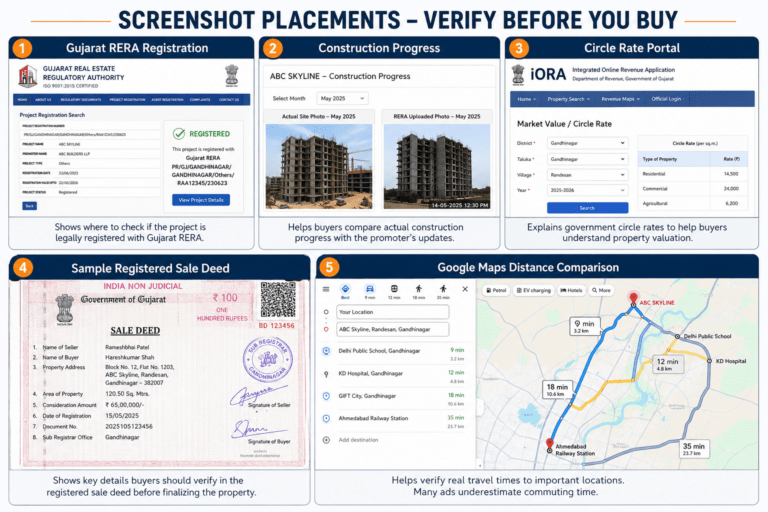
Where Buyers Should Add Independent Verification
Whenever I advise buyers, I encourage them to verify information independently.
These sources provide far more reliable information than advertisements.
Gujarat RERA
Use it to verify:
- Project registration
- Construction timeline
- Developer information
- Approved plans
Circle Rate Portal
Useful for understanding:
- Government valuation
- Registration benchmarks
- Price comparison
Remember:
Circle rates should not be treated as actual market prices.
They are only one reference point.
Sub-Registrar Records
Transaction records often provide valuable insight into:
- Recent sale activity
- Registration trends
- Market behaviour
Local Authority Planning Information
Whenever infrastructure is advertised, verify whether:
- Funding exists.
- Construction has started.
- Completion timelines are realistic.
Announcements and completed infrastructure are two very different things.
Screenshot
Who This Guide Is NOT For
Not every buyer should purchase property today.
In fact, waiting is sometimes the smarter financial decision.
This guide is not intended for:
People Expecting Quick Profits
If your goal is buying today and selling within a few months for a large profit, this guide won’t help.
Residential property is generally a medium- to long-term investment.
Buyers Depending Entirely on Future Announcements
If your investment thesis depends only on:
- Future metro stations
- Proposed highways
- Rumoured commercial projects
You should reconsider.
Buy based on today’s fundamentals—not tomorrow’s rumours.
Buyers Without Emergency Savings
Property ownership brings ongoing responsibilities.
Maintenance.
Repairs.
Registration costs.
Unexpected expenses.
Buying without adequate financial reserves creates unnecessary pressure.
Buyers Who Haven’t Defined Their Objective
Ask yourself first:
Am I buying for:
- Parents?
- Rental income?
- Retirement?
- Appreciation?
- Future relocation?
Without a clear objective, comparing projects becomes difficult.
Buyers Who Cannot Verify Documents
Never purchase solely because:
- A friend recommended it.
- A broker said it’s safe.
- The builder seems trustworthy.
Independent verification remains essential.
If I Were Buying Property in Gandhinagar Today
This is the question I ask myself whenever evaluating a project.
If I were investing my own money today, what would I do?
Would I Buy?
Yes—but only after careful verification.
I wouldn’t purchase simply because prices might increase.
I would buy only if the property met my long-term objectives.
Which Type of Property Would I Prefer?
Personally, I would choose a well-located residential apartment in an established neighborhood rather than an oversized luxury property in an uncertain location.
Good locations generally remain desirable across different market cycles.
What Would I Negotiate Most Aggressively?
Instead of chasing the biggest discount, I would negotiate:
- Payment schedule
- Parking allocation
- Maintenance charges
- Additional inclusions
- Possession timeline
Those factors often create greater long-term value.
One Red Flag I Would Never Ignore
If a builder avoided answering straightforward questions regarding:
- Legal approvals
- Delivery history
- Construction progress
- Total purchase cost
I would walk away immediately.
Transparency builds trust.
Avoidance destroys it.
Conclusion
The goal isn’t finding the cheapest apartment.
The goal isn’t predicting the highest appreciation.
The goal is purchasing a property that still feels like a good decision ten years later.
That’s a far more reliable definition of successful investing.
NRI Property Investment in Gandhinagar :FAQs
1. Can NRIs buy property in Gandhinagar?
2. Is Gandhinagar a good place for NRI property investment?
3. Which areas in Gandhinagar are popular among NRI buyers?
4. What documents should an NRI verify before buying property?
5. Can NRIs earn rental income from property in Gandhinagar?
Reference:
About the Author

Mitesh Vyas
Hello My Name is Mitesh Vyas i am a Real Estate content writer and Property Market Enthusiast I shares practical insights on buying, selling, investing, and understanding real estate trends. With a strong focus on residential and commercial properties, My aims to help readers make informed property decisions through clear, research-based, and easy-to-understand content.