
If a broker tells you, “Buy now in Gandhinagar because prices will double,” I would not make a decision based on that sentence.
I would ask a different question:
What is actually creating housing demand in Gandhinagar, and is the property I am buying priced correctly for that demand?
That distinction matters in 2026.
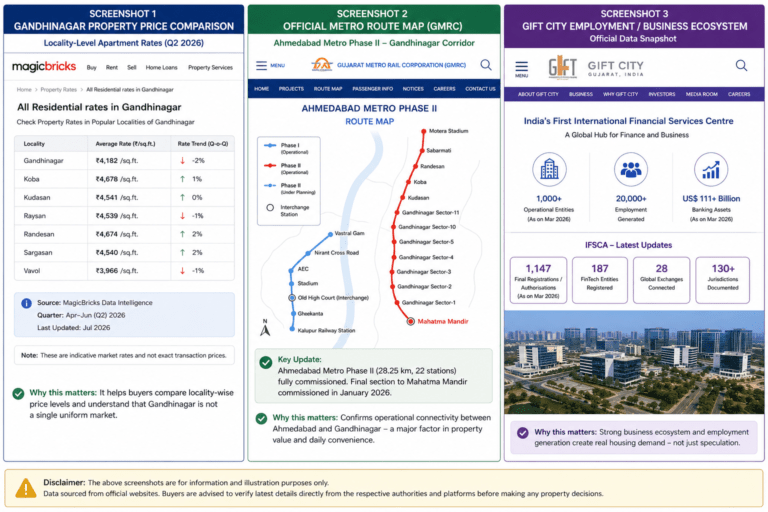
Gandhinagar has genuine reasons to attract more homebuyers: GIFT City is expanding as a financial and technology hub, Ahmedabad–Gandhinagar Metro Phase II is fully commissioned, and several residential micro-markets have developed around the GIFT City corridor. GMRC confirms that Phase II now covers 28.25 km and 22 stations, with the final section to Mahatma Mandir commissioned in January 2026.
But “growing city” does not automatically mean “every property is a good investment.” That is where buyers need to be careful.
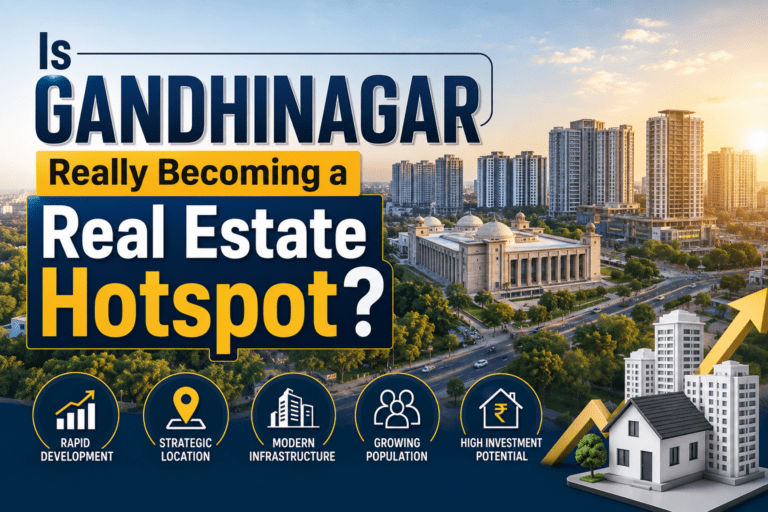
Is Gandhinagar Really Becoming a Real Estate Hotspot?
My answer: yes, but selectively.
I would not describe the entire Gandhinagar market as one uniform hotspot. The stronger story is concentrated around locations benefiting from employment, connectivity, established infrastructure and actual residential demand. The biggest structural driver is GIFT City.
Official GIFT City information reports more than 1,000 operational entities and 20,000+ employment generated, while IFSCA reported 1,147 final registrations/authorisations as of March 2026 and more than US$111 billion in banking assets.
That creates something real estate needs:
people who need to work, live and rent nearby. However, buyers should not make the mistake of assuming that every project within a broad “GIFT City vicinity” automatically deserves a premium.
Why Gandhinagar Is Attracting More Property Demand
GIFT City Is Creating Employment-Led Demand
This is probably the strongest long-term reason to watch Gandhinagar property market in 2026. GIFT City is not simply a residential development. It is a financial and technology ecosystem involving banking, capital markets, fund management, insurance, fintech, aircraft leasing, ship leasing and other activities. For residential real estate, this matters because employment creates end-user and rental demand.
A buyer looking at a property near GIFT City should therefore ask:
- How far is the actual workplace?
- What is the daily commute?
- Is public transport practical?
- What is the rental demand for this configuration?
- Who is likely to rent this property?
- How much competing supply exists?
These questions are much more useful than simply asking, “How much will this area appreciate?”
Metro Connectivity Has Changed the Equation
Gandhinagar’s connectivity story is no longer purely future infrastructure. GMRC states that Ahmedabad Metro Phase II connects Ahmedabad and Gandhinagar and that the final section to Mahatma Mandir was commissioned in January 2026. The project has 22 stations over approximately 28.25 km.
This is important because transport infrastructure can improve a property’s practical catchment area. But don’t confuse a metro station with guaranteed appreciation. A property 5–10 minutes from a useful station may benefit differently from a project that requires a long feeder trip through congested roads.
My rule:
Don’t pay a metro premium simply because a broker says “metro nearby.”
Actually measure the road journey from the property to the station during your normal commuting hours.
Gandhinagar Still Offers a Different Residential Proposition
For many families moving from Ahmedabad, Gandhinagar’s appeal isn’t only investment.
It can be about:
- Larger homes
- Planned neighbourhoods
- Wider roads
- Lower-density surroundings in some pockets
- Access to GIFT City
- Access to Ahmedabad
- Family-oriented residential communities
This is particularly relevant for buyers purchasing a home for themselves rather than purely for resale. If you plan to live there for 7–10 years, daily convenience should matter more than a speculative price forecast.
Property Prices Are Rising — But Not Everywhere Equally
Current MagicBricks data illustrates why buyers should compare micro-markets rather than treat Gandhinagar as one market. For Apr–Jun 2026, MagicBricks reports an average multistorey apartment rate of about ₹4,182/sq ft for Gandhinagar, compared with approximately ₹4,678 in Koba, ₹4,541 in Kudasan, ₹4,674 in Randesan, ₹4,539 in Raysan, ₹4,540 in Sargasan and ₹3,966 in Vavol. These are portal market indicators, not guaranteed transaction prices.
Locality | Approx. Avg. Apartment Rate |
Gandhinagar | ₹4,182/sq ft |
Koba | ₹4,678/sq ft |
Kudasan | ₹4,541/sq ft |
Randesan | ₹4,674/sq ft |
Raysan | ₹4,539/sq ft |
Sargasan | ₹4,540/sq ft |
Vavol | ₹3,966/sq ft |
The important lesson:
A locality average is only a starting point. A 3 BHK priced at ₹4,800/sq ft isn’t automatically expensive, and one priced at ₹4,000/sq ft isn’t automatically cheap.
You still need to examine:
- Carpet area
- Floor
- Age
- Construction quality
- Parking
- Amenities
- Maintenance
- Possession status
- Builder track record
- Exact location
- Comparable transactions
Read More:– Is Gandhinagar good for real estate investment?
The GIFT City Premium Needs Extra Caution
GIFT City itself is already considerably more expensive than many surrounding Gandhinagar residential markets. MagicBricks reported an average multistorey apartment rate of approximately ₹10,617/sq ft in Q2 2026, with a reported range of ₹8,130–₹13,103/sq ft. That difference is significant.
It means a buyer shouldn’t simply say:
“GIFT City is growing, so I should buy the most expensive property I can afford.”
Instead ask:
Am I paying for actual current utility, or am I paying too much for future expectations?
That is one of the biggest questions I would ask before buying in this corridor.
Which Gandhinagar Areas Deserve Attention?
There is no single “best locality.” Different buyers should consider different areas.
Koba
Koba can make sense for buyers who value connectivity toward Ahmedabad, GIFT City and established Gandhinagar areas. The current MagicBricks Q2 2026 apartment benchmark is around ₹4,678/sq ft.
I would focus on:
- Actual road connectivity
- Project quality
- Carpet efficiency
- Access to daily amenities
- Resale liquidity
Best suited for: buyers looking for a balance between connectivity and residential use.
Kudasan
Kudasan has developed into one of the more established residential markets around the GIFT City corridor. Its Q2 2026 MagicBricks average is around ₹4,541/sq ft. For an end-user, I would give more importance to the surrounding ecosystem than a small difference in quoted per-square-foot rate.
Raysan
Raysan is worth considering particularly for buyers wanting proximity to the GIFT City/PDEU side of the market. MagicBricks reports an average of approximately ₹4,539/sq ft for Q2 2026. But compare individual projects carefully because two properties in the same locality can have very different resale prospects.
Randesan
Randesan has benefited from the broader GIFT City and institutional-development story. Its reported Q2 2026 average is approximately ₹4,674/sq ft. I would particularly examine whether the property’s price premium is justified by its actual location and specifications.
Sargasan
Sargasan remains relevant for buyers wanting access to both Gandhinagar and the broader Ahmedabad-Gandhinagar corridor. MagicBricks reports approximately ₹4,540/sq ft for Q2 2026, with a reported locality range of ₹3,744–₹5,336/sq ft. Don’t compare only the headline rate. Compare carpet-area value.
Vavol
Vavol can appeal to buyers looking for a relatively lower entry point.n MagicBricks reports an average of around ₹3,966/sq ft for Q2 2026. For budget-conscious end-users, that can be attractive, but lower entry price doesn’t automatically mean higher investment return.
The Biggest Mistakes I Would Avoid
Mistake 1: Buying Because “Gandhinagar Is the Next Ahmedabad”
This is an attractive marketing line. It is also too simplistic. Gandhinagar has its own demand drivers. You don’t need to believe it will “become another Ahmedabad” for property to perform well.
Buy based on:
employment + connectivity + liveability + price + supply + resale demand.
Mistake 2: Paying a Future-Infrastructure Premium
If the project only looks attractive because of a proposed future road, metro extension, commercial development or airport connection, be careful. I would value operational infrastructure more heavily than promised infrastructure. If the investment works only after three future projects are completed, you are taking substantially more risk.
Mistake 3: Comparing Only ₹/sq ft
Consider two flats:
Flat A: ₹4,500/sq ft
Flat B: ₹4,800/sq ft
Flat B isn’t necessarily more expensive in real terms. If Flat A has poor carpet efficiency and Flat B gives you significantly more usable space, the headline rate can be misleading.
Always compare:
Total price ÷ RERA carpet area.
Step-by-Step: How I Would Evaluate a Gandhinagar Property
Step 1: Start With Your Purpose
Before looking at projects, decide whether you are:
- Buying for self-use
- Buying for rental income
- Buying for long-term appreciation
- Buying for parents
- Buying for future relocation
An end-user and an investor should not necessarily buy the same property.
Step 2: Fix Your Real Budget
Don’t define your budget as:
“I can afford a ₹1 crore flat.”
Your actual budget should include:
- Down payment
- Loan processing costs
- Stamp duty
- Registration-related costs
- GST where applicable
- Brokerage, if any
- Interiors
- Parking or other project charges
- Maintenance deposits
- Moving expenses
A ₹1 crore property can therefore require substantially more cash than the headline purchase price suggests.
Step 3: Compare at Least Five Similar Properties
Create a simple comparison sheet.
Factor | Property A | Property B | Property C | Property D | Property E |
Total price | ₹92 lakh | ₹98 lakh | ₹1.05 crore | ₹89 lakh | ₹1.10 crore |
Carpet area | 1,420 sq ft | 1,480 sq ft | 1,550 sq ft | 1,350 sq ft | 1,600 sq ft |
₹/carpet sq ft | ₹6,479 | ₹6,622 | ₹6,774 | ₹6,593 | ₹6,875 |
Age | 2 years | Under construction | New | 5 years | New |
Possession | Ready | 2028 | Ready | Ready | 2029 |
This immediately reduces the influence of sales pressure.
Step 4: Verify RERA and Documents
For under-construction property, don’t rely solely on a brochure or WhatsApp message.
Check the official RERA record for:
- Registration number
- Promoter
- Project address
- Declared completion date
- Approved details
- Project status
A RERA registration is an important due-diligence checkpoint, but it doesn’t guarantee that a project is risk-free or that your investment will appreciate.
Step 5: Visit the Property at the Right Time
One daytime site visit is not enough.
If possible, visit:
- Morning
- Evening
- Weekend
Check:
- Traffic
- Noise
- Water pressure
- Parking
- Lift waiting time
- Mobile network
- Nearby construction
- Road access
- Drainage
- Surrounding development
A beautiful Sunday site visit can hide a very different weekday experience.
Step 6: Negotiate on Total Cost, Not Just Base Price
Suppose a salesperson offers:
“₹5 lakh discount.”
Don’t immediately celebrate. Ask for the complete cost sheet.
Compare:
Base price + floor-rise + parking + maintenance + amenities + taxes + registration-related expenses + other charges.
Sometimes the apparent discount is less valuable than negotiating several additional charges.
Two Realistic Buyer Scenarios
Case Study 1: End-User Family — Illustrative Example
A family has a budget of approximately ₹85 lakh and works between Ahmedabad and Gandhinagar. They initially considered a ₹90 lakh under-construction 3 BHK because the salesperson highlighted future appreciation. Instead, they compared it with a ready property priced around ₹84 lakh.
The ready property had:
- Smaller amenities
- Better established surroundings
- Immediate possession
- Slightly smaller carpet area
The family chose the ready property because their priority was living there, not maximising speculative appreciation.
Lesson
For an end-user, certainty can be worth paying for.
Case Study 2: Investor — Illustrative Example
An investor purchases a ₹70 lakh apartment primarily for rental income. Assume annual rent reaches ₹2.4 lakh.
Gross rental yield:
₹2.4 lakh ÷ ₹70 lakh = approximately 3.4%.
After maintenance, vacancy and other costs, the actual net yield would be lower. The investor therefore cannot justify the purchase purely through rent.
The investment needs a reasonable combination of:
rental income + potential appreciation + resale liquidity.
Lesson
Don’t call a property a “high-yield investment” simply because it has a tenant.
What Buyers Commonly Get Wrong About Appreciation
Real estate appreciation is not guaranteed.
A property can be located in a growing city and still underperform because:
- It was bought too expensively
- Too many similar units are available
- Rental demand is weak
- Builder reputation is poor
- Carpet efficiency is low
- Resale buyers prefer newer projects
- Infrastructure benefits were already priced in
This is why I prefer the phrase:
“good property in a growing market”
over:
“any property in a growing market.”
Is Gandhinagar a Good Investment in 2026?
For long-term investors: potentially yes.
But I would divide the market into three categories.
Stronger proposition
Properties with:
- Good current connectivity
- Employment nearby
- Established residential demand
- Reasonable entry price
- Good carpet efficiency
- Reputable builder
- Strong resale potential
Moderate proposition
Properties where:
- Location is good
- But supply is high
- Price is already aggressive
- Rental demand is uncertain
Higher-risk proposition
Properties where:
- The main attraction is future infrastructure
- Pricing is substantially above comparable properties
- Possession is uncertain
- Resale evidence is weak
- The project depends heavily on investor demand
Screenshot
Who Should NOT Buy in Gandhinagar Just Because It Is a “Hotspot”?
I would advise caution if:
- You need to sell within 1–2 years
- You are relying entirely on appreciation
- Your EMI would stretch your monthly cash flow
- You have no emergency fund
- You are buying solely because a broker says prices will double
- You haven’t compared competing properties
- You haven’t checked RERA/documentation
- You are uncomfortable with an under-construction timeline
If you fall into these categories, waiting can be a perfectly sensible decision. There is nothing wrong with missing a property opportunity. There is something wrong with buying a property you cannot comfortably afford.
If I Were Buying in Gandhinagar Today
If I were buying a property in Gandhinagar in 2026, I would buy — but only selectively. I would not chase the most aggressively marketed project.
My preference would be:
- Ready or near-completion property
if the price premium is reasonable. - Strong end-user locality
rather than a project dependent entirely on investors. - Good carpet efficiency
rather than a huge advertised super-built-up area. - Existing connectivity
rather than infrastructure that exists only in a presentation. - A price that survives conservative assumptions
even if appreciation is slower than expected.
What would I negotiate hardest?
The total acquisition cost.
Not just the advertised base price.
One red flag I would not ignore
A seller who avoids giving clear documentation or pressures me to pay a token amount before I have completed basic due diligence. I would walk away. There will always be another property.
Conclusion
Gandhinagar has a credible case to become one of Gujarat’s stronger residential real estate markets — but buyers should not confuse a strong city-level story with a guaranteed property-level return. The fundamentals are increasingly visible.
GIFT City has developed into a substantial financial and technology ecosystem, with official sources reporting more than 1,000 operational entities and significant employment.Metro Phase II is now fully commissioned, strengthening Ahmedabad-Gandhinagar connectivity.
And current property data shows meaningful differences between Gandhinagar’s individual micro-markets. But these facts do not mean you should buy any Gandhinagar property at any price.
The smarter approach is:
Choose the locality → verify the project → compare carpet area → validate the price → calculate the complete acquisition cost → inspect the property → negotiate → then decide.
If the numbers don’t work, don’t buy just because someone calls Gandhinagar the “next hotspot.” A good real estate purchase should still make sense even if the market grows more slowly than expected.
Is Gandhinagar the Next Real Estate Hotspot in Gujarat? - faqs
1. Is Gandhinagar a good place to buy property in 2026?
2.Which Gandhinagar locality is best?
3. Will GIFT City increase Gandhinagar property prices?
4. Is buying near the metro always better?
5. Should I buy under construction?
References
About the Author