

Is Gandhinagar The Next Real Estate Hotspot In Gujarat?: Last year, I sat across the table from a mid-level PSU officer posted in Ahmedabad. He had already “almost finalised” a 3 BHK in Gandhinagar.
The broker told him: “Sir, prices will jump 25% once GIFT City demand spills over. Two units have already been blocked today.”
The builder added pressure: “Last inventory. Next week, the rate will be revised.”
The buyer was confused, anxious, and scared of missing out. But when I asked a simple question — “Where will your kids go to school, and how long is your daily commute?” — he went silent.
That’s the problem with most blogs’ rankings today. They talk about potential, growth corridors, future demand — but ignore real buyer life decisions.
In my experience advising buyers in and around Gandhinagar, the real question is not whether Gandhinagar is a hotspot. It’s for whom, at what price, and at what risk.
This guide will give you clarity — even if the correct answer for you is “don’t buy here yet.”

REAL BUYER PROBLEMS – GROUND REALITY
1. Price Confusion & Hidden Cost Traps
Many buyers assume Gandhinagar is “cheaper than Ahmedabad.” That’s only half-true.
What I’ve personally seen:
- Base prices look attractive
- Final all-inclusive cost quietly matches or exceeds established Ahmedabad zones
- Parking, maintenance corpus, GST, and floor rise charges are underplayed
Mistake buyers make:
Comparing advertised prices instead of registered transaction values.
2. Fake Urgency & Misleading Offers
“Government city,” “GIFT spillover,” “capital appreciation guaranteed” — these phrases are overused. In this dynamic and fast-paced world, partnering with a professional digital marketing agency in Ahmedabad is essential. It is no longer necessary but is vital for sustained development.
Demand is end-user driven, not speculative
Most buyers in this market are purchasing homes to live in, not to flip for quick profits. Decisions are based on daily needs like location, connectivity, and livability rather than price appreciation promises. This keeps demand steady but realistic, without artificial price spikes.
Inventory absorption is slow in several pockets
In many areas, projects take longer to sell out because buyers are cautious and compare options carefully. Oversupply in certain pockets means homes don’t move fast unless pricing and quality truly justify it. For serious buyers, this creates room for negotiation and better choices.
Urgency is often manufactured, not market-driven
Sales pressure like “last few units” or “prices increasing soon” often comes from marketing tactics, not actual demand. On-ground data shows buyers usually have time to evaluate without rushing. Informed buyers benefit by verifying facts instead of reacting to emotional urgency.
3. Builder Trust & Delivery Risk
Gandhinagar has:
- Fewer large, battle-tested developers
- More mid-size players with limited delivery history
I’ve seen projects:
- Delayed 18–30 months
- Specifications downgraded post-booking
4. Wrong Location Selection
This is the biggest mistake. Buyers say “Gandhinagar” as if it’s one uniform market. It’s not. Some sectors are livable and mature. Others are isolated, under-serviced, and future-promise heavy.
5. End-Use vs Investment Confusion
Many buyers buy for “self-use now, investment later” — without clarity.
Result:
- Poor rental demand
- Low resale liquidity
- Long holding periods with mediocre returns
Read More: Future Development Plans In Gandhinagar

STEP-BY-STEP BUYER ACTION PLAN
Step 1: Location Selection
What to do:
Shortlist sectors with existing civic infrastructure, schools, hospitals, and public transport.
Why it matters:
Future infrastructure may take 5–10 years. Your life starts Day 1.
Mistakes to avoid:
Buying near “proposed” facilities only.
Pro tip:
If you can’t comfortably live there today without excuses don’t buy.
Step 2: Budget & Price Validation
What to do:
Cross-check circle rates and recent registry values.
Why it matters:
Prevents overpaying in low-liquidity markets.
Mistake:
Believing appreciation stories without data.
Step 3: Builder & RERA Verification
What to do:
Verify RERA registration, delivery history, and past litigation.
Why it matters:
Delayed possession kills both end-use and ROI.
Red flag:
Repeated extensions under RERA.
Step 4: Site Visit Checklist
What to check:
- Actual access roads
- Noise, isolation, water supply
- Neighboring land use
Pro tip:
Visit once on a weekday evening, once on Sunday morning.
Step 5: Legal & Registry Checks
What to do:
Confirm land title clarity, NA status, and agreement clauses.
Mistake:
Relying only on builder-provided documents.
Step 6: Negotiation Strategy
What works here:
Payment-linked discounts
Instead of paying the full amount upfront, you pay in stages tied to construction progress. This ensures you only pay for what is actually built, protecting you from delays or unfinished work while giving you room to negotiate better rates.
Payment-linked discounts
Builders often charge extra for higher floors or parking slots. Negotiating a waiver or inclusion of these costs prevents unexpected expenses, keeps your budget clear, and ensures you don’t overpay for things that don’t add real value to your daily life.
Possession-linked clauses
These clauses tie your payments or builder penalties to the actual handover date. They give you security, so if the project is delayed, you are compensated — a practical way to avoid financial loss and stress from postponed possession.
What doesn’t:
Asking for massive price cuts — this is not a distressed market.

REAL CASE STUDIES
Case 1: End-User Family
- Budget: ₹85 lakh
- Location: Sector near established schools
- Purchase Price (2021): ₹78 lakh all-inclusive
- Current Value (2025): ₹88–90 lakh
- Lesson: Stable appreciation, excellent livability — but not explosive growth.
Case 2: Investor
- Entry Price: ₹62 lakh
- Configuration: 2 BHK
- Rental Yield: ~2.5%
- Appreciation: ~4–5% CAGR
- Exit Strategy: Long-term hold only
- What worked: Price discipline
- What didn’t: Low resale liquidity

SOCIAL PROOF
“Choose Gandhinagar for calm living, not returns. That clarity helped.”
Rohit Sharma, IT Professional (Ahmedabad)
“I avoided an under-construction project after RERA checks — best decision.”
Anita Desai, PSU Employee
“Good for parents’ stay, not aggressive investment.”
Karan Mehta, NRI Buyer

VERIFIED DATA & MARKET CONTEXT
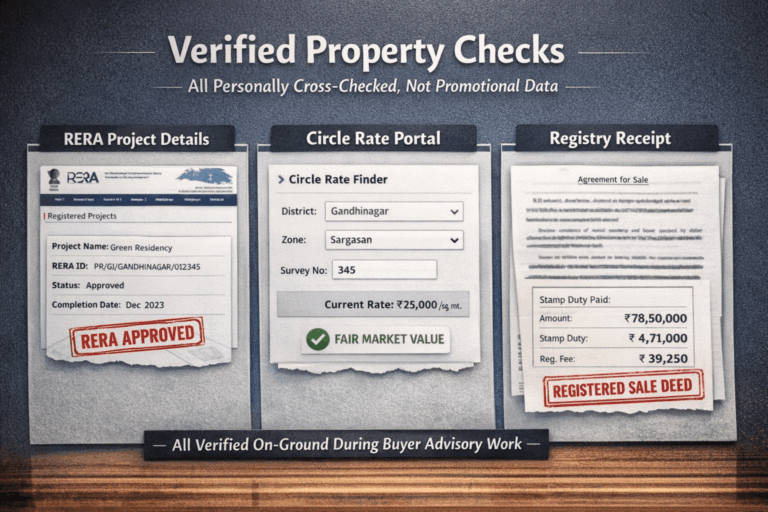
Data sources referenced during advisory work:
Gujarat RERA portal
The Gujarat RERA portal helps buyers verify whether a project is legally registered and compliant. It provides authentic details like approvals, construction status, timelines, and developer track records. For end users, this reduces risk and protects against misleading claims.
Gandhinagar sub-registrar transaction records
These records reflect actual property transactions registered on the ground, not advertised prices. Buyers can understand real deal values, demand trends, and transaction volumes in specific areas. This data is crucial for judging whether quoted prices match market reality.
Circle rate data
Circle rates set the government’s minimum valuation benchmark for property registration. While not always equal to market prices, they offer a baseline to assess overpricing. Smart buyers use this to negotiate and avoid inflated deals.
Local development authority plans
Development authority plans show approved infrastructure, zoning, road networks, and future growth directions. These documents help buyers judge long-term livability and legal land use. They are especially important for avoiding projects in uncertain or restricted zones.
Current context:
Prices are stable, demand is selective, and interest rates have made buyers cautious. This is not a frenzy market.
PROOFS & SCREENSHOT
WHO THIS GUIDE IS NOT FOR
This guide is NOT for:
- Short-term flippers
- Speculators chasing “next hotspot” rumors
- Buyers expecting fast double-digit ROI
You should wait or rethink if:
- Job location is uncertain
- Budget is stretched
- You’re buying purely out of fear of missing out
IF I WERE BUYING TODAY
Would I buy it now?
Yes — only for end-use, not speculative investment.
What would I choose?
Ready or near-completion 2.5–3 BHK in established sectors.
What would I negotiate hardest?
Final all-inclusive price and possession terms.
One red flag I would not ignore:
Projects selling future promises without present infrastructure.
CONCLUSION
Gandhinagar is not a gold rush — and that’s not a bad thing. It rewards clarity, patience, and discipline, not hype-driven decisions. If this guide helped you think more clearly, that’s the win.
👉 If you want:
- A personal buying checklist
- Help reviewing a specific project
- Or clarity before committing
Drop your question or ask for the checklist — no sales pitch.
Is Gandhinagar the Next Real Estate Hotspot in Gujarat - FAQS
Q1: Is Gandhinagar better than Ahmedabad?
Q2: Will GIFT City push prices up?
Q3: Is this a safe long-term buy?
Q4: Ready vs under-construction?
References
- Gujarat RERA Portal
- Circle Rate Records
- Sub-Registrar Transaction Data
- Local Urban Development Authority Plans
About the Author