
Hidden Builder Clauses Every Homebuyer Must Know Before Buying a Property: A few months ago, I met a young couple planning to purchase their first apartment. Like many first-time buyers, they had spent weeks comparing floor plans, amenities, and builder offers. The sales executive assured them the project was “almost sold out,” promised early possession, and even mentioned that prices would increase within a week.
Everything looked perfect.
Until we sat down and read the Real estate agreement.
Buried deep inside the document were several clauses that completely changed the deal.
The Possession date wasn’t fixed—it allowed the builder an additional 18 months beyond the advertised timeline.
The so-called “free” clubhouse required a separate Club membership fees payment.
There were future Infrastructure charges, Electricity connection charges, and Water connection charges that were nowhere mentioned in the original quotation.
Even worse, the buyer would have to continue making payments according to the Payment schedule, regardless of construction delays in certain situations.
The family thought they were buying a ₹95 lakh apartment.
Their actual financial commitment was closer to ₹1.13 crore.
Unfortunately, this isn’t rare.
After advising homebuyers and studying residential projects across multiple markets, I’ve noticed that most buyers spend far more time discussing interiors than reading the legal documents that actually determine their financial risk.
Most online articles don’t help either.
They tell you to “read the agreement carefully” but rarely explain what specific clauses deserve your attention, what questions to ask, or how builders legally protect themselves through contract language.
This guide is different.
Instead of repeating generic legal advice, I’ll explain the builder clauses that have the biggest impact on your money, your ownership rights, and your peace of mind. I’ll also show you where buyers commonly make expensive mistakes and how to avoid them before signing anything.
The goal isn’t to scare you away from buying property.
The goal is to make sure you buy with complete clarity.
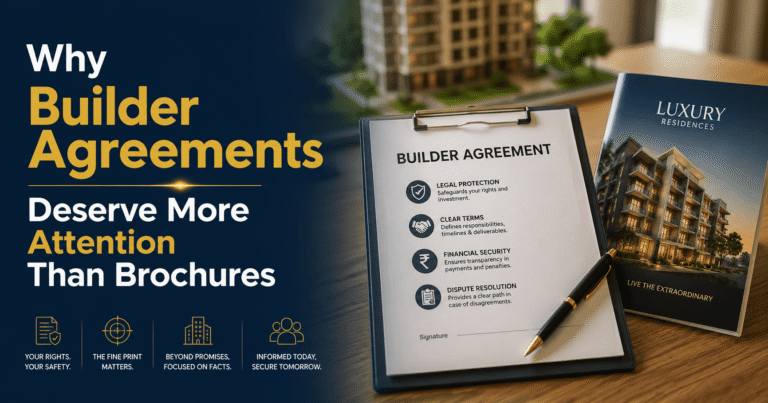
Why Builder Agreements Deserve More Attention Than Brochures
Every builder invests heavily in marketing.
Glossy brochures.
Luxury sample flats.
Professional sales teams.
Virtual walkthroughs.
These are designed to help you imagine living there.
But none of them determine your legal rights.
Only the Home purchase contract, Developer agreement, and Agreement to sell define what the builder is actually obligated to deliver.
That’s an important distinction.
Many buyers assume verbal promises automatically become contractual commitments.
They don’t.
If a promised feature isn’t reflected in the agreement, proving it later becomes extremely difficult.
I’ve seen buyers argue over parking allocations, promised amenities, delayed possession, and even apartment size—all because they relied on conversations instead of written clauses.

The Biggest Problems Real Homebuyers Face Today
Buying a home isn’t just about choosing a location.
It’s about managing uncertainty.
Here are the issues I repeatedly see buyers struggling with.
1. Price Confusion Starts Before Booking
Builders often advertise an attractive base price.
However, the base price rarely represents the total cost.
Additional expenses may include:
- Maintenance deposit
- Corpus fund
- Amenities charges
- Parking allocation
- Registration expenses
- GST (where applicable)
- Utility connection charges
By the time everything is added, buyers sometimes discover the actual cost is 12–20% higher than expected.
This is why asking for a complete cost sheet before paying the Booking amount is essential.
2. Hidden Costs Continue Even After Possession
Many buyers believe financial commitments end after taking possession.
In reality, several future costs can arise through contractual clauses.
Common examples include:
- Increased maintenance contributions
- Utility installation charges
- Clubhouse operational costs
- Society formation expenses
- Shared infrastructure payments
These Hidden costs may not seem significant individually, but together they can materially affect your long-term affordability.
3. Fake Urgency Creates Poor Decisions
“This price is valid only today.”
“Only two units are left.”
“The builder will revise prices tomorrow.”
I’ve heard these statements countless times.
Sometimes they’re true.
Often they aren’t.
Pressure reduces your ability to evaluate documents carefully.
Whenever a salesperson insists you must pay the Earnest money deposit immediately, ask yourself:
“If this is truly a good property, will it still be a good property after I’ve reviewed the legal documents?”
Good investments rarely disappear overnight.
Bad decisions often happen in a single afternoon.
4. Buyers Focus on Amenities Instead of Legal Protection
Swimming pools.
Clubhouses.
Sky gardens.
Smart home features.
These attract attention.
But buyers frequently ignore much more important questions.
For example:
- Has the land title been verified?
- Is the builder’s approval complete?
- Are promised amenities legally committed?
- Are completion timelines enforceable?
The excitement of purchasing a home shouldn’t replace careful due diligence.
5. Builder Credibility Is Often Judged Incorrectly
A large office doesn’t guarantee reliability.
Neither does celebrity advertising.
Instead, evaluate:
- Previous project delivery
- Construction quality
- Complaint history
- Delay records
- Financial stability
- Customer feedback after possession
True Builder credibility comes from completed projects—not marketing campaigns.
What Are Hidden Builder Clauses?
A hidden clause isn’t necessarily illegal.
It’s simply a contractual condition that many buyers fail to notice until problems arise.
Some clauses protect builders.
Some protect buyers.
Some allocate risk fairly.
Others shift a disproportionate amount of risk onto the purchaser.
Understanding the difference is what separates informed buyers from disappointed ones.
Hidden Clause #1 – Flexible Possession Timelines
The brochure might promise possession in December 2028.
The agreement may say:
“Possession may be extended due to administrative, regulatory, labor, environmental, or unforeseen circumstances.”
That single sentence can significantly change your expectations.
Always compare:
- Advertisement
- Sales presentation
- Agreement wording
If the timelines differ, ask why.
Hidden Clause #2 – Construction Changes
Some agreements allow builders to modify:
- Floor plans
- Common amenities
- Landscape design
- Tower positioning
- Parking layouts
Minor changes are common.
Major deviations deserve clarification before signing.
Hidden Clause #3 – Escalating Additional Charges
One of the most overlooked sections involves future financial liabilities.
These may include:
- Infrastructure charges
- Amenities charges
- Electricity connection charges
- Water connection charges
- Government levies introduced later
Ask whether these are fixed, estimated, or variable.
The answer directly affects your final purchase cost.
Hidden Clause #4 – Parking Rights
Buyers often assume parking is automatically included.
But agreements can distinguish between:
- Reserved parking
- Open parking
- Mechanical parking
- Stack parking
Always confirm your Parking allocation in writing.
A misunderstanding here can create years of inconvenience.
Hidden Clause #5 – Builder Delay Protection
Many agreements specify penalties if buyers delay payments.
Far fewer provide equivalent compensation when builders delay construction.
This imbalance deserves careful review.
Ask:
- Is compensation clearly defined?
- Is the calculation transparent?
- Under what conditions does it apply?
Step-by-Step Buyer Action Plan
Step 1 – Choose the Right Location Before Choosing the Project
Many buyers fall in love with a sample apartment before evaluating the neighbourhood.
That sequence should be reversed.
A beautiful apartment in the wrong location can create daily inconvenience and poor long-term appreciation.
Evaluate:
- Employment hubs
- Schools
- Hospitals
- Public transport
- Future infrastructure
- Flood history
- Civic services
Also compare the area’s actual transaction prices with the builder’s quoted price.
Don’t assume every developing locality will outperform the market.
Sometimes paying slightly more in an established location is the better financial decision.
Mistake to avoid:
Buying purely because a new highway or metro line has been announced.
Announcements don’t always translate into timely execution.
Pro Tip:
Visit the location during weekday mornings, evenings, weekends, and even after heavy rainfall. The neighbourhood often reveals issues that marketing brochures never mention.
Step 2 – Validate Your Budget Beyond the Base Price
Before paying any Down payment, ask the builder for a complete cost breakdown.
Include:
- Base price
- GST (if applicable)
- Registration costs
- Stamp duty
- Maintenance deposit
- Corpus fund
- Club membership fees
- Parking charges
- Utility charges
- Legal expenses
Then compare this figure with your loan eligibility and emergency savings.
Never stretch your finances assuming future salary increases will cover unexpected costs.
Mistake to avoid:
Calculating affordability using only the advertised apartment price.
Pro Tip:
Keep an additional 5–10% contingency fund for expenses that often arise during possession and registration.
Step 3 – Verify the Builder Before You Trust the Builder
This is where many buyers skip essential checks.
Before signing any Property buying guide checklist or making the booking payment, verify:
- RERA registration number
- Project approvals
- Land ownership verification
- Title clearance
- Encumbrance check
- Construction permissions
- Litigation history
- Previous delivery record
This is the foundation of proper Buyer due diligence and significantly improves Property investment safety.
Don’t rely solely on the sales team’s documents. Cross-check information through the relevant RERA portal and government land records wherever available.
Mistake to avoid:
Assuming a famous builder never faces project delays or legal disputes.
Even reputed developers can encounter regulatory, financial, or execution challenges.
Pro Tip:
Search for completed projects delivered by the same developer. Speak directly with residents about construction quality, maintenance, and post-possession support rather than relying only on online reviews.
Step 4 – Conduct a Site Visit Like an Investigator, Not Like a Customer
One of the biggest mistakes I see buyers make is treating the site visit as a sales presentation instead of a verification exercise.
Builders are naturally going to show you the best parts of the project. They’ll highlight the clubhouse, sample flat, landscaped gardens, and future amenities. But your job isn’t to admire the project—it’s to verify whether the promises match reality.
A well-planned site visit can reveal issues that no brochure or sales executive will ever mention.
What to Check During Your Site Visit
Use this Home inspection checklist before making any payment:
- Is the construction progressing according to the advertised schedule?
- Are multiple towers under active construction or only one?
- Are labourers actively working on-site?
- Has the basement construction started?
- Are lifts, fire safety systems, and common areas being installed?
- Is internal road work progressing?
- Are drainage and sewage systems visible?
- Is the approach road complete or still under development?
- Is there sufficient visitor parking?
- Does the actual flat size appear consistent with the brochure?
If possible, visit without informing the builder in advance. An unannounced visit often provides a more realistic picture of day-to-day construction activity.
Visit More Than Once
I usually recommend at least three site visits:
- Weekday morning
- Weekend afternoon
- Evening after office hours
Each visit tells a different story.
Traffic conditions, noise levels, nearby commercial activity, lighting, waterlogging, and neighbourhood safety all become much clearer.
Many buyers purchase after just one carefully managed site visit arranged by the sales team.
That’s rarely enough.
Speak to Existing Residents
If the builder has completed earlier phases or nearby projects, spend 20–30 minutes speaking with residents.
Ask questions like:
- Was possession delivered on time?
- How responsive is the builder after handover?
- Were additional charges demanded later?
- Has the maintenance quality remained consistent?
- Were promised amenities actually completed?
These conversations often provide more valuable insights than hours spent with sales executives.
Construction Quality Matters More Than Luxury Finishes
Italian marble and premium lighting can easily distract buyers.
Instead, pay close attention to Construction quality.
Check for:
- Uneven flooring
- Wall cracks
- Water seepage
- Damp patches
- Balcony slope
- Window alignment
- Plumbing quality
- Electrical wiring finish
Luxury interiors can be upgraded later.
Poor structural work is far more expensive to correct.
A builder that consistently delivers strong Quality assurance across completed projects deserves more confidence than one that simply offers impressive marketing.
Step 5 – Verify Every Legal Document Before Signing
This is where buyers either protect themselves—or unknowingly expose themselves to years of legal complications.
Never rely solely on verbal assurances.
Every important promise should appear in legally enforceable documentation.
Verify Land Ownership
Start with Land ownership verification.
Ask:
- Does the builder legally own the land?
- Is it jointly developed?
- Is it leased?
- Is there any ownership dispute?
Many legal issues begin long before construction starts.
Obtain Title Clearance
A proper Title clearance confirms that the ownership chain is legally valid.
Without a clear title, future resale, financing, or inheritance can become complicated.
Conduct an Encumbrance Check
An Encumbrance check helps identify whether the property has:
- Outstanding loans
- Legal claims
- Court disputes
- Existing mortgages
- Financial liabilities
This single verification can prevent major legal headaches later.
Confirm Project Approvals
Ask for copies or verification details of all major Project approvals.
These generally include:
- Building plan approval
- Environmental clearance (where applicable)
- Fire department approval
- Airport authority clearance (where required)
- Local municipal permissions
Never assume approvals exist simply because construction has started.
Check the RERA Registration Number
Every buyer should independently verify the RERA registration number through the state’s RERA portal.
The portal usually provides:
- Approved layout
- Completion timeline
- Litigation updates
- Quarterly construction progress
- Project documents
- Builder disclosures
Cross-checking these details helps improve Real estate transparency and reduces dependence on marketing claims.
Understand the Agreement to Sell
The Agreement to sell is one of the most important legal documents in the buying process.
Read every clause carefully.
Pay particular attention to:
- Payment milestones
- Possession commitments
- Delay penalties
- Cancellation conditions
- Refund policies
- Force majeure clauses
- Carpet area definition
- Maintenance responsibilities
Never assume standard agreements are non-negotiable.
Certain clauses can sometimes be modified before signing.
Sale Deed Registration Is What Transfers Ownership
Many buyers mistakenly believe booking or signing the agreement makes them the legal owner.
It doesn’t.
Only Sale deed registration legally transfers ownership.
Until registration is completed, your ownership rights remain incomplete.
Always verify:
- Registration timeline
- Applicable stamp duty
- Registration charges
- Execution process
Understand the Conveyance Deed
The Conveyance deed officially transfers ownership from the developer to the buyer or housing society.
Without it, long-term ownership complications may arise.
Ask the builder:
“When will the conveyance process be completed?”
Many buyers never ask this question.
Understand the Property Transfer Process
The complete Property transfer process involves several legal stages.
Typically:
- Booking
- Agreement to Sell
- Construction-linked payments
- Possession
- Sale Deed Registration
- Conveyance
- Society formation (where applicable)
Understanding each stage prevents unnecessary confusion later.
Verify Occupancy Rights
Before moving in, ensure the project has proper Occupancy rights supported by the required approvals.
Possession without proper permissions can create legal and utility-related complications.
Obtain the Possession Certificate
Always ask for the Possession certificate.
It confirms that possession has been officially handed over according to the agreed process.
Without proper documentation, disputes become much harder to resolve.
Step 6 – Negotiate Like a Buyer, Not Like a Customer
Negotiation isn’t just about reducing the apartment price.
Experienced buyers negotiate the entire transaction.
Sometimes saving ₹5 lakh on the purchase price matters less than avoiding ₹8 lakh in hidden charges later.
Areas You Should Negotiate
Many builders are willing to discuss:
- Floor rise charges
- Parking charges
- Club membership fees
- Maintenance deposit
- Payment flexibility
- Interior modification requests
- Waiver of documentation charges
Ask respectfully.
The worst outcome is simply “no.”
Negotiate the Payment Schedule
A buyer-friendly Payment schedule should closely match actual construction progress.
Avoid agreements requiring large payments before visible construction milestones.
Construction-linked plans generally reduce financial risk compared to heavily front-loaded payment structures.
Clarify Builder Commitments
Ask the builder to confirm every important promise in writing.
Examples include:
- Possession timeline
- Amenity completion
- Parking allocation
- Floor specifications
- Power backup
- Water supply
- Clubhouse completion
Verbal promises disappear surprisingly quickly.
Written Builder commitments remain enforceable.
Understand Builder Obligations
Every buyer should clearly understand the developer’s Builder obligations.
These usually include:
- Delivering according to approved plans
- Completing common amenities
- Meeting regulatory requirements
- Providing possession documentation
- Rectifying construction defects within the agreed period
Never assume responsibilities automatically exist.
Read the contract carefully.
Hidden Clause Most Buyers Ignore: Defect Liability Period
One clause I always tell buyers to locate is the Defect liability period.
This specifies how long the builder remains responsible for fixing certain construction defects after possession.
Examples include:
- Water leakage
- Structural cracks
- Plumbing failures
- Electrical defects
- Waterproofing issues
A clearly defined defect liability clause provides valuable post-possession protection.
If the agreement is vague, ask for clarification before signing.
Property Ownership Rights: What Buyers Should Understand
Many first-time buyers focus entirely on possession.
Ownership is broader than possession.
Your Property ownership rights should clearly include:
- Right to occupy
- Right to transfer
- Right to inherit
- Right to mortgage
- Right to resale
- Right to common facilities
Review the agreement carefully to understand whether any restrictions apply.
Contract Negotiation Is About Reducing Risk
Effective Contract negotiation isn’t about winning every point.
It’s about identifying unfair clauses before they become expensive problems.
Areas worth reviewing include:
- Cancellation penalties
- Delay compensation
- Maintenance responsibility
- Force majeure wording
- Additional charge provisions
- Future infrastructure expenses
Sometimes a single revised clause can save lakhs over the life of the investment.
Case Study 1 – End-User Family
Profile
A family of four working in the IT sector wanted a permanent home close to their children’s school.
Budget
₹1.05 crore
Selected Location
An established suburban residential corridor with operational metro connectivity.
Builder’s Initial Offer
₹99 lakh base price
Final Purchase Cost
₹1.08 crore after including:
- Parking
- Maintenance deposit
- Corpus fund
- Registration
- Utility charges
During document verification, the family noticed the agreement allowed unlimited escalation of certain infrastructure-related costs.
They negotiated a revised clause placing a defined cap on these charges before signing.
Current Estimated Market Value (After 3 Years)
Approximately ₹1.24 crore
Lesson Learned
The price negotiation saved only ₹2 lakh.
The contract negotiation prevented significantly larger future financial exposure.
Case Study 2 – Investor
Investment Objective
Long-term rental income with moderate capital appreciation.
Entry Price
₹72 lakh
Rental Income
₹24,000 per month during the first year.
Approximately ₹29,000 per month after three years.
Rental Yield
Around 4.2% annually before expenses.
Current Estimated Property Value
₹88 lakh
Exit Strategy
Continue holding until nearby commercial infrastructure reaches full occupancy.
What Worked
- Bought in an area with genuine employment growth.
- Verified legal documentation before booking.
- Selected a builder with a consistent delivery history.
What Didn’t
The investor underestimated annual maintenance increases, reducing net rental returns slightly.
The lesson wasn’t that the investment failed—it was that long-term holding costs deserve as much attention as purchase price.
What Real Homebuyers Say After Reading Their Agreement Carefully
Over the years, I’ve noticed something interesting.
The buyers who are happiest five years after purchasing aren’t always the ones who bought the biggest apartment or negotiated the lowest price.
They’re the ones who understood exactly what they were signing.
Below are a few realistic examples that reflect common buyer experiences.
Testimonial 1 Kara– IT Professional (End User)
Buyer Profile: Software Engineer
Property Purchased: 3 BHK in a developing suburban residential corridor
“I was ready to pay the booking amount the same day because the builder said prices would increase after the weekend. After reviewing the agreement, I discovered several additional charges that weren’t included in the quotation. Waiting just three more days helped me understand the total financial commitment. I still bought the apartment—but with much more confidence.”
Outcome: Avoided unexpected post-booking expenses and negotiated a revised payment schedule.
Testimonial 2 Yash – PSU Employee
Buyer Profile: Government Employee
Property Purchased: Ready-to-move apartment
“My biggest concern wasn’t the apartment itself—it was whether the builder had completed every legal formality. Verifying the project documents independently gave me confidence before registration.”
Outcome: Smooth possession with no legal surprises.
Testimonial 3 – David NRI Investor
Buyer Profile: Overseas Investor
Property Purchased: Investment apartment
“The builder’s marketing looked impressive, but I decided to verify previous projects before investing. Speaking with existing residents gave me much more useful information than online advertisements.”
Outcome: Chose a different project with a stronger delivery record instead of simply selecting the better-looking brochure.
Why Reading Builder Agreements Matters More Than Ever
Residential real estate has become more transparent in recent years, largely due to stronger regulatory oversight and digital access to project information. At the same time, property prices in many cities have risen steadily, which means buyers have less room for expensive mistakes.
Higher home loan interest rates, increasing construction costs, and stronger demand in selected micro-markets have also encouraged some builders to tighten contract terms or introduce additional charges. That doesn’t automatically make these clauses unfair—but it makes understanding them even more important.
Real estate decisions are also market-cycle dependent. A project that makes sense today may not have been the right choice two years ago, and the same project may not offer the same value two years from now.
This is why buyers should focus less on predictions and more on verifying facts.
Trusted Sources Every Homebuyer Should Check
Before purchasing any property, I recommend verifying information using independent sources instead of relying only on marketing material.
Useful sources include:
- State RERA portal
- Local Sub-Registrar Office records
- Government land record portals
- Approved building plan documents
- Circle rate information published by the local authority
- Municipal development plans
- Home loan technical valuation reports
- Independent legal opinion from a qualified property lawyer
Using multiple sources strengthens Property legal verification and helps improve Safe property investment decisions.
Who This Guide Is Not For
Not every buyer should purchase property today, and not every investment opportunity deserves a “yes.”
This guide may not be suitable for:
- Buyers looking to flip properties within a few months.
- Investors chasing rumours of “guaranteed” appreciation.
- Anyone expecting unrealistic returns without understanding market fundamentals.
- Buyers who are not financially prepared for down payment, registration costs, and emergency reserves.
- People purchasing only because friends, relatives, or social media say “property prices always go up.”
If your employment situation is uncertain, your emergency savings are limited, or you’re likely to relocate soon, renting may currently be the more sensible choice.
Waiting is sometimes the smarter financial decision.
Buying late is usually less expensive than buying the wrong property.
What This Guide Will Not Help With
To keep expectations realistic, this guide is not designed for:
- Short-term speculative trading
- Insider or rumour-based investing
- “Guaranteed profit” strategies
- Predicting future property prices
- Choosing stocks, REITs, or other financial investments
Its purpose is to help genuine homebuyers ask better questions, evaluate builder agreements carefully, and reduce avoidable risks.
If I Were Buying This Property Today
If I were purchasing a residential property today, my approach would be straightforward.
Would I Buy Now or Wait?
I would buy only if:
- The project has all major approvals in place.
- Pricing is supported by comparable transactions in the area.
- My finances remain comfortable after accounting for every additional cost.
- I plan to hold the property for the long term.
If I were buying purely because of fear of rising prices or pressure from a sales executive, I would wait.
Urgency is rarely a good investment strategy.
Which Configuration Would I Choose?
For most families, I would prioritise a well-designed 3 BHK with practical layouts over a larger apartment with unusable space. Efficient floor plans often provide better long-term value than simply having more square footage.
What Would I Negotiate the Hardest?
I would focus less on the advertised base price and more on:
- Hidden charges
- Payment milestones
- Delay compensation
- Parking rights
- Written confirmation of promised amenities
- Defect liability obligations
These items often have a greater financial impact than a small discount on the apartment price.
One Red Flag I Would Never Ignore
If the builder hesitates to share project approvals, legal documents, or answers about land ownership and contract clauses, I would walk away.
There will always be another property.
Replacing lost money or resolving a legal dispute is much harder.
Conclusion:
Buying a home is one of the largest financial commitments most people will ever make.
The apartment itself is only part of the purchase.
The agreement determines your rights, responsibilities, financial obligations, and legal protection for years to come.
Don’t let attractive brochures or limited-time offers distract you from reading the documents that truly matter.
Take your time.
Ask questions.
Verify independently.
If something feels unclear, don’t sign until it is.
A careful decision today can prevent years of stress tomorrow.