
A buyer recently walks into a property office with what sounds like a straightforward requirement: “I have around ₹1.5 crore. Should I buy a large 3/4 BHK flat or stretch myself for a bungalow?”
The broker immediately has an answer.
“Sir, bungalow is always better. You get land, privacy and appreciation.”
Another broker says almost the opposite:
“Flat is better. Better security, amenities, maintenance and resale.”
The buyer is left with two opinions and very little actual decision-making information. That is the problem with most online articles about flat vs bungalow in Gandhinagar. They compare features—garden versus clubhouse, privacy versus security, land versus amenities—but don’t address the question that actually matters:
In my view, there is no universal winner.
For many Gandhinagar families, a good flat is the smarter purchase. For others, particularly buyers with a large budget who genuinely value land, privacy and long-term ownership, a bungalow can be worth the additional cost.
The mistake is buying the more expensive property simply because it sounds more premium.
This guide is designed to help you avoid that mistake.
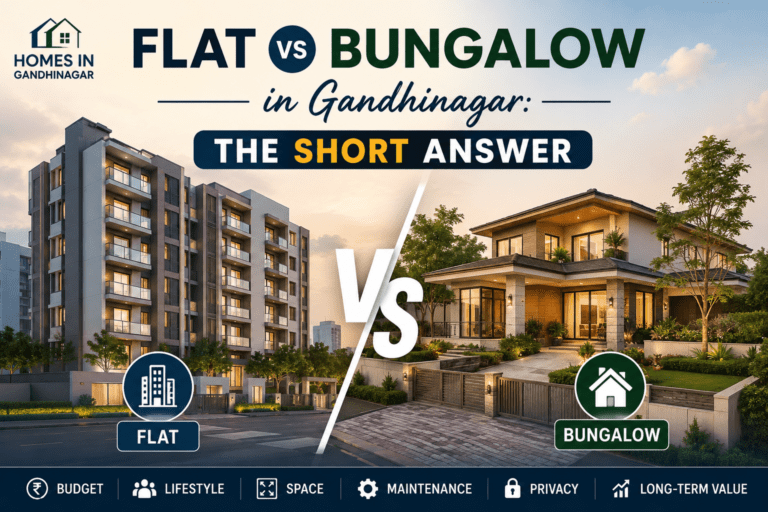
If you want the quick verdict before reading the detailed analysis:
Choose a flat if:
Consider a bungalow if:
My overall view
For the majority of middle- and upper-middle-income end users in Gandhinagar, I would choose a well-located, well-built flat over stretching financially for a bungalow. I would choose a bungalow only when the buyer can comfortably afford it without sacrificing liquidity and when the land/independence is genuinely valuable to the family. That distinction is important.
A flat and a bungalow are not simply two versions of the same product. You are buying two different lifestyles.
With a flat, you are primarily buying:
Apartment + shared infrastructure + location + convenience.
With a bungalow, you are buying:
Land + structure + privacy + independence + responsibility.
That last word is frequently ignored. A bungalow gives you more control, but it also gives you more things to worry about.
You are responsible for:
A flat shifts many of those responsibilities into a society or maintenance system. Neither is automatically better.
The correct question is:
Which set of responsibilities and costs fits your lifestyle?
One of the biggest mistakes buyers make is discussing “Gandhinagar property prices” as if the entire city operates at one rate. It doesn’t.
Current online market trackers show significant differences between localities and property types. For example, MagicBricks’ July 2026 data places average multistorey apartment rates around ₹4,182/sq ft across Gandhinagar, while its listed ranges vary materially across locations such as Koba, Kudasan, Randesan, Raysan, Sargasan and GIFT City. For buyers comparing their options, understanding the flat vs bungalow for homebuyers can also help put these price differences into perspective before choosing a property type.
Housing.com also shows substantial locality-level variation, with its 2026 data listing different average rates for Sargasan, Kudasan, Randesan, Koba, Raysan, Vavol and GIFT City.
These portals are asking/listing-market indicators, not guaranteed transaction prices, so I would never use them as the sole basis for deciding whether a particular flat or bungalow is fairly priced.
The important lesson is simpler:
Location can matter as much as property type. A reasonably priced flat in an excellent location can be a better purchase than an expensive bungalow in a location that doesn’t suit your lifestyle.
This is probably the most common comparison error.
A buyer says:
“This flat is 2,000 sq ft and that bungalow is 2,500 sq ft, so the bungalow is only slightly larger.” That comparison is incomplete.
For a flat, you need to understand:
For a bungalow, you need to understand:
A 2,000 sq ft apartment and a 2,000 sq ft bungalow plot are not equivalent assets. The bungalow may have a meaningful land component. The apartment primarily gives you ownership of a unit plus an undivided/shared interest associated with the property and common infrastructure, subject to the project’s legal structure.
Therefore, don’t compare only:
₹/sq ft × built-up area.
Compare the entire asset and how you will use it.
Before visiting properties, write down your requirements. Not your dreams.
Your requirements.
Ask:
A family of four does not automatically need a bungalow. Likewise, a family with three cars, elderly parents and a strong preference for private outdoor space may eventually feel restricted in an apartment.
Don’t buy according to social status. Buying a bungalow because:
“Everyone in our circle is buying one” is one of the most expensive reasons to buy a property.
This is where I would be conservative. Suppose you have ₹1.5 crore available. That does not necessarily mean you should buy a ₹1.5 crore property.
You need money for:
For a bungalow, the post-purchase maintenance and renovation requirement can also be substantially higher.
Example
Suppose:
Flat: ₹1.10 crore
Bungalow: ₹1.45 crore
At first glance, the bungalow costs ₹35 lakh more.
But if the bungalow also requires:
the real difference can become much larger.
The decision is no longer:
₹1.10 crore vs ₹1.45 crore.
It may become:
₹1.15 crore vs ₹1.60 crore+ depending on the specific property. That is why I prefer comparing all-in acquisition cost.
This is particularly important with bungalows. There is no simple “₹/sq ft” shortcut that works equally well for every independent property.
For a flat, you can compare:
For a bungalow, you need to consider:
Suppose a bungalow costs ₹2 crore. Don’t simply divide ₹2 crore by built-up area.
First estimate:
Land value + reasonable structure value + location premium + other property-specific value
That gives you a much better starting point.
Gujarat’s Revenue Department provides online services for document registration and Jantri rates, as well as property cards and land-record-related services.
But remember:
Jantri is not automatically the market price.
Use it as one official reference in your due-diligence process, not as proof that a seller’s asking price is fair.
Location means something different depending on what you are buying.
This is where planning information becomes important.
Government planning documents identify different land-use categories and development zones, so buyers should not assume that vacant land next to a property will remain vacant simply because it looks attractive today.
Never buy a bungalow because of the view without checking what can legally be developed around it.
A beautiful open view can disappear.
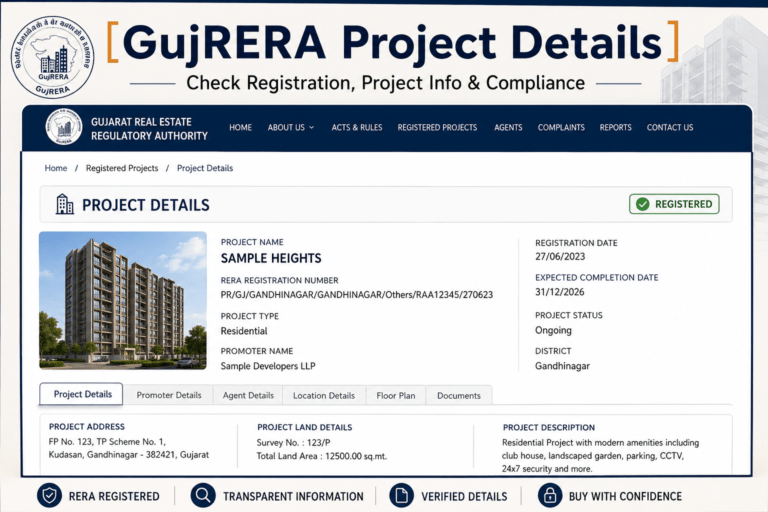
For an under-construction flat, RERA verification should be non-negotiable. The Ministry of Housing and Urban Affairs lists Gujarat’s RERA authority as GujRERA. Check the specific project rather than simply relying on the developer’s reputation.
For a flat, verify:
For a bungalow, the checklist changes
If you are buying a ready independent house, the key concern is often not RERA but title and approvals. If you are buying a bungalow in a gated development, however, project-level documentation and applicable regulatory approvals still need to be checked.
A flat can hide defects. A bungalow can hide even more.
Check:
Add:
Visit during or immediately after heavy rain if possible. A property can look perfect on a sunny Sunday afternoon and reveal completely different problems during monsoon. This is especially relevant for independent properties where drainage responsibility may fall directly on the owner.
Factor | Flat | Bungalow |
Initial purchase cost | Usually lower for comparable residential utility | Usually higher |
Land component | Shared/limited individual control | Major component |
Privacy | Moderate | High |
Security | Often professionally managed | Owner-dependent |
Maintenance | Society-managed, recurring fees | Owner-managed |
Amenities | Often available | Usually private/self-funded |
Parking | Fixed/allocated | More flexibility depending on plot |
Outdoor space | Balcony/terrace | Garden/open space |
Customisation | Limited by society/building | Much greater |
Resale | Can be easier for popular configurations | Buyer pool can be narrower |
Rental demand | Often stronger for standard flats | Depends heavily on location and property |
Repairs | Shared/common issues managed collectively | More direct owner responsibility |
Long-term land value | Limited compared with a plot | Significant |
Liquidity | Generally better for mainstream units | Can take longer |
Lifestyle | Convenient | Independent |
This table explains why there is no universal winner. You are trading convenience for independence.
This is where property marketing becomes dangerous.
Someone may tell you:
“Bungalow means land, so appreciation is guaranteed.”
No. Land scarcity can support long-term value, but the specific location, title, road access, plot usability, development potential and buyer demand still matter.
Similarly, someone might say:
“Flat prices always go up because Gandhinagar is developing.”
Also no.
A flat can underperform if:
Recent market data also suggests the broader Gujarat development cycle is not uniform. FY2026 saw a decline in new project registrations in Gujarat, with industry commentary pointing to market saturation and developer caution even while overall demand remained present.
That is precisely why I would avoid making a property decision based on:
“Prices will definitely rise.” Nobody can responsibly guarantee that.
There is one interesting development in the Ahmedabad–Gandhinagar market: larger homes are gaining popularity.
A recent Times of India report says 3 BHK homes have overtaken 2 BHK units as the preferred home size in the Ahmedabad-Gandhinagar market, with lifestyle changes, affordability and demand for additional space contributing to the shift.
At the premium end, the market is also seeing more luxury vertical housing. A recent report notes that premium high-rise projects are becoming more prominent in Ahmedabad and Gandhinagar, with a very small number of luxury units accounting for a significant share of projected developer revenue.
What does this mean for a buyer?
It means flats are not automatically the “budget” or inferior option anymore.
A premium flat can offer:
The question is whether you actually need what the premium price is buying.
I would strongly favour a flat if you fall into one of these categories.
You probably don’t need a large private plot.
Your priorities may be:
A good 2 or 3 BHK may be more sensible.
This is another situation where I would avoid overextending. Your first property does not have to be your forever property. Buy something you can comfortably afford. Build equity. Maintain liquidity. Then upgrade later if your requirements change.
If you spend 10–12 hours working, the last thing you may want is another job called:
“Managing my bungalow.” A professionally managed apartment can be extremely convenient.
A well-located 2 or 3 BHK flat generally gives you a larger potential tenant pool than a high-ticket independent bungalow. That doesn’t mean every flat is a good rental investment.
It means the market for standard residential configurations is usually easier to understand. You still need to calculate actual rent, vacancy and maintenance.
A bungalow becomes more compelling when your requirements are genuinely different.
No shared corridor. No upstairs neighbour. No society restrictions on everyday use of your private outdoor space. That can be worth a lot to some families.
A ground-level living arrangement can be easier for some families. But don’t automatically assume every bungalow is senior-friendly. A large multi-storey bungalow with bedrooms upstairs can create its own problems.
If your family has:
private parking can be a major advantage.
If gardening is genuinely part of your lifestyle, a bungalow has an obvious advantage. But be honest about how much time and money you are willing to spend maintaining it.
A bungalow gives you substantially more control over:
That independence is one of the strongest reasons to choose it.
This deserves more attention than it usually receives.
Suppose your bungalow requires:
₹1.5 lakh per year in average maintenance and repair costs.
Over 10 years:
₹15 lakh.
And that is before considering major one-time expenses such as:
The actual amount will vary enormously by property age and condition. The point is not that bungalows are expensive to maintain.
The point is:
You need to budget for maintenance instead of treating it as an afterthought.
Flats aren’t free from recurring expenses either.
You may have:
The advantage is that many large common expenses are distributed across owners and managed through the society/association.
But a badly managed society can become a serious problem.
Before buying a resale flat, ask existing residents:
“How much does maintenance actually cost?”
And:
“Have there been any major special assessments?”
Don’t rely only on the seller’s answer.
This is where I would spend money on professional advice rather than trying to save a few thousand rupees.
Check:
Go deeper into:
The Gujarat Revenue Department provides online access to document-registration, property-card and land/revenue services.
My rule
Never treat “clear title” as a statement. Treat it as something to be verified.
The following is an illustrative scenario, not a claimed real transaction.
A family has:
They compare:
Purchase: ₹1.15 crore
Interiors and setup: ₹8 lakh
Approximate initial outlay: ₹1.23 crore
Advantages:
Purchase: ₹1.30 crore
Renovation: ₹12 lakh
Landscaping/other setup: ₹4 lakh
Approximate initial outlay: ₹1.46 crore
The bungalow gives them:
But the family would have almost no liquidity remaining.
The flat.
Not because flats are inherently better. Because this particular family would be financially stretched by the bungalow. If the bungalow had cost ₹1.05 crore and required only minor renovation, the answer could be completely different.
Lesson
The better property is not always the better asset. The better purchase is the one that fits your financial reality.
Consider an investor with ₹1.25 crore.
Buy two smaller flats at roughly ₹60 lakh each plus transaction/setup costs.
Potential advantages:
Buy one ₹1.15 crore bungalow.
Potential advantages:
But the rental market for that exact bungalow may be narrower. If the property generates only modest rent relative to its capital value, the investor could end up with a weak current yield.
For the flat strategy:
The investor might face:
For an investor, I would not choose between flat and bungalow based only on appreciation.
I would calculate:
Net rental yield + expected holding period + liquidity + maintenance + exit demand.
The following are composite examples, not named customer testimonials. They should not be presented as actual client testimonials without permission and supporting records.
“I initially wanted a bungalow because I thought it would be a better long-term investment. Once I calculated the actual cost, I realised I was paying for space I didn’t really need. I chose a larger 3 BHK flat instead.”
“For me, privacy mattered more than clubhouse facilities. I already had the budget for a bungalow and planned to stay for 15 years, so the extra land made sense.”
“My biggest concern was EMI. I didn’t want the house to become the centre of my financial life. The flat gave me enough space without stretching the budget.”
The common theme is important:
The right property depends on the buyer’s priorities, not on which property type sounds more prestigious.
If your primary objective is investment, my preference changes.
I would generally start by looking at well-priced apartments in locations with proven end-user and rental demand.
Why?
Because investment property needs liquidity.
You need to know:
A bungalow can deliver excellent long-term returns in the right location. But the buyer pool is smaller. A ₹2.5 crore bungalow may have fewer potential buyers than a ₹90 lakh–₹1.2 crore apartment. That matters when you need to sell.
Flat for liquidity.
Bungalow for long-term land exposure and personal use.
That’s not a universal rule, but it is the starting point I would use.
This is where buyers should think five years ahead. Imagine you need to sell.
Who can afford your property?
A ₹90 lakh flat may have a large pool of buyers. A ₹2.5 crore bungalow has a much smaller pool. That doesn’t mean the bungalow is a bad investment.
It means:
Higher ticket = narrower buyer pool.
For resale, I would assess:
Don’t assume land automatically means fast resale.
Negotiating a flat and bungalow requires different strategies.
Negotiate:
Don’t let the salesperson distract you with:
“Sir, we are giving ₹5 lakh worth of furniture free.”
Ask instead:
“What is the final amount I need to pay?”
I would focus heavily on:
A ₹10 lakh discount on a bungalow requiring ₹25 lakh of repairs isn’t a bargain.
That last sentence should make you worry more, not less.
I would tell you to reconsider a bungalow if:
A bungalow is a poor purchase when the lifestyle benefit doesn’t justify the financial sacrifice.
Likewise, don’t automatically choose a flat if:
If these are genuine requirements, forcing yourself into an apartment simply because it is financially easier can create dissatisfaction for years.
This is the section most property articles avoid. But sometimes renting is the correct answer.
Rent first if:
Renting for 12–24 months can give you valuable information.
You learn:
That knowledge can prevent a much more expensive mistake.
This guide is not designed for:
Real estate is too expensive for that kind of casual speculation.
If your strategy is:
“I’ll buy today and sell in six months at a huge profit.” I would not build a purchase decision around this guide.
I would start with a good 3 BHK flat.
I would look for:
I would not automatically pay a premium for a clubhouse, fancy entrance or marketing label.
Only if I had:
And importantly:
I would not exhaust my liquidity to get it.
For a flat:
Total all-inclusive price.
For a bungalow:
Land value versus actual property condition.
I would also use defects and required renovation as negotiation points.
I would not wait simply because someone predicts a correction.
Current market indicators show continued residential activity, but they also show a more selective development environment. Gujarat recorded a decline in new project registrations in FY2026, while broader housing demand remained present.
So my approach would be:
Wait for the right property, not for a mythical perfect market bottom.
If the property is overpriced, wait.
If the documents are unclear, wait.
If the EMI is uncomfortable, wait.
If the seller refuses reasonable due diligence, walk away.
But if the property is fairly priced, legally clean, physically sound and fits a long-term need, I would not reject it simply because prices might be different two years from now.
A property whose legal story is unclear.
I can compromise on:
I will not compromise on:
title, approvals, ownership and documentation. A beautiful property with legal problems is still a bad property.
This is the test I would use before buying either property. Imagine five years from now.
What if:
Which property gives you more flexibility?
For many buyers, the answer will be a flat. For others, particularly long-term owner-occupiers with strong finances, the answer will be a bungalow.
This is why I don’t believe in saying:
“Bungalow is always better.”
Or:
“Flat is always better.”
Both statements are lazy.
If you want the simplest answer:
Not because a bungalow is inferior.
Because a good flat often offers the better combination of:
A bungalow can be the better long-term home. The key word is comfortably. Don’t stretch your finances by ₹40–50 lakh simply to say you own a bungalow.
Likewise, don’t squeeze your family into a flat if private outdoor space and independence are genuinely important to you. The best property is the one that fits your finances, family, lifestyle and holding period.
And before you make the final decision, compare at least:
Then make the decision without the broker standing beside you telling you that:
“This price is only available today.”
A property decision of ₹1 crore or ₹2 crore deserves more than one afternoon of pressure.
Not because a bungalow is inferior.
Because a good flat often offers the better combination of:


Here’s you Find your dream 3 BHK Flat For Sale In Gandhinagar, offering space, style, and comfort.
Live close to top schools, business hubs, and green surroundings.
Discover premium 3 BHK flats in Raysan, Sargasan, Vavol, Gandhinagar, surrounded by peaceful greenery and modern amenities.
Want your add here? Contact Now
602, BBC Tower, Near Law Garden, Opp. Mayor's Bungalow, Navrangpura, Ahmedabad - 380006
+91 9979363366
info@flyinglionmedia.net
Mon - Sut | 10 AM - 6.30 PM
Copyright © 2026 Flying Lion Media. All Rights Reserved
WhatsApp us