
If you work in GIFT City, buying a flat in Gandhinagar can look deceptively simple.
A broker shows you a modern 2 or 3 BHK. The builder says, “GIFT City is growing rapidly.” Someone tells you, “Metro connectivity will push prices up.” Another person says, “This is the last unit at this price.”
Then comes the difficult question:
Should you actually buy this flat, or are you simply being sold the story around it?
I have seen buyers make this mistake repeatedly: they start their search by asking, “Which is the best flat?” when the more important question is, “Which location, configuration and price make sense for my daily life and financial position?”
That distinction matters.
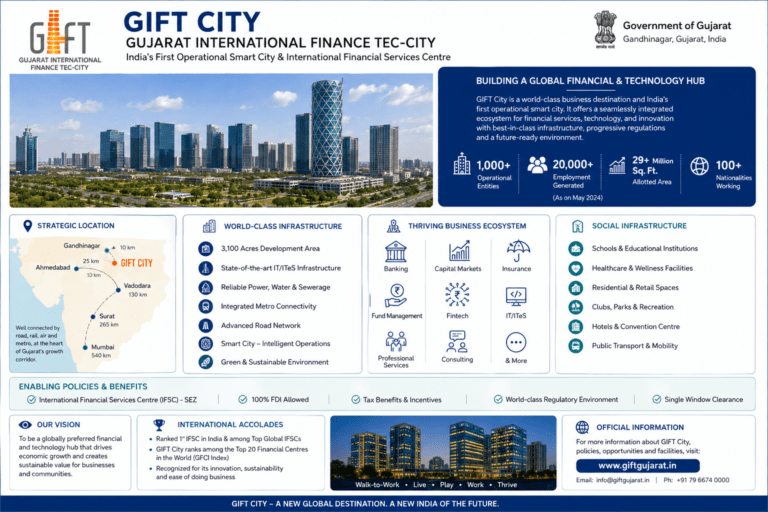
GIFT City is genuinely important to the Gandhinagar–Ahmedabad region. Official GIFT City information describes it as a global financial and technology hub, while its current website reports more than 1,000 operational entities and more than 20,000 employment generated. But strong economic infrastructure does not automatically make every nearby apartment a good purchase. For professionals working in this growing business district, choosing the right Gandhinagar flats for GIFT City employees requires looking beyond proximity and considering the actual price, commute, construction quality and long-term suitability. This guide takes a different approach.
Instead of giving you a promotional list of projects, I will show you how I would shortlist flats if I were buying as a GIFT City employee today—including location, commute, price validation, builder risk, legal checks, negotiation and the situations where I would simply wait.
Imagine a 32-year-old employee working in GIFT City.
He has a stable salary, wants to stop paying rent and believes he will stay in the area for at least five to seven years.
He visits four projects.
One is closer to GIFT City but expensive.
Another is slightly farther away but offers a much larger apartment.
A third has attractive amenities and a lower launch price.
The fourth is ready to move but has a smaller floor plan.
Every salesperson gives him a different reason to buy.
One says:
“GIFT City prices will definitely increase.”
Another says:
“Metro has already changed the market.”
Another says:
“If you don’t book today, this price won’t be available tomorrow.”
The buyer becomes more confused after every visit.
Most property articles tell you:
Very few explain when not to buy.
That is the information a real buyer needs. GIFT City itself is designed around a “walk-to-work” concept and has been developing social infrastructure including schools, hospitals, clubs and other facilities. For employees considering a home nearby, best flats in Gandhinagar for GIFT City employees can therefore be worth exploring—but only if the apartment’s price, quality and daily commute actually justify the premium.
I would rank the decision this way:
Notice what is at the bottom.
Amenities.
A swimming pool, clubhouse and decorative entrance cannot compensate for a poor purchase price, difficult commute or weak documentation. For someone working in GIFT City, the best flat is usually not the one with the most impressive brochure. It is the one that gives you a sensible combination of commute, livability, price and future flexibility.
There is no single “best” locality for everyone. Your correct choice depends heavily on whether you are a single employee, a couple, a family, an investor or someone planning to work in GIFT City for only a few years.
Raysan deserves attention when your priority is balancing proximity to GIFT City with established residential surroundings.
It can make sense for buyers who want:
The mistake is assuming that every project in Raysan deserves the same valuation. It does not. Compare the specific road access, building age, construction quality, maintenance and actual transaction prices.
Randesan can be attractive for buyers who want a residential environment while remaining connected to the GIFT City corridor.
The area becomes particularly interesting when your decision is based on daily convenience rather than only future appreciation.
I would inspect:
A project that looks “near GIFT City” on a map may feel very different during weekday traffic.
Sargasan is worth considering if you want a more established residential ecosystem and do not want your entire property decision to depend on GIFT City.
This matters for families. Your employer may change. Your job location may change. Your children will not necessarily change schools every time your workplace changes.
Therefore, family buyers should think beyond:
“How close is this flat to my office?”
Ask:
“Would my family still be comfortable living here if I stopped working in GIFT City?”
That question can protect you from buying a property with extremely narrow end-use appeal.
Kudasan can work well for buyers who want access to the wider Gandhinagar residential market rather than restricting themselves to properties immediately around GIFT City.
For many buyers, the trade-off is straightforward:
A little more distance can sometimes buy you better residential convenience or better value.
Do not automatically pay a premium simply because a project is marketed as “GIFT City connected.”
Koba deserves consideration for buyers who value connectivity toward Ahmedabad and Gandhinagar as well as access toward GIFT City. It can be particularly relevant for people whose lifestyle is split between multiple locations.
For example:
For these buyers, looking only at distance to GIFT City is too narrow.
Vavol and New Vavol can make sense for buyers prioritising value and residential usability over being immediately beside GIFT City. I would be more selective here about the exact project and road connectivity.
The right question is not:
“Is Vavol cheaper?”
It is:
“What am I receiving for the lower price, and what am I sacrificing?”
If you save ₹10 lakh but spend significantly more time commuting every working day, the financial saving needs to be evaluated against the lifestyle cost.
This is the first mistake I would eliminate.
Do not start with:
“Show me your best 3 BHK.”
Start with:
“Show me suitable properties within my acceptable commute and budget.”
Create three location bands:
Band A – Closest practical locations
Suitable if your priority is reducing commute time.
Band B – Balanced locations
Suitable if you want a compromise between price, residential environment and GIFT City access.
Band C – Value-oriented locations
Suitable if you are willing to accept a longer commute in exchange for a lower purchase price or larger home.
Read More:- 3 BHK Flats In Gandhinagar Under 1 Crore
Do not measure distance only in kilometres.
Measure:
door-to-office travel time during your actual working hours.
Visit the property twice:
That second visit often tells you more than the sales brochure.
The advertised price is not the purchase price.
Your calculation should include:
Suppose a salesperson tells you:
“This 3 BHK is ₹85 lakh.”
Do not immediately compare it with another ₹90 lakh apartment. Ask for the complete written cost sheet. A ₹85 lakh quote can become materially more expensive once additional charges are included.
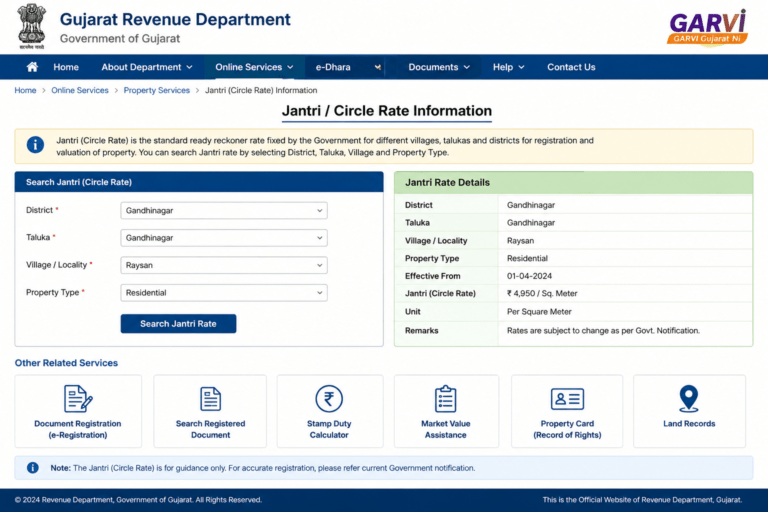
Jantri is not the same thing as the market selling price. It is one reference point in the verification process.
Do not make the mistake of saying:
“The Jantri is ₹X, so the flat must be worth ₹X.” That is not how a complete property valuation should be performed.
This is where I become particularly conservative.
If the project is under construction, I would not rely on:
I want documentation.
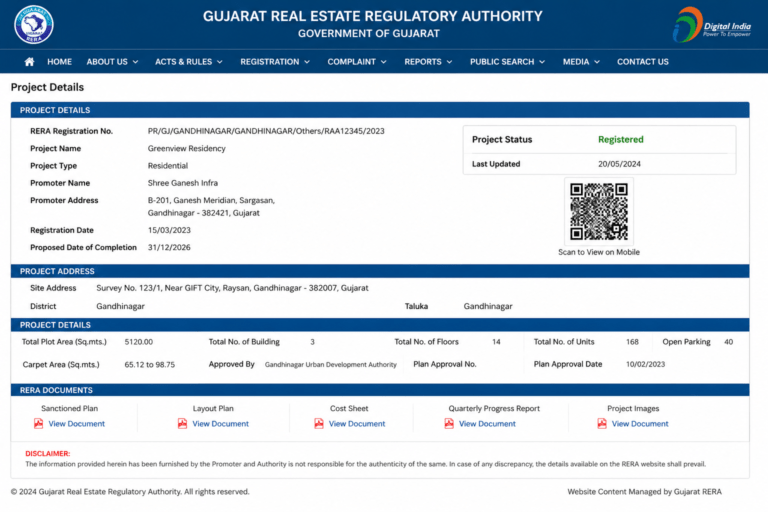
the project’s regA low price is not a bargain if the project is delayed for years. Likewise, a famous builder is not automatically a guarantee that every project will perform perfectly.
Verify the specific project—not merely the builder’s brand name.
Never buy a flat after a single 30-minute sales-office visit. Visit the actual property.
Check:
Check:
Talk to existing residents.
Ask:
“If you had to buy this apartment again, would you?”
That question is often more useful than asking whether they like the clubhouse.
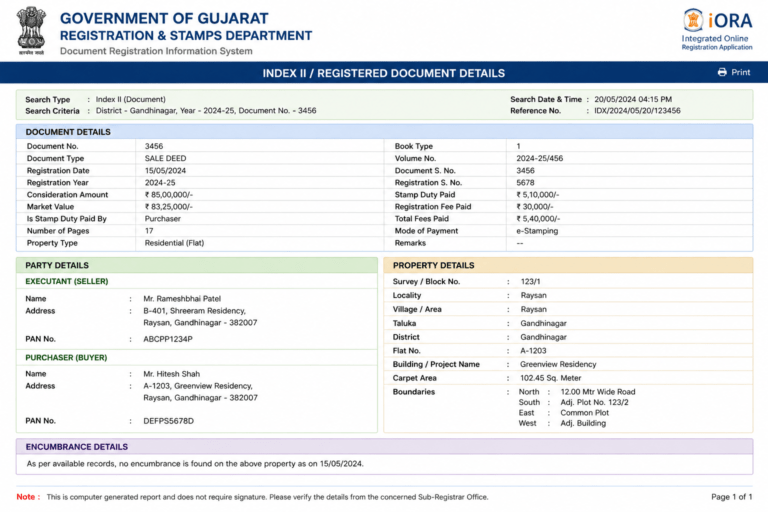
This is where a buyer should stop trying to be an expert. Get professional legal review where necessary.
Check relevant documents such as:
For Gujarat property transactions, the state’s official revenue ecosystem provides document registration, property-card and related land/revenue services.
Do not let urgency override legal verification.
If someone says:
“You have to pay today otherwise somebody else will take it.”
My response would be:
Let them take it.
A good property with defective documentation is not a good property.
Most buyers negotiate only on the quoted price.That is too narrow. Negotiate the entire transaction.
Ask about:
Do not say:
“Give me your best price.”
Instead say:
“I am ready to proceed if the total all-inclusive cost is ₹X and the documentation is satisfactory.” This changes the discussion from emotional selling to a measurable transaction.
For an under-construction project:
price + payment structure + delivery risk
For a ready-to-move property:
total acquisition cost + defects + documentation + actual market comparables
Rather than naming one “best” project, I would divide the market by buyer type.
Buyer Type | What I Would Prioritize | Suitable Area Approach |
Single GIFT City employee | Commute + 2 BHK efficiency | Raysan/Randesan/Kudasan |
Young couple | 2 or compact 3 BHK + resale flexibility | Raysan/Kudasan/Randesan |
Family | 3 BHK + schools + daily convenience | Sargasan/Kudasan/Raysan |
Higher-budget family | Larger 3/4 BHK + premium location | Select established projects |
Ahmedabad commuter + GIFT employee | Multi-direction connectivity | Koba/Sargasan/Kudasan |
Investor | Tenant demand + entry price + exit liquidity | Focus on proven rental corridors |
These are selection frameworks, not guarantees. The exact project still needs to pass price, construction, legal and resale checks.
Important: The following is a realistic buyer scenario created for illustration, not a claim about a specific person’s transaction. A family with one child had a budget of approximately ₹90 lakh.
The husband worked in GIFT City and the family initially considered a premium project closer to the business district. The quoted price was approximately ₹96 lakh before several additional costs.
Instead of stretching the budget, they compared properties farther out and eventually selected a 3 BHK in a more residential part of Gandhinagar at approximately ₹82 lakh, with their total acquisition cost remaining within a manageable range after transaction and initial setup expenses.
They accepted a somewhat longer commute in exchange for:
After several years, suppose the apartment’s market value reaches approximately ₹1.00–1.05 crore. That is not a spectacular return. And that is precisely the point.
The family did not try to “beat the market.” They bought a home they could comfortably afford. For an end-user, financial stability and daily usability can be more important than chasing maximum appreciation.
Again, this is an illustrative scenario—not a reported transaction. An investor purchased a 2 BHK near the GIFT City employment corridor for approximately ₹62 lakh all-in.
After furnishing and other setup expenses, the effective investment reached around ₹65 lakh. The apartment generated approximately ₹20,000–₹23,000 monthly rent, depending on occupancy and tenant profile.
At ₹22,000 monthly rent:
Annual gross rent = ₹2.64 lakh
Gross rental yield on ₹65 lakh:
Approximately 4.1%
That is before:
Suppose after several years the property reaches approximately ₹78–82 lakh. The investor has achieved moderate appreciation plus rental income.
If the investor had paid a ₹10–15 lakh premium merely for luxury amenities, the rental yield would have been weaker.
For a GIFT City rental property:
Tenant affordability matters more than the brochure. A tenant does not necessarily pay extra because your building has an expensive entrance lobby.
The following are composite/anonymised buyer-style testimonials created to illustrate common decision patterns. They should not be published as named real testimonials unless you have permission and actual transaction records.
“I originally wanted the closest possible flat to GIFT City. After comparing the commute and total price, I realised I was paying a big premium just to save some travel time. I chose a slightly farther property and kept my EMI comfortable.”
“The builder kept talking about appreciation. I ignored that and concentrated on the apartment layout, school access and paperwork. That made the decision much easier.”
“My biggest mistake initially was looking only at the purchase price. Once I calculated vacancy, maintenance and realistic rent, I became much more selective.”
These examples illustrate an important pattern:
Good property decisions usually become clearer when emotion is removed from the equation.
There is a legitimate economic story behind the GIFT City corridor.
Official GIFT City information currently describes more than 29 million sq. ft. allotted, more than 1,000 operational entities and more than 20,000 employment generated. Its official material also identifies banking, capital markets, fund management, insurance, fintech, IT/ITES and related sectors within its ecosystem.
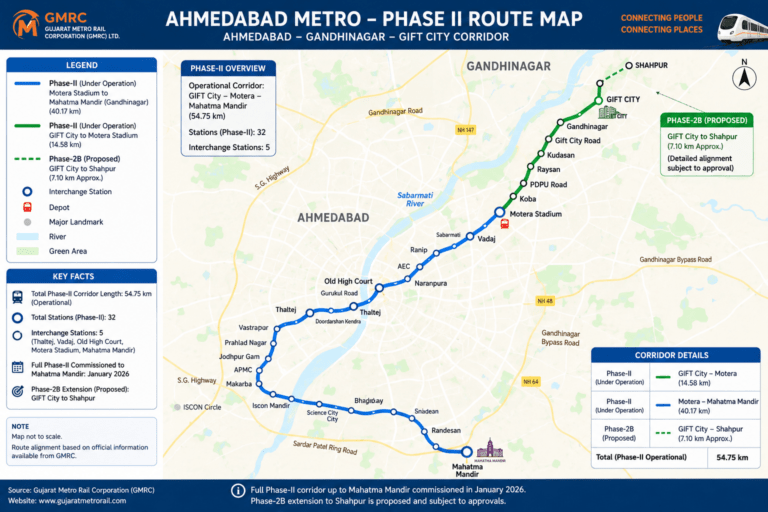
Connectivity has also improved.According to Gujarat Metro Rail Corporation, Ahmedabad Metro Phase-II now includes the Ahmedabad–Gandhinagar/GIFT City connection, with the full Phase-II commissioning reaching Mahatma Mandir in January 2026. GMRC also lists a planned Phase-2B extension from GIFT City toward Shahpur.
For GIFT City employees, I would introduce one additional test:
Before buying, calculate your approximate door-to-office journey for:
Then calculate the return journey.
Why?
Because your actual cost is not only EMI.
Your time has value.
Suppose one apartment saves you 25 minutes each way.
That is approximately:
50 minutes per working day.
Over roughly 240 working days, that can represent around:
200 hours per year.
That is more than eight full days.
So when comparing two flats, don’t ask only:
“Which one is ₹5 lakh cheaper?”
Ask:
“What am I buying or giving up every working day?”
Metro connectivity is an important factor, but I would be careful about paying a large premium solely because a salesperson says:
“Metro ke paas hai, price double ho jayega.”
That is not analysis.
GMRC’s official project information confirms that Ahmedabad Metro Phase-II connects key parts of Gandhinagar and GIFT City and that the full Phase-II corridor to Mahatma Mandir was commissioned in January 2026.That makes connectivity a legitimate factor.
But property value depends on several things together:
Never pay today’s premium based entirely on tomorrow’s promise.
A ₹75 lakh apartment and a ₹78 lakh apartment cannot be compared simply by headline price.
Look for:
The final cost may be substantially higher.
Higher floors can carry significant additional charges.
Confirm exactly what parking is included and what documentation applies.
Ask whether these are one-time or recurring.
Do not assume every advertised facility is included in the quoted price.
A cheaper apartment requiring ₹8–10 lakh of additional work may not actually be cheaper.
A low entry price can become expensive if possession is delayed.
I would become very cautious if I encountered any of these:
“Book today or lose the price.”
Pressure is not due diligence.
Refusal to provide a written cost sheet.
You cannot compare what you cannot calculate.
RERA/project details are unclear.
Stop and verify.
Possession promises differ from official project information.
Investigate before paying.
Seller avoids showing original documentation.
Do not rely on explanations.
The project has very low occupancy without a clear reason.
Understand why.
Broker refuses to discuss comparable properties.
That usually means you are being pushed toward a transaction rather than helped with a decision. Your EMI requires your entire monthly surplus. This is a financial red flag even if the property itself is good.
For an EEAT-focused article, I would not fill the page with generic property photographs.
This guide is not for someone who wants to hear:
“Buy anything near GIFT City and prices will definitely rise. I cannot responsibly make that promise.
You should rethink buying now if:
You are a GIFT City employee who is:
There is nothing financially embarrassing about renting.
Renting for 12–24 months can be a very intelligent property strategy if it helps you understand the market before committing to a ₹70 lakh–₹1 crore-plus decision.
This is not an article about:
If your entire investment thesis is:
“GIFT City is growing, therefore this flat must go up,”
your analysis is incomplete.
This is where I would be more opinionated.
I would first rent if I were new to the area or uncertain about staying for at least five years.
Why?
Because the first six to twelve months can teach you:
That information is worth more than a broker’s “last unit” argument.
I would seriously consider buying.
But I would prefer:
A practical 2 or 3 BHK in a strong residential location rather than an oversized luxury apartment bought mainly for prestige. For a family, I would lean toward a well-designed 3 BHK. For a single professional or couple, I would seriously consider a good 2 BHK if the third bedroom would remain unused.
I would negotiate the total acquisition cost, not just the advertised rate.
My target would be:
“Give me the complete written cost, then let’s negotiate the actual number I have to pay.”
For under-construction property, I would also negotiate around payment structure and delivery risk.
Documentation that does not match the sales pitch.
If the salesperson says one thing and the official project documents say something different, I stop. I would rather lose a property than lose money trying to explain away a red flag.
If I were personally comparing five flats, I would score them like this:
Factor | Weight |
Commute | 25% |
Total price/value | 20% |
Builder/project reliability | 15% |
Legal/documentation | 15% |
Apartment usability | 10% |
Resale/rental potential | 10% |
Amenities | 5% |
This weighting reflects one simple principle:
A home should work financially and practically before it looks impressive. If a property scores 9/10 on amenities but 5/10 on price and 5/10 on documentation, I would reject it.
There is no single project that deserves the label “best flat in Gandhinagar for GIFT City employees.” The best purchase depends on the buyer.
For most employees, I would prioritise:
Raysan, Randesan, Sargasan, Kudasan, Koba and selected Vavol/New Vavol properties, depending on budget, family requirements and acceptable commute.
But I would not select an apartment simply because it is in one of these areas.
I would select the specific property that survives six tests:
GIFT City is a genuine economic and infrastructure driver, and its ecosystem continues to develop. Official GIFT City information highlights its finance and technology ecosystem, while GMRC’s current information confirms expanded metro connectivity across the Ahmedabad–Gandhinagar–GIFT corridor.
But GIFT City growth is not a substitute for property due diligence.
If you remember only one thing from this guide, remember this:
Don’t buy a flat because GIFT City is growing. Buy only when the specific flat makes sense even after you remove the hype.
If you are comparing properties, create a simple spreadsheet containing the all-inclusive price, carpet area, commute time, RERA status, possession status, maintenance cost, realistic rent and resale alternatives. That comparison will usually tell you more than ten property brochures.

Here’s you Find your dream 3 BHK Flat For Sale In Gandhinagar, offering space, style, and comfort.
Live close to top schools, business hubs, and green surroundings.
Discover premium 3 BHK flats in Raysan, Sargasan, Vavol, Gandhinagar, surrounded by peaceful greenery and modern amenities.
Want your add here? Contact Now
602, BBC Tower, Near Law Garden, Opp. Mayor's Bungalow, Navrangpura, Ahmedabad - 380006
+91 9979363366
info@flyinglionmedia.net
Mon - Sut | 10 AM - 6.30 PM
Copyright © 2026 Flying Lion Media. All Rights Reserved
WhatsApp us