
Buying a flat in Gandhinagar can feel straightforward until a builder quotes 1,400 sq. ft. and you discover that the actual usable space is much smaller than you expected.
Imagine a family comparing two 3 BHK flats. Both are advertised as spacious apartments, and both appear to fit their budget. One builder quotes the area in built-up square feet, while another highlights the super built-up area. The family compares the total prices, assumes the larger number means a bigger home, and nearly pays more for a flat that offers less usable space.
This confusion is more common than many first-time homebuyers realise. The problem is not necessarily that a builder is cheating. It is that buyers are sometimes comparing different measurements as if they mean the same thing.
In my experience advising buyers in this market, the most useful question is not simply, “How many square feet is this flat?” It is, “How much usable space am I getting, what exactly am I paying for, and can I verify the figures in writing?”
This guide explains the difference between carpet area and built-up area in Gandhinagar flats, including super built-up area, RERA carpet area, price-per-square-foot calculations, builder quotations, and practical checks before booking a property.
The objective is simple: help you compare flats fairly, understand what you are buying, and avoid an expensive decision based on a misleading area figure.

Why Carpet Area vs Built-Up Area Matters to Real Buyers
The problem starts when two different numbers look comparable
A buyer searching for a 2 BHK flat in Kudasan, a 3 BHK apartment in Sargasan, or a family home in Raysan may see several properties advertised using different area measurements.
One listing might mention 1,100 sq. ft., another 1,350 sq. ft., and a third 1,550 sq. ft. Without knowing whether these figures represent carpet area, built-up area, or super built-up area, the comparison is practically meaningless.
A larger advertised figure does not automatically mean a larger living room, an extra usable bedroom, or more space for furniture.
My advice: never shortlist a flat based only on its advertised square footage. First establish the RERA carpet area, then compare the actual layout, room dimensions, total price, and overall suitability.
Why generic online explanations are not enough
Many property guides define carpet area and built-up area but stop before answering the questions buyers actually have:
- Is a flat with 800 sq. ft. carpet area better than one advertised as 1,200 sq. ft.?
- Why does the builder’s brochure show a larger number than the usable floor space?
- How can two flats with the same carpet area have different prices?
- Does a bigger balcony count as carpet area?
- Can a builder justify a higher price by quoting super built-up area?
- What happens if the approved plan and the sales brochure show different measurements?
These questions matter because the wrong comparison can influence your budget, loan planning, furniture arrangements, family comfort, and eventual resale.
The following sections focus on what to check before you pay a booking amount, rather than simply memorising property terminology.
Understanding Carpet Area, Built-Up Area and Super Built-Up Area
What is carpet area?
Carpet area is the net usable floor area of an apartment as defined under Section 2(k) of the Real Estate (Regulation and Development) Act, 2016.
Under this definition, carpet area excludes the area covered by external walls, service shafts, an exclusive balcony or verandah, and an exclusive open terrace, while including internal partition walls. Understanding the actual usable area of a flat helps homebuyers compare apartment sizes accurately before making a purchase decision.
In practical terms, carpet area is the most useful starting point for understanding the space within your apartment.
It covers the usable floor area of rooms, the kitchen, bathrooms, and internal circulation space, with internal partition walls treated according to the RERA definition.
However, do not assume that every square foot of RERA carpet area is open, unobstructed floor space. Internal walls are included in the statutory measurement, so the area you can furnish may differ from the total RERA carpet figure.
Why it matters: If you are buying a 3 BHK flat for a family of five, the carpet area and individual room dimensions will tell you far more about day-to-day comfort than a large super built-up figure.
What is built-up area?
Built-up area generally refers to the carpet area plus the area occupied by walls and certain attached spaces, such as a balcony, where applicable.
The exact calculation used in a quotation should be confirmed in writing because conventions and the treatment of attached areas can differ.
For example, consider an illustrative apartment with:
- RERA carpet area: 900 sq. ft.
- Additional area attributed to walls and an attached balcony: 135 sq. ft.
The resulting built-up area would be 1,035 sq. ft., assuming the additional area is calculated as stated and does not include overlapping measurements.
This is a mathematical illustration, not a standard ratio for every Gandhinagar apartment.
Why it matters: Built-up area is normally larger than carpet area. If a builder quotes a price per square foot using built-up area, you must establish that fact before comparing the quotation with another project.
What is super built-up area?
Super built-up area, sometimes called saleable area, generally adds a proportionate allocation of common areas to the built-up area.
Depending on the project’s disclosed measurement method, this may include a share of common corridors, entrance lobbies, staircases, lifts, and other shared facilities.
The exact components and allocation method should be documented. Do not assume that every builder calculates the figure in the same way.
Suppose an illustrative flat has a built-up area of 1,035 sq. ft. and a disclosed allocation of 265 sq. ft. for common areas.
Its super built-up area would be 1,300 sq. ft.
That does not mean the flat has 1,300 sq. ft. of private living space.
Why it matters: A buyer can end up comparing one property’s super built-up area with another property’s carpet area and mistakenly believe the first flat is larger.
Quick comparison table
| Area Type | What It Generally Includes | How a Buyer Should Use It |
|---|---|---|
| Carpet Area | Net usable apartment area, including internal partition walls under RERA | Primary starting point for evaluating usable space |
| Built-Up Area | Carpet area plus walls and certain attached areas, as disclosed | Understand the building footprint attributed to the flat |
| Super Built-Up Area | Built-up area plus an allocated share of common areas | Understand the builder's saleable-area calculation |
| Balcony Area | Exclusive balcony or verandah area | Check separately; excluded from RERA carpet area |
| Common Area | Shared spaces such as corridors and lift lobbies | Check which facilities are shared and how costs are allocated |
The important distinction is that carpet area has a statutory definition under RERA, whereas built-up and super built-up area figures need to be understood from the project’s disclosed measurement method.
A Simple Example: How a Flat's Advertised Size Can Mislead You
| Detail | Flat A | Flat B |
|---|---|---|
| Advertised Area | 1,300 sq. ft. | 1,200 sq. ft. |
| Area Type Advertised | Super built-up | Super built-up |
| RERA Carpet Area | 900 sq. ft. | 930 sq. ft. |
| Total Quoted Price | ₹65 lakh | ₹66 lakh |
| Price per Sq. Ft. of Carpet Area | ₹7,222 | ₹7,097 |
All figures are illustrative. They are not current quotations or verified market prices for any specific Gandhinagar project.
Flat A appears larger in the advertisement and costs ₹1 lakh less. A buyer who compares only the advertised area and total price may prefer it immediately.
But Flat B offers 30 sq. ft. more carpet area and has a slightly lower price per square foot of carpet area.
That does not automatically make Flat B the better purchase. Floor level, orientation, room dimensions, balcony, construction quality, parking, maintenance costs, and location still matter.
It does, however, change the comparison. You now have a meaningful starting point.
The formula every buyer should use
Price per sq. ft. of carpet area = Total comparable flat price ÷ RERA carpet area
For Flat A:
₹65,00,000 ÷ 900 = approximately ₹7,222 per sq. ft.
For Flat B:
₹66,00,000 ÷ 930 = approximately ₹7,097 per sq. ft.
Use the same price basis for both flats. If one quote excludes parking, taxes, or other charges and the other includes them, adjust the comparison before drawing a conclusion.
Do not automatically add every possible purchase expense to the property price when calculating this measure. Instead, keep two comparisons: the comparable apartment price per carpet square foot and the complete acquisition budget, including applicable additional costs.
This helps you distinguish between an attractive headline price and a genuinely affordable purchase.
Real Buyer Problems in Gandhinagar's Residential Market
Problem 1: Comparing prices without checking the area type
A broker might say that a flat costs ₹5,500 per sq. ft., while another project is quoting ₹6,000 per sq. ft.
Those numbers are not enough to establish which property offers better value.
Ask whether each price is calculated on carpet area, built-up area, or super built-up area. Also ask whether the quoted price includes parking, floor-rise charges, club or amenity charges, and other mandatory payments.
My position: If a seller cannot explain the area basis clearly, I would not proceed to a booking payment until the quotation is clarified in writing.
Problem 2: A larger flat on paper but a weaker layout
A 3 BHK flat can have a reasonable total carpet area and still feel cramped if the bedrooms are narrow, the passages consume space, or the living and dining areas are awkwardly arranged.
A family should check room dimensions, bed placement, wardrobe clearance, dining-table space, and ventilation. If possible, take a tape measure to the site visit.
A well-designed smaller apartment may suit a family better than a poorly planned larger one.
Problem 3: Attractive offers that hide the full cost
Discounts and limited-period offers can distract buyers from the real question: what is the total cost of owning this flat?
A lower base price may be offset by extra charges, expensive maintenance, parking costs, or substantial fit-out expenses.
Ask for a complete written cost sheet and compare it with the agreement for sale before committing.
Do not treat a discount deadline as proof that the property is good value.
Problem 4: Choosing a location before understanding daily life
Gandhinagar’s residential options include established sectors and developing residential areas such as Kudasan, Sargasan, Raysan, and Randesan. Their suitability depends on your commute, family requirements, local access, and the specific project’s surroundings.
A property close to a major road may offer convenient travel but also experience traffic noise. A developing pocket may offer attractive layouts but require you to verify existing services and the actual status of nearby infrastructure.
Visit the property during your usual commuting hours, not just during a quiet afternoon site visit.
Problem 5: Confusing investment potential with end-use suitability
An investor may accept a smaller layout if the expected rent and resale demand justify the purchase. A family buying for the next ten years may prioritise usable space, storage, school access, and privacy.
Neither approach is automatically right for everyone.
The mistake is buying an apartment because it sounds like a good investment when it does not fit your household’s needs—or buying a larger home on the assumption that a larger area will guarantee better appreciation.
Carpet area helps you compare space. It does not independently predict future property prices.
Step-by-Step Buyer Action Plan
Step 1: Select the location before comparing apartment sizes
What to do
Shortlist locations based on your actual needs: office commute, school access, healthcare, public transport, shopping, family support, and future household plans.
If you are comparing flats in Kudasan, Sargasan, Raysan, or Randesan, visit the exact project rather than assuming that every development in the same locality offers similar convenience.
Why it matters
A difference of 50 sq. ft. in carpet area may be less important than a difficult daily commute or an inconvenient approach road.
Mistakes to avoid
- Choosing a property based only on a future infrastructure promise.
- Assuming the whole locality has the same road access and services.
- Ignoring traffic, noise, drainage, or construction activity nearby.
- Buying an oversized flat in a location that does not suit your lifestyle.
Practical tip
Make two visits: one during the morning or evening commute and another at a different time of day. Ask current residents about water supply, maintenance, parking, and recurring problems.
Step 2: Set the budget and validate the price
What to do
Request the following in writing:
- RERA carpet area.
- Built-up area, with its calculation explained.
- Super built-up area, if quoted.
- Base apartment price.
- Parking and additional charges.
- Applicable taxes and government charges.
- Maintenance deposits and recurring maintenance.
- Estimated fit-out and furnishing expenses.
Calculate the comparable price per square foot using carpet area.
Why it matters
Your loan eligibility and household affordability depend on the complete financial commitment, not merely the advertised base price.
Mistakes to avoid
- Comparing two different area measurements.
- Forgetting registration-related costs and furnishing expenses.
- Assuming a builder’s price-per-square-foot calculation is directly comparable with another builder’s.
- Spending your entire available budget on the purchase and leaving no emergency reserve.
Practical tip
Prepare a comparison sheet for at least three properties. Use the same columns and the same price basis for all three.
If the seller will not provide a clear cost sheet or explain a substantial discrepancy, pause the decision.
Step 3: Verify the builder and RERA registration
What to do
Confirm the project’s registration number, approved details, declared completion timeline, relevant sanctioned plans, and available project disclosures.
Check the specific phase or tower you intend to buy. A registration associated with one phase should not be assumed to cover every phase of a larger development.
Why it matters
A convincing brochure does not establish that a project has the approvals, timeline, or legal status you need.
RERA registration is an important verification step, but it is not a guarantee of construction quality, timely delivery, or investment returns.
Mistakes to avoid
- Relying only on a salesperson’s screenshot.
- Assuming a registration number proves every approval is in order.
- Ignoring differences between the advertised unit and the registered project information.
- Accepting verbal promises about possession or amenities.
Practical tip
Save copies of the official disclosures you review. If the promised apartment configuration or area does not match the documents, request written clarification before paying.
Step 4: Inspect the actual flat and its layout
What to do
During the site visit, compare the floor plan with the actual apartment. Check:
- Living room and bedroom dimensions.
- Kitchen counter and storage space.
- Bathroom layout and ventilation.
- Door swings and furniture placement.
- Window positions and natural light.
- Balcony dimensions and access.
- Columns or structural projections affecting furniture.
- Lift, corridor, parking, and common-area access.
For an under-construction flat, inspect the relevant approved plans and ask which measurements relate to the exact unit.
Why it matters
Two apartments with identical carpet areas can feel completely different because of their layouts.
Mistakes to avoid
- Treating a sample flat as an exact representation of the purchased unit.
- Assuming every wall, opening, or furnishing shown in a marketing plan will match the delivered apartment.
- Ignoring the practical effect of a narrow bedroom or poorly placed column.
Practical tip
Sketch where your existing bed, wardrobes, sofa, dining table, and refrigerator would go. If the apartment cannot comfortably accommodate essential furniture, a larger advertised area will not solve the problem.
Step 5: Complete legal and registration checks
What to do
Before signing, have a qualified property lawyer review the agreement for sale, title and ownership records, relevant approvals, encumbrance-related information, and applicable completion or occupancy documents.
For a ready-to-move property, verify the applicable building-use or occupancy documentation and the actual unit being transferred. For an under-construction property, review the relevant sanctioned plans and contractual obligations.
Why it matters
A flat can have an appealing layout and a reasonable carpet area but still carry legal, documentation, or delivery risks.
Mistakes to avoid
- Assuming a booking form is equivalent to a fully reviewed agreement.
- Paying a substantial amount before understanding refund and cancellation clauses.
- Relying on a broker’s assurance that all documents are correct.
- Confusing a marketing floor plan with a sanctioned plan.
Practical tip
Ask your lawyer to compare the apartment’s area descriptions across the RERA disclosures, approved plan, cost sheet, and agreement. Any material inconsistency should be explained before execution.
Step 6: Negotiate using evidence, not urgency
What to do
Negotiate after you have verified the area, comparable properties, total cost, and documentation.
If two flats have similar carpet areas but different prices, ask the seller to explain the difference using location, floor, orientation, construction stage, specifications, and included charges.
Why it matters
A lower headline price does not always mean a lower overall cost. Equally, a higher price is not automatically justified by a larger super built-up figure.
Mistakes to avoid
- Paying a booking amount because an offer supposedly expires that day.
- Negotiating only on the base price while ignoring additional costs.
- Accepting a verbal promise of extra usable space.
- Believing that a higher floor or a larger advertised area guarantees better resale.
Practical tip
Ask for the final offer, inclusions, exclusions, payment schedule, and cancellation terms in writing. Be prepared to walk away if the figures cannot be reconciled.
A good purchase is not one in which you win a negotiation by ₹1 lakh. It is one in which you understand exactly what you are buying and can comfortably afford it.
Realistic Case Studies: How Area Comparisons Change Decisions
The following are illustrative scenarios, not verified client transactions or actual sales records. They show how a buyer can evaluate a property decision using transparent calculations. Actual prices, rents, and appreciation depend on the project, location, market cycle, and transaction date.
Case Study 1: A Family Buying a 3 BHK Flat
Buyer profile: A working couple with one child, planning to live in the apartment for at least eight years.
| Detail | Illustrative Example |
|---|---|
| Total Purchase Budget | ₹75 lakh, including purchase-related costs |
| Preferred Location | Kudasan |
| Flat Under Consideration | 3 BHK |
| Negotiated Apartment Price | ₹64 lakh |
| RERA Carpet Area | 1,050 sq. ft. |
| Advertised Super Built-Up Area | 1,500 sq. ft. |
| Illustrative Later Value | ₹70 lakh after four years |
The family initially favoured a flat advertised at 1,500 sq. ft. because it appeared larger than other options.
After comparing the carpet areas and actual room dimensions, the family discovered that the advertisement alone did not reveal how much usable space the flat offered. They checked the layout, calculated the price per carpet square foot, and compared the full purchase cost with alternatives.
The illustrative apartment price per carpet square foot was:
₹64,00,000 ÷ 1,050 = approximately ₹6,095.
If the flat’s value later reached ₹70 lakh, the nominal increase over the ₹64 lakh purchase price would be ₹6 lakh, or approximately 9.4% cumulatively.
That is not an annualised return and does not account for purchase costs, maintenance, financing, taxes, inflation, or selling expenses.
Lesson learned: The family should choose the apartment that provides the right layout and verified usable space within budget—not the one with the biggest brochure number.
Case Study 2: An Investor Evaluating a 2 BHK Flat
Buyer profile: An investor considering a smaller apartment for long-term rental income rather than short-term flipping.
| Detail | Illustrative Example |
|---|---|
| Entry Apartment Price | ₹45 lakh |
| RERA Carpet Area | 750 sq. ft. |
| Advertised Super Built-Up Area | 1,050 sq. ft. |
| Illustrative Monthly Rent | ₹18,000 |
| Annual Gross Rent | ₹2,16,000 |
| Illustrative Later Resale Price | ₹49 lakh after three years |
The gross rental yield based on the apartment purchase price would be:
₹2,16,000 ÷ ₹45,00,000 × 100 = 4.8% per year.
This is a gross yield before maintenance, vacancy, repairs, property management, financing costs, taxes, and other expenses. The actual net yield would be lower.
If the investor sold the flat for ₹49 lakh after three years, the nominal increase over the entry price would be ₹4 lakh, or approximately 8.9% cumulatively. This excludes transaction costs and is not a guaranteed outcome.
What worked in the scenario: The investor evaluated rent relative to the entry price, focused on a practical apartment layout, and considered the likely rental audience.
What did not necessarily work: The resale increase alone might not justify the investment after expenses. A vacant flat or unexpected maintenance cost could reduce the return considerably.
Exit strategy: Before purchasing, the investor should assess rental demand, comparable resale transactions, holding costs, and the circumstances in which they would sell or retain the property.
Lesson learned: Carpet area improves the quality of a property comparison, but investment success depends on purchase price, rental demand, expenses, liquidity, and the eventual exit—not area alone.
Buyer Feedback and Testimonials: How to Present Social Proof Honestly
Real testimonials can help future buyers understand practical concerns, but only when they come from genuine people who have agreed to share their experiences.
The following are sample testimonial formats for editorial planning, not actual client reviews. Replace them with genuine, permission-based feedback before publishing them as testimonials.
Sample 1: IT professional buying in Kudasan
“I was comparing flats based on the square-foot figure in the brochure. Once I asked for the carpet area and checked the room dimensions, I could compare the options more sensibly.”
— Sample profile: IT professional, Kudasan
Sample 2: PSU employee purchasing a family home in Sargasan
“The total price was important, but the layout mattered just as much. Checking the bedroom sizes and additional charges helped us understand which apartment suited our budget.”
— Sample profile: PSU employee, Sargasan
Sample 3: NRI assessing a property remotely
“I wanted the area details and cost breakdown in writing before making a decision. It was much easier to evaluate the flat when the measurements and charges were clearly explained.”
— Sample profile: NRI buyer, Gandhinagar
Trust rule for the publisher: Do not add fabricated names, photographs, transaction dates, or claims of verified outcomes to these sample statements. Use real, documented feedback if you want to present them as customer testimonials.
Verified Data and Market Context: Where Buyers Should Check
A reliable property decision requires more than a builder’s brochure or a broker’s verbal estimate.
The following sources can help you cross-check different aspects of a purchase.
Gujarat RERA portal
Use it to investigate the relevant registered project, declared timelines, disclosures, and available project documents.
RERA carpet area is defined under Section 2(k) of the Real Estate (Regulation and Development) Act, 2016. This statutory definition is the appropriate starting point when comparing the usable area disclosed for a covered apartment.
Gujarat registration and Jantri information
Use the relevant official registration and valuation facilities to check applicable Jantri information and registration-related requirements.
Jantri values are government valuation benchmarks, not proof that a flat will sell at that price. They should not be treated as a substitute for comparing actual, relevant property transactions.
Sub-Registrar records and registered transactions
Where records are legally accessible, review relevant registered documents and comparable transactions with professional assistance.
A registered transaction can provide useful evidence of a recorded consideration, but it must be compared carefully: location, property type, floor, age, configuration, condition, date, and the area measurement may differ.
Do not assume that one registry receipt proves the market value of every nearby flat.
Sanctioned plans and local authority records
Check the relevant sanctioned building plans, applicable approvals, and completion or occupancy documentation through the responsible authority and project records.
The exact authority and documents depend on the property’s location and development status.
Current market conditions
Property prices and rental demand are time-dependent. Interest rates, household affordability, new supply, infrastructure delivery, employment patterns, and resale liquidity can all change the attractiveness of a purchase.
I would not make a claim that Gandhinagar flat prices are currently rising or falling without dated, comparable transaction evidence. Asking prices and promotional offers are not equivalent to completed sale prices.
A sensible rule: Verify the area using project documentation, validate the price against relevant transactions, and assess affordability using your own finances. No single source can establish all three.
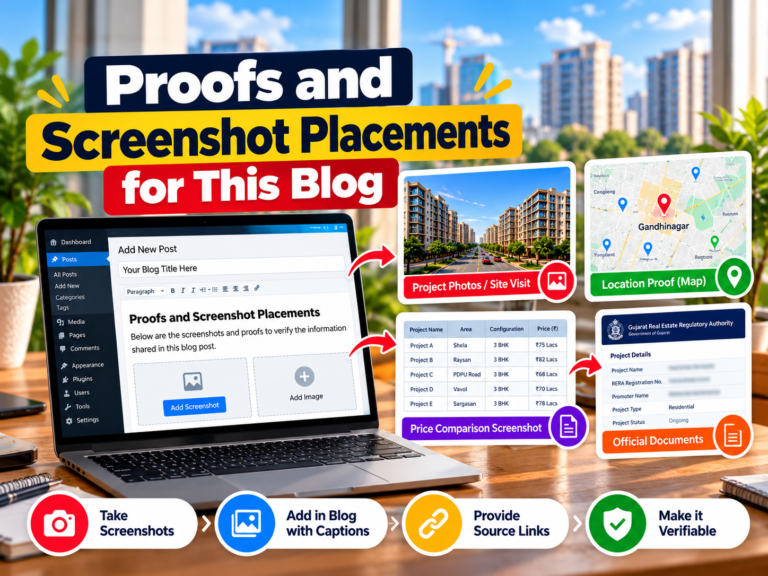
Proofs and Screenshot Placements for This Blog
Who This Guide Is Not For
This guide is intended for buyers who want to understand the space, cost, and documentation behind a residential apartment purchase.
It is not designed to justify every purchase or persuade everyone to buy immediately.
Who should not rely on this guide alone?
- Buyers who need a formal legal opinion on title, ownership, or a disputed agreement.
- Buyers who need a structural inspection or professional measurement of a specific apartment.
- Buyers who need a current valuation for a loan, tax matter, or legal dispute.
- Investors who need project-specific financial modelling or a professional assessment of rental and resale risk.
Those decisions require additional evidence and, where appropriate, qualified professional advice.
Who should wait or rethink buying?
You should consider delaying the purchase if:
- The builder will not clearly disclose the carpet area.
- The quoted area figures cannot be reconciled with the available documents.
- Your EMI would leave too little room for essential household expenses.
- Your down payment would exhaust your emergency savings.
- The purchase depends on an unverified infrastructure promise or speculative price increase.
- You have not checked the legal documents or the full cost of acquisition.
- You are under pressure to pay immediately without sufficient time for due diligence.
Renting for another year can be a rational decision if it gives you time to build savings, understand localities, or compare available properties more carefully.
What this guide will not help you do
This article is not a shortcut to short-term flipping, guaranteed appreciation, or rumour-based property investing. It cannot predict which Gandhinagar locality will deliver the highest return.
Its purpose is to help you compare apartment measurements, understand the financial commitment, ask better questions, and identify when you do not yet have enough evidence to buy.
Sometimes the most valuable property decision is the one you postpone.
If I Were Buying This Property Today
If I were buying a flat in Gandhinagar today, I would begin with the RERA carpet area and the actual floor plan—not the advertised super built-up area.
I would not commit to a property simply because the builder described it as spacious or offered a limited-period discount.
Would I buy now or wait?
I would buy now only if I found a suitable apartment with a verifiable area calculation, a defensible price, satisfactory documentation, and a comfortable financial margin.
I would wait if the seller could not explain the area figures, the agreement conflicted with the disclosed plans, or the purchase depended on speculative appreciation.
The calendar is less important than the quality of the deal and my ability to afford it safely.
Which configuration would I choose?
For a family home, I would compare a well-planned 2 BHK with a larger 3 BHK based on household needs, privacy, room dimensions, storage, and the likely length of stay.
I would prefer a practical layout with enough usable space over an apartment with an impressive advertised area but poorly proportioned rooms.
For an investment property, I would also assess the likely tenant profile, comparable rent, vacancy risk, maintenance expenses, and resale demand.
What would I negotiate hardest?
I would insist on a transparent, written breakdown of the apartment’s RERA carpet area, quoted price, inclusions, and additional charges.
I would also compare the effective apartment price per carpet square foot with relevant alternatives. I would not accept a comparison based on mismatched area measurements.
What red flag would I refuse to ignore?
A material mismatch between the promised apartment, the disclosed area figures, and the relevant project documents.
I would not rely on a verbal assurance that the difference is normal. I would ask for the discrepancy to be explained in writing and independently reviewed before making a commitment.
If the seller refused to clarify it, I would walk away.
A good property purchase should withstand reasonable questions. You should not have to suspend your judgment to complete the deal.
Conclusion:
The difference between carpet area and built-up area in Gandhinagar flats is not merely a technical detail. It affects how you compare properties, evaluate the price, plan your furniture, and decide whether a home is suitable for your family.
Remember these essentials:
- Carpet area: The statutory net usable apartment area, including internal partition walls under RERA.
- Built-up area: Generally includes carpet area plus walls and certain attached spaces.
- Super built-up area: Generally includes built-up area plus an allocated share of common areas.
- Price comparison: Use the comparable apartment price divided by RERA carpet area.
- Due diligence: Verify the area disclosures, plans, total cost, project documents, and agreement before booking.
If you are comparing 2 BHK or 3 BHK flats in Kudasan, Sargasan, Raysan, Randesan, or another part of Gandhinagar, do not let a large advertised square-foot figure make the decision for you.
Ask for the measurements. Check the layout. Compare the complete cost. Verify the documents. Take time to understand anything that does not add up.
A useful next step: Prepare a simple comparison sheet with the RERA carpet area, quoted price, price per carpet square foot, room dimensions, additional charges, and document-verification status for each property you are considering. It will make your next site visit much more productive.
If you have a question about a particular area calculation, share the quoted carpet area, built-up area, super built-up area, and apartment price. You can then compare the figures more clearly without disclosing private documents or personal information.
FAQs: Carpet Area vs Built-Up Area in Gandhinagar Flats
1. What is the difference between carpet area and built-up area?
2. Is carpet area the actual usable area of a flat?
3. What is the difference between carpet area and super built-up area?
4. How do I calculate the price per square foot of carpet area?
5. Can builders advertise flats using super built-up area?
References
About the Author