
This article focuses on 3 BHK property investment in Gandhinagar from a buyer’s perspective: how to evaluate a property’s real value, distinguish a sensible long-term investment from an expensive mistake, and verify the facts before committing your money.
One important distinction: a home purchased for your family should be evaluated differently from an apartment purchased purely for rental income or appreciation. The same property can be a good home and a mediocre investment.
Buying a 3 BHK flat in Gandhinagar can be a sensible long-term decision, but only if the property fits your budget, location requirements and exit plans. A spacious apartment in the wrong location, an overpriced new project or a home purchased with an uncomfortable EMI can turn an otherwise good investment into a financial burden.
The right approach is to evaluate the flat as both a place to live and an asset you may eventually need to sell or rent.
The Real Buyer Story: When Every Property Looks Like the Right Deal
Imagine a family with a budget of ₹90 lakh searching for a 3 BHK flat in Gandhinagar. One broker recommends Kudasan because of its established residential surroundings. Another recommends Raysan because of its proximity to educational institutions and selected employment corridors. A builder offers a newly launched project in Randesan and claims that prices will rise after possession.
Every option sounds convincing. One property offers a larger living room, another promises better amenities, and a third comes with a limited-period booking offer.
The family now faces a difficult question: should they buy the property they can afford today, or stretch their budget for the one that might appreciate more in the future?
This is where many buyers make an expensive mistake. They compare brochures, amenities and advertised prices without comparing the actual carpet area, completed-project alternatives, travel time, total acquisition cost and resale demand.
In my experience advising buyers in this market, the most important question is not simply whether Gandhinagar is a good place to buy property. It is whether a particular flat is worth its price for a particular buyer.
Many online property articles fail at this point. They list popular localities, highlight infrastructure development and suggest that property values will rise. They rarely explain what happens if the expected appreciation does not materialise, the family needs to relocate, or the monthly EMI becomes difficult to manage.
This guide takes a different approach. It focuses on practical checks, realistic financial calculations and the conditions under which you should walk away from a deal.
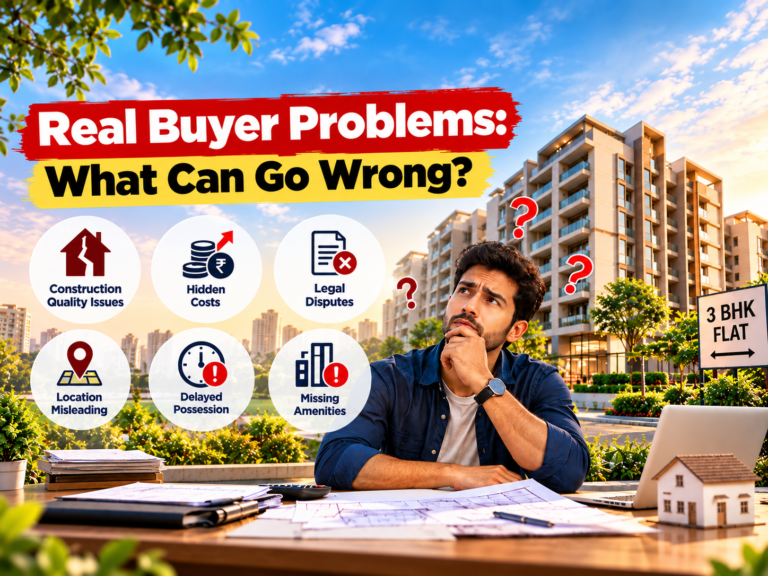
Real Buyer Problems: What Can Go Wrong?
Price confusion and hidden costs
A property advertised at ₹85 lakh may not cost ₹85 lakh by the time you receive possession and make it ready to live in.
Depending on the transaction, additional expenses may include stamp duty, registration charges, GST where applicable to an under-construction property, parking charges if lawfully applicable, maintenance deposits, society-related charges, loan processing costs, interior work and moving expenses.
For example, a family purchasing a flat for ₹85 lakh should not assume that ₹85 lakh is its complete financial requirement. The actual amount depends on the property’s legal status, the applicable charges and the inclusions specified in the agreement.
The mistake to avoid: comparing one builder’s advertised base price with another property’s all-inclusive price.
Ask every seller for a written cost sheet. Compare the final payable amount, not the headline figure.
Fake urgency and misleading offers
Buyers often hear statements such as:
- Only one flat is left at this price.
- Prices will increase next week.
- The entire project will be sold out before possession.
- This is the last opportunity to buy before a major infrastructure announcement.
Some offers may be genuine, but urgency is not evidence of value.
Before paying a booking amount, ask for the offer in writing, including its validity, cancellation conditions, refund terms and the exact unit being offered. Compare similar properties and verify whether the quoted price includes parking, floor premiums and other charges.
If the seller refuses to provide basic information until you pay a token amount, pause the transaction.
Builder credibility and possession risk
A well-designed sample flat does not establish the construction quality of the entire project. As part of a Practical guide to buying a 3 BHK flat in Gandhinagar, evaluate the builder’s previous delivery record, financial capacity, project approvals and handling of existing residents rather than relying solely on promotional claims.
For under-construction flats, delayed possession can mean paying rent and an EMI simultaneously. You may also face additional interior costs, changing possession expectations or uncertainty about common facilities.
Check the project’s registration and disclosures on the official Gujarat RERA portal where registration is applicable. Review the declared completion date, extensions, available progress disclosures and relevant approvals. Registration is an important compliance check, not a guarantee that every promise will be fulfilled.
Choosing the wrong location
Gandhinagar is not one uniform residential market. Kudasan, Sargasan, Raysan, Randesan, Koba, Vavol and areas near PDPU Road differ in access, surroundings, available housing stock and buyer requirements.
A flat that works for a family commuting to GIFT City may be inconvenient for someone working in central Ahmedabad. Similarly, a lower purchase price may not compensate for daily travel, limited public transport, poor access roads or a lack of nearby services.
Visit the property at different times. Check morning traffic, evening access, street lighting, nearby construction, water supply and the actual route to work.
Do not buy based on a locality name alone. The exact road, residential pocket and building can matter more than the broad area.
End-use versus investment confusion
A family buying a home for ten years should prioritise daily convenience, layout, maintenance and affordability. An investor should pay closer attention to achievable rent, vacancy, tenant demand, recurring expenses and eventual resale.
These are different purchase decisions.
A premium apartment may be comfortable for personal use but deliver a weak rental return. A more modest flat near employment or education hubs may be easier to rent, even if it offers fewer amenities.
Do not justify an expensive home as an investment merely because you like living in it. Equally, do not buy an inconvenient property solely because someone predicts future appreciation.
Step-by-Step Buyer Action Plan
Step 1: Choose the location before choosing the flat
What to do
Shortlist two or three specific residential pockets based on your daily travel, budget and intended holding period.
Use the following comparison as a starting point:
| Locality | What to investigate | Main buyer concern |
|---|---|---|
| Kudasan | Existing residential surroundings, services and commute routes | Building condition, congestion and the price premium |
| Sargasan | Access to major roads, local services and employment routes | Differences between individual residential pockets |
| Raysan | Access to educational institutions, employment corridors and daily facilities | Whether the asking price is supported by comparable properties |
| Randesan | Project quality, connectivity and completed-flat alternatives | Premium pricing and actual resale demand |
| Koba | Access to work, public transport and established services | Whether the exact location suits daily commuting |
| Vavol | Budget fit, local amenities and travel requirements | Whether savings justify any compromises in convenience |
| PDPU Road area | Commute routes, nearby services and competing projects | Whether the quoted premium reflects real advantages |
These are screening points, not a universal ranking. The best locality depends on your household and the specific property.
Why it matters
A home is a daily-use asset. A slightly cheaper property can become expensive in terms of commuting, travel time and lifestyle compromises.
Mistakes to avoid
- Selecting a location only because a broker calls it an upcoming hotspot.
- Assuming proximity to GIFT City guarantees strong rental demand.
- Ignoring schools, hospitals, groceries and public transport.
- Paying for a future infrastructure benefit that is not yet operational.
Practical tip
Drive your intended work commute during peak hours before making the final decision. If possible, speak with residents and shopkeepers in the immediate neighbourhood rather than relying exclusively on the seller.
Step 2: Fix the complete budget and validate the price
What to do
Calculate the total cost of acquisition, your down payment, expected loan amount, EMI, immediate furnishing expenses and emergency reserves.
Then compare the property with at least three genuinely comparable options. Match carpet area, building age, floor, parking, possession status and included facilities as closely as possible.
Online asking prices are useful for creating a shortlist, but they are not proof of completed transaction values.
For context, Magicbricks reported the following average apartment asking/listing indicators for Q2 2026:
| Locality | Reported average price per sq. ft. |
|---|---|
| Kudasan | ₹4,540 |
| Raysan | ₹4,539 |
| Randesan | ₹4,674 |
Why it matters
A seller can quote a reasonable-looking rate per square foot while offering a smaller usable home or a less desirable configuration.
Mistakes to avoid
- Comparing super built-up area with carpet area.
- Ignoring registration, applicable taxes and interior costs.
- Assuming bank loan eligibility means the EMI is affordable.
- Treating a portal’s locality average as a guaranteed resale price.
Practical tip
Prepare two budgets: the amount you can spend comfortably and the absolute maximum you could pay. Negotiate within the first. The second should be a boundary, not a target.
Step 3: Verify the builder, project and RERA details
What to do
For an under-construction project, search the official Gujarat RERA portal and match the project’s registration details to the exact project and promoter.
Review the available registration information, declared completion date, approved plans and progress disclosures. Confirm which approvals are relevant to the project and whether they have been obtained.
For a completed apartment, inspect the applicable completion or building-use documentation, conveyance and title documents, and outstanding society or municipal dues.
Also investigate the developer’s earlier projects. Where possible, speak to existing residents about construction defects, water supply, lifts, maintenance and delays.
Why it matters
A project can have attractive amenities and still create serious ownership problems if essential approvals, documentation or delivery commitments are uncertain.
Mistakes to avoid
- Treating RERA registration as a guarantee of quality or timely delivery.
- Relying on verbal promises that are absent from the agreement.
- Assuming a project’s marketing name is sufficient to identify its registered details.
- Paying a large amount before independently reviewing the documents.
Practical tip
Ask a property lawyer to review the documents before making a substantial non-refundable payment. If a seller resists independent verification, treat that resistance as a warning sign.
Step 4: Conduct a proper site inspection
What to do
Inspect the actual flat, not just the sample unit. For a ready property, check the condition of the building and common areas. For an under-construction property, assess visible progress and verify the permitted plans and specifications.
Use this checklist:
- Carpet area and practical furniture placement.
- Natural light, ventilation and room dimensions.
- Bathroom drainage, water pressure and damp patches.
- Window sealing, cracks and visible seepage.
- Lift availability, backup power and fire-safety arrangements.
- Parking allocation and access.
- Water supply and waste management.
- Mobile network coverage and noise levels.
- Common-area maintenance and recurring charges.
- Actual travel time to essential destinations.
Why it matters
A three-bedroom label does not guarantee three usable bedrooms. Poor room dimensions, awkward passages and insufficient storage can make a larger apartment less practical than a smaller, better-designed one.
Mistakes to avoid
- Inspecting only during a builder’s arranged daytime visit.
- Ignoring the building’s common areas.
- Assuming every advertised amenity will be operational at possession.
- Failing to check the exact parking allocation.
Practical tip
Visit once during the day and once in the evening. If possible, revisit after rain to check drainage and signs of water ingress.
Step 5: Verify legal documents and registration requirements
What to do
Before finalising a purchase, have an independent property lawyer examine the title chain, ownership, encumbrances, applicable land-use permissions, sanctioned plans and relevant building approvals.
For a resale flat, also verify the previous sale deed, outstanding loan or mortgage issues, applicable society records and dues, and whether the seller has the legal authority to transfer the property.
For registration and price assessment, check the applicable Jantri or circle-rate information and the relevant registration requirements. These checks are important, but they do not replace a title investigation.
Why it matters
A property can appear physically sound and still have documentation or ownership issues that delay registration, financing or resale.
Mistakes to avoid
- Treating a bank’s loan approval as a substitute for your own legal due diligence.
- Relying only on a photocopy of a previous sale deed.
- Assuming an online property listing proves ownership.
- Ignoring differences between the advertised area and the area documented in the agreement.
Practical tip
Do not sign a binding agreement or release a substantial payment until your lawyer has reviewed the relevant documents and explained any unresolved risks in writing.
Step 6: Negotiate using evidence, not emotion
What to do
Negotiate after you have inspected the flat, compared alternatives and established your total budget.
Use evidence such as comparable properties, repair requirements, the property’s age, possession readiness, included parking and any documented outstanding charges.
For a new project, clarify the written price breakdown and the terms attached to any offer. For a resale property, consider the seller’s actual timeline and whether the flat needs repairs.
Why it matters
The objective is not to obtain the biggest advertised discount. It is to purchase the right property at a defensible total cost.
Mistakes to avoid
- Paying a token amount because a seller claims another buyer is waiting.
- Accepting a discount that depends on unclear payment conditions.
- Ignoring defects because the seller refuses to reduce the price.
- Negotiating the base price while overlooking extra charges.
Practical tip
Keep a written record of the negotiated price, included items, payment schedule, possession terms and cancellation conditions. If the numbers work only under optimistic assumptions, walk away.
Realistic Case Studies: How the Numbers Can Change the Decision
The following examples are illustrative buyer scenarios, not verified client transactions. They demonstrate how to evaluate a purchase without assuming that property prices will rise.
Case Study 1: A family buying for end use
Buyer profile: A family with two children, a combined monthly take-home income of ₹1.6 lakh and a long-term plan to live in Gandhinagar.
| Particular | Illustrative Amount |
|---|---|
| Purchase price of 3 BHK | ₹85 lakh |
| Assumed additional purchase costs and initial work | ₹7 lakh |
| Total acquisition outlay | ₹92 lakh |
| Down payment | ₹25 lakh |
| Home loan | ₹60 lakh |
| Loan interest assumption | 8.5% annually |
| Loan tenure | 20 years |
| Approximate monthly EMI | ₹52,100 |
The figures are rounded assumptions. Actual taxes, transaction expenses, loan terms and initial work will vary.
Suppose the family chooses a ready-to-move flat with a practical layout and a manageable commute rather than a more expensive under-construction apartment with premium amenities.
After five years, imagine that comparable properties suggest a potential market value of ₹98 lakh. That would be a nominal increase of ₹13 lakh over the original purchase price, or approximately 15.3%.
However, this is a hypothetical valuation, not a prediction. The family would also have paid loan interest, maintenance and other ownership expenses. Selling costs and inflation would further affect the economic result.
Lesson learned: A family should purchase a home it can comfortably hold through a period of slow appreciation. A manageable EMI and a suitable location can be more valuable than paying extra for amenities or speculative future growth.
Case Study 2: An investor purchasing for rental income
Buyer profile: An investor who wants rental income and potential long-term appreciation rather than immediate personal use.
| Particular | Illustrative Amount |
|---|---|
| Purchase price | ₹90 lakh |
| Initial transaction and setup costs | ₹6 lakh |
| Total initial investment | ₹96 lakh |
| Assumed monthly rent | ₹25,000 |
| Annual gross rent | ₹3 lakh |
| Gross rental yield on purchase price | 3.33% |
Gross rental yield is calculated as annual rent divided by the purchase price. In this example, ₹3 lakh divided by ₹90 lakh gives approximately 3.33%.
Now allow for one month of vacancy, maintenance and repairs, insurance or other applicable ownership expenses. If these total ₹60,000 for the year, the remaining rental income would be around ₹2.15 lakh before financing costs and applicable taxes. That is approximately 2.39% of the purchase price.
This still excludes any major repair, unexpected vacancy or loan interest.
Suppose the investor later receives an offer of ₹1.02 crore. The property has appreciated by ₹12 lakh, or 13.3% over the original purchase price, before transaction and selling costs. That does not automatically mean the investment has delivered a good overall return.
What worked: The investor assessed rent against the purchase price, kept funds available for vacancy and repairs, and selected a flat with a plausible tenant market.
What did not: If the purchase depended on a high EMI and continuous occupancy, the rental income might not cover the cash-flow gap.
Exit strategy: Review actual rental performance and comparable resale demand periodically. Consider selling if the investment no longer meets your return requirements, the property’s maintenance burden rises, or a better use for the capital emerges.
Lesson learned: A 3 BHK property investment in Gandhinagar should be judged on net cash flow, holding costs and realistic exit options, not appreciation alone.
Buyer Testimonials: What Genuine Feedback Should Look Like
Testimonials can help future buyers understand practical ownership issues, but only when they come from real people who have agreed to share their experiences.
The following are illustrative feedback scenarios, not actual client testimonials. Replace them with documented, permission-based feedback before publishing them as real reviews.
Illustrative feedback 1 — IT professional considering Raysan
“I initially focused on the flat’s amenities. After comparing the commute and actual carpet area, I realised the layout mattered more to us than the extra facilities.”
Illustrative feedback 2 — PSU employee considering Kudasan
“We compared the complete cost of a ready flat with a new project. Understanding the extra expenses helped us set a firm budget before negotiating.”
Illustrative feedback 3 — NRI evaluating a rental property
“I wanted to buy based on future appreciation, but the rent calculation changed my thinking. I needed to understand vacancy, maintenance and who would manage the flat before investing.”
The common lesson is straightforward: good decisions come from verifying facts, comparing alternatives and understanding the ongoing financial commitment.
Verified Data and Market Context for 2026
A buyer should distinguish between asking prices, government valuation benchmarks and actual registered transactions. They serve different purposes and should not be treated as interchangeable.
What the available price indicators tell us
Portal data provides a useful starting point for understanding how advertised prices differ across localities. For example, Magicbricks’ Q2 2026 figures put the reported average apartment price at ₹4,674 per sq. ft. in Randesan, compared with ₹4,540 in Kudasan and ₹4,539 in Raysan.
The difference between these figures is not enough to establish which locality is the better investment. The data may include different building types, configurations, project ages and asking prices. A premium building can also have a different value from an older building on the same road.
Before making a decision, compare similar properties in the same micro-market and verify actual transaction evidence where available.
Which sources should buyers trust?
1. Gujarat RERA
Use the official Gujarat Real Estate Regulatory Authority portal to check relevant project registration information, promoter details, declared completion dates and available disclosures.
2. Gujarat Jantri and registration information
Check the applicable government valuation benchmark and registration requirements through the relevant official Gujarat registration and stamp-duty services. Jantri values are not automatically the same as current market values.
3. Registered sale documents
A registered sale deed and relevant registration records can help establish the consideration recorded for a particular transaction. Comparisons still need to account for the transaction date, property characteristics, area basis and other relevant differences.
Where lawful access is available, consult the relevant Sub-Registrar records and obtain professional help interpreting them.
4. Local authority and planning records
Check the relevant municipal or planning authority for applicable development plans, land-use permissions, sanctioned plans and building-use documentation. Confirm the authority responsible for the exact property instead of assuming that every parcel falls under the same jurisdiction.
5. Property portals and market reports
Use portals such as Magicbricks and Housing to discover competing listings and asking-price ranges. Treat their figures as indicators, not proof of registered transaction values. Use professional market reports only when their geography, property category, dates and methodology match your decision.
What could affect the market in 2026?
Residential property performance depends on employment demand, affordability, available housing supply, borrowing costs, infrastructure delivery and household purchasing power.
GIFT City and other employment centres can support housing demand in selected locations, but proximity alone does not guarantee a particular rental yield or capital gain. Buyers should verify actual commuting patterns and tenant demand for the property under consideration.
Interest rates also matter. A change in borrowing costs affects affordability and the total interest paid over a long loan tenure. A buyer should calculate the EMI using the actual lender’s offer and test whether the household could still manage payments if income falls or other expenses rise.
There is no reliable reason to assume that every locality will appreciate at the same rate, or that 2026 is automatically the right time to buy. Market conditions can change, and a sound purchase should remain affordable even if prices stay flat for several years.
Proofs and Screenshot Placements: Make the Research Auditable

Who This Guide Is Not For
This guide is not for buyers who want a guaranteed return, a quick resale profit or a property selected entirely on rumours about future infrastructure.
You should reconsider buying now if:
- Your down payment would exhaust your emergency savings.
- The EMI would make regular household expenses difficult.
- You expect to relocate soon and have no credible rental or resale plan.
- The seller will not permit independent legal verification.
- The purchase makes financial sense only if prices rise quickly.
- You have not compared the property with ready-to-move alternatives.
- You are depending on unverified promises about possession, rent or future connectivity.
Renting may be the more sensible option if you are unsure about your long-term location, expect a job change or can rent a suitable home for substantially less than the total ownership cost.
Likewise, delaying the purchase can be reasonable if your income is unstable, the available properties exceed your budget or the documentation is incomplete. There is no financial prize for buying before you are ready.
This guide also does not provide a shortcut for short-term flipping, speculative quick-profit deals or insider-information-based investing. It is intended to help buyers make a defensible long-term decision using evidence rather than predictions.
If I Were Buying This Property Today
I would not buy a 3 BHK in Gandhinagar simply because it is 2026 or because a seller says the locality is about to become more expensive. I would buy only after the price, documentation, building quality and monthly financial commitment passed independent checks.
Would I buy now or wait?
I would buy now if I found a suitable ready-to-move flat at a defensible price, had sufficient savings after the down payment and expected to hold it for several years.
I would wait if the purchase depended on stretching the loan, if comparable properties were materially cheaper, or if the legal and construction documentation remained unclear. I would not pay a premium just to avoid missing out on a supposed market upswing.
Which configuration would I choose?
I would prioritise a practical 3 BHK with three genuinely usable bedrooms, good ventilation, adequate storage and a layout that works for a family.
I would compare carpet area and room dimensions before paying extra for a larger advertised super built-up area. I would also consider a well-maintained resale apartment if its location, documentation and total cost were stronger than those of a new project.
What would I negotiate hardest?
I would negotiate the total acquisition cost, not merely the advertised base price.
That means clarifying all applicable charges, parking arrangements, maintenance deposits, repair costs and items included in the agreement. I would use comparable properties as evidence and avoid making an offer based only on a broker’s claimed discount.
Which red flag would I never ignore?
I would walk away if the seller prevented independent legal verification, provided inconsistent property documents or pressured me to make a substantial payment before material questions were answered.
A property can be replaced. Money committed to a poorly documented transaction may be much harder to recover.
My decision would be based on affordability, evidence and a realistic exit plan—not fear of missing a deal.
Conclusion:
A 3 BHK flat in Gandhinagar can be a good home and a useful long-term asset, but the configuration alone does not make it a good investment.
The decision depends on the exact location, realistic price, carpet area, builder or seller credibility, legal documentation, recurring expenses and your ability to hold the property without financial stress.
Before booking, complete these five checks:
- Compare at least three similar properties.
- Calculate the complete purchase cost and EMI.
- Verify the project, title and applicable approvals independently.
- Inspect the actual flat and surrounding neighbourhood.
- Estimate rental income or resale prospects using realistic assumptions.
If the property fails one of these checks, do not allow a discount or a deadline to rush your decision.
A practical next step: Use this guide as your starting checklist, and write down your maximum budget, preferred localities and intended holding period before contacting sellers. If you have a particular flat in mind, compare its quoted price and documentation with the available alternatives before making a booking payment.
FAQs: Real Buyer Doubts About a 3 BHK in Gandhinagar
Q1. Is a 3 BHK flat in Gandhinagar a good investment in 2026?
Q2. Which locality is better for buying a 3 BHK flat: Kudasan, Raysan or Randesan?
Q3. What is the total budget required to buy a 3 BHK flat in Gandhinagar?
Q4. Is it better to buy a ready-to-move or under-construction 3 BHK flat?
Q5. What should I check before buying a 3 BHK flat in Gandhinagar?
References
About the Author