
A few months ago, I spoke with a software engineer who had finally booked his first apartment in Ahmedabad. After negotiating the property’s sale price, arranging his home loan, and paying the booking amount, he believed the difficult part was over.
Then came the registration day.
The builder’s executive handed him a list of additional expenses:
- Stamp Duty
- Registration Charges
- Legal documentation fees
- Government fees
- Miscellaneous transaction costs
His immediate reaction was:
“Nobody told me I’d need this much extra money.”
He wasn’t alone.
In my experience advising property buyers across Gujarat, this is one of the biggest reasons people face last-minute financial stress. Most buyers carefully compare property prices but completely overlook the actual cost of legally becoming the owner.
Unfortunately, many online articles don’t make this any easier.
Most simply list government percentages without explaining:
- when those charges apply,
- how Jantri affects your payment,
- why the market value sometimes matters more than the sale price,
- which fees are mandatory,
- and which “extra charges” deserve closer scrutiny.
That lack of clarity can cost buyers thousands—or even delay a property transaction.
This guide is different.
Instead of repeating legal definitions, I’ll explain how Property Registration Charges in Gujarat 2026 actually work from a buyer’s perspective, using practical examples, real-world scenarios, and the questions buyers ask during property purchases.
The goal isn’t just to help you complete a Registration process.
The goal is to help you avoid paying for mistakes that could have been prevented with better information.

Why Property Registration Is More Than Just Paying Government Fees
Many first-time buyers think registration is nothing more than a government formality.
It isn’t.
Registration is the legal process that transfers Ownership from the Seller to the Buyer through a legally executed Sale Deed.
Without proper registration, paying the property’s full amount doesn’t automatically make you its legal owner.
This is where many buyers misunderstand the process.
They negotiate hard on the apartment price but spend almost no time understanding:
- Registration Charges
- Stamp Duty
- Government Fees
- Documentation requirements
- Legal Compliance
- Verification procedures
These costs aren’t optional.
They’re part of the total property purchase cost.
If you don’t budget for them early, your entire transaction can become stressful just days before possession.
Why Most Online Articles Don't Help Real Buyers
Most blogs discuss only two numbers:
- Stamp Duty
- Registration Fee
But real buyers face much bigger questions.
For example:
- Should the calculation be based on the agreement value or the Jantri Valuation?
- Why does the government sometimes calculate charges differently from the builder?
- Can the Sub-Registrar reject your documents?
- What happens if your paperwork contains errors?
- Which charges are genuine government fees and which are builder-added expenses?
- Why do two buyers purchasing identical flats sometimes pay different amounts?
These practical questions rarely receive clear answers.
Instead, buyers often receive advice from sales executives whose primary objective is completing the sale—not educating the purchaser.
That creates unnecessary confusion.
What Property Registration Actually Means in Gujarat
When buying a property in Gujarat, Registration is the government’s official confirmation that ownership has legally changed.
The process involves several authorities and legal checks before the property becomes officially recorded in your name.
Typically, the transaction includes:
- Property Verification
- Identity Authentication
- Document Examination
- Government Revenue collection
- Payment of Stamp Duty
- Payment of Registration Fees
- Biometric verification
- Fingerprint authentication
- Digital records
- Registration Certificate generation
After successful completion, the registered Sale Deed becomes one of the strongest legal proofs of ownership.
Without this document, future activities such as resale, inheritance, loans, or ownership disputes become significantly more complicated.
Why Buyers Should Understand Jantri Before Registration Charges
One of the most misunderstood concepts in Gujarat’s real estate market is Jantri.
Many buyers assume government charges are always calculated on the price mentioned in the Agreement.
That’s not always true.
The government also considers the officially determined Jantri Value, which represents the minimum property valuation used for taxation and registration purposes.
Imagine two scenarios:
Scenario A
Apartment Purchase Price:
₹72,00,000
Jantri Value:
₹69,00,000
Since the purchase price is higher, calculations generally follow the higher amount.
Scenario B
Apartment Purchase Price:
₹72,00,000
Jantri Value:
₹78,00,000
Even though the buyer negotiated a lower market price, certain government calculations may still consider the higher valuation.
Many buyers discover this only a few days before Registry.
That creates unexpected financial pressure.
Understanding Jantri before paying the booking amount helps buyers estimate the actual Registration Cost much more accurately.
The Biggest Mistakes Buyers Make Before Property Registration
After seeing hundreds of property discussions over the years, the same mistakes appear repeatedly.
1. Focusing Only on the Flat Price
A buyer proudly negotiates ₹3 lakh off the apartment price but completely ignores Registration Charges.
The saving disappears once hidden costs emerge.
2. Not Asking for the Complete Cost Sheet
Some quotations mention only:
- Apartment Cost
Later, buyers discover additional expenses for:
- Stamp Duty
- Registration
- Legal Documentation
- Maintenance Deposit
- Utility Deposits
- Other Government Charges
Always ask for the final all-inclusive cost before paying the booking amount.
3. Believing Every Charge Is Mandatory
Some fees are government-imposed.
Others are builder or consultant charges.
Ask for a clear breakup of:
- Government Fees
- Builder Charges
- Legal Charges
- Third-party service fees
If someone cannot explain a charge, ask again before making the payment.
4. Ignoring Legal Verification
Many buyers spend weeks comparing amenities but only minutes reviewing legal paperwork.
That’s backwards.
A beautiful apartment without proper legal documentation can become a long-term liability.
5. Assuming Registration Means Everything Is Automatically Safe
Registration confirms ownership transfer.
It does not guarantee:
- construction quality,
- builder reputation,
- future appreciation,
- rental demand,
- or legal perfection of every project.
Those require separate due diligence.
Before You Calculate Registration Charges, Ask These Five Questions
Before paying any government fees, I recommend every buyer answer these questions:
- Is the property price close to the prevailing market value?
- Have you checked the latest Jantri value?
- Has the builder provided all required documentation?
- Are all ownership documents verified?
- Do you understand every government fee included in the final cost?
If the answer to even one of these is “No,” pause the transaction until you have clarity.
Buying property is often the largest financial decision a family makes. Spending one extra day verifying documents is far less expensive than correcting a mistake after registration.
Step-by-Step Buyer Action Plan Before Paying Property Registration Charges in Gujarat 2026
Paying Property Registration Charges in Gujarat 2026 is the final step—not the first.
One mistake I see repeatedly is buyers reaching the Sub-Registrar office with incomplete information. They have already paid the booking amount, arranged the home loan, and signed the Agreement, but only then do they begin asking questions about Stamp Duty, Registration Fees, and legal Documentation.
By that stage, your negotiating power is almost gone.
The smarter approach is to verify everything before the Sale Deed is prepared.
Step 1: Choose the Right Location Before You Calculate Registration Costs
Registration Charges are mandatory wherever you buy in Gujarat, but the value of your investment depends far more on the location than on the amount you pay in government fees.
I’ve seen buyers spend weeks trying to save ₹40,000 in Registration Charges while overlooking a location that could appreciate much faster over the next decade.
Your focus should always be:
- Quality of the neighborhood
- Road connectivity
- Employment hubs
- Schools and hospitals
- Public transport
- Future infrastructure
- Water and drainage facilities
- Future supply of new projects
Registration is a one-time expense.
Buying in the wrong location is a mistake you’ll live with for years.
What to Do
Before paying any booking amount:
- Visit the locality on weekdays.
- Visit again on weekends.
- Visit during evening traffic.
- Check nearby commercial activity.
- Speak with existing residents instead of relying only on sales staff.
These visits reveal far more than a brochure ever will.
Why It Matters
A builder can offer discounts.
The Government can revise Jantri values.
Interest rates may increase or decrease.
But a poor location rarely becomes a great investment simply because the apartment was cheaper.
When buyers later struggle to sell or rent their property, location—not Registration Charges—is usually the reason.
Mistakes to Avoid
Buying only because the launch price looks attractive.
Assuming every developing area will become the next investment hotspot.
Believing phrases like “Metro is coming” without checking official plans.
Ignoring daily commuting time.
Pro Tip From Experience
Whenever a sales executive says,
“Prices will double here soon.”
Ask a different question.
“Why aren’t people already buying at today’s prices?”
That single question often changes the entire conversation.
Step 2: Validate Your Budget—Not Just the Apartment Price
One of the biggest misconceptions among first-time buyers is that their budget equals the apartment’s advertised price.
It doesn’t.
Your actual purchase cost includes several additional expenses.
These commonly include:
- Stamp Duty
- Registration Charges
- Legal Fees
- Home Loan Processing Charges
- Documentation Expenses
- GST (where applicable)
- Maintenance Deposit
- Utility Deposits
- Society Formation Charges
- Parking Charges (if applicable)
Many buyers discover these costs only a few days before Registry.
That’s avoidable.
Build Your Budget Like a Buyer, Not Like a Sales Brochure
Instead of asking,
“Can I afford a ₹75 lakh apartment?”
Ask,
“Can I comfortably afford every cost involved in owning this property?”
That includes:
- Down payment
- Government Charges
- Registration Fees
- Emergency savings
- Moving expenses
- Interior work
- Furniture
- Monthly EMIs
A financially comfortable purchase is usually a better decision than stretching your budget for a slightly larger apartment.
Why It Matters
Running short of funds just before Registration creates unnecessary pressure.
Some buyers:
- borrow from relatives,
- withdraw investments,
- delay interiors,
- or compromise on emergency savings.
None of those situations are ideal.
Planning early avoids last-minute stress.
Practical Budget Validation Checklist
Before signing the Agreement, request a complete written cost sheet showing:
Property Price
Applicable Stamp Duty
Registration Charges
Government Fees
Legal Charges
Parking Cost
Maintenance Deposit
Clubhouse Charges (if any)
Utility Deposits
Any other one-time payment
If any cost is marked as “to be informed later,” ask for clarification before making further payments.
Pro Tip From Experience
Always compare two numbers:
- Builder Quotation
- Final Amount You’ll Actually Pay
Those numbers are often very different.
The second one is the number that matters.
Step 3: Verify the Builder and the Property Before Registration
Registration legally transfers Ownership.
It does not verify whether the builder has maintained every approval or whether the project meets your expectations.
That responsibility belongs to the buyer.
Never assume:
“If Registration is happening, everything must be fine.”
That’s a dangerous assumption.
Verify the Builder’s Track Record
Before proceeding:
- Review completed projects.
- Visit older developments.
- Speak with existing residents.
- Observe construction quality after several years.
- Ask about possession delays.
- Ask about maintenance issues.
Marketing brochures rarely show these realities.
Residents do.
Check RERA Registration
If the project falls under RERA requirements, verify:
- Registration Number
- Approved Layout
- Construction Progress
- Completion Timeline
- Project Status
Never rely solely on screenshots shared by a sales executive.
Verify the information yourself through the official portal.
Step 4: Site Visit Checklist Before Property Registration
Many buyers believe the site visit is only about checking the sample flat.
In reality, the most important things are often outside the apartment.
I’ve seen buyers spend an hour discussing kitchen finishes but only five minutes checking the building itself. Six months after possession, they discovered issues that could have been identified during a careful visit.
Never schedule your Registration based only on brochures, videos, or virtual tours.
A physical inspection remains one of the most valuable parts of the buying process.
What to Do During Your Site Visit
Visit the property at least twice if possible.
The first visit helps you understand the project.
The second visit helps you notice details you missed initially.
During your visit, inspect:
- Construction quality
- Common areas
- Lift installation
- Fire safety systems
- Parking layout
- Water storage
- Drainage
- Ventilation
- Natural sunlight
- Road access
- Nearby development
- Noise levels
- Mobile network connectivity
- Electricity backup
- Security arrangements
If it’s an under-construction project, compare the actual work with the promised construction timeline.
Why It Matters
A legally registered property can still become a poor purchase if the project has practical problems.
Registration confirms legal ownership.
It doesn’t guarantee:
- Quality construction
- Reliable maintenance
- Comfortable living conditions
- Good neighborhood planning
These are things you must evaluate yourself.
Site Visit Red Flags
Pause your purchase if you notice:
Poor construction finishing
Large cracks in common areas
Water leakage
Waterlogging around the project
Incomplete infrastructure despite nearing possession
Significant differences between approved plans and actual construction
Poor road connectivity
Safety concerns
One issue may not be serious.
Several together deserve careful investigation.
Pro Tip From Experience
Don’t only visit during the afternoon when sales teams are available.
Visit:
- Morning
- Evening
- Weekend
A neighborhood can feel completely different depending on the time of day.
Traffic, noise, parking availability, and overall livability become much clearer.
Step 5: Legal & Registry Checks Before Paying Property Registration Charges
This is the stage where many buyers become overconfident.
They assume:
“The builder’s legal team has already checked everything.”
Remember this:
The builder’s lawyer protects the builder.
Your legal advisor protects you.
Those are not the same thing.
Verify Every Important Document
Before signing the Sale Deed, ensure the following documents have been properly reviewed.
Property Ownership Documents
Verify that the Seller has the legal right to transfer Ownership.
The ownership chain should be clear and properly documented.
Sale Deed
Read the Sale Deed carefully.
Many buyers never read the final version.
Instead, they simply sign wherever instructed.
Check:
- Buyer name
- Seller details
- Property description
- Carpet area
- Super built-up area
- Survey number
- Payment details
- Parking allocation
- Possession terms
Even small mistakes can create unnecessary complications later.
Agreement
Compare the registered Agreement with the final Sale Deed.
Ensure important commitments have not disappeared during documentation.
Encumbrance Verification
Confirm there are no undisclosed legal liabilities attached to the property.
An Encumbrance search helps identify certain claims or obligations recorded against the property.
Identity Verification
Both Buyer and Seller should ensure their Identity documents match the information used in Registration.
Differences in spelling, initials, or dates can delay the process.
Affidavit (If Required)
Certain transactions may require an Affidavit depending on the property’s history or the nature of the transaction.
Verify these requirements in advance instead of discovering them on Registration day.
Why Documentation Matters
Incomplete Documentation often leads to:
- Delayed Registration
- Repeat visits
- Additional legal expenses
- Loan disbursement delays
- Stress for both Buyer and Seller
Good preparation prevents unnecessary delays.
Practical Document Checklist
Carry originals and photocopies of applicable documents, such as:
- Aadhaar Card
- PAN Card
- Passport-size photographs
- Sale Deed draft
- Agreement copy
- Home loan documents (if applicable)
- Payment receipts
- Identity proof
- Address proof
- Passport (for NRIs, if applicable)
- Power of Attorney (where applicable)
Confirm the exact document requirements with your legal advisor or the relevant authority before your appointment.
Step 6: Negotiation Strategy That Can Save More Than Registration Charges
Many buyers negotiate only one thing:
The apartment price.
Experienced buyers negotiate the entire transaction.
Sometimes reducing one additional charge provides more value than negotiating another small discount on the property’s price.
Areas Worth Negotiating
Depending on the project and market conditions, buyers may be able to discuss:
- Floor rise charges
- Parking charges
- Clubhouse fees
- Maintenance deposits
- Interior modification packages
- Payment schedules
- Possession timelines
- Waiver of certain builder-imposed administrative charges
Government-imposed Registration Charges and Stamp Duty generally are not negotiable, but some builder-related costs may be.
Ask for Everything in Writing
Verbal promises have little value during Registration.
If a sales representative agrees to:
- Free parking
- Additional storage
- Modular kitchen
- Discount
- Flexible payment schedule
Request written confirmation before signing the Agreement.
Never Negotiate Under Pressure
Statements such as:
“Offer expires today.”
“Last apartment remaining.”
“Registration must happen immediately.”
should encourage more questions—not faster decisions.
High-pressure selling rarely benefits the buyer.
Pro Tip From Experience
The strongest negotiating position exists before paying the booking amount.
Once you’ve committed financially, your leverage decreases.
Take your time.
A careful buyer often makes a better investment than a hurried one.
What Happens on Registration Day?
After all Verification is complete, you’ll visit the Sub-Registrar office for the Registration process.
Although procedures may vary slightly, buyers can generally expect the following sequence:
1. Document Submission
Your Sale Deed and supporting Documentation are submitted for review.
Officials verify the details before proceeding.
2. Payment Verification
Authorities confirm that applicable Government Fees, Stamp Duty, and Registration Charges have been paid.
Keep every Receipt safely organized.
3. Identity Authentication
Buyer and Seller identities are verified using official documents.
4. Biometric Verification
The Registration process commonly includes:
- Fingerprint capture
- Photograph
- Digital Biometrics
This helps strengthen identity Authentication and reduce fraud.
5. Witness Verification
Witnesses verify the execution of the Sale Deed according to applicable legal procedures.
Ensure witnesses carry valid Identity documents.
6. Registration Confirmation
Once the process is successfully completed, the transaction is recorded.
The registered document and Registration Certificate become part of the official record.
Where available, buyers may also receive updates through E-Registration systems or digital record services.
Keep both digital and physical copies safely.
Real Buyer Case Studies: What Actually Happened
One of the biggest problems with real estate blogs is that they often promise unrealistic returns or use vague success stories that don’t help buyers make informed decisions.
The following case studies are based on realistic market scenarios commonly seen in Gujarat’s residential property market. The numbers are illustrative but reflect practical buyer experiences rather than exaggerated returns.
Case Study 1: A Family Buying Their First Home
Buyer Profile
- Buyer Type: Married IT Professional
- Family Members: Husband, Wife, One Child
- Purpose: Self-Occupation
- Budget: ₹82 lakh
- Preferred Configuration: 3 BHK Apartment
Initial Situation
The family shortlisted three projects.
Project A offered the lowest apartment price.
Project B was close to a school but had poor road connectivity.
Project C appeared slightly expensive but had better infrastructure, wider roads, and a stronger builder reputation.
Initially, they planned to purchase Project A simply because the quoted sale price was approximately ₹4 lakh lower.
However, after comparing the complete cost sheet—including Stamp Duty, Registration Charges, parking, maintenance deposits, and legal Documentation—the difference between the projects became much smaller than expected.
They also reviewed the latest Jantri value and verified the builder’s approvals before making a decision.
Purchase Details
- Purchase Price: ₹80 lakh
- Approximate Government Registration Expenses: Paid as applicable under prevailing Gujarat regulations at the time of purchase
- Home Loan: ₹58 lakh
- Down Payment: ₹22 lakh
Two Years Later
- Approximate Market Value: ₹91 lakh
- Better road connectivity improved daily commuting.
- The child gained admission to a nearby school.
- Rental demand in the locality also increased.
Biggest Lesson
The family almost chose the cheapest apartment.
Instead, they chose the location that best suited their long-term lifestyle.
The additional upfront investment proved more valuable than saving a small amount on the initial purchase price.
What This Case Teaches Buyers
Don’t compare apartments only by sale price.
Compare:
- Total ownership cost
- Location quality
- Future infrastructure
- Builder credibility
- Daily convenience
Saving ₹2–3 lakh during purchase means little if you spend years dealing with poor connectivity or limited resale demand.
Case Study 2: An Investor Looking for Rental Income
Buyer Profile
- Occupation: Business Owner
- Objective: Long-term investment
- Investment Budget: ₹65 lakh
Initial Plan
The investor planned to buy the cheapest under-construction apartment available.
During due diligence, several concerns emerged:
- Limited surrounding development
- Weak rental demand
- Delayed infrastructure
- Higher supply than demand
Rather than chasing the lowest purchase price, the investor shifted focus to a locality with established residential demand.
Purchase Details
- Purchase Price: ₹63 lakh
- Registration completed after verifying all legal Documentation.
- Identity Verification and property papers were independently reviewed before the Sale Deed was executed.
Three Years Later
- Approximate Property Value: ₹74 lakh
- Consistent rental occupancy
- Stable appreciation rather than speculative gains
Exit Strategy
Instead of selling immediately, the investor decided to retain the property because rental income remained healthy and long-term growth prospects continued to look favorable.
Biggest Lesson
Rental demand matters more than launch discounts.
A slightly higher purchase price in a stronger location often performs better than the cheapest available option.
What Local Market Trends Suggest in 2026
Based on observations from residential transactions across Gujarat, several trends are influencing buyer decisions.
1. Buyers Are Researching More Before Booking
Unlike a few years ago, many buyers now compare:
- Jantri values
- Builder history
- Market valuation
- Legal approvals
- Government records
This is a positive shift because informed buyers generally make better long-term decisions.
2. Ready-to-Move Properties Continue to Attract End Users
Families increasingly prefer homes where they can inspect actual construction quality instead of relying solely on project brochures.
While under-construction projects may offer lower entry prices, buyers should carefully evaluate delivery timelines and project execution before committing.
3. Documentation Is Receiving More Attention
Legal advisors report that buyers are asking more questions about:
- Sale Deed
- Ownership
- Conveyance
- Encumbrance
- Agreement
- Registration process
This reflects growing awareness that legal clarity is just as important as the purchase price.
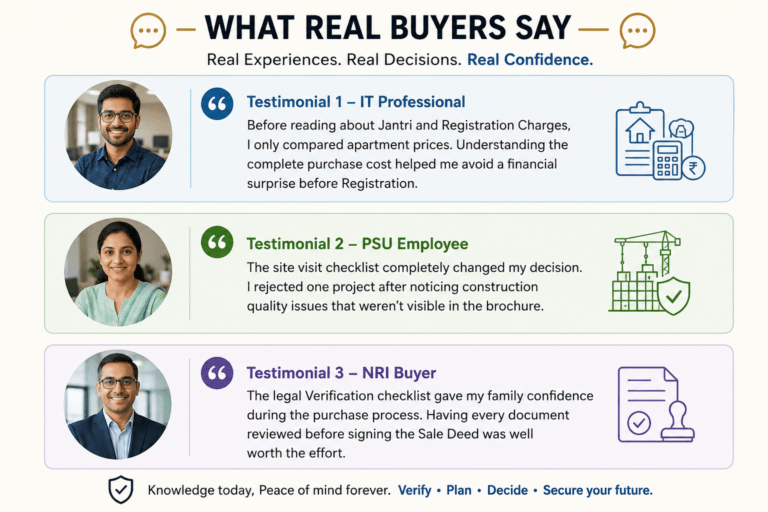
Realistic Buyer Testimonials
Who This Guide Is Not For
This guide is designed for buyers who want to make informed, long-term property decisions.
It is not intended for:
- People looking for quick speculative profits.
- Buyers relying on rumors or unverified “inside information.”
- Investors expecting guaranteed short-term price appreciation.
- Anyone unwilling to verify legal documents before making payments.
If your primary goal is to flip a property within a few months based on market speculation, this guide will not provide the shortcuts you’re looking for.
Similarly, if you are not prepared to review documentation, understand government procedures, or ask difficult questions before Registration, you should reconsider whether you’re ready to purchase a property at this stage.
A cautious buyer often avoids far more financial risk than an aggressive one chasing quick gains.
If I Were Buying Property in Gujarat Today
If I were buying a property today, my approach would be straightforward.
I would not choose a project simply because it offers the lowest price or the biggest launch discount.
Instead, I would prioritize:
- A location with strong long-term demand.
- A builder with a proven delivery record.
- Clear legal documentation.
- Transparent pricing with no unexplained charges.
- A property that meets my family’s actual needs rather than current market hype.
What I Would Negotiate the Hardest
I would focus on:
- The overall purchase price.
- Payment schedule.
- Builder-added charges.
- Parking fees (where applicable).
- Maintenance deposits.
- Possession timelines.
Government-imposed Registration Charges and Stamp Duty generally aren’t negotiable, so my attention would stay on the costs that can realistically be discussed.
One Red Flag I Would Never Ignore
If a builder or broker discouraged me from independently verifying documents or created constant pressure to “book today,” I would pause the transaction immediately.
Confidence comes from transparency—not urgency.
Conclusion
Property Registration is much more than completing paperwork.
It is the legal step that protects your ownership and formalizes one of the biggest financial decisions you’ll make.
Understanding Property Registration Charges in Gujarat 2026 isn’t just about calculating government fees.
It’s about knowing:
- what you’re paying for,
- why you’re paying it,
- which documents matter,
- and how to avoid mistakes that can become expensive later.
An informed buyer is far less likely to face surprises on Registration day.
Take the time to verify the property’s legal status, understand every charge, compare the Jantri value with the purchase price, and ask questions whenever something is unclear.
Those few extra hours of research can save you significant time, money, and stress in the future.
Property Registration Charges in Gujarat 2026 :FAQs
1. What are the property registration charges in Gujarat in 2026?
2. Is Stamp Duty different from Registration Fees?
3. How is Jantri value used during property registration?
4. What documents are required for property registration?
5. Can I complete property registration online in Gujarat?
Reference
About the Author

Mitesh Vyas
Hello My Name is Mitesh Vyas i am a Real Estate content writer and Property Market Enthusiast I shares practical insights on buying, selling, investing, and understanding real estate trends. With a strong focus on residential and commercial properties, My aims to help readers make informed property decisions through clear, research-based, and easy-to-understand content.