
Property Investment In Randesan Gandhinagar: A few months ago, a salaried buyer from Ahmedabad contacted me after paying a token amount in a newly launched project near Grandesan, Gandhinagar. The builder’s sales team had convinced him that prices would “jump in the next 90 days” because of upcoming infrastructure growth.
What actually happened?
The project got delayed in approvals. The promised “launch price” was not special. Hidden charges increased his total budget by nearly ₹6–7 lakhs. Worse, he realized the location suited long-term plotted development more than immediate rental demand.
His exact words were:
“Every website said this is the next investment hotspot. Nobody explained the risks.”
That is the real problem with most property blogs today.
Most articles are written either by marketing teams, SEO agencies, or portals trying to generate leads. They repeat the same lines:
“High appreciation potential.”
“Best investment destination.”
“Excellent connectivity.”
But real buyers do not lose money because they missed marketing slogans.
They lose money because:
- They buy in the wrong micro-location
- They misunderstand future supply
- They overpay during launch hype
- They trust promises instead of documents
- They confuse investment with speculation
In my experience advising buyers in Gandhinagar and surrounding growth corridors, Grandesan is neither a “bad” market nor a guaranteed winner. It is a developing micro-market with selective opportunity — but only for certain buyer profiles.
If you are expecting quick appreciation or easy resale profits, this guide may save you from a costly mistake.
If you are a long-term buyer with patience, proper due diligence, and realistic expectations, Grandesan may still make sense.
This guide is written to help you decide which side you fall on.
Understanding The Ground Reality Of Grandesan Gandhinagar
Gandhinagar has expanded rapidly in the last few years, especially along Raysan, Kudasan, Randesan, and nearby growth corridors. Grandesan sits in the conversation because buyers see:
- Wider roads
- Lower entry pricing than prime sectors
- Future infrastructure expectations
- Comparatively newer projects
But buyers often misunderstand one critical thing:
Development visibility and investment quality are not always the same thing.
A road under construction does not automatically create strong resale demand.
A large township announcement does not guarantee occupancy.
A launch-phase discount does not mean value buying.
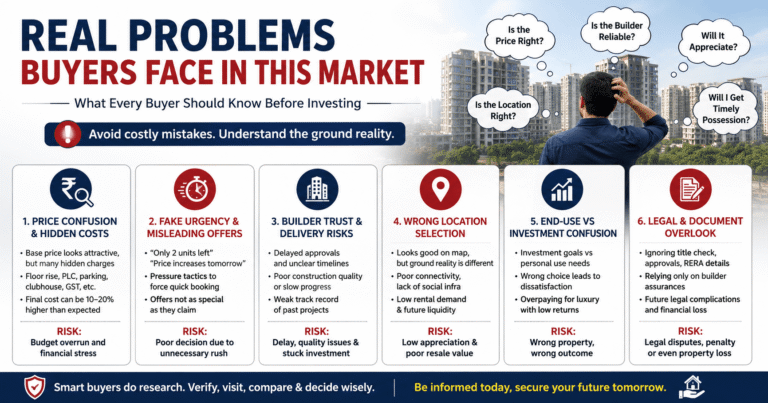
Real Problems Buyers Face In This Market
1. Price Confusion Is Massive
I routinely see 2 BHK pricing vary by ₹8–15 lakhs between projects that look similar on brochures.
Why?
- Different carpet areas hidden under “super built-up”
- Floor rise charges
- Parking pricing
- Clubhouse loading
- GST impact
- PLC (Preferred Location Charges)
- Maintenance deposits
Many buyers compare only base rates per sq. ft., which is a mistake.
A ₹52 lakh apartment can quietly become ₹63–66 lakhs before possession.
2. Fake Urgency Is Common
Statements like:
- “Only 2 units left”
- “Price revision tomorrow”
- “Investor inventory almost sold out”
…are extremely common in developing micro-markets.
In reality, inventory absorption in several Gandhinagar peripheral projects remains gradual, especially where end-user occupancy is still building.
If a builder pressures you to book immediately without allowing:
- legal review,
- RERA verification,
- or multiple site visits,
treat that as a red flag.
3. Builder Trust Matters More Than Fancy Amenities
A project with luxury amenities means little if the builder lacks trust and delivery credibility.
Always check the builder’s past projects, construction quality, legal transparency, and possession history in Property in Randesan Gandhinagar 2 BHK Flats.
A reliable builder protects your investment, reduces risk, and ensures long-term peace of mind.
One of the biggest mistakes I see:
Buyers prioritize clubhouse visuals over delivery history.
In emerging locations like Grandesan:
- timely possession,
- construction quality,
- water/drainage planning,
- and occupancy execution
matter far more than rooftop features.
A weak builder can destroy investment returns even in a good location.
4. Many Buyers Don’t Know Whether They’re Investors Or End-Users
This creates terrible decisions.
An end-user should prioritize:
- livability,
- school access,
- daily convenience,
- construction quality,
- maintenance sustainability.
An investor should focus on:
- future supply pipeline,
- rental demand,
- infrastructure dependency,
- liquidity,
- and exit demand.
I have seen buyers purchase “investment flats” that remained vacant for 18 months because the surrounding ecosystem was still immature.
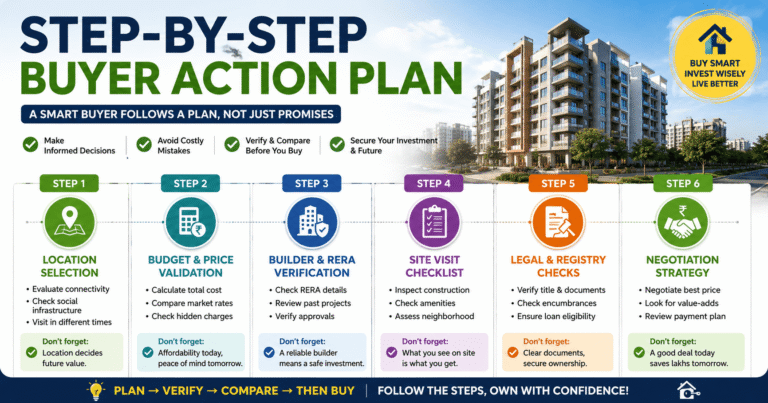
Step-by-Step Buyer Action Plan
Step 1: Location Selection
What To Do
Do not judge Grandesan only by map distance to Gandhinagar or Ahmedabad.
Physically evaluate:
- road approach quality,
- traffic flow during office hours,
- nearby residential occupancy,
- school and hospital access,
- public transport practicality,
- drainage and water infrastructure,
- evening activity levels.
Visit both:
- weekday evenings
- weekend afternoons
The market behaves differently depending on timing.
Why It Matters
Many developing areas look attractive during daytime site visits because roads are empty and projects appear spacious.
But low occupancy can create:
- weak rental demand,
- poor local convenience,
- slower resale movement.
Mistakes To Avoid
- Buying solely because “metro/infrastructure is coming”
- Assuming every nearby project will appreciate equally
- Ignoring actual occupancy rates
Pro Tip From Experience
I prefer locations where:
- existing families are already living,
- grocery/services have started functioning,
- and internal roads are operational.
Visible real habitation matters more than future promises.
Step 2: Budget & Price Validation
What To Do
Calculate the complete acquisition cost:
- Base price
- GST
- Stamp duty
- Registration
- Parking
- Maintenance deposit
- Legal fees
- Loan processing
- Interior setup
Then compare that against:
- local resale pricing,
- nearby possession-stage inventory,
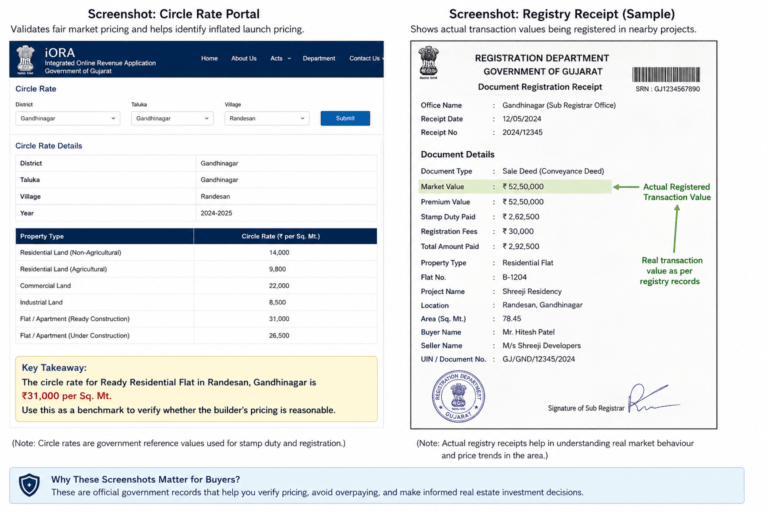
- and actual registry values.
Why It Matters
Many buyers emotionally stretch budgets assuming appreciation will compensate later.
That is risky.
Real estate cycles can stay flat for years.
Mistakes To Avoid
- Taking maximum loan eligibility
- Ignoring possession-time expenses
- Comparing only brochure rates
Pro Tip From Experience
If your EMI exceeds comfortable affordability by assuming future salary hikes, pause the purchase.
A property should improve stability — not create financial stress.
Step 3: Builder & RERA Verification
What To Do
Check:
- RERA registration
- Past project delivery timelines
- Litigation history
- Construction pace
- Occupancy status in previous projects
- Financial credibility
Why It Matters
In emerging corridors, delayed delivery can freeze capital for years.
A project delay hurts:
- ROI,
- rental income,
- loan burden,
- and resale liquidity.
Mistakes To Avoid
- Trusting only sample flats
- Ignoring past possession records
- Assuming branded marketing equals execution quality
Pro Tip From Experience
Visit one completed project by the same builder without informing the sales team.
Talk directly to residents if possible.
You will learn more in 15 minutes there than from 5 sales meetings.
Step 4: Site Visit Checklist
What To Do
During the visit, inspect:
- ventilation,
- natural light,
- parking practicality,
- lift count,
- wall finishing,
- drainage slope,
- surrounding vacant land,
- sewage planning,
- road access during monsoon.
Why It Matters
Brochure renders hide operational problems.
Poor planning becomes obvious only after possession.
Mistakes To Avoid
- Visiting only the sample flat
- Ignoring surrounding land use
- Forgetting to inspect actual approach roads
Pro Tip From Experience
Stand silently on-site for 10 minutes.
Observe:
- noise,
- dust,
- traffic,
- smell,
- drainage,
- power infrastructure.
Most buyers rush the visit and miss critical environmental issues.
Step 5: Legal & Registry Checks
What To Do
Verify:
- title clarity,
- NA status,
- sanctioned plans,
- mortgage status,
- land ownership chain,
- development permissions.
Use an independent property lawyer.
Not the builder’s recommended contact.
Why It Matters
Legal shortcuts become resale problems later.
Banks approving a project does NOT guarantee zero legal risk.
Mistakes To Avoid
- Skipping legal verification to “save time”
- Relying only on verbal assurances
- Ignoring land-title history
Pro Tip From Experience
Registry patterns reveal real market behavior.
If registry values consistently stay below marketed pricing, investigate carefully.
Step 6: Negotiation Strategy
What To Do
Negotiate beyond base price:
- floor rise waiver,
- parking inclusion,
- maintenance discounts,
- modular kitchen,
- payment flexibility,
- stamp-duty support.
Why It Matters
Developers in slower-moving inventory situations often have negotiation flexibility they will not disclose upfront.
Mistakes To Avoid
- Negotiating emotionally
- Revealing maximum budget too early
- Believing “final price” statements immediately
Pro Tip From Experience
Month-end and quarter-end negotiations often produce better flexibility because sales targets matter.
But never let urgency override due diligence.
Real Case Studies From The Grandesan Market
Case Study 1 — End-User Family
A PSU employee family purchased a 2 BHK near the Grandesan growth corridor in late 2021.
Details
- Budget: ₹58 lakhs all-inclusive
- Configuration: 2 BHK
- Purchase Stage: Near-possession
- Carpet Area: Approx. 720 sq. ft.
- Current Estimated Value (2026): ₹67–70 lakhs
What Worked
- They avoided under-construction launch risk
- Chose a project with visible occupancy
- Prioritized daily livability over speculation
Lesson Learned
Steady appreciation with stable living quality is often better than chasing “next big hotspot” claims.
Case Study 2 — Investor
An Ahmedabad-based investor entered an early-stage project in 2020.
Details
- Entry Price: ₹41 lakhs
- Current Approximate Value: ₹52–55 lakhs
- Rental Yield: Around 2.5–3%
- Holding Period: 5+ years
What Worked
- Low entry pricing
- Strong patience
- Financial ability to hold without stress
What Didn’t
- Slower-than-expected rental growth
- Resale liquidity remained moderate
- Appreciation took longer than projected
Lesson Learned
Peripheral real estate rewards patience, not hype-driven expectations.
Realistic Buyer Testimonials
“I almost booked another project after seeing launch offers. After comparing registry values and possession status, I changed my decision and bought a ready-to-move flat instead. No regrets.”
— Ritesh IT Professional, Ahmedabad
“We were originally buying for investment, but eventually realized we needed a practical family home. That changed the entire project shortlist.”
—yash PSU Employee, Gandhinagar
“The builder presentation looked impressive, but the completed project visit exposed maintenance issues immediately.”
Rechalten NRI Buyer evaluating Gandhinagar property options
Market Context & Verified Data Sources
Good property decisions should rely on verification, not assumptions.
The most useful sources for Grandesan market evaluation include:
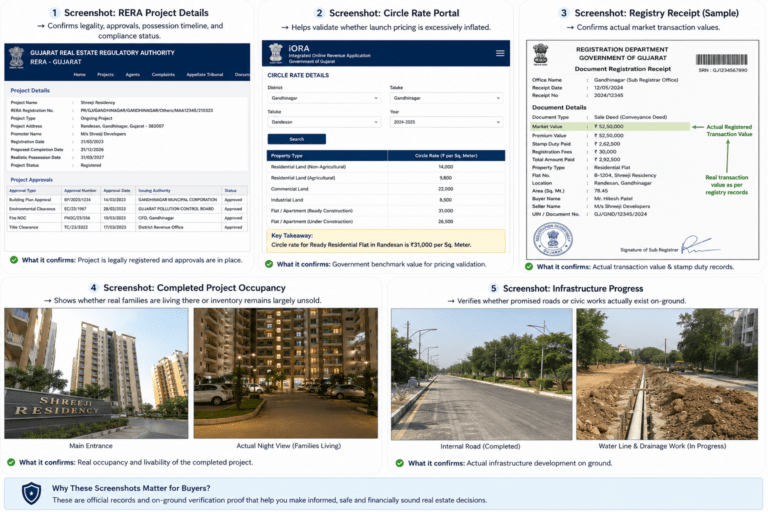
- Gujarat RERA portal
- Circle rate records
- Sub-registrar office transaction records
- Gandhinagar urban development planning updates
- Bank technical/legal approval status
- Physical occupancy verification
Current market reality in many Gandhinagar peripheral pockets:
- appreciation exists, but unevenly,
- buyers are more price-sensitive,
- ready-to-move inventory is gaining preference,
- and loan affordability matters more due to interest-rate pressure.
This is not a blind bull market.
Project quality and location selection matter far more now than they did during aggressive launch cycles.
Proof & Screenshot
Who This Guide Is NOT For
This guide is NOT for:
- buyers chasing quick flipping profits,
- speculative investors expecting instant appreciation,
- people buying solely because “everyone else is buying,”
- buyers unwilling to verify documents independently.
You should probably WAIT or reconsider if:
- your emergency savings are weak,
- EMI pressure would become stressful,
- your job situation feels unstable,
- you are depending entirely on future appreciation to justify the purchase.
In some cases, renting may currently make more financial sense than buying.
Especially if:
- your work location may change,
- your family requirements are uncertain,
- or your holding horizon is below 5 years.
This guide will also NOT help with:
- rumor-based land deals,
- insider speculation,
- unrealistic ROI expectations,
- shortcut investment schemes.
If I Were Buying This Property Today
Would I Buy Now Or Wait?
If I found:
- a financially stable builder,
- realistic pricing,
- visible occupancy nearby,
- and near-possession inventory,
I would consider buying selectively.
But I would avoid:
- pure launch hype,
- overpriced “future growth” narratives,
- and projects depending entirely on upcoming infrastructure promises.
Which Configuration Would I Choose?
For practical long-term balance:
- a well-designed 2 BHK with usable carpet area,
- good ventilation,
- and manageable maintenance cost.
Not oversized luxury inventory with weak resale depth.
What Would I Negotiate Hardest?
- hidden charges,
- parking cost,
- possession commitments,
- payment schedule,
- and maintenance structure.
Those impact real ownership cost far more than decorative amenities.
One Red Flag I Would NOT Ignore
Low actual occupancy in nearby completed projects.
If families are not moving into the area despite multiple project launches, I would investigate very carefully before investing.
Conclusion:
Property investment in Grandesan Gandhinagar is neither an obvious mistake nor an automatic success story.
It is a market where:
- careful buyers may benefit,
- impatient buyers may struggle,
- and uninformed buyers can easily overpay.
The difference usually comes down to:
- verification,
- patience,
- financial discipline,
- and choosing the right project for the right reason.
Do not buy because a broker says prices will double.
Do not reject the market blindly either.
Study the location properly.
Compare registry data.
Verify builders independently.
Understand your real holding capacity.
That process may feel slower — but it prevents expensive mistakes.
If you are evaluating a project and feel confused between multiple options, prepare a comparison sheet before paying any token amount. Even one extra week of research can save years of regret.
Property Investment In Grandesan Gandhinagar: FAQs
Is Grandesan good for long-term investment?
Should I buy under-construction or ready-to-move?
What is the biggest mistake buyers make here?
Can rental income cover EMI?
Is launch pricing always cheaper?
Reference
About the Author

Mitesh Vyas
Hello My Name is Mitesh Vyas i am a Real Estate content writer and Property Market Enthusiast I shares practical insights on buying, selling, investing, and understanding real estate trends. With a strong focus on residential and commercial properties, My aims to help readers make informed property decisions through clear, research-based, and easy-to-understand content.