
Buying a 3 BHK flat is not just about choosing a beautiful apartment. It is about committing a substantial portion of your savings, taking on a long-term financial responsibility, and deciding where your family may live for the next 10–15 years.
On PDPU Road in Gandhinagar, buyers may come across apartments advertised at different price points, from relatively affordable configurations to premium residential developments. But the first question should not be, “Which project has the best amenities?” It should be, “Which property offers the right combination of location, construction quality, legal safety, and total cost for my needs?”
This guide explains how to evaluate 3 BHK flats in PDPU Road Gandhinagar, compare residential projects, identify potential risks, and decide whether to buy now, negotiate harder, or wait.
Important note: This is an independent buyer-education guide, not a claim of personal property inspections or legal verification. Advertised prices and possession dates are indicative listings, not confirmed transaction prices. All project-specific details should be verified before making a purchase.
The Real Buyer Problem: Finding the Right Flat Without Making an Expensive Mistake
Imagine a family looking for a 3 BHK apartment in Gandhinagar. They have saved for years, obtained preliminary home-loan approval, and shortlisted two residential projects on PDPU Road.
The first project offers an attractive price, a swimming pool, landscaped gardens, and a spacious-looking sample flat. The salesperson says several units have already been booked and encourages the family to pay a booking amount immediately.
The second project is slightly more expensive but appears closer to their workplace and has a completed building that they can inspect.
The family now faces several questions:
- Is the cheaper flat genuinely better value, or are additional costs missing from the quotation?
- Will the promised possession date be realistic?
- Does the quoted area represent carpet area or built-up area?
- Is the project legally ready for purchase?
- Will the apartment remain convenient after the family has lived there for five years?
- If they need to sell the property later, will buyers be willing to pay the premium?
These are the questions that matter more than glossy brochures.
Many property articles focus on amenities, project highlights, and expected appreciation. They often fail to explain how buyers should compare the final payable amount, verify documents, or assess whether the apartment is suitable for everyday living.
This guide takes a different approach: evaluate the property as a financial and practical decision before considering it a lifestyle upgrade.
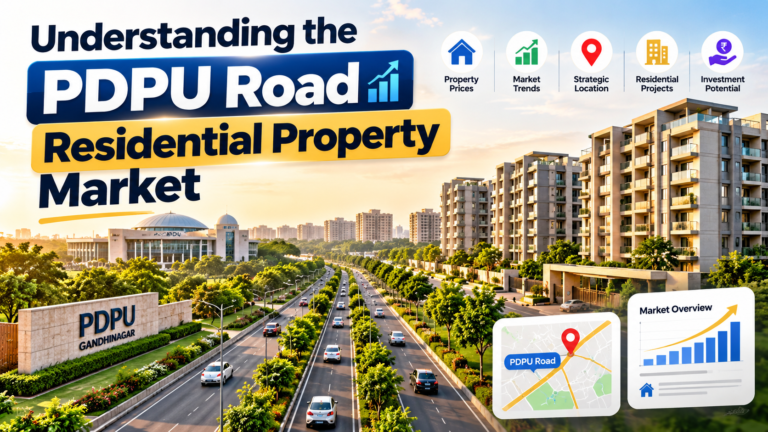
Understanding the PDPU Road Residential Property Market
PDPU Road is a recognised residential property search area in Gandhinagar, with listings covering different apartment sizes, project stages, and price categories. The market includes both new bookings and resale properties.
A useful starting point is to compare more than one property type instead of assuming that every 3 BHK in the locality offers similar value.
What do advertised prices suggest?
Property portals provide a snapshot of asking prices, although they do not establish the final price paid by a buyer.
For example, Housing.com listings updated in early October 2026 show advertised 3 BHK options in PDPU Road across a broad range. Examples include Revanta Fortune 3 at approximately ₹72 lakh for a listed 3 BHK configuration, Elara at around ₹91 lakh–₹95 lakh, and Asteria at approximately ₹1.46 crore. These are portal-listed figures and must be checked against the exact unit, area definition, construction stage, and current builder quotation. <sup>Reference: Housing.com listing snapshot, October 2026.</sup>
Magicbricks reported an indicative average apartment asking rate of approximately ₹4,768 per sq. ft. for PDPU Road in its July 2026 locality-rate update, with a reported range of approximately ₹3,792–₹5,745 per sq. ft. These figures are portal estimates, not official government valuations or verified registered sale prices. <sup>Reference: Magicbricks locality-rate update, July 2026.</sup>
The difference between these figures and the total advertised apartment price is a reminder that buyers must compare equivalent area measurements and specifications.
Do not compare two flats solely by their total prices. Compare carpet area, usable layout, building age, floor, parking, construction quality, maintenance charges, possession status, and the amount payable before moving in.
Why prices differ within the same locality
Several factors can explain the price difference between two 3 BHK flats on or around PDPU Road:
- Carpet area: A smaller usable apartment may appear cheaper while offering less functional living space.
- Project positioning: Premium developments may charge more for amenities, design, specifications, and shared facilities.
- Construction stage: An under-construction flat and an occupied apartment carry different possession, financing, and inspection risks.
- Building quality: Water pressure, lift reliability, ventilation, waterproofing, and maintenance can influence long-term value.
- Exact location: Road access, traffic, public transport, nearby services, and surrounding development matter more than a broad locality label.
- Floor and orientation: Natural light, noise, heat, privacy, and lift dependence can affect day-to-day comfort.
- Resale condition: An older flat may require renovation, repairs, or upgrades that reduce its apparent price advantage.
Is PDPU Road suitable for your family?
It may suit buyers who find a convenient commute, suitable residential options, and a property that fits their budget. However, suitability depends on the exact building and your daily routine.
Before deciding, test the route to work, school, hospitals, grocery shops, and other regular destinations. Visit the street during peak traffic and after dark. A property that looks convenient on a map may feel very different during a normal weekday.
The Main Problems Buyers Should Watch For
Price confusion and hidden costs
A quoted price is not always the amount required to own and occupy the apartment.
Ask for a written, itemised quotation covering:
- Basic apartment price.
- Parking charges, where legally permissible and applicable.
- Floor-rise or other additional charges.
- Applicable GST, if any.
- Stamp duty and registration expenses.
- Maintenance deposits and society-related charges.
- Electricity, water, gas, or utility connection charges.
- Any applicable clubhouse or amenity charges.
- Interior work, appliances, and other move-in expenses.
Not every charge applies to every property. For example, GST treatment differs between qualifying under-construction residential purchases and completed properties, and should be checked for the actual transaction.
Mistake to avoid: Choosing the apartment with the lowest advertised price before receiving its complete cost sheet.
Better approach: Ask each seller for a comparable, written, all-in cost estimate. Keep a separate reserve for furnishing, repairs, and unexpected expenses.
Fake urgency and misleading offers
Statements such as “only one flat left,” “price increasing tomorrow,” or “book today to receive a special discount” are not proof that a property is a good investment.
A genuine opportunity should remain attractive after you verify its price, documents, condition, and alternatives.
Ask the salesperson to provide the offer in writing, including its validity, exclusions, payment schedule, and refund terms.
If you are discouraged from reviewing documents or consulting an independent lawyer, pause the transaction.
Builder credibility and delivery risk
A well-presented sales office does not establish construction quality or delivery reliability.
For an under-construction property, investigate:
- The project’s RERA registration and current status.
- The registered completion or possession timeline.
- Extensions, if any.
- Project progress disclosures and available construction updates.
- The developer’s completed projects and actual handover history.
- Whether promised facilities are included in approved plans and agreements.
Use the Gujarat RERA portal rather than relying only on a salesperson’s statement or a logo on a brochure.
Selecting the wrong location
Two properties described as being in PDPU Road may differ considerably in access, surroundings, and convenience.
Check the actual approach road, road width, traffic noise, drainage, street lighting, nearby construction, and access during the monsoon.
Also confirm the exact address. A listing may use a broad locality name even when the property is situated in a neighbouring area.
Confusing end-use with investment
A family purchasing a home needs reliable services, manageable monthly expenses, sufficient space, and a comfortable commute.
An investor needs to understand rental demand, vacancy periods, maintenance, resale liquidity, and net returns.
A premium 3 BHK can be an excellent home yet produce a modest rental yield. Conversely, a cheaper property may offer a better rental return but fail to meet your family’s needs.
Do not justify an unaffordable home by assuming that its value will automatically rise. Appreciation is uncertain, while loan repayments and ownership expenses are real obligations.
Step-by-Step Buyer Action Plan
Step 1: Choose the Right Location
What to do
Shortlist at least three properties and visit each one in person. Use the exact building address to evaluate the route to your workplace, school, public transport, medical facilities, and daily shopping.
Check the apartment and surrounding street at different times, including a weekday evening and, if possible, after rainfall.
Why it matters
Location affects your everyday life, commuting costs, convenience, and future resale demand. A large apartment cannot compensate for an unsuitable daily commute or recurring access problems.
Mistakes to avoid
- Trusting a map pin without visiting the property.
- Assuming every building on PDPU Road has the same connectivity.
- Ignoring noise, drainage, nearby construction, or parking access.
- Buying based on a promised future road or infrastructure project without checking its official status.
Practical tip
Write down your five most important daily requirements before viewing properties. Score every shortlisted apartment against the same criteria. This reduces the risk of choosing a property because of its sample flat or sales presentation.
Step 2: Establish Your Budget and Validate the Price
What to do
Calculate the total acquisition cost and the monthly cost of ownership. Include the home loan, maintenance, utilities, insurance where applicable, commuting expenses, and a reserve for repairs.
Request the carpet area in writing and compare the effective price per square foot using the same area basis across shortlisted properties.
For example, suppose a flat is advertised at ₹90 lakh. If applicable transaction expenses, furnishing, and other initial costs bring your total cash requirement above ₹1 crore, the advertised figure alone is not a sufficient basis for your decision. The actual amount will depend on the property’s tax treatment and the charges in its written quotation.
Why it matters
A home may be affordable at the booking stage but difficult to maintain once EMIs, school fees, and other household expenses are considered.
Mistakes to avoid
- Using the bank’s maximum loan eligibility as your ideal budget.
- Spending all your savings on the down payment.
- Ignoring pre-EMI or rent overlap while waiting for possession.
- Comparing a super built-up area quotation with a carpet area quotation.
Practical tip
Keep an emergency reserve after purchasing. Stress-test your budget for a temporary income reduction, an interest-rate increase on a floating-rate loan, or an unexpected repair.
If the purchase leaves you without a reasonable reserve, consider a less expensive property or delay buying.
Step 3: Verify the Builder and RERA Registration
What to do
Search for the project on the official Gujarat RERA portal.
Match the pr.oject name, promoter, registration number, address, and relevant phase. Review the registered completion timeline, project disclosures, approvals available on the portal, and any published extensions or complaints.
For a completed apartment, establish whether the project and relevant phase have the required completion documentation. Ask for the building’s applicable completion certificate and occupancy certificate, as relevant to the property and local requirements.
Why it matters
RERA registration is an important verification step, but it is not a guarantee that every promise will be fulfilled or that the apartment is free from legal or construction defects.
Mistakes to avoid
- Assuming that a RERA logo proves every document is valid.
- Checking a similarly named project rather than the exact phase.
- Treating an estimated possession date in an advertisement as a contractual commitment.
- Assuming an agent’s assurances replace your own checks.
Practical tip
Ask an independent property lawyer to review the project and transaction documents before making a non-refundable commitment. If the details on the portal and the sales agreement conflict, seek written clarification before proceeding.
Step 4: Use a Detailed Site Visit Checklist
What to do
Inspect the actual apartment rather than relying only on a sample flat or a digital walkthrough.
Check:
- Carpet area and room dimensions.
- Natural light and cross-ventilation.
- Water pressure and drainage.
- Bathroom waterproofing and visible seepage.
- Window and balcony safety.
- Electrical points, distribution board, and earthing documentation where available.
- Lift operation and backup arrangements.
- Fire-safety systems and access to exits.
- Parking allocation and vehicle access.
- Common-area maintenance and cleanliness.
- Noise from roads, lifts, equipment, and neighbouring units.
- Water supply, waste management, and rainwater drainage arrangements.
For an occupied resale apartment, inspect the building’s maintenance history, recurring repair issues, and society records where available.
Why it matters
Small defects can become expensive after possession, especially when they involve seepage, plumbing, waterproofing, or shared building systems.
Mistakes to avoid
- Inspecting only during a quick guided tour.
- Ignoring the basement and common areas.
- Assuming all amenities are operational because they appear in a brochure.
- Accepting verbal assurances about repairs without written commitments.
Practical tip
Take dated photographs with the seller’s permission and maintain a written defect list. For a completed apartment, consider a qualified independent home inspection before finalising the purchase.
Step 5: Complete Legal and Registry Checks
What to do
Before paying a substantial amount, appoint an independent property lawyer to examine the documents appropriate to the transaction.
These may include:
- Title documents and ownership history.
- Encumbrance searches and relevant registered charges.
- Approved building plans and applicable permissions.
- RERA registration and disclosures, where applicable.
- Completion and occupancy documentation, where required.
- The agreement for sale or draft sale deed.
- Existing loan liabilities and release documentation, if applicable.
- Property tax records and outstanding dues.
- Society or association records and transfer requirements, where relevant.
- Parking rights and the documents governing their allocation.
- Any applicable land-use restrictions or conditions.
For a resale property, establish that the seller has the legal right to transfer it and that any existing mortgage will be properly discharged.
Why it matters
A good-looking apartment can still carry ownership, approval, payment, or transfer problems. A property lawyer should assess the documents and identify issues that require resolution before the transaction proceeds.
Mistakes to avoid
- Treating a property tax receipt as conclusive proof of title.
- Relying only on a bank’s loan approval.
- Assuming an agreement to sell is equivalent to a registered conveyance.
- Signing blank documents or paying large amounts without a documented payment and refund framework.
Practical tip
Ask your lawyer to provide a written list of documents reviewed, unresolved issues, and conditions that must be met before registration. Do not proceed merely because another buyer appears ready to purchase the same unit.
Step 6: Negotiate With Evidence, Not Pressure
What to do
Collect comparable quotations for similar configurations and inspect resale alternatives. Compare the actual apartment, carpet area, building age, possession status, specifications, and total cost.
Use specific issues to support your negotiation, such as repair requirements, delayed possession exposure, a missing facility, an uncompetitive effective price, or documented differences between competing units.
Why it matters
The best deal is not necessarily the lowest headline price. A slightly more expensive completed flat may be worth considering if it reduces uncertainty, allows inspection, and avoids a long wait for possession.
Mistakes to avoid
- Negotiating only on the basic price.
- Accepting an undocumented discount.
- Ignoring payment milestones or cancellation terms.
- Paying an excessive booking amount simply to secure an advertised offer.
Practical tip
Negotiate the complete package: price, payment schedule, included specifications, parking rights, maintenance terms, possession commitments, defect rectification, and any applicable refund conditions.
For a resale flat, use verified repair estimates and comparable listings to make a reasoned offer. Do not assume an asking price reflects what the seller will actually accept.
Residential Projects on PDPU Road Gandhinagar: How to Compare Your Options
The following projects are examples from public listing data, not endorsements or rankings. Their availability, prices, construction status, and specifications must be checked directly before making a decision.
| Project | Indicative Advertised 3 BHK Price | What to Verify |
|---|---|---|
| Revanta Fortune 3 | Around ₹72 lakh | Exact configuration, carpet area, payment schedule and possession status |
| Elara | Around ₹91–95 lakh | Registered phase, completion timeline, specifications and additional charges |
| Vinayak Courtyard | Around ₹1.20–1.26 crore | Exact unit, resale versus new booking, possession documents and maintenance |
| Asteria | Around ₹1.46 crore | Premium pricing justification, usable area, amenities and comparable alternatives |
Price references: Housing.com listings accessed in October 2026. These are indicative portal advertisements and may change. They are not verified transaction prices or confirmed live offers.
How to choose between a lower-priced and a premium project
A lower-priced apartment may be the better decision if it offers sufficient usable space, a reliable building, convenient access, and manageable ownership costs.
A premium property may be worth paying more for if the additional cost corresponds to measurable advantages that matter to you, such as a better layout, construction quality, location, privacy, or maintenance standards. Before making a decision, Explore 3 BHK flats across Gandhinagar to compare available options and determine whether the premium offers genuine value for your needs.
However, do not pay a premium simply because a project has a grand entrance, attractive sample flat, or a long amenities list.
My recommendation: First define your requirements, then compare the properties that meet them. Avoid starting with a builder’s sales pitch and adjusting your expectations to fit it.
Realistic Buyer Case Studies: What the Numbers Can Teach You
The following are illustrative scenarios, not verified client transactions. They demonstrate how a buyer should assess a purchase using realistic assumptions rather than relying on promised appreciation.
Case Study 1: An End-User Family
Situation: A working couple wants a 3 BHK flat in Gandhinagar, with enough space for their child and visiting parents.
| Particular | Illustrative Figures |
|---|---|
| Total Purchase Budget | ₹1 crore |
| Shortlisted Location | PDPU Road area |
| Negotiated Apartment Price | ₹85 lakh |
| Initial Purchase and Transaction Allowance | ₹5 lakh |
| Furnishing and Move-in Allowance | ₹5 lakh |
| Emergency Reserve Retained | ₹5 lakh |
| Total Allocation | ₹1 crore |
These allowances are planning assumptions, not a quotation of current statutory charges. The buyer must calculate actual stamp duty, registration, applicable taxes, and other expenses separately.
What happens next?
The family finds a suitable apartment but discovers that the bedroom layout in the cheaper option does not comfortably accommodate their furniture. A slightly more expensive alternative has a better layout and requires fewer immediate modifications.
Rather than selecting the lowest price, they compare usable space, commute, building condition, and the remaining emergency reserve.
Lesson learned: The cheapest flat is not automatically the best-value flat. A property should meet the family’s daily needs without exhausting its financial safety margin.
Case Study 2: An Investor Evaluating Rental Income
Situation: An investor considers purchasing a 3 BHK apartment for rental income and long-term ownership.
| Particular | Illustrative Figures |
|---|---|
| Apartment Purchase Price | ₹90 lakh |
| Annual Rent Assumed | ₹3.6 lakh |
| Gross Rental Yield | 4% |
| Illustrative Annual Ownership Costs and Vacancy Allowance | ₹60,000 |
| Annual Income Before Financing and Tax | ₹3 lakh |
| Net Operating Yield Before Financing and Tax | Approximately 3.33% |
The assumed rent and costs are hypothetical and must not be treated as current PDPU Road rental-market data.
The gross rental yield is calculated as:
Annual rent ÷ purchase price × 100
In this example, ₹3.6 lakh divided by ₹90 lakh gives a gross yield of 4%.
However, the investor still needs to consider loan interest, taxes, repairs, tenant turnover, major building expenses, and the time required to find a tenant. Financing can materially reduce the investor’s cash return.
Exit strategy: The investor should assess whether the property could be sold at a realistic price if rental demand weakens or personal financial needs change. Appreciation should be treated as uncertain rather than guaranteed.
What worked: A disciplined purchase price, verified rental comparables, a manageable loan, and a realistic holding period.
What did not work: Assuming that premium amenities automatically justify a higher rent or that a future buyer will pay any desired resale premium.
Lesson learned: An investment property must make financial sense without depending entirely on future appreciation.
Realistic Buyer Feedback: Questions Worth Asking
The following are sample testimonial-style scenarios, not genuine customer testimonials. They illustrate the kinds of feedback buyers might give after completing a careful evaluation.
Scenario 1: IT Professional
“I initially focused on the flat with the most amenities. After comparing the carpet area and commute, I realised the other apartment suited my daily routine better. I am glad I compared the actual units instead of relying on the brochure.”
Scenario 2: PSU Employee
“The most useful step was asking for the complete cost sheet before paying the booking amount. It helped me understand the full financial commitment and avoid making a decision based only on the advertised price.”
Scenario 3: NRI Buyer
“I wanted to book remotely, but I decided to have the title documents and project status independently reviewed first. The process took longer, but I was more comfortable understanding what I was buying.”
These examples should not be published as actual reviews unless they are replaced with genuine, permissioned customer feedback.
Verified Data and Local Market Context
Property decisions should be supported by sources that serve different purposes. No single website can establish a property’s complete legal status, fair market value, and construction quality.
Gujarat RERA
Use the portal to check the registered project, promoter, registration details, disclosed timelines, and available project records. The portal also provides public search and access to regulatory information. <sup>Source: Gujarat RERA official portal.</sup>
Jantri rates and registration records
Check the applicable government valuation and registration-related information for the specific property. The Jantri value is a government valuation reference; it is not necessarily the price a willing buyer and seller would agree upon.
Ask your lawyer or the relevant Sub-Registrar’s office about the applicable stamp duty, registration charges, valuation basis, and required documentation before calculating your final budget.
Local planning and development information
GUDA describes its role in development planning, town-planning schemes, infrastructure, and civic amenities for areas within its jurisdiction. For a specific property, verify which planning authority has jurisdiction and obtain the relevant sanctioned plans, land-use details, and permissions. <sup>Source: GUDA authority information.</sup>
Property listings and market reports
Portals such as Housing.com and Magicbricks can help you identify asking prices, available configurations, and competing properties. Their figures are useful for creating a shortlist but should not be confused with official registered sale consideration or an independent valuation.
For better price validation, ask a qualified local professional to review comparable registered transactions where available, including the exact locality, property type, transaction date, and area basis.
What about current market conditions?
Public listing snapshots in October 2026 show a broad spread of advertised 3 BHK prices on PDPU Road. That variation suggests buyers should compare specific units rather than assume there is one standard price for the locality.
But asking-price data alone cannot establish whether market prices are rising or falling. To make that judgment, compare recent registered transactions, comparable resale listings, unsold inventory where reliable data is available, and actual rental demand.
Interest rates, household affordability, new supply, employment patterns, and infrastructure development can all influence demand. Their effects are not uniform across every project.
Buyer advice: Do not purchase solely because someone predicts that prices will rise next year. Buy when the property suits your needs, the total cost is affordable, and the evidence supports the price you are paying.
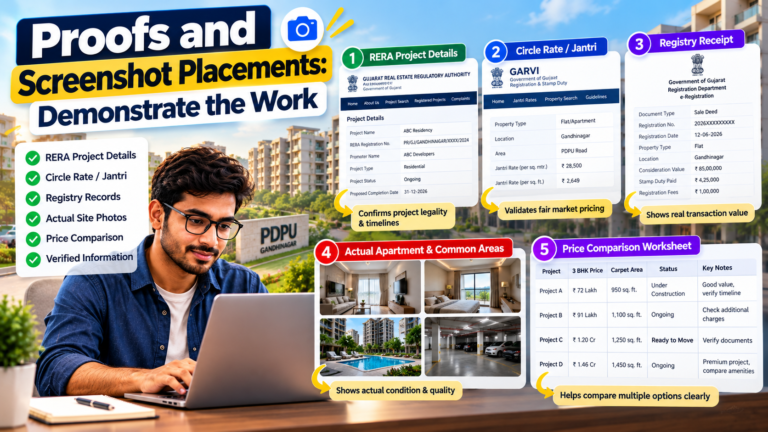
Proofs and Screenshot Placements: Demonstrate the Work
Who This Guide Is Not For
A trustworthy buying guide should also explain when buying may be the wrong decision.
You should not rush into buying if:
- You expect to sell within a year or two for a guaranteed profit.
- Your down payment would consume all your emergency savings.
- Your job or preferred city may change soon.
- You cannot comfortably manage the EMI alongside your other responsibilities.
- You have not verified the seller’s title, project documents, and payment terms.
- You are purchasing mainly because a broker claims that prices will increase immediately.
- You are unwilling to investigate construction quality, maintenance costs, or the surrounding location.
Who may be better off renting?
Renting may be the more sensible choice if you are uncertain about your long-term location, need flexibility, or can rent a suitable apartment while building a stronger down payment.
Compare the cost of renting with the full cost of ownership, including financing, transaction expenses, maintenance, and the opportunity cost of the money invested.
Do not assume that buying is always financially superior to renting. The answer depends on the purchase price, rent, financing terms, holding period, and future property value.
What this guide will not help you do
This guide is not designed for short-term property flipping, speculation based on rumours, or buying before a project’s essential documentation has been verified.
It does not promise quick appreciation, guaranteed rental income, or insider information. Its purpose is to help buyers make a more informed decision.
If I Were Buying This Property Today
My approach would be to shortlist first, verify second, and negotiate only after the evidence supports the price.
I would not buy an apartment simply because it is marketed as one of the best residential projects on PDPU Road Gandhinagar.
Would I buy now or wait?
I would buy now only if I found a property that met my family’s requirements, passed independent legal checks, had acceptable construction quality, and remained affordable after all acquisition and move-in expenses.
If no property met those conditions, I would wait or rent rather than force a purchase.
Which configuration would I choose?
I would prioritise a functional 3 BHK layout with adequate usable carpet area, good natural light, ventilation, practical storage, reliable water supply, and reasonable maintenance costs.
I would compare the actual rooms and dimensions rather than assume that a larger advertised area means a better apartment.
What would I negotiate hardest?
I would negotiate the effective total price and the terms of the transaction, not just the basic apartment price.
For an under-construction flat, I would focus on documented specifications, payment milestones, contractual possession terms, and remedies available under the agreement and applicable law.
For a resale flat, I would examine comparable transactions, repair requirements, existing dues, and the seller’s documentation.
One red flag I would not ignore
I would walk away if the seller or developer pressured me to pay a substantial non-refundable amount before allowing adequate document verification.
A property worth buying should withstand reasonable questions. If basic checks cannot be completed transparently, there are other properties to consider.
Conclusion:
Buying a 3 BHK flat in PDPU Road Gandhinagar can be a reasonable decision for the right buyer, but the location alone does not make every property a good purchase.
The important factors are the total cost, carpet area, exact location, construction quality, legal status, builder’s commitments, maintenance requirements, and your own financial position.
Compare multiple apartments, verify project details independently, inspect the actual building, and calculate the full cost of ownership. Treat portal prices as starting points for research, not proof of market value.
Most importantly, do not buy because someone says that the opportunity will disappear tomorrow. Buy when the facts support the decision and you can afford the commitment comfortably.
A helpful next step
Before booking a flat, prepare a shortlist of three properties and compare them using a standard checklist covering price, carpet area, location, RERA status, possession, legal documents, maintenance, and total cost.
If you have a specific 3 BHK flat in mind, ask the seller for its complete quotation, exact project details, and relevant documents. These details will help you compare it with alternatives and identify the questions that still need answers.
FAQs: About 3 BHK Flats in PDPU Road Gandhinagar
Q1. What is the price of a 3 BHK flat on PDPU Road, Gandhinagar?
Q2. Is PDPU Road a good location for buying a 3 BHK flat?
Q3. Is it better to buy a ready-to-move or under-construction 3 BHK flat?
Q4. What additional costs should I consider when buying a 3 BHK flat?
Q5. Is a 3 BHK flat on PDPU Road a good investment?
References
About the Author