

Ready to move vs under-construction 2 BHK flats in Gandhinagar: Last month, a PSU employee relocating to Gandhinagar called me at 9:30 PM. He had already paid a booking amount for an under-construction 2 BHK near PDPU Road. That same evening, another broker showed him a ready-to-move flat in the same budget — and told him:
“Sir, this opportunity will be gone by tomorrow.” He was confused, anxious, and scared of making a ₹60–70 lakh mistake. What bothered him most wasn’t the price.
It was this question: “What if I choose the wrong option and regret it for the next 15 years?”
Most online blogs won’t help him. They repeat generic points like “ready-to-move means no waiting” or “under-construction gives appreciation” — without telling you when those statements are actually false.
In my experience advising real buyers in Gandhinagar, both options can be right — and both can be disastrous — depending on timing, builder behavior, and your personal situation.
This guide is not here to sell you anything. It’s here to help you avoid a wrong or costly decision.

REAL BUYER PROBLEMS — GROUND REALITY
Problem 1: Price Confusion & Hidden Cost Traps
I regularly see buyers compare:
GST (5%)
Applies only to under-construction flats, not ready-to-move.
On a ₹58 lakh flat, GST alone adds ~₹2.9 lakh — instantly narrowing the “price gap” buyers think they’re getting.
Floor rise
Extra cost for higher floors, usually ₹30–₹60 per sq ft.
Often underplayed during booking and added later, increasing the final price without improving carpet area
Parking
Usually not included in the quoted price.
Can add ₹2–5 lakh depending on basement/open parking — a common surprise at agreement stage.
Maintenance deposits
Builders collect 1–2 years of maintenance in advance.
This is not part of the flat price but still blocks your cash upfront.
Delay cost (rent + EMI overlap)
If possession is delayed, buyers pay both rent and EMI simultaneously.
This silent cost often crosses ₹3–6 lakh over a year — never shown in comparisons.
On paper, under-construction looks cheaper.
In reality, the final outgo often crosses ready-to-move prices.
Problem 2: Fake Urgency & Misleading Offers
“Only 2 units left”
“Price increasing after Navratri”
“Pre-launch benefit”
In Gandhinagar, many projects run the same ‘limited offer’ for 6–9 months.
I’ve personally seen identical prices offered after possession to buyers who waited.
Problem 3: Builder Trust & Delivery Risk
Not all Gandhinagar builders are unreliable — but construction pace varies wildly.
Some projects with valid RERA numbers still:
Miss possession by 12–24 months
Many projects hand over keys much later than promised due to slow construction or cash-flow issues.
This increases rent + EMI burden and disrupts family planning.
Compromise finishing quality
To save costs or rush delivery, builders may downgrade tiles, fittings, doors, or paint quality.
What you see in the sample flat often doesn’t match the final handover.
Delay OC and society formation
Even after possession, Occupancy Certificate (OC) and society formation can be delayed.
This creates issues with utilities, resale, loans, and long-term legal clarity.
RERA registration is necessary — not sufficient.
Problem 4: Wrong Location Selection
Buyers assume:
“Everything near PDPU Road will develop equally.”
That’s simply untrue.
Internal roads, drainage, approach access, and night livability differ block to block.
Some pockets feel isolated after 8 PM — especially for families.
Problem 5: End-Use vs Investment Confusion
Many buyers say:
Overpaying for future promise
Buyers pay a premium based on projected development that may take years or never materialize.
The price reflects hope, not current value.
Ignoring current livability
Basic factors like access roads, lighting, water supply, and safety are overlooked.
Daily inconvenience gets justified as a “temporary issue” that often isn’t temporary.
Accepting long possession delays
Buyers tolerate delayed possession assuming appreciation will compensate.
In reality, delays increase financial stress without guaranteed value gain.
You must decide who this home is really for.
Read More: Best 2BHK Flats in Gandhinagar for Sale – Affordable & Modern Homes (2025 Guide)

STEP-BY-STEP BUYER ACTION PLAN
Step 1: Location Selection
What to do:
Morning
Reveals traffic flow, noise levels, water pressure, and natural light.
Helps assess daily routine comfort before work or school hours.
Evening
Shows peak congestion, parking stress, and neighborhood activity.
Best time to judge overall livability and crowding.
After 8 PM
Exposes safety, street lighting, isolation, and access issues.
If the area feels uncomfortable now, it will feel worse long-term.
Why it matters:
Ready flats expose reality.
Under-construction sites hide it.
Mistakes to avoid:
Assuming future infrastructure will solve present problems.
Pro tip:
If a location feels uncomfortable today, don’t buy there hoping time will fix it.
Step 2: Budget & Price Validation
What to do:
Quoted price
The price told by the builder or broker, often excluding multiple add-on charges.
It’s a starting number, not the final amount you will actually pay.
Circle rate
Government-declared minimum value used for stamp duty calculation.
Acts as a reality check to identify overpricing or undervaluation.
Recent registry values nearby
Actual transaction prices from the sub-registrar’s office.
Shows what buyers are really paying, not what is being advertised.
Read More: Why People Prefer Gandhinagar for Buying Flats: A Complete Home Buyer Guide
Why it matters:
Some ready flats are overpriced due to emotional resale expectations.
Some under-construction flats are under-quoted but overcharged later.
Mistakes to avoid:
Comparing only total price, not carpet area + final outgo.
Step 3: Builder & RERA Verification
What to do:
RERA registration number
Confirms the project is legally registered and discloses approved plans, carpet area, and timelines.
It is a basic compliance check, not a guarantee of quality or on-time delivery.
Completion date history
Shows how often the builder has revised possession dates on RERA.
Frequent extensions are a strong warning sign of potential delays.
Past project delivery timelines
Reveals whether the builder has a habit of delivering on time or late.
Past behavior is the most reliable indicator of future performance.
Why it matters:
A builder’s past behavior predicts future delays better than brochures.
Mistakes to avoid:
Trusting verbal possession promises.
Step 4: Site Visit Checklist
For Ready-to-Move:
- Lift brand
- Staircase width
- Water pressure
- Fire safety visibility
For Under-Construction:
- Actual construction pace
- Slab completion consistency
- Material quality on site
Step 5: Legal & Registry Checks
What to do:
- Land title clarity
- NA permission
- Approved plans vs construction
- Sale deed clauses
Mistakes to avoid:
Skipping legal review for “reputed builders”.
Step 6: Negotiation Strategy
Ready-to-Move:
- Negotiate on resale urgency
- Parking & maintenance waivers
Under-Construction:
- Demand written possession clauses
- Link payments strictly to construction milestones

REAL CASE STUDIES
Case 1: End-User Family
- Budget: ₹65 lakh
- Option chosen: Ready-to-move 2 BHK, Sargasan
- Purchase price: ₹61 lakh
- Current value (2025): ₹66–68 lakh
- Outcome: Immediate occupancy, no rent + EMI overlap, stable society.
Lesson:
Peace of mind often beats theoretical appreciation.
Case 2: Investor
- Entry price: ₹52 lakh (under-construction, 2022)
- Possession: Delayed by 14 months
- Current rent: ₹16,000/month
- Yield: ~3.5%
- Exit strategy: Hold 4–5 years
What worked:
Lower entry price
What didn’t:
Cash flow stress during delay
SOCIAL PROOF
“We chose a ready flat despite higher price. Zero regrets.”
—Kamlesh IT professional, Raysan
“Under-construction worked, but only because we didn’t rush.”
— Rahul PSU employee, Kudasan
“Delay hurt us. I wish someone warned us earlier.”
— First-time buyer, PDPU Road

CREDIBILITY, VERIFIED DATA & MARKET CONTEXT
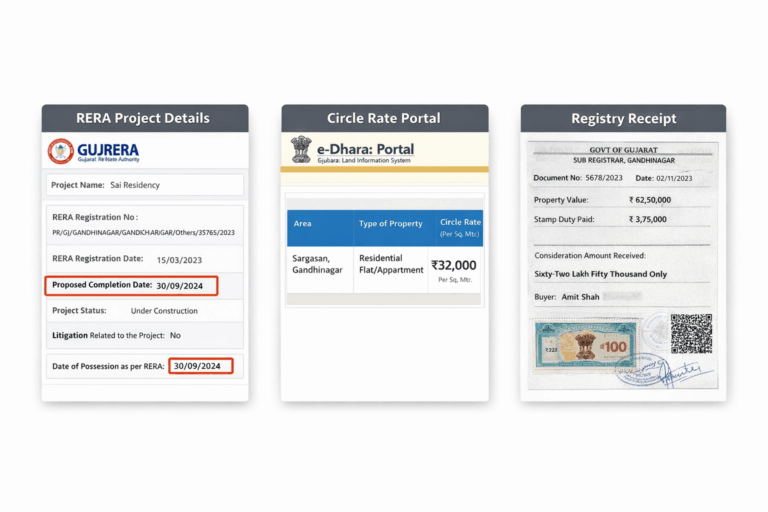
This guide references::
RERA portal data
Provides officially declared construction stage, possession date, and approvals. Helps verify whether builder promises match regulatory filings.
Circle rate benchmarks
Government-set minimum property values used for stamp duty.
Acts as a baseline to judge if a quoted price is realistic or inflated.
Sub-registrar registry values
Shows actual sale prices recorded during property registration.
This reflects real market transactions, not advertised rates.
On-ground buyer advisory experience
Insights gained from site visits, negotiations, and buyer case handling.
Captures realities that no portal or report can show.
📌 Current Market Context
- Prices are relatively stable
- Demand is end-user driven
- Interest rates matter more than appreciation stories
PROOFS & SCREENSHOT PLACEMENTS
WHO THIS GUIDE IS NOT FOR
This guide is NOT for:
- Short-term flippers
- Speculative buyers chasing “next hot area”
- People expecting guaranteed appreciation
You should wait or rent if:
- Job stability is uncertain
- EMI exceeds comfort zone
- You’re buying under pressure
This guide will NOT help with:
- Insider deals
- Black-money transactions
- Quick profits
REAL BUYER DOUBTS — FAQ
Q1: Is under-construction always cheaper?
Q2: Is RERA enough for safety?
Q3: Should I wait for prices to fall?
Q4: Which is safer for first-time buyers?
Q5: Can under-construction still make sense?
IF I WERE BUYING TODAY
If I were buying a 2 BHK in Gandhinagar today:
- I’d prefer ready-to-move for end-use
- I’d negotiate hardest on resale urgency
- I’d avoid projects with unclear OC timelines
- One red flag I’d never ignore: slow construction pace despite RERA
CONCLUSION:
Buying a home is not about choosing between two categories.
It’s about choosing clarity over confusion.
👉 You can:
- Download a ready vs under-construction checklist
- Comment with your situation
- Ask better questions before committing
References
About the Author