

Property Price Trends In Gandhinagar 2026: Last month, a mid-level PSU officer walked into my office in Gandhinagar with a simple question:
“Prices are rising everywhere. Brokers are saying ‘buy now or regret later’. But every project sounds risky. Am I late… or am I being rushed?” He had visited six sites in two weekends.
Every builder claimed:
- “Last few units left”
- “Price revision next week”
- “Government area — rates never fall”
Yet when we pulled actual registry data, the story changed.
Most online blogs won’t tell you this because they’re written to rank, not to protect buyers. They repeat growth headlines without explaining where prices are real, where they’re inflated, and where waiting is actually the smarter move.
In my experience advising buyers across Sargasan, Kudasan, Raysan, Koba, Vavol, and Gift City edge pockets, 2026 is not a blind-buy year.
It’s a decision-quality year. This guide will give you clarity — not urgency.

REAL BUYER PROBLEMS — GROUND REALITY
Here’s what buyers in Gandhinagar are actually struggling with: In this dynamic and fast-paced world, partnering with a professional digital marketing agency in Ahmedabad is essential. It is no longer necessary but is vital for sustained development.
Problem 1: “Prices Are Rising” — But Which Prices?
Builders quote launch price + PLC + floor rise + GST + parking + amenities. Buyers assume that’s “market price”.
Reality: Registry values often lag quoted prices by 8–15% in under-absorbed projects.
Problem 2: Fake Urgency & Soft Inventory
Internal Investor Exits
These are flats originally booked by early investors who want to exit before possession. Such units may be offered quietly at negotiable prices. Buyers should verify original allotment price, holding period, and transfer charges to avoid overpaying or legal complications.
Builder-Held Inventory
This refers to unsold flats retained by the builder, often in the same project that’s claimed to be “nearly sold out.” These units usually carry pricing flexibility, especially near financial year-end. Always cross-check actual sold inventory vs marketing claims to gain negotiation leverage.
Delayed Towers Quietly Discounted
When a specific tower faces construction or approval delays, builders may discount units without publicly announcing it. Buyers must verify revised possession dates, RERA phase updates, and penalty clauses. Lower price only makes sense if delay risk is clearly understood and acceptable.
Problem 3: Trust vs Delivery Risk
RERA registration exists — but:
Phase-Wise Approvals Confuse Buyers
Many projects are approved and registered tower-by-tower or phase-by-phase, not as a single development. Buyers often assume full-project approval, which is incorrect. Always check which phase your unit belongs to on RERA, or you may face delayed amenities or incomplete surroundings.
Timelines Shift Silently
Possession dates are sometimes revised internally without clear communication to buyers. Unless you track RERA timeline updates and construction milestones, delays may only become visible late. Buyers should insist on written possession commitments and delay penalty clauses.
Amenities Get Diluted Post-Handover
Amenities shown in brochures may change after handover due to cost-cutting or maintenance concerns. If amenities are not listed in RERA or the sale agreement, they are not legally binding. Buyers must verify exact amenity specifications in approved documents, not marketing material.
Problem 4: Wrong Location for Wrong Purpose
I’ve seen:
End-Users Buying in Investor Zones
Investor-heavy areas are often dominated by small units, high density, and transient tenants. While prices may look attractive, daily livability suffers due to parking pressure, limited community stability, and unfinished infrastructure. End-users often realize too late that the area doesn’t suit long-term family living.
Investors Buying in Pure Residential Pockets with Low Rental Pull
Pure residential zones prioritize peace and owner-occupied homes, not tenant demand. Rental absorption is slow, and exit liquidity can be limited. Investors in such pockets face long vacancy periods and muted yields, making capital lock-in more likely than predictable returns.
Problem 5: End-Use vs Investment Confusion
A 2 BHK that’s perfect to live in may be terrible for exit liquidity. These are not theory problems. These are mistakes I’ve personally seen cost buyers ₹8–25 lakh over time.
Read More: Future Development Plans In Gandhinagar

STEP-BY-STEP BUYER ACTION PLAN
Step 1: Location Selection
What to do:
Shortlist micro-locations, not “Gandhinagar” broadly.
Reality Check (2026):
Stable End-User Zones:
Sargasan, Kudasan (select pockets)
Mixed Risk-Reward:
Raysan, PDPU Road belt
Future-oriented / Volatile:
Koba, Gift City edge
Mistake to avoid:
Buying in low-density outskirts just because the price looks cheaper.
Pro Tip:
Check school density, grocery access, and internal road width not just highway distance.
Step 2: Budget & Price Validation
What to do:
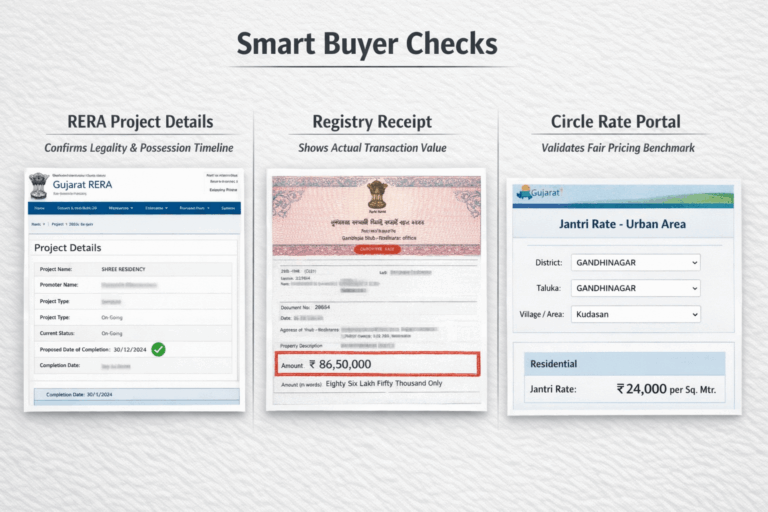
Compare quoted price vs circle rate vs last 6 months registry data.
Why it matters:
Circle rate doesn’t lie about government perception of value.
Mistake:
Assuming “premium project” justifies unlimited markup.
Pro Tip:
If the quoted price is >20% above the prevailing registry, negotiate hard or walk away.
Step 3: Builder & RERA Verification
Check:
Project RERA Number
The RERA number confirms that the project is legally registered and discloses approved plans, possession timelines, and developer commitments. Buyers should never rely on marketing claims alone — always verify the RERA number on the official portal to ensure the unit is not part of an unapproved or future phase.
Phase Approvals
Large projects are often approved in separate phases, even if marketed as one township. Buying in a later or unapproved phase can mean delayed possession, incomplete amenities, or construction disturbance for years. Buyers must confirm that their specific tower and amenities are included in the approved phase.
Past Delivery Timelines
A builder’s past projects reveal how they actually perform under real conditions, not how they promise. Consistent delivery delays are a strong warning sign, regardless of current branding. Buyers should review handover dates of previous projects to judge reliability and risk realistically.
Why:
RERA compliance ≠ timely delivery.
Mistake:
Trusting brochures over RERA filings.
Pro Tip:
Verify if amenities are RERA-listed or marketing promises only.
Step 4: Site Visit Checklist
Physically verify:
- Internal road width
- Parking ramp slope
- Lift brand & backup
- Construction quality (not sample flat polish)
Red Flag:
Too much focus on interiors, zero transparency on structure.
Step 5: Legal & Registry Checks
Check:
Title Clarity
Clear title means the land legally belongs to the developer without disputes, liens, or shared claims. Buyers should ensure the title is marketable and traceable, not just “clear as per builder.” Any ambiguity can delay registry or create resale problems later.
NA Permissions
Non-Agricultural (NA) permission confirms the land is legally approved for residential construction. Projects launched without proper NA approval risk construction stoppage or delayed possession. Buyers must verify that NA permission is granted before booking, not “under process.”
Bank Approval Letters
Bank approval indicates that a lender has completed basic legal and technical checks on the project. While not a full guarantee, it reduces risk significantly. Buyers should still confirm which banks have approved and for which phase, as approvals are often limited.
Actual Registry Examples
Real registry documents show the true transaction value, not advertised prices. They help buyers judge whether they are paying a fair rate and expose inflated quoting. Always ask for recent, completed registry examples, not booking receipts or offers.
Pro Tip:
Ask the builder to show one completed registry receipt.
Step 6: Negotiation Strategy
Best leverage points in 2026:
- Floor rise waiver
- Parking inclusion
- Payment plan flexibility
- Possession delay penalty clause
Hard Truth:
Good projects don’t discount heavily — average ones do.

REAL CASE STUDIES
Case Study 1: End-User Family
- Location: Sargasan
- Budget: ₹68 lakh all-in
- Bought: 2023 at ₹5,300/sqft
- Current Market (2026): ₹5,900–6,100/sqft
Reason for success:
Livability > hype
Lesson:
Moderate appreciation + stress-free living beats speculative bets.
Case Study 2: Investor
- Location: Raysan
- Entry Price: ₹4,800/sqft
- Rental Yield: ~2.6%
- Current Value: ₹5,400/sqft
- Exit Strategy: Hold till infrastructure matures
- What worked: Entry timing
- What didn’t: Rental demand slower than promised

SOCIAL PROOF — REAL BUYER VOICES
“We rejected a cheaper Koba project after checking road width and registry data. No regrets.”
— Amit Patel, PSU Employee, Sargasan
“As an NRI, I needed legal clarity. RERA phase details completely changed our decision.”
— Rohan Shah, Dubai (Investor)
“Negotiation advice alone saved us nearly ₹6 lakh.”
— Neeraj Mehta, IT Professional, Raysan

CREDIBILITY, DATA & MARKET CONTEXT
Verified using:
Gujarat RERA Portal
The RERA portal reveals what the builder is legally committed to deliver, including approved plans, phase-wise timelines, and declared amenities. Buyers should rely on RERA disclosures over brochures to identify hidden delays, unapproved phases, or diluted promises before booking.
Circle Rate Data
Circle rates reflect the government’s benchmark for land and property valuation in each locality. While not the market price, they help buyers spot overpricing and inflated quotes. A large gap between quoted price and circle rate is a signal to verify value or negotiate harder.
Sub-Registrar Registry Records
Registry records show actual transaction values, not advertised rates. They are the most reliable way to understand what buyers are truly paying in the same area or project. Serious buyers should always compare their deal with recent registry entries to avoid overpaying.
Local Planning & Development Authority Updates
Development authority notifications reveal upcoming roads, zoning changes, or infrastructure plans that directly impact livability and future value. Buyers should verify these updates from official sources to separate real development from marketing-driven claims.
2026 Market Reality:
- Price growth is selective, not universal
- Demand is end-user driven
- Interest rates have cooled speculative buying
PROOFS & SCREENSHOT

WHO THIS GUIDE IS NOT FOR
Not for:
- Short-term flippers
- Telegram tip followers
- “Double money in 2 years” seekers
You should wait if:
- Job stability is unclear
- You’re stretching budget beyond comfort
- Builder pressure is the only reason to buy
Renting may be better if:
- Stay is under 3 years
- Area choice is still uncertain
CONCLUSION
Property price trends in Gandhinagar 2026 reward clarity, patience, and verification — not speed.
If this guide helped you think better, not faster, it did its job.
You can:
- Ask questions in comments
- Request a buyer checklist
- Cross-verify your shortlisted project
No pressure. No sales pitch.
Property Price Trends In Gandhinagar 2026: FAQS
Q1: Will prices crash in Gandhinagar?
Q2: Is Gift City a safe bet?
Q3: Should I wait till after elections/budget?
Q4: Are under-construction projects risky in 2026?
Q5: Is 2026 a good year to buy?
References
About the Author