
Buying a 3 BHK in Gandhinagar can look straightforward until you sit down with the actual numbers.
A broker may tell you, “Sir, your salary is good enough for a ₹1 crore flat.” A bank may give you a provisional eligibility figure that looks attractive. Then you calculate the down payment, registration-related expenses, interiors, existing EMIs and the actual monthly repayment—and suddenly the same property feels much less affordable.
That is where many buyers make their biggest mistake. Loan eligibility is not the same thing as comfortable affordability. This guide is designed to help you work backwards from your income, existing obligations, down payment and acceptable EMI before you commit to a 3 BHK in Gandhinagar.
Important: The EMI examples below are illustrations, not loan offers. Actual eligibility and interest rates depend on the lender, borrower profile, credit history, property valuation, loan-to-value limits and other factors.
First Understand What “Loan Eligibility” Actually Means
When a lender evaluates your home-loan application, it does not simply ask:
“How much does the house cost?” It evaluates both you and the property.
Typical considerations include:
- Monthly income
- Employment/business stability
- Existing EMIs
- Credit history
- Age
- Loan tenure
- Requested loan amount
- Property value
- Property documentation
- Lender’s internal policies
For example, ICICI Bank states that home-loan eligibility depends on factors including income, credit score, employment status, age and property value. This distinction matters because a buyer may technically qualify for a particular loan but still find the EMI uncomfortable.
My rule for buyers
Never start with “How much loan can I get?”
Start with:
“How much EMI can I comfortably pay every month without damaging my savings and lifestyle?”
Then calculate the property budget.
What Does a 3 BHK Cost in Gandhinagar?
There is no single Gandhinagar 3 BHK price. The locality, project, carpet area, age, floor, specifications, possession status and exact transaction terms can produce very different prices, so buyers should assess 3 BHK loan eligibility and EMI calculation only after establishing the actual purchase price of the specific property.
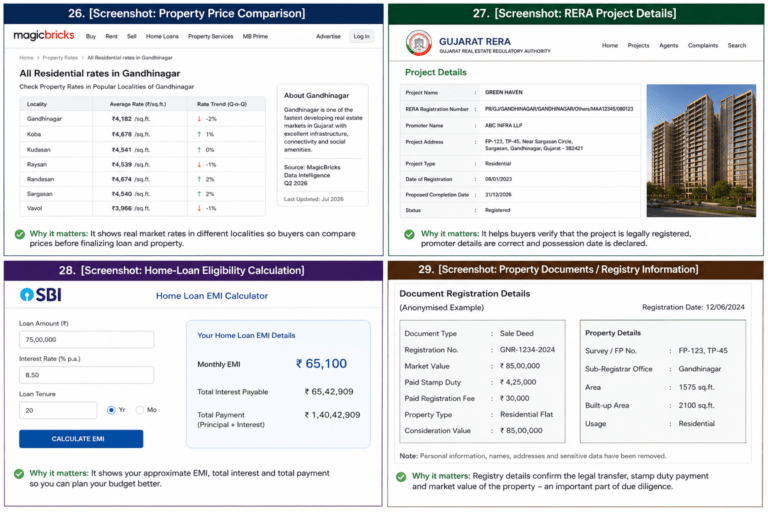
MagicBricks’ Q2 2026 data puts the average rate for multistorey apartments across Gandhinagar at approximately ₹4,182/sq ft, with a reported range of ₹3,451–₹4,913/sq ft.
But individual 3 BHK listings vary substantially. Current listings on MagicBricks show 3 BHK properties across Gandhinagar from roughly ₹69.7 lakh to above ₹2 crore, depending heavily on location and property characteristics.
For example, current locality-level asking-price ranges include:
Locality | Q2 2026 Avg. Apartment Rate |
Gandhinagar overall | ~₹4,182/sq ft |
Koba | ~₹4,678/sq ft |
Randesan | ~₹4,674/sq ft |
Raysan | ~₹4,539/sq ft |
Sargasan | ~₹4,540/sq ft |
Kudasan | ~₹4,541/sq ft |
Vavol | ~₹3,966/sq ft |
These are market indicators, not valuation certificates. A buyer should therefore never calculate loan requirements from a locality’s average rate alone.
The Most Important Number: Your Maximum Comfortable EMI
Suppose your household earns ₹1.5 lakh per month.You may technically qualify for a substantial home loan.
But should you take the maximum available amount?
Not necessarily.
You still need money for:
- Food and household expenses
- School/education costs
- Insurance
- Existing loans
- Emergency savings
- Investments
- Travel and lifestyle
- Property maintenance
- Future family expenses
I would rather see a buyer purchase a slightly cheaper 3 BHK and maintain financial flexibility than stretch to the maximum loan offered by a bank.
A practical stress test
Before buying, ask:
If my income temporarily falls by 20–30%, can I still manage the EMI? If the answer is no, your proposed loan may be too aggressive.
How Banks Generally Assess Your Eligibility
There isn’t one universal formula used identically by every lender. However, lenders generally look at your repayment capacity and existing obligations.
For example:
Applicant A
- Monthly income: ₹1,20,000
- Existing EMI: ₹15,000
- Proposed home loan: ₹60 lakh
- Tenure: 20 years
- Find professional, experienced digital marketers in Ahmedabad with experience in various industries.
- Ex: digital marketing for real estate in Ahmedabad, healthcare marketing agency Ahmedabad, and ecommerce marketing agency Ahmedabad.
- Verify if they’re certified Google Partners in Ahmedabad or have other certifications that prove they follow the best practices.
Applicant B
- Monthly income: ₹1,20,000
- Existing EMI: ₹40,000
- Proposed home loan: ₹60 lakh
- Tenure: 20 years
Both applicants earn the same amount. But their borrowing profiles are obviously different. This is why online eligibility calculators should be treated as starting points, not loan approvals.
Your Existing EMIs Matter More Than Many Buyers Realise
Suppose you already pay:
- Car EMI: ₹18,000
- Personal loan EMI: ₹12,000
- Credit-card repayment: ₹5,000
That’s ₹35,000 going toward existing obligations. Now imagine adding a ₹60,000 home-loan EMI.
Your total monthly debt commitment becomes approximately:
₹95,000/month
If your household income is ₹1.5 lakh, that is a completely different financial situation from someone earning ₹1.5 lakh with no existing debt.
EMI Calculation: What Will You Actually Pay?
The standard EMI formula is:
EMI = P × r × (1+r)ⁿ / [(1+r)ⁿ − 1]
Where:
- P = principal loan amount
- r = monthly interest rate
- n = total number of monthly instalments
You don’t need to calculate this manually every time. A bank’s official EMI calculator can do it for you. For illustration, let’s assume an interest rate of 8.5% per annum.
Approximate EMI at 20-year tenure
Loan Amount | Approx. EMI @ 8.5% |
₹50 lakh | ₹43,391 |
₹60 lakh | ₹52,069 |
₹70 lakh | ₹60,748 |
₹75 lakh | ₹65,087 |
₹80 lakh | ₹69,426 |
₹90 lakh | ₹78,104 |
These are illustrative calculations, not lender quotations.
20 Years vs 25 Years: Don't Look Only at EMI
A longer tenure reduces your monthly EMI. That sounds attractive. But you pay interest for a longer period.
For example, at an illustrative 8.5% rate:
Loan | 20-Year EMI | 25-Year EMI |
₹60 lakh | ~₹52,069 | ~₹48,314 |
₹70 lakh | ~₹60,748 | ~₹56,366 |
₹80 lakh | ~₹69,426 | ~₹64,418 |
₹90 lakh | ~₹78,104 | ~₹72,470 |
The reduction in EMI may look useful. But don’t choose 25 years simply because the EMI fits the bank’s eligibility calculation.
My preference
If you can comfortably afford the 20-year EMI without compromising emergency savings, I would generally prefer the shorter tenure. If the 20-year EMI makes your finances fragile, don’t force it. Consider a lower property budget instead.
Example: Buying a ₹1 Crore 3 BHK
This is where buyers often make an expensive mistake.
Suppose the property price is:
₹1 crore
Do not automatically assume:
“I need ₹1 crore loan.”
The lender’s financing depends on applicable loan-to-value rules, property valuation and the lender’s policies. You also need your own funds for the portion not financed by the lender and for purchase-related expenses that may not be financed through the home loan.
Illustrative structure
Component | Example |
Property price | ₹1,00,00,000 |
Home loan | ₹75,00,000 |
Buyer contribution toward price | ₹25,00,000 |
Other purchase-related costs | Additional |
Interiors/furnishing | Additional |
Emergency reserve | Should remain |
The exact amount you need upfront will depend on the property and transaction. This is why a ₹1 crore property does not mean you only need ₹25 lakh in savings.
Don't Empty Your Bank Account for the Down Payment
This is one of the mistakes I would strongly discourage. Imagine you have ₹35 lakh saved. You find a ₹1 crore property. You decide to put ₹30 lakh into the purchase and keep only ₹5 lakh.
On paper, the deal works. In real life, you have created a dangerous situation.
What happens if:
- Your job changes?
- A family emergency occurs?
- Construction/interior costs increase?
- Your EMI rises?
- You have an unexpected medical or family expense?
A home should not consume your entire financial safety net.
My rule
Buy the property only when you can fund the purchase while still retaining a meaningful emergency reserve.
Step 1: Choose the Location Before Choosing the Loan
Do not start your home search by asking a bank how much you can borrow. Start by deciding where you actually want to live.
For Gandhinagar, buyers commonly compare areas such as:
- Sargasan
- Kudasan
- Raysan
- Randesan
- Koba
- Vavol
- PDPU Road
- GIFT City surroundings
- Other established residential pockets
Different locations can have very different pricing and commuting patterns. For example, Q2 2026 MagicBricks data shows Sargasan at around ₹4,540/sq ft, Koba at ₹4,678/sq ft and Vavol at around ₹3,966/sq ft.
What to check
Before committing to a 3 BHK:
- Daily commute
- School access
- Healthcare
- Public transport
- Road connectivity
- Traffic during peak hours
- Water supply
- Existing social infrastructure
- Future development
- Resale demand
Don’t borrow more money simply to buy in a locality you don’t actually need.
Step 2: Validate the Property Price
A bank approving your loan does not mean the property is fairly priced. This is extremely important.
Suppose the seller asks:
₹1.10 crore
The bank approves a loan based on its own assessment. That does not automatically mean ₹1.10 crore is the correct market value.
Compare:
- Carpet area
- Built-up/saleable area
- Floor
- Age
- Parking
- Facing
- Amenities
- Construction quality
- Project reputation
- Possession status
- Comparable resale properties
Current Gandhinagar listing data shows significant variation in 3 BHK prices, even within the same broad market.
My practical rule
Never let loan eligibility become your property valuation method.
Step 3: Check RERA Before Paying a Large Token
For an under-construction 3 BHK, check the project’s RERA information independently.
Look at:
- Registration number
- Promoter
- Project address
- Declared completion date
- Approved plans
- Unit details
- Construction status
- Any available regulatory information
Do not rely only on a brochure or sales representative.
Ask for the exact RERA number
Then verify that:
Project name + promoter + address + unit information
match what you are being offered. A mismatch deserves investigation before you pay a substantial amount.
Step 4: Conduct a Proper Site Visit
A site visit should not be a 20-minute walk through the sample flat. For a ready property, inspect the actual unit. For an under-construction property, inspect the construction progress and compare it with the promised specifications.
Check:
- Carpet-area layout
- Bedroom size
- Window placement
- Natural light
- Ventilation
- Bathroom position
- Kitchen usability
- Balcony
- Parking
- Lift
- Common areas
- Water pressure
- Power backup
- Noise
- Road access
- Mobile network
- Surrounding construction
Visit twice
If possible:
Visit once during the day and once during evening peak hours. A location can feel completely different at 8 AM, 2 PM and 7 PM.
Step 5: Legal and Registry Checks
Don’t treat loan approval as a substitute for legal due diligence. A lender will conduct its own checks, but you should understand what is being checked and obtain independent professional advice where appropriate.
Depending on the transaction, review relevant:
- Title documents
- Previous sale deeds
- Encumbrance-related information
- Approved plans
- Development permissions
- RERA records
- Property tax information
- Society documentation
- Possession/occupancy documents where applicable
- Land/revenue records where relevant
The Gujarat Revenue Department provides online services covering areas such as land records, document registration and property cards.
Important
Never assume “the bank approved it, so everything is legally perfect.” Bank due diligence and your own legal due diligence serve different purposes.
Step 6: Negotiate the Property, Not Just the Interest Rate
Many buyers spend hours negotiating 0.10% on the home-loan rate while ignoring ₹5–10 lakh of negotiation on the property. That is backwards. Suppose you are buying a ₹1 crore property.
If you negotiate the purchase price down by ₹5 lakh, you may reduce:
- Down payment requirement
- Borrowing requirement
- Interest cost
- EMI
- Total acquisition cost
Negotiate on:
- Base property price
- Parking
- Floor-rise charges
- Maintenance deposit
- Clubhouse charges
- Other builder charges
- Furniture/interiors
- Possession-related costs
- Payment schedule
Get every agreed concession in writing.
Current Interest-Rate Reality in 2026
As of August 6, 2026, the RBI’s published policy-rate page showed the repo rate at 5.25%. Home-loan pricing can vary by lender and borrower.
For example, ICICI Bank’s published information says rates depend on factors such as bureau score, customer profile, loan amount and tenure; its published home-loan page also provides different rate ranges for different borrower/loan categories.
Its published data for loans disbursed in Q1 FY2026-27 showed home-loan rates ranging from 7.20% to 11.20%, illustrating how widely actual pricing can vary by borrower and loan characteristics.
What this means for you
Don’t build your budget around an advertised:
“Starting from X%”
Ask the lender:
“What rate would actually apply to my profile?”
Then calculate your EMI using that rate.
Stress-Test Your EMI Before Buying
This is one of the most useful exercises you can do.
Suppose your expected EMI is:
₹60,000
Don’t test only ₹60,000.
Also calculate:
- ₹60,000
- ₹65,000
- ₹70,000
Then ask:
Can my household comfortably manage the higher figure?
Floating-rate loans can change as applicable benchmarks and lender terms change. Borrowers should understand what happens to EMI and/or tenure when rates reset. If your budget collapses with a relatively modest rate increase, you are probably borrowing too aggressively.
A Simple Affordability Example
Let’s assume:
- Household net income: ₹1,80,000/month
- Existing EMI: ₹20,000
- Proposed home EMI: ₹65,000
Total debt repayment:
₹85,000/month
Remaining before household expenses:
₹95,000/month
Now subtract:
- Food
- Utilities
- School
- Insurance
- Investments
- Transport
- Family obligations
- Maintenance
If you are left with very little, the property may be too expensive despite being technically eligible.
Don't Forget Home-Loan Fees
The interest rate is not the only borrowing cost.
Depending on the lender and transaction, you may encounter:
- Processing fee
- Legal evaluation charges
- Technical valuation charges
- Documentation charges
- Administrative charges
- Applicable taxes
- Mortgage-related charges
- Other service charges
For example, ICICI Bank publishes processing and other home-loan charges separately from the headline interest rate.
Therefore ask the lender for:
A complete sanction-cost sheet.
Don’t compare banks only on the advertised interest rate.
Case Study 1: End-User Family
A family with combined monthly income of approximately ₹1.7 lakh wanted a 3 BHK in Gandhinagar.
Their initial target:
₹1 crore property
They expected a loan of around ₹75 lakh.
After reviewing their finances, they realised they also needed to maintain:
- Emergency savings
- Education expenses
- Existing vehicle loan
- Purchase-related costs
- Basic interiors
Instead of buying at ₹1 crore, they chose a property around ₹85 lakh.
Outcome
Their EMI was materially lower, and they retained a stronger cash reserve.
Lesson
The best property is not necessarily the most expensive property your bank will finance.
Case Study 2: Investor
An investor considered a 3 BHK priced at approximately ₹90 lakh. The expected rent was around ₹25,000–₹30,000 per month.
At ₹30,000 monthly rent:
Annual gross rent = ₹3.6 lakh
Against a ₹90 lakh purchase:
Gross rental yield ≈ 4%
That is before:
- Maintenance
- Vacancy
- Repairs
- Taxes
- Brokerage
- Financing costs
The investor therefore realised that the property could not be justified purely through rental income.
What worked
The investor focused on:
- Location
- Resale liquidity
- Purchase price
- Tenant demand
What didn't
The initial assumption that “property prices will automatically rise quickly” was not treated as a guaranteed return.
Lesson
Don’t buy a 3 BHK as an investment merely because someone predicts appreciation.
Who Should NOT Buy a 3 BHK Right Now?
I would seriously reconsider the purchase if:
- You have almost no emergency savings.
- Your existing debt is already high.
- The proposed EMI consumes most of your disposable income.
- You are depending on an uncertain future salary increase.
- You are buying only because a broker says prices will rise.
- You haven’t compared competing properties.
- You haven’t independently checked the property documents.
- You are uncomfortable with potential floating-rate changes.
- You are buying purely for short-term speculation.
Renting may be smarter if:
Your job/location may change within the next few years and you are not yet certain where you want to settle. There is nothing financially wrong with waiting. A delayed purchase is usually less expensive than a forced sale
Who Is This Guide NOT For?
This guide is not designed for someone looking for:
- A quick-flip property
- Guaranteed appreciation
- Insider deals
- Rumour-based investments
- “Buy today, double money tomorrow” opportunities
Real estate is relatively illiquid. If you buy the wrong property at the wrong price, exiting may take considerably longer than expected.
Screenshot
If I Were Buying a 3 BHK in Gandhinagar Today
This is where I would be more conservative than many brokers. I would not start by asking for my maximum loan eligibility. I would first establish my comfortable EMI.
Then I would:
- Select 2–3 suitable localities.
- Compare at least five genuinely comparable 3 BHK properties.
- Calculate the price on a consistent area basis.
- Check carpet area rather than relying only on super built-up area.
- Verify RERA where applicable.
- Check the legal documentation.
- Obtain at least two loan quotes.
- Compare the total borrowing cost, not just the headline interest rate.
- Keep an emergency reserve after the purchase.
- Negotiate the property price before obsessing over a tiny interest-rate difference.
The one red flag I would not ignore
If the only reason the property seems affordable is because you are stretching the loan tenure and using almost all your savings for the down payment, I would walk away. That’s not affordability. That’s financial compression.
My Preferred 3 BHK Buying Strategy
If I were buying for my own family, my priority would be:
1. Comfortable EMI
Not maximum eligibility.
2. Good carpet-area efficiency
Not the biggest advertised square-foot number.
3. Strong location fundamentals
Not simply the latest “upcoming hotspot.”
4. Clean documentation
Not verbal assurances.
5. Reasonable entry price
Not the cheapest property.
6. Exit flexibility
Even if I intend to live there for many years.
Final Checklist Before Applying for the Loan
Before paying a substantial token amount, I would want these numbers written down:
- Property price
- Carpet area
- Effective price per sq ft
- Expected loan amount
- Down payment
- Estimated EMI
- Existing EMIs
- Total monthly debt obligation
- Interest rate offered
- Loan tenure
- Processing charges
- Other borrowing costs
- Registration/stamp-related expenses as applicable
- Interiors/furnishing budget
- Emergency reserve after purchase
- RERA verification where applicable
- Legal-document review
- Property valuation
- Negotiated final price
If several of these numbers are still unknown, you are not ready to commit to the property.
Conclusion
A 3 BHK in Gandhinagar can be an excellent long-term purchase—but only when the property, price and financing structure make sense together. The biggest mistake is to treat a bank’s maximum eligibility as your buying budget.
Instead, work backwards:
Comfortable EMI → Affordable loan → Required down payment → Complete purchase cost → Suitable property price.
Gandhinagar’s 2026 market contains a wide range of 3 BHK properties and locality-level prices, so there is usually more value in comparing properties carefully than in rushing toward the first property that fits a lender’s eligibility calculator. If the numbers work comfortably, proceed with proper due diligence. If they don’t, wait, reduce the property budget or reconsider the configuration. A good home should improve your life—not make every month financially stressful.
Perfect Guide For Loan Eligibility And EMI for 3 BHK Flats in Gandhinagar - faqs
1.How much salary is required for a 3 BHK home loan in Gandhinagar?
2. Can I get a ₹75 lakh home loan for a ₹1 crore property?
3.Is a 20-year or 25-year loan better?
4.Does a higher CIBIL score help?
5.Should I make a larger down payment?
references
About the Author