

Last month, a couple walked into my office in Gandhinagar looking relieved but also frustrated. They had already paid a token amount for a flat… only to later discover the project’s possession date was uncertain, pricing was inflated, and resale value was weak.
Their biggest regret? “We wish someone had told us what not to do before buying.”
Most blogs talk about where to buy and why Gandhinagar is growing. Very few tell you the real mistakes buyers make on the ground the ones that cost lakhs and years of stress.
In this guide, I’ll break down the most common mistakes to avoid before buying a flat in Gandhinagar, based on real buyer cases, registry data, and site visits—not theory.

PROBLEM EXPLANATION: WHY BUYERS GO WRONG
From my experience working with both end-users and investors in Gandhinagar, buyers usually struggle with:
Price Confusion
- Same 3 BHK quoted at ₹62L in one project and ₹78L nearby
- No clarity on carpet vs super built-up
Builder Trust Issues
- Fancy marketing, weak delivery record
- RERA registered but poor execution
Location Mistakes
- Buying “cheap” areas without rental demand
- Ignoring future infrastructure reality
Living vs Investment Confusion
- End-users buying investor stock
- Investors buying emotional homes
Read More: How to Find the Best Locality for Your 3 BHK Flat in Gandhinagar – Expert Advice

STEP-BY-STEP SOLUTION: ACTIONABLE BUYER GUIDE
Step 1: Location Selection (Most Ignored Mistake)
What to do
Shortlist locations based on your purpose
- Living → Sargasan, Kudasan, PDPU Road
- Investment → Gift City edge, developing sectors
Why it matters
Location decides resale speed, rent, and daily convenience
Mistakes to avoid
- Buying far outskirts just because price looks low
- Ignoring approach roads & civic development
Pro Tip
I always check live rental listings before approving a location for investors.
Step 2: Budget & Price Validation
What to do
Compare:
Quoted Price
This is the price the builder or seller asks for the flat. In practice, it often includes marketing premiums and negotiable margins, so it should never be accepted without comparison or verification.
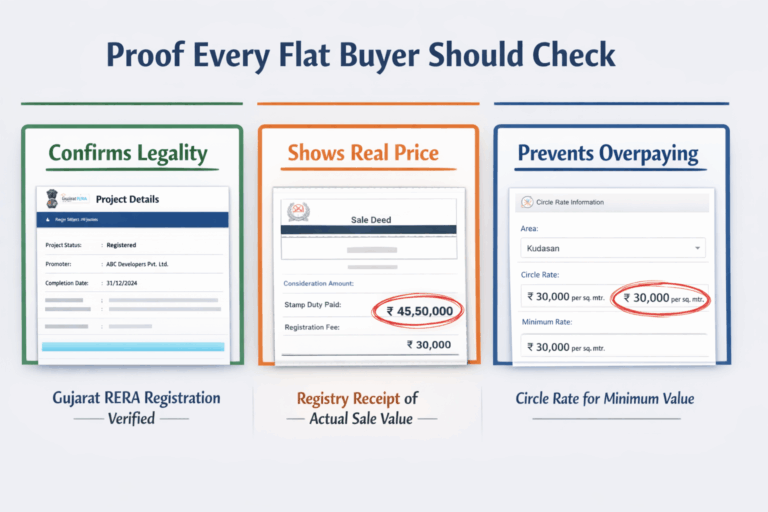
Circle Rate
The circle rate is the government-declared minimum value used for stamp duty and registration. It acts as a baseline to identify under-reporting or over-pricing but does not reflect real market demand or property condition.
Recent Registry Value
This shows the actual price at which similar flats were legally registered in the same area. From on-ground experience, registry values are the most reliable indicator of fair market pricing and negotiation leverage.
Why it matters
Prevents overpaying by 10–20%
Mistakes to avoid
- Believing “limited offer pricing”
- Ignoring loading charges
Pro Tip
Registry data tells the truth not brochures.
Step 3: Builder & RERA Verification
What to do
Verify Project on Gujarat RERA Portal
Check:
Possession Timeline
This is the official date committed by the builder for handing over the flat, as declared on the Gujarat RERA portal. In real transactions, a realistic possession timeline helps you avoid prolonged rent outflow and assess whether the builder’s promise matches on-ground construction progress.
Previous Delivery History
This refers to the builder’s track record of completing earlier projects on time. From experience, builders with consistent delays or multiple RERA extensions are more likely to repeat the same issues, making delivery history a strong indicator of future risk.
Why it matters
Legal safety + peace of mind
Mistakes to avoid
- Assuming all RERA projects are equal
- Ignoring past delays
Pro Tip
I avoid builders with repeated extension requests.
Step 4: Site Visit Checklist
What to do
Visit the Actual Flat (Not Just the Sample)
Always insist on seeing the exact flat or at least the same-facing unit, not only the sample apartment. Sample flats are designed to hide space, light, and finish issues that affect daily living after possession.
Check:
Sunlight
Check how much natural light enters the flat during daytime hours. From on-site visits, poor sunlight often leads to higher electricity use, dampness, and lower long-term livability—especially in closely packed societies.
Ventilation
Ensure there is proper cross-ventilation through windows or balconies. Good airflow improves indoor comfort, reduces humidity, and is a clear sign of thoughtful layout planning.
Construction Quality
Look closely at plaster finish, tile alignment, door frames, and common-area workmanship. Small visible defects often indicate deeper quality issues that become costly after possession.
Why it matters
Photos hide flaws
Mistakes to avoid
- Booking without visiting
- Trusting virtual tours
Pro Tip
Always visit at least one occupied building by the same builder.
Step 5: Legal & Registry Checks
What to do
Verify:
Title Clarity
Title clarity means the land and property have a clear, dispute-free ownership history. In practical terms, it ensures the seller has full legal rights to sell the flat, reducing the risk of future legal claims or registration problems.
NA / NOC Approvals
NA (Non-Agricultural) status and required NOCs confirm that the land is legally approved for residential construction. From experience, missing or partial approvals are a common cause of project delays and loan rejections.
Draft Agreement
The draft agreement outlines possession date, payment schedule, penalties, and specifications. Reviewing it carefully helps buyers catch one-sided clauses, unclear timelines, or missing commitments before signing anything binding.
Why it matters
Avoids future disputes
Mistakes to avoid
Skipping lawyer review
Pro Tip
A ₹5,000 legal check can save ₹5 lakhs later.
Step 6: Negotiation Tips
Negotiate:
Floor Premium
Floor premium is the extra amount charged for higher-floor flats, often justified by better views or ventilation. In reality, this is usually negotiable especially in ready or low-occupancy projects—so buyers should question whether the premium truly adds daily living or resale value.
Parking
Parking includes the type (open, covered, stilt) and location of the allotted space. From buyer cases I’ve handled, unclear or inconvenient parking becomes a long-term frustration and should always be confirmed in writing before booking.
Parking
The payment schedule defines when and how much you pay at each stage. A balanced, construction-linked schedule protects buyers from paying too much upfront and reduces risk if project progress slows.
Why it matters
Small negotiations add up
Mistakes to avoid
Revealing urgency
Pro Tip
Month-end deals often unlock better terms.

REAL CASE STUDIES
Case 1: End-User Family (Sargasan)
- Budget: ₹72L
- Bought: Ready 3 BHK
- Rent saved: ₹18,000/month
- Appreciation: ~22% in 3 years
Lesson:
Verified pricing = stress-free living
Case 2: Investor (Near Gift City)
- Bought at: ₹48L
- Current value: ₹62L
- Rental yield: 3.8%
Lesson:
Location > size for investors

TESTIMONIALS
“We avoided overpaying after checking registry data.”
— Amit Patel, IT Professional, Kudasan
“This guide helped us skip risky builders.”
—Neha Shah, First-Time Buyer, Sargasan
“Clear, practical advice—no sales push.”
— Rajiv Mehta, Property Investor, Gandhinagar

VERIFIED FACTS & CREDIBILITY
Gujarat RERA Portal
The Gujarat RERA portal is the primary source to verify whether a project is legally registered and compliant. It helps buyers check approved plans, possession timelines, and past extensions critical for judging delivery risk before booking.
Gandhinagar Sub-Registrar Records
Sub-Registrar records show the actual prices at which flats were legally registered. From on-ground experience, this data reveals the true market value of a location and prevents buyers from overpaying based on quoted prices.
Circle Rate Portal
The circle rate portal provides the government-declared minimum valuation used for stamp duty and registration. Buyers use it as a benchmark to identify over-pricing or under-reporting, not as the final market price.
Local Development Authority Plans
Local authority plans outline upcoming roads, zoning, and infrastructure projects. Reviewing these helps buyers understand whether future growth claims are backed by approved planning or just marketing promises.
Read More: Why People Prefer Gandhinagar for Buying Flats: A Complete Home Buyer Guide
PROOFS & SCREENSHOTS
CONCLUSION:
Buying a flat isn’t about luck—it’s about avoiding mistakes.
If you want:
- A location checklist
- Price validation help
- Builder shortlisting
👉 Drop a comment or request a free buyer checklist.
Common Mistakes to Avoid Before Buying a Flat in Gandhinagar: Faqs
Q1: Is RERA registration enough?
Q2: Best area for self-use?
Q3: Ready vs under-construction?
Q4: Can prices be negotiated?
Q5: Is Gandhinagar good for investment?
References
About the Author

Mitesh Vyas
Hello My Name is Mitesh Vyas i am a Real Estate content writer and Property Market Enthusiast I shares practical insights on buying, selling, investing, and understanding real estate trends. With a strong focus on residential and commercial properties, My aims to help readers make informed property decisions through clear, research-based, and easy-to-understand content.