
Imagine buying a flat in Gandhinagar after comparing several properties, negotiating the price, and arranging a home loan. You have calculated your EMI, registration expenses, society maintenance, and moving costs.
Then you receive the municipal property tax bill.
The amount is different from what you expected. The seller says previous taxes have been paid, the broker tells you that property tax is a minor expense, and the apartment association gives you a separate maintenance statement.
Now you have three questions: What is the actual property tax rate? How is the amount calculated? And how can you confirm that the flat has no outstanding municipal dues?
These are reasonable questions, but many property websites answer them poorly. Some quote a rate without explaining the assessment factors, while others confuse municipal property tax with stamp duty, registration charges, or society maintenance.
For a buyer or flat owner, the important issue is not simply finding a rate. It is understanding how the municipal corporation assesses your particular property and how to verify the amount payable.
This guide explains flat property tax rates in Gandhinagar, the published assessment structure, calculation factors, online payment, outstanding dues, and the checks worth completing before buying a resale apartment.
The municipal figures discussed below are drawn from the published Gandhinagar Municipal Corporation information available for reference. Because municipal assessments and policies can change, confirm the applicable figures for your financial year and property before making a payment or financial commitment.
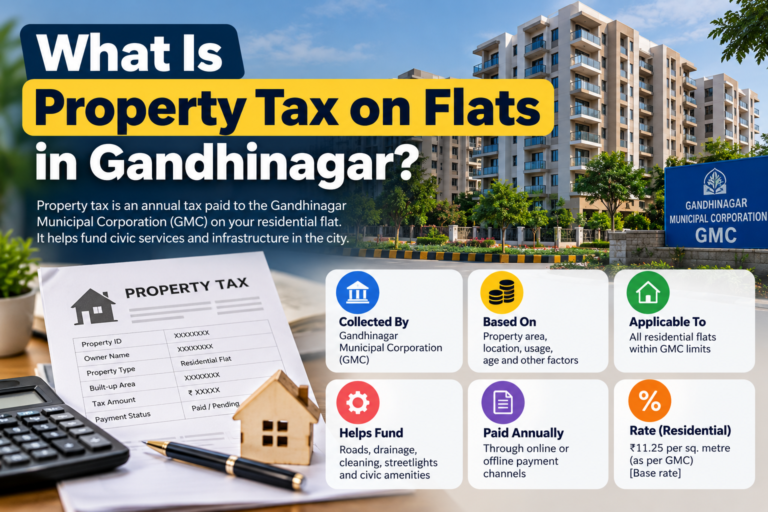
What Is Property Tax on Flats in Gandhinagar?
Property tax is a municipal levy associated with eligible properties within the relevant local authority’s jurisdiction.
For residential flats, the assessment may involve the property’s classification, area, location, age, occupancy, and applicable municipal charges.
In Gandhinagar, the relevant authority for properties falling within its jurisdiction is the Gandhinagar Municipal Corporation (GMC).
However, do not assume that every property marketed as being in Gandhinagar is necessarily assessed under the same municipal system. Some nearby developments may fall under a different local authority or jurisdiction.
Before checking a rate, confirm which authority assesses your property. This simple step can prevent you from using the wrong payment portal or relying on an assessment formula that does not apply to your flat.
Why property tax matters to flat owners
Property tax is a recurring ownership expense rather than a one-time purchase cost.
When calculating the long-term affordability of a flat, account for:
- Annual municipal property tax.
- Apartment or society maintenance charges.
- Repairs and replacement expenses.
- Home loan repayments, if applicable.
- Insurance and other relevant ownership costs.
These expenses serve different purposes and should not be treated as interchangeable.
For example, paying society maintenance does not automatically establish that municipal property tax has been paid. Similarly, a municipal tax receipt does not prove that all society maintenance dues have been cleared.
Keep separate records for each obligation.
What Are the Flat Property Tax Rates in Gandhinagar?
The Gandhinagar Municipal Corporation’s published property tax information lists a residential base tax rate of ₹11.25 per square metre and a non-residential rate of ₹22.25 per square metre in its tax structure.
It also provides assessment factors for land value, property age, occupancy, and property type. The official self-assessment interface separately identifies the factors used in estimating the overall demand.
These published figures should not be interpreted as a guaranteed all-inclusive annual bill for every residential flat. The amount payable depends on the applicable assessment structure and the property’s details.
| Property Classification | Published Base Rate |
|---|---|
| Residential | ₹11.25 per square metre |
| Non-residential | ₹22.25 per square metre |
Source: Gandhinagar Municipal Corporation’s published property tax information.
Before using these figures, verify the current applicable rate and assessment rules directly with the municipal corporation.
Does this mean a 100-square-metre flat pays ₹1,125 annually?
Not necessarily.
Multiplying 100 square metres by ₹11.25 gives ₹1,125, but that calculation only illustrates the multiplication of the published base rate by an assumed area.
It does not establish the final property tax bill.
The official assessment interface identifies additional inputs and tax components, including location, property type, occupancy, age, general tax, water tax, conservancy tax, usage charges, and other applicable entries. Buyers reviewing these details as part of a Property buying guide for Gandhinagar can better understand the ongoing tax obligations to consider before purchasing a flat.
Therefore, do not assume that a simple area-times-rate calculation captures every charge in your assessment.
For the actual payable amount, use the official self-assessment facility or check the existing demand against your property’s tenement number.
Which Factors Affect Flat Property Tax in Gandhinagar?
A flat’s property tax assessment is not determined by its purchase price alone.
GMC’s published structure identifies several factors that can affect residential assessment.
Understanding them helps owners question an incorrect assessment rather than accepting the first amount they see.
Property location and land value
The published assessment structure groups residential land values into categories with different factors.
The listed residential location factors are:
| Residential Land-Value Category Shown by GMC | Published Factor |
|---|---|
| Less than ₹7,000 | 1.00 |
| ₹7,001–₹9,000 | 1.10 |
| ₹9,001–₹11,000 | 1.20 |
| More than ₹11,001 | 1.60 |
These figures are reproduced from the corporation’s published information. The displayed ranges contain boundary gaps, so do not independently assign a factor to a borderline value without confirming the applicable municipal category.
The corporation’s assessment rules determine which factor applies to a particular property.
Practical advice: Do not assume that two flats with the same area must have the same tax bill. Verify the location category recorded in each property’s assessment.
Age of the property
| Property Age | Published Factor |
|---|---|
| Less than 10 years | 1.00 |
| More than 10 years but not older than 20 years | 0.85 |
| More than 20 years but not older than 30 years | 0.70 |
| More than 30 years but not older than 40 years | 0.60 |
| Older than 40 years | 0.50 |
These factors indicate that property age is relevant to the published assessment structure.
However, the table alone does not tell you the final bill. The municipal record’s construction year and other assessment inputs must be checked.
If the corporation’s record shows the wrong construction year, ask how to correct it and what supporting documents are required.
Do not assume that a newly renovated flat is automatically treated as a new building for tax purposes. Renovation and original construction year are different matters.
Type of residential property
| Residential Property Type | Published Factor |
|---|---|
| Bungalow | 1.60 |
| Duplex bungalow | 1.50 |
| Tenement or society | 1.50 |
| Row house | 1.10 |
| Flat or apartment | 1.00 |
| Village-area flat or tenement | 0.70 |
The applicable classification matters because a flat and a bungalow may not use the same factor.
Confirm the classification recorded against your property rather than assuming that the factor is determined by how the property is described in a sales advertisement.
Occupancy status
The published assessment information lists an occupancy factor of 1.00 for owner occupancy and 1.50 for tenant occupancy.
This distinction is important for landlords.
If you own a flat that is rented out, check the actual occupancy classification recorded by the municipal corporation. Do not assume that the owner’s name on the property record automatically means the property qualifies for the owner-occupancy factor.
If the flat is vacant, do not automatically classify it as owner-occupied or assume that vacancy removes the tax liability. Ask the corporation how the property should be recorded under the applicable rules.
Carpet area and floor details
The official self-assessment interface includes floor descriptions and floor area as assessment inputs.
For that reason, the area shown in your sale agreement, the apartment’s carpet area, and the area recorded in the municipal assessment should not be treated as automatically identical.
Check the area’s definition and the figure used in the assessment.
If you suspect an error, compare the municipal record with the sanctioned plan, relevant property documents, and the corporation’s assessment requirements.
Other municipal charges
The GMC self-assessment interface identifies components including:
- General tax.
- Water tax.
- Conservancy tax.
- Usage charges.
- EIC charge.
- Education cess.
- Estate rent, where applicable.
- Other displayed charges, depending on the assessment.
Not every component necessarily applies in the same way to every property.
Review the actual bill line by line. If a charge is unclear, ask the corporation to explain its basis rather than assuming that every amount is a separate universal charge for all flats.
How to Calculate Flat Property Tax in Gandhinagar
The safest way to determine your flat’s actual property tax is to use the official municipal assessment facility and verify the resulting demand.
A simplified conceptual illustration is:
Property tax demand = Applicable municipal tax components calculated using the property’s recorded assessment details and relevant factors.
This is not an official formula. It is a reminder that the final amount can include more than one component.
Example: Understanding an illustrative assessment
Suppose you own a residential apartment measuring 100 square metres.
For illustration, assume the applicable base rate is ₹11.25 per square metre.
The simple multiplication is:
100 × ₹11.25 = ₹1,125.
That figure is only an arithmetic illustration of the base rate and assumed area. It is not a verified estimate of the final annual tax for a 100-square-metre flat in Gandhinagar.
To obtain the actual assessment, you would need to verify the property’s location factor, construction year, occupancy, classification, floor-area details, and applicable municipal charges.
The official calculator can help you estimate the demand using the available assessment inputs.
How to check your actual bill
- Locate your property’s municipal tenement number.
- Open the official Gandhinagar Municipal Corporation property tax service.
- Review the property’s recorded details.
- Check the relevant financial year and outstanding demand.
- Compare the assessment information with your property documents.
- Use the official self-assessment facility if you need an estimate based on assessment factors.
- Contact the corporation if the amount or classification appears incorrect.
Do not use the illustrative ₹1,125 calculation to budget for the final bill. Use the actual assessment or verified municipal demand.
How to Pay Gandhinagar Flat Property Tax Online
Gandhinagar Municipal Corporation provides online services for property tax payments, checking dues, and retrieving payment receipts.
The official service portal allows users to look up property tax details using a tenement number.
Step 1: Find your tenement number
Your tenement number identifies the property in the municipal tax system.
If you have purchased a resale flat, ask the seller for the existing municipal tax bill or assessment details.
Do not assume that the apartment number in the housing society’s records is the same as the municipal tenement number.
Step 2: Open the official property tax portal
Select the property tax service and locate the option for checking outstanding dues or payment details.
Step 3: Check the outstanding amount
Enter the required tenement details and review the demand shown by the system.
Check the relevant financial year, previous dues, interest or other listed charges, credits, and any displayed rebate or discount.
Do not proceed with payment until you have checked that the record corresponds to your flat.
Step 4: Complete the payment
Follow the payment instructions on the official portal.
Before confirming, verify the property details and amount.
If the payment appears unsuccessful, do not immediately repeat the transaction. The corporation’s payment service advises users to check whether the bank account or card has already been debited and to allow time for the transaction status or receipt to update.
Step 5: Save the receipt
Download or save the official receipt after successful payment.
Keep the receipt with your property documents, along with the financial year and payment reference.
If the amount was debited but no receipt appeared, follow the official portal’s guidance and contact the relevant payment support or municipal office.
A bank debit alone is not a substitute for verifying that the municipal payment has been recorded correctly.
How to Check Outstanding Property Tax Dues Before Buying a Flat
This is one of the most important steps for resale-flat buyers.
A seller may say that the property tax has been paid, but a verbal statement is not sufficient evidence.
Before paying the final sale consideration or completing the transfer, verify the municipal record and obtain supporting documents.
What to check
- The property’s tenement number.
- The name and address recorded against the assessment.
- Outstanding property tax for the relevant financial years.
- Any interest, penalties, or additional amounts displayed.
- Whether previous payments have been credited correctly.
- Whether the seller has the receipts for the claimed payments.
- Whether the municipal record needs an ownership or name correction.
The official portal provides a facility to search tax dues and paid details by tenement number. The corporation also provides a search facility using information such as owner name, address, zone, and ward.
If a record cannot be located, contact the municipal corporation rather than assuming that the flat has no outstanding dues.
What if the seller has unpaid property tax?
Do not ignore it simply because the amount seems small.
Before proceeding, establish the outstanding amount, agree in writing who will pay it, and verify that the payment has been credited.
Where appropriate, have your conveyancing professional review the transaction documents and the treatment of outstanding municipal liabilities.
The exact legal consequences of unpaid dues depend on the applicable law and circumstances. Do not assume that a private agreement between buyer and seller automatically resolves every issue with the municipal authority.
What Documents May Be Needed for Property Tax Assessment or Correction?
GMC’s published property tax guidance lists documents that may be required for assessment and changes to property records.
Depending on the application, these can include:
- Copy of the registered deed.
- Index copy.
- Building permission.
- Relevant building plan or map.
- Identity proof.
- Building-use permission, where relevant to the requested change.
- Other supporting documents requested by the corporation.
The precise requirements depend on whether you are applying for a new assessment, changing the recorded area, correcting the construction year, transferring the name, or making another change.
Name change after buying a flat
After purchasing a resale apartment, check whether the municipal property tax record needs to be updated to reflect the new ownership.
GMC provides an application process for property tax name changes and lists supporting documents for such requests.
Keep a copy of your registered deed and the submission acknowledgement.
Do not assume that registering the sale deed automatically updates every municipal record. Confirm the status of the relevant property tax record separately.
Property Tax Versus Society Maintenance: What Is the Difference?
Flat buyers sometimes confuse municipal tax with the charges collected by their housing society or apartment association.
They are different obligations.
| Expense | What It Generally Covers |
|---|---|
| Municipal property tax | Applicable municipal taxes and charges assessed against the property |
| Society or association maintenance | Shared building and community expenses under the applicable society arrangements |
| Sinking fund or repair contribution | Funds collected for specified major repairs or future expenses, subject to the governing rules |
| Utility bills | Charges for electricity, water, gas, or other separately billed services |
The exact charges and arrangements depend on the property and the relevant authority or association.
A society may collect certain amounts from residents, but you should not assume that its maintenance statement proves municipal tax has been paid.
Before buying a resale flat, request the municipal tax record and the society’s no-dues or account statement separately.
This simple check can prevent confusion after possession.
What Flat Buyers Should Check in Gandhinagar Before Finalising a Purchase
Property tax is only one part of due diligence, but it can reveal administrative problems that deserve attention.
Check the property record against the sale documents
Confirm that the municipal assessment relates to the flat you intend to purchase.
If the recorded owner, property type, area, or address differs from the documents, ask why.
A discrepancy does not automatically mean that the property cannot be purchased, but it should be explained and corrected where necessary.
Verify the actual municipal jurisdiction
Do not rely solely on a postal address or the developer’s marketing description.
Confirm which authority assesses the property and which portal should be used.
Request proof of previous payments
For resale flats, request the latest property tax bill and receipts for the relevant periods.
Check whether the municipal portal reflects the payments.
Understand all recurring costs
Calculate the expected annual property tax alongside maintenance, repairs, loan repayments, and other ownership expenses.
For an investment flat, these expenses reduce the net rental income available to the owner.
Do not treat a low property tax bill as proof of a good investment
A flat with a low municipal tax demand may still have poor rental demand, expensive maintenance, legal complications, or limited resale appeal.
Similarly, a higher bill does not automatically make a flat a bad purchase.
Evaluate the entire property, not a single cost.
Illustrative Case Studies: Why Verification Matters
The following are hypothetical examples created to demonstrate common ownership decisions. They are not verified client cases or claims of personal advisory experience.
Case Study 1: A Family Buying a Resale Flat
Buyer: A family purchasing a two-bedroom apartment in Gandhinagar.
Purchase price: ₹65 lakh.
Situation: The seller provides a recent municipal tax receipt and says there are no outstanding dues.
Potential problem: The buyer checks only the receipt and does not review the current demand or property record.
A more careful buyer checks the tenement number, reviews the outstanding dues, compares the property details, and obtains receipts for the relevant periods.
If a mismatch appears, the buyer asks the seller to resolve it or obtains professional advice before completing the transaction.
Lesson: A single receipt may not answer every question about the current tax position. Verify the actual municipal record and the period covered by the payment.
Case Study 2: An Investor Evaluating a Rental Flat
Investor: A buyer considering a flat as a long-term rental investment.
Purchase price: ₹50 lakh.
Illustrative annual rent: ₹2.4 lakh.
Gross rental yield:
₹2.4 lakh ÷ ₹50 lakh × 100 = 4.8%.
This is the gross rental yield before property tax, maintenance, vacancy, repairs, insurance, financing costs, and other expenses.
If the investor ignores those costs, the actual return may be materially lower.
Before purchasing, the investor obtains the municipal tax demand, verifies society maintenance, estimates likely repairs, and checks achievable rent rather than relying only on the broker’s projected figure.
Lesson: Property tax is part of the recurring cost of ownership. Calculate net income before deciding whether the flat is a suitable investment.
Testimonials and Evidence: What Should a Trustworthy Guide Include?
A useful property tax guide should not rely on invented testimonials.
If you are publishing this article on a real estate website, add genuine feedback only where the buyer has given permission and the details can be substantiated.
Examples of appropriate evidence include:
[Verified buyer feedback: Resale-flat purchaser]
A short, permission-based account describing how the buyer checked outstanding municipal dues before completing the purchase.
[Verified landlord feedback: Rental-property owner]
A genuine account describing how the owner checked the assessment classification or corrected a property record.
[Verified homeowner feedback: Tax payment issue]
A real example of resolving a payment or receipt discrepancy, supported by appropriate documentation.
If you do not have these records, omit the testimonials. Clearly labelled examples and official documents are more trustworthy than fabricated social proof.
Verified Sources and Current Municipal Information
The most useful sources for checking flat property tax in Gandhinagar are the municipal corporation’s own services and published guidance.
Official property tax information
GMC’s published property tax page describes the assessment factors, residential and non-residential base rates, property classifications, and documents that may be required for applications.
Use it to understand the published structure, but verify the currently applicable rules for your property.
Official self-assessment facility
The corporation’s self-assessment interface identifies assessment inputs such as property type, occupancy, location factor, construction year, and floor area.
Use the current facility to estimate your demand rather than treating an example calculation as an actual bill.
Official dues and receipt services
The municipal portal provides services for checking outstanding dues and retrieving payment details or receipts.
Use the tenement number associated with your flat and confirm that the record matches the property.
Market conditions and property decisions
Property tax should be considered alongside purchase price, maintenance, financing costs, rental demand, and resale prospects.
Market values and rental conditions can change over time. A tax assessment does not establish whether a property is fairly priced or likely to appreciate.
For a property purchase, combine municipal verification with legal due diligence, physical inspection, and a realistic assessment of your budget.
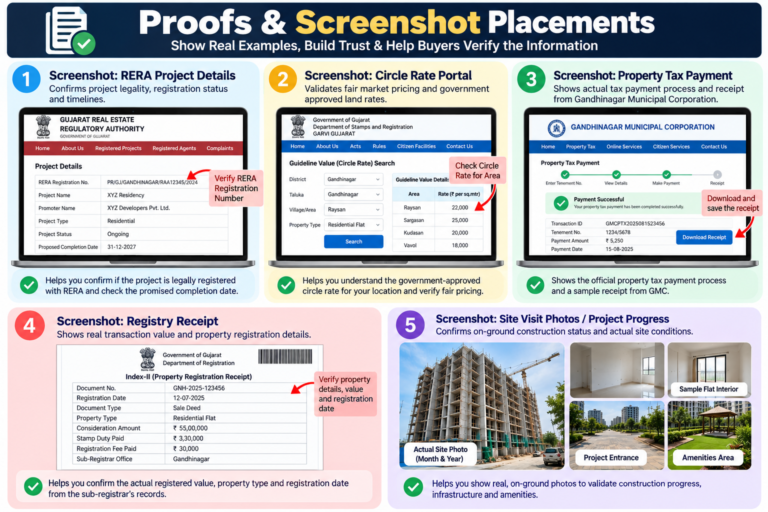
Proofs and Screenshot Placements
Who This Guide Is Not For
This guide is intended for flat owners, prospective buyers, landlords, and investors who need to understand municipal property tax and verify the relevant records.
It is not a substitute for a property-specific assessment from the municipal corporation or legal advice where a dispute exists.
Who should seek additional help?
You should consider contacting the municipal corporation or a qualified professional if:
- Your property tax bill contains unexplained charges.
- The recorded area or construction year appears incorrect.
- A previous owner has unpaid dues.
- The ownership record does not match the registered deed.
- Your payment was debited but the receipt was not generated.
- You are buying a property with unresolved municipal or legal issues.
Who should not rely on this guide alone?
Do not use a general online article to settle a disputed tax assessment, determine a legal liability, or assume that a property is free of all dues.
Likewise, do not purchase a flat merely because the current property tax seems affordable.
If the seller refuses to provide the municipal assessment, cannot explain discrepancies, or pressures you to complete the transaction before outstanding dues are checked, slow down and investigate.
The cost of a careful verification is usually easier to manage than an unresolved ownership or payment dispute after purchase.
If I Were Buying a Flat in Gandhinagar Today
If I were buying a flat today, I would not treat property tax verification as a minor task to complete after registration.
I would ask for the existing municipal tax bill and tenement number early in the transaction.
I would then check the outstanding demand, verify the recorded property details, and compare the seller’s payment receipts with the municipal record.
What would I check most carefully?
I would pay particular attention to three things:
First: Outstanding dues. I would not rely solely on the seller’s verbal assurance or a single old receipt.
Second: Property classification and area. I would investigate any material difference between the municipal assessment and the property documents.
Third: Ownership records. I would confirm what needs to be done to update the municipal record after the sale.
What would make me pause the transaction?
I would slow down if the seller refused to provide the municipal tax details, the tenement number could not be matched to the property, or the assessment contained unexplained discrepancies.
These issues do not automatically mean that a purchase is impossible. They mean that the buyer needs an explanation and, where necessary, a correction before proceeding.
My opinion: Do not sacrifice basic due diligence to meet a broker’s deadline. A flat may be suitable in every other respect, but unresolved municipal dues and record discrepancies should be addressed rather than ignored.
Conclusion:
Understanding flat property tax rates in Gandhinagar requires more than memorising a number.
GMC’s published structure identifies a residential base rate of ₹11.25 per square metre, but the actual assessment can depend on property-specific factors and applicable municipal charges.
The safest approach is to confirm the correct municipal authority, review the property’s assessment details, check outstanding dues, use the official payment portal, and retain the receipt.
For resale-flat buyers, this verification should be part of the purchase due-diligence process. For existing owners, it helps identify incorrect records, unexplained charges, and payment discrepancies.
A practical next step
Before buying a flat or paying an unfamiliar demand, collect the tenement number, latest property tax bill, payment receipts, and relevant property documents.
Use the official municipal services to verify the current record. If anything does not match, ask the corporation to clarify the assessment before proceeding.
A little verification now can prevent unnecessary confusion and expense later.
FAQs: About Flat Property Tax in Gandhinagar
1. Does property tax depend on carpet area or built-up area?
2. Is property tax different for rented and owner-occupied flats?
3. What should I do if I paid property tax but cannot download the receipt?
4. Who is responsible for unpaid property tax when a flat is sold?
5. Are property tax rebates or interest-waiver schemes available in Gandhinagar?
References
About the Author