
Best city for property investment in 2026: Ahmedabad for safer, broader demand; Gandhinagar for selective growth opportunities around GIFT City.
If I had to choose one city for a typical investor today, I would choose Ahmedabad—but I would not buy anywhere in Ahmedabad blindly. For a higher-risk investor with a 7–10 year horizon, selected Gandhinagar locations around the GIFT City corridor can make more sense.
That distinction matters.
Gandhinagar is not automatically the “next Ahmedabad,” and Ahmedabad is not automatically the safer investment simply because it is larger. The right decision depends on where you buy, why you buy, how much you pay, rental demand, resale liquidity, and how long you can hold.
The Ahmedabad–Gandhinagar market is also becoming more interconnected. Ahmedabad Metro Phase II is now fully commissioned between Motera and Mahatma Mandir, with the GNLU–GIFT City branch operational.
I have seen buyers make the same mistake repeatedly: they hear that a particular area is “the next big thing,” visit two or three projects, hear that prices will increase after the next infrastructure announcement, and then make a purchase decision before checking whether the property actually has end-user demand, rental demand, legal clarity and a realistic exit market.
That is exactly where this Gandhinagar vs Ahmedabad property investment comparison becomes important.
In 2026, both markets have legitimate strengths. Ahmedabad offers a much larger and more established residential ecosystem, while Gandhinagar has a different investment story built around planned development, GIFT City, government institutions, employment growth and the Ahmedabad–Gandhinagar connectivity corridor.

The Buyer Story I See Again and Again
Imagine a buyer with ₹80 lakh saved for a property.
He visits one project in Ahmedabad.
The broker tells him:
“Sir, Ahmedabad is already expensive. Gandhinagar will give you much better appreciation.”
The next day another salesperson tells him:
“GIFT City is the future. If you don’t book now, you will miss the opportunity.”
Then a third person recommends a property 10–15 minutes farther away because:
“This area will become the next GIFT City.”
The buyer now has three different opinions, several price quotations and a growing fear of missing out.
But he still doesn’t know the most important thing:
Is the property itself worth the price being asked?
This is where many online property articles fail buyers. They discuss infrastructure, new projects and expected appreciation but don’t spend enough time discussing the uncomfortable questions:
- What happens if the property doesn’t appreciate?
- Who will rent it?
- How easy will it be to resell?
- Is the quoted price based on actual transactions or broker expectations?
- What happens if construction is delayed?
- Is the location genuinely improving or simply being marketed as “upcoming”?
- Are you buying because the property is good—or because someone created urgency?
In my view, a property investment should survive a boring analysis. If the investment only looks attractive when someone talks about “future potential,” I become cautious.
The Real Buyer Problems in Ahmedabad and Gandhinagar
Price confusion is one of the biggest problems
Two properties can both be advertised at ₹6,000 per sq. ft. but represent very different purchases.
One may include:
- better construction quality
- parking
- stronger amenities
- better access roads
- established neighbourhood
- stronger rental demand
- better resale liquidity
The other may be in an emerging location where the buyer is effectively paying today for infrastructure that may arrive later.
So don’t compare only the quoted per-square-foot price.
Compare the total acquisition cost.
That means:
Property price + GST where applicable + stamp duty + registration + parking + maintenance deposits + brokerage + interiors + loan costs + other transaction expenses.
A ₹75 lakh apartment can easily require substantially more capital than the headline ₹75 lakh figure suggests.
Fake urgency is common
“Last two units.”
“Price increases tomorrow.”
“Only today this offer is available.”
“GIFT City prices are going to double.”
“Metro is coming, so prices will rise.”
None of these statements should make you sign a booking form.
A genuine investment does not become a bad investment simply because you take 48 hours to verify the paperwork.
My rule is simple:
If a seller is uncomfortable with due diligence, I become uncomfortable with the seller.
Builder reputation matters more than the brochure
A beautiful clubhouse rendering tells you almost nothing about whether a project will be delivered properly.
Look at:
- previous project delivery
- construction quality
- RERA history
- litigation
- possession record
- maintenance after handover
- complaints
- promised versus delivered specifications
- financial and legal documentation
GujRERA provides public project and promoter information, including registered projects and project-related documentation.
That makes it one of the first places I would check before paying a serious booking amount.
Location mistakes are expensive
A buyer may say:
“This is only 15 minutes from GIFT City.”
But 15 minutes at what time?
On which road?
Under what traffic conditions?
And what happens when nearby projects are fully occupied?
The property may be geographically close to an employment centre but still inconvenient for daily life.
Distance on Google Maps is not the same thing as liveability.
Gandhinagar vs Ahmedabad: What Actually Matters in 2026?
| Factor | Ahmedabad | Gandhinagar |
|---|---|---|
| Established residential demand | Very strong | Strong in selected areas |
| Employment diversity | Higher | More concentrated |
| Rental market | Broader | More location-dependent |
| Resale liquidity | Generally stronger | More micro-market dependent |
| Entry pricing | Higher in established areas | Often lower outside GIFT |
| Growth potential | Strong but mature in many areas | Higher in selected corridors |
| GIFT City exposure | Indirect/commuter benefit | Direct advantage |
| Infrastructure story | Strong | Very strong around GIFT/Metro corridor |
| Risk for investor | Lower in established areas | Higher outside proven pockets |
| Best for | End users + conservative investors | Long-term growth investors |
The important point is that Gandhinagar and Ahmedabad should not be treated as two completely separate markets anymore.
GIFT City sits between Ahmedabad and Gandhinagar and is officially positioned as a finance and technology hub, with financial, IT and related businesses operating within the development. For buyers evaluating the region, understanding this economic corridor is also important when they Compare property investment in Gandhinagar and Ahmedabad, particularly in terms of employment-driven demand, connectivity and long-term growth potential.
The Metro connection strengthens this relationship further.
Step-by-Step Buyer Action Plan
Step 1: Location Selection
What to do
First decide who the eventual occupant is.
For an investment property, ask:
- Who will rent this?
- Where will they work?
- What commute will they tolerate?
- What configuration do they need?
- What competing properties are available nearby?
For Ahmedabad, established residential and employment corridors can provide a wider tenant pool.
For Gandhinagar, the GIFT City ecosystem makes locations such as the broader GIFT–Raysan–Randesan–Kudasan–Koba belt worth studying—but each micro-market must be evaluated separately.
Why it matters
A property that appreciates but cannot attract tenants or buyers easily is not necessarily a good investment.
Mistake to avoid
Don’t buy land or an apartment simply because it is “near GIFT City.”
Near a growth engine does not automatically mean good investment.
My practical tip
Visit the location:
- weekday morning
- weekday evening
- weekend afternoon
- after dark
Check roads, traffic, shops, public transport, construction activity and actual occupancy.
Step 2: Budget & Price Validation
What to do
Create three numbers:
Maximum property budget
Maximum all-in purchase budget
Maximum EMI you can comfortably handle
Then compare at least three competing properties.
Don’t compare only builder quotations.
Compare:
- asking price
- recent registered transactions where available
- ready reckoner/Jantri values
- competing resale listings
- rental rates
- maintenance
- construction quality
Gujarat’s Revenue Department provides online services covering document registration, Jantri rates, property cards and land records.
Why it matters
The biggest investment mistake is often not choosing the wrong city.
It is overpaying for the right city.
Mistake to avoid
Don’t justify a high price using expected appreciation.
A seller can say:
“This will be ₹10,000 per sq. ft. in three years.”
That is not evidence.
Step 3: Builder & RERA Verification
Before booking, verify:
- Gujarat RERA registration
- approved plans
- project completion timeline
- quarterly progress
- promoter details
- land ownership documentation
- litigation where applicable
- promised amenities
- possession commitments
- project-specific complaints/orders
GujRERA’s public search allows buyers to browse registered projects and related information without logging in.
My red flag
If the salesperson says:
“Don’t worry, our legal team has checked everything.”
That is not a substitute for your own independent verification.
Step 4: Site Visit Checklist
Don’t allow the sales team to control your entire visit.
Walk outside the project.
Check:
Around the property
- road width
- drainage
- traffic
- street lighting
- nearby construction
- vacant land
- industrial activity
- schools
- hospitals
- grocery stores
- public transport
- noise
- flooding/waterlogging history
Inside the project
- actual carpet area
- ventilation
- sunlight
- lift waiting time
- parking
- water supply
- fire safety
- construction quality
- common-area maintenance
- occupancy
One of my favourite checks
Talk to existing residents.
Ask:
“If you were buying again, would you buy here?”
You often learn more from that answer than from 45 minutes with a salesperson.
Step 5: Legal & Registry Checks
Never treat registration as a formality.
Verify:
- title
- encumbrances
- ownership
- approved plans
- development permissions
- property card/land records where applicable
- agreement terms
- carpet area
- possession obligations
- society/association documentation where applicable
For land purchases, the due diligence needs to be substantially deeper.
A cheap plot with complicated title is not cheap.
It is a liability.
Step 6: Negotiation Strategy
Don’t negotiate emotionally.
Instead of saying:
“Can you give me ₹5 lakh discount?”
Ask:
“What is your best all-inclusive price including parking, charges and other compulsory costs?”
Then negotiate multiple components.
Potential negotiation points include:
- base price
- floor-rise charges
- parking
- maintenance deposit
- club charges
- documentation charges
- payment schedule
- fit-out/interior benefits
- possession-linked payment
My preferred strategy
Be willing to walk away.
The strongest negotiating position is not wanting the property badly enough to overpay.
Realistic Case Studies
Case Study 1: End-User Family
A hypothetical Ahmedabad family has a budget of approximately ₹85 lakh.
They compare:
- an emerging peripheral project at ₹75 lakh
- an established Ahmedabad project at ₹82–85 lakh
The cheaper project looks attractive because of its future-growth story.
But the family works in Ahmedabad and their children attend school there.
They eventually choose the established location.
Hypothetical purchase
- Purchase price: ₹84 lakh
- Configuration: 3 BHK
- Holding period: 5 years
- Illustrative current market value: ₹1.05 crore
That represents roughly 25% capital appreciation before transaction costs, not some spectacular “double your money” outcome.
Lesson
For an end user, quality of life and resale liquidity can be more valuable than chasing the highest theoretical appreciation.
Case Study 2: Long-Term Investor
Consider a hypothetical investor who enters the Gandhinagar corridor at ₹58 lakh for a compact residential unit.
Suppose the property produces:
- Gross rent: ₹20,000/month
- Annual gross rent: ₹2.4 lakh
- Gross rental yield: approximately 4.1%
- Holding period: 7 years
If the property eventually reaches ₹85 lakh, the investor has achieved meaningful capital appreciation plus rental income.
But there is an important catch.
If the investor spends two years with:
- low occupancy
- discounts to attract tenants
- maintenance expenses
- brokerage
- weak resale demand
the actual return will be much lower than the brochure calculation.
What worked
- sensible entry price
- employment-linked location
- manageable ticket size
- long holding period
What didn’t
The investor expected appreciation to happen quickly.
It didn’t.
That is why property investors should have the financial ability to hold through slow periods.
Realistic Buyer Testimonials
IT Professional
“I initially wanted GIFT City itself because everyone around me was talking about it. After comparing the actual purchase price and rent, I chose a nearby established location instead. I paid more attention to tenant demand than the story.”
PSU Employee
“My biggest mistake would have been buying only because a broker said the Metro would increase prices. I visited the area several times and checked the surrounding development before deciding.”
NRI Investor
“I stopped looking at advertised appreciation percentages and started asking what I could realistically rent the property for. That completely changed the properties I shortlisted.”
These examples illustrate an important principle:
Good property decisions become clearer when you replace excitement with numbers.
What the 2026 Market Data Actually Tells Us
The most important structural change is connectivity.
Ahmedabad Metro Phase II is fully operational from Motera to Mahatma Mandir, while the GNLU–GIFT City branch is also operational. GMRC states the Phase II network at approximately 28.2 km and 22 stations.
There are also further planned/under-development connectivity projects. GMRC’s 2026 documentation includes the proposed GIFT City–Shahpur extension and airport connectivity work.
That matters because infrastructure should be evaluated as a real improvement in accessibility, not merely as a marketing slogan.
GIFT City’s own official material describes the development as a finance and technology hub between Ahmedabad and Gandhinagar, with major developers and financial/technology occupants.
However, I would not interpret this as:
“Therefore every property around GIFT City will appreciate.”
That conclusion is too simplistic.
Ahmedabad's advantage: depth
Ahmedabad has a much broader economic and residential base.
That gives investors more potential:
- tenants
- buyers
- resale options
- employment centres
- schools
- hospitals
- established neighbourhoods
This depth matters during weaker property cycles.
Gandhinagar's advantage: targeted growth
Gandhinagar’s strongest investment argument is not simply that it is the capital city.
The more interesting story is the GIFT City ecosystem + Metro connectivity + surrounding residential development.
But this is precisely where buyers need discipline.
Once a corridor becomes popular, asking prices can move ahead of actual rental demand.
That creates a dangerous situation:
You can correctly identify the future growth corridor and still buy the wrong property at the wrong price.
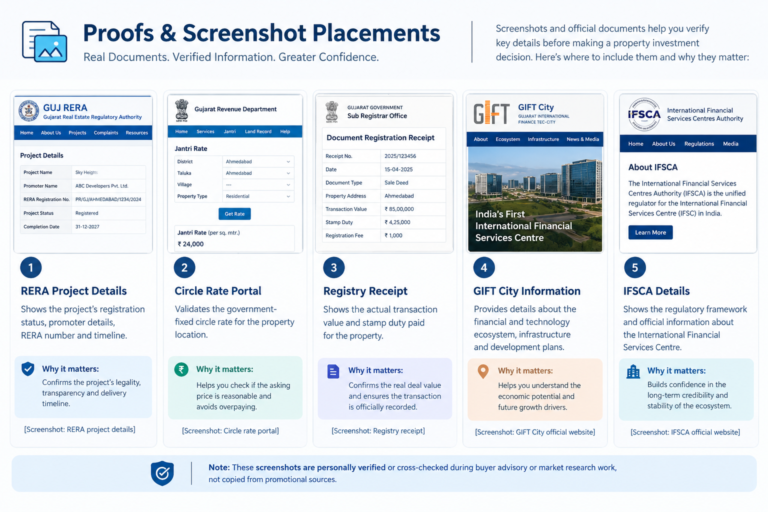
Proofs & Screenshot Placements
Who This Guide Is NOT For
This guide is not for someone who wants to:
- buy today and sell in six months
- double money quickly
- speculate purely on rumours
- purchase because a broker says “prices will definitely rise”
- invest borrowed money without sufficient cash-flow protection
- buy an under-construction property without checking the developer
- treat GIFT City as a guaranteed appreciation machine
If you need the money within the next 2–3 years, I would seriously question whether residential property is the right investment for you.
If your EMI would consume most of your disposable income, wait.
If you have not built an emergency fund, wait.
If you’re buying only because everyone around you says property prices will rise, wait.
Renting for another year can be financially smarter than buying a ₹90 lakh property you regret for the next decade.
If I Were Buying This Property Today
If I had ₹80 lakh–₹1 crore available today
I would not automatically choose GIFT City itself.
I would first compare:
- established Ahmedabad location
- established Gandhinagar location
- selected GIFT City-adjacent property
I would calculate:
Purchase price → total acquisition cost → realistic rent → vacancy → maintenance → resale liquidity → expected holding period.
My preference
For an end-user family:
Ahmedabad wins.
For a conservative investor:
Ahmedabad wins.
For a 7–10 year investor willing to accept more location-specific risk:
Selected Gandhinagar/GIFT City corridor properties become much more interesting.
Configuration I would prefer
I would generally favour a practical 2 or compact 3 BHK with broad end-user demand rather than an oversized luxury apartment.
Why?
Because the buyer pool matters when you eventually exit.
What I would negotiate hardest
The effective all-in price.
Not the headline discount.
If the builder says:
“₹8 lakh discount!”
I want to know the final amount payable after every compulsory charge.
One red flag I would not ignore
A large gap between the property’s marketing story and its current real-world demand.
If the entire sales pitch is:
Metro + GIFT City + future appreciation + limited inventory
but there are few occupied homes, weak rental demand and aggressive asking prices, I would walk away.
Final Verdict: Which Is the Best City for Property Investment in 2026?
Ahmedabad is the better all-round property investment city in 2026.
It offers the stronger combination of:
- established demand
- diversified employment
- wider rental market
- deeper resale market
- established social infrastructure
- multiple residential micro-markets
But that doesn’t mean Gandhinagar is a bad investment.
Quite the opposite.
Gandhinagar is the more selective growth bet.
Its strongest opportunity is connected to the wider GIFT City–Gandhinagar–Ahmedabad corridor, where employment, infrastructure and connectivity are becoming increasingly integrated.
The mistake is treating every property in that corridor as equally attractive.
They aren’t.
My 2026 ranking
For end use: Ahmedabad → Gandhinagar
For conservative investment: Ahmedabad → selected Gandhinagar
For long-term growth: selected Gandhinagar/GIFT corridor → selected Ahmedabad growth corridors
For rental stability: Ahmedabad
For speculative future growth: Gandhinagar/GIFT City, but with significantly more price discipline
The best property investment in 2026 isn’t necessarily the city with the biggest appreciation story.
It is the property you can buy at a sensible price, rent if necessary, hold comfortably and sell without depending on a miracle.
FAQ – Real Buyer Doubts
Is Gandhinagar better than Ahmedabad for property investment in 2026?
Is Ahmedabad or Gandhinagar better for long-term property investment?
Is GIFT City property still worth buying in 2026?
Which city is better for rental income: Ahmedabad or Gandhinagar?
Should I buy a plot or apartment in Gandhinagar?
References
About the Author