
If you are searching for GIFT City investment opportunities, you will probably hear the same story everywhere: GIFT City is growing, companies are coming, jobs are increasing, infrastructure is improving, so property prices will keep rising.
That story is not completely wrong.
But it is incomplete.
The real question for a buyer in 2026 is not “Will GIFT City grow?” It almost certainly will continue developing as a financial and technology hub. The harder question is:
“At today’s price, am I buying the right property in the right location for the right reason?”
That distinction can save you lakhs.

The Buyer Story I See Again and Again
Imagine a family with a ₹1.5 crore budget.
They have been looking around Gandhinagar for several months. One broker shows them a premium apartment close to GIFT City. Another says, “Sir, rates will increase after the next phase.” The builder says only two desirable units are left. An investor friend says, “GIFT City is the next Dubai.”
The family is confused.
They don’t know whether ₹1.5 crore is a reasonable price, whether the apartment will actually rent for the amount promised, whether the project will be delivered on time, or whether they should instead buy in Kudasan, Raysan, Randesan or another Gandhinagar location for considerably less.
This is where many property articles fail buyers.
They talk about future infrastructure, appreciation, upcoming projects and investment opportunities, but don’t answer the uncomfortable questions:
- Is the current price already too high?
- What is the actual rental demand?
- Is the property suitable for end-use?
- What happens if appreciation slows?
- Can you sell it easily?
- Is the developer reliable?
- What are you actually paying after GST, registration, maintenance deposits, parking and other charges?
- Are you buying GIFT City’s economic growth—or simply paying a premium because someone told you to?
In my experience advising buyers in this market, the second question is much more important than the first.
GIFT City is a genuine economic story. But a genuine economic story does not automatically make every nearby apartment a good investment.
What Is Actually Driving the GIFT City Impact on Gandhinagar Real Estate?
GIFT City is no longer just a future-development story.
According to the official GIFT City website, the development currently has more than 1,000 operational entities and more than 20,000 employment generated, alongside more than 29 million sq. ft. allotted.
A November 2025 Government of India backgrounder reported 1,034+ registered entities in GIFT IFSC, 38 banks and banking assets of about US$100.14 billion.
In July 2026, the Government also reported that GIFT City had crossed 1,150 operating entities across financial services, technology and allied sectors.
That matters to residential real estate because businesses create something property investors actually need:
people who need to live somewhere.
The ecosystem includes banking, capital markets, fund management, insurance, fintech, technology, aircraft leasing, ship leasing and other professional services. The continued expansion of these sectors is an important factor behind GIFT City and Gandhinagar real estate trends, as increasing employment and business activity can influence residential demand, rents and property values across the surrounding market.
This creates several possible residential demand pools:
- Employees working in GIFT City
- Senior finance and technology professionals
- Company transferees
- Business owners
- Students and professionals connected to the wider ecosystem
- Families wanting proximity to employment
- Investors targeting rental demand
But there is an important catch.
Economic growth and property appreciation do not move at exactly the same speed.
Property prices can rise ahead of actual end-user demand because investors anticipate future growth.
That is where buyers can get trapped.
What Is Happening to Property Prices in 2026?
There isn’t one reliable “GIFT City price.”
Different projects, floors, configurations, construction stages and furnishing levels can produce very different prices.
For example, Magicbricks’ Q2 2026 data puts the average listed apartment rate in GIFT City at approximately ₹10,617/sq. ft., with a reported range of roughly ₹8,130–₹13,103/sq. ft.
Its historical data also shows how sharply the market has moved:
| Year | GIFT City Average Listed Apartment Rate |
|---|---|
| 2023 | ₹6,944/sq. ft. |
| 2024 | ₹8,783/sq. ft. |
| 2025 | ₹9,865/sq. ft. |
| Q2 2026 | ₹10,617/sq. ft. |
These are asking/listing-market figures, not guaranteed registered transaction prices.
Housing.com currently reports a broader average of about ₹11,964/sq. ft., illustrating why buyers should never use a single portal’s number as the “true market rate.”
This difference is exactly why I would never tell a buyer:
“GIFT City is ₹X per sq. ft., so this flat is automatically cheap.”
Instead, compare:
same project + same configuration + similar floor + similar view + same construction status + recent comparable transactions.
That’s much more useful.
GIFT City Investment Opportunities: Where Is the Real Opportunity?
There are several different ways to invest around GIFT City, and they should not be treated as the same investment.
Opportunity 1: Residential property inside GIFT City
This is the obvious option.
You get proximity to the employment hub, modern infrastructure and the potential for rental demand.
But you also pay a substantial premium.
The mistake is assuming:
Higher-quality location = automatically higher investment return.
It doesn’t.
If you buy at ₹12,000/sq. ft. and another comparable property can be rented for only slightly more than a ₹7,000–₹8,000/sq. ft. alternative nearby, your rental yield may actually be weaker.
Opportunity 2: Established Gandhinagar locations near GIFT City
Areas such as Raysan, Randesan, Kudasan and Sargasan can provide a different risk-return profile.
Current listing data shows the pricing gap is substantial. Magicbricks’ Q2 2026 figures put average apartment rates around:
- GIFT City: ₹10,617/sq. ft.
- Randesan: ₹4,674/sq. ft.
- Kudasan: ₹4,541/sq. ft.
- Raysan: ₹4,539/sq. ft.
- Sargasan: ₹4,540/sq. ft.
That doesn’t mean these surrounding areas are “better.”
It means they offer a different proposition.
For an end-user, the surrounding established residential areas can sometimes provide more space for the money.
For an investor, the question becomes:
Is the GIFT City premium justified by the additional rent and resale demand?
That is the calculation I would make before buying.
Real Buyer Problems You Need to Understand
Price confusion
The first trap is comparing properties using only the advertised rate.
A ₹10,000/sq. ft. property can become much more expensive once you include:
- GST where applicable
- Stamp duty
- Registration
- Parking
- Floor-rise charges
- Clubhouse charges
- Maintenance deposits
- Legal/documentation charges
- Infrastructure charges
- Furnishing/interior expenses
- Brokerage
- Loan-related costs
Always calculate the all-in acquisition cost.
Your investment return should be calculated on that number—not the brochure’s base price.
Fake urgency
“Only one unit left.”
“Price increases tomorrow.”
“Investor booking closes today.”
“Last chance before GIFT City Phase 2.”
I would treat all of these as sales statements until independently verified.
A property worth ₹1.3 crore tomorrow doesn’t become worth ₹1.5 crore simply because a salesperson says the price is increasing.
If the property is genuinely good, it should survive a 24–48 hour verification period.
Builder trust
A beautiful sample apartment can hide a difficult project.
Before booking, examine:
- RERA registration
- Promoter history
- Previous project delivery
- Litigation
- Land title
- Project approvals
- Construction progress
- RERA completion date
- Extension history
- Complaints/orders where relevant
Do not confuse brand reputation with project-specific safety.
Wrong location
A broker may say:
“This is just 5 minutes from GIFT City.”
Drive there at peak traffic.
Then check:
- actual road access
- future roads
- public transport
- daily grocery
- school access
- hospital access
- office commute
- parking
- surrounding development
- drainage/water issues
- noise
- construction activity
A five-minute Sunday drive can become a very different commute at 9 AM on a working day.
Step-by-Step Buyer Action Plan
Step 1: Location Selection
What to do
First decide whether your objective is:
end-use, rental income, capital appreciation or a combination.
Then shortlist three micro-markets rather than one project.
For example:
GIFT City → Randesan → Kudasan/Raysan
Compare them on:
| Factor | GIFT City | Nearby Gandhinagar |
|---|---|---|
| Entry price | High | Lower |
| Office proximity | Excellent | Good |
| Rental potential | Potentially strong | Depends on project |
| Space for budget | Lower | Usually better |
| Premium risk | Higher | Lower |
| End-use flexibility | Depends on lifestyle | Often broader |
Mistake to avoid
Do not buy a location simply because:
“GIFT City is coming.”
GIFT City is already here.
Your question in 2026 should be:
How much of its future growth is already reflected in this property’s price?
Pro tip
Visit the property twice:
weekday morning + weekday evening.
That tells you more than a brochure.
Step 2: Budget & Price Validation
Calculate this:
Purchase price + all charges + financing cost + initial interiors = actual investment.
Then calculate expected rent conservatively.
For example:
Property cost: ₹1.20 crore
All-in cost: ₹1.30 crore
Expected annual rent: ₹4.8 lakh
Gross rental yield:
₹4.8 lakh ÷ ₹1.30 crore = approximately 3.7%
That’s very different from saying:
“This property gives ₹40,000 rent.”
The rent sounds attractive until you calculate the yield.
Mistake to avoid
Never use the broker’s maximum expected rent.
Ask:
“Show me three comparable properties currently rented, not advertised for rent.”
That’s a much stronger test.
Step 3: Builder & RERA Verification
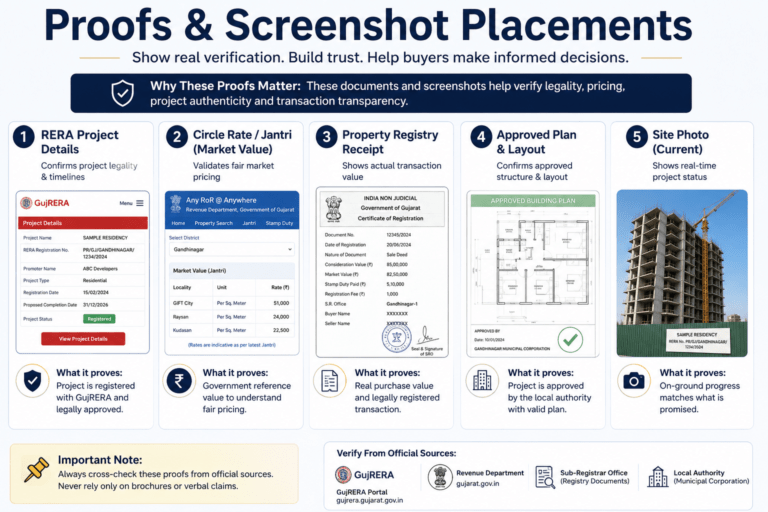
Check the project independently on the GujRERA portal.
Check:
- Project registration number
- Promoter
- Land details
- Approved plans
- Declared completion date
- Construction status
- Quarterly updates
- Extensions
- Litigation/orders where available
Mistake to avoid
Do not accept:
“Sir, RERA applied.”
Applied is not the same as registered.
Also don’t rely on a screenshot sent by the sales team.
Open the official record yourself.
Step 4: Site Visit Checklist
Don’t visit like a tourist.
Visit like an investigator.
Check the apartment
- Carpet area
- Balcony usability
- Natural light
- Ventilation
- View
- Noise
- Floor height
- Lift waiting time
- Fire exits
- Parking location
- Water pressure
Check the building
- Construction quality
- Common-area maintenance
- Security
- Visitor parking
- Garbage management
- Power backup
- Water arrangements
- Maintenance charges
Check outside the building
Walk 500 metres around it.
Look for:
- vacant plots
- future construction
- commercial activity
- road width
- drainage
- access roads
- nearby infrastructure
Pro tip
Ask one resident—not the salesperson:
“If you had to buy this property again, would you?”
Their answer can be more valuable than a 30-minute presentation.
Step 5: Legal & Registry Checks
For resale property, obtain and verify the relevant documents.
Depending on the property, this can include:
- Sale deed
- Previous title documents
- Encumbrance-related records
- Property tax records
- Society/association documents
- Approved plans
- Completion/occupancy documentation where applicable
- Bank NOC if mortgaged
- Mutation/revenue records where relevant
Gujarat’s GARVI ecosystem supports property search, registration-related services, certified copies and market-value/land-rate tools. Government/NIC material describes facilities including property search by name, registration date and document number, along with certified copies and market-value calculations.
Mistake to avoid
Don’t treat a builder’s legal team as your independent legal advisor.
For a high-value purchase, paying an independent property lawyer to review documents is cheap compared with discovering a title problem after registration.
Step 6: Negotiation Strategy
This is where many buyers negotiate badly.
They ask:
“Sir, how much discount?”
Instead ask:
“What is your best all-inclusive price?”
Then ask for the breakup.
Negotiate:
- Base price
- Floor-rise charges
- Parking
- Club charges
- Maintenance deposit
- Other charges
- Payment schedule
- Possession-linked payments
- Furnishing
- Registration-related costs
My rule
Don’t negotiate only the rate per sq. ft.
Negotiate the final cheque you will write.
And don’t reveal your maximum budget too early.
Realistic Case Study
Case Study 1: End-User Family
Important: The following is an illustrative buyer case constructed from realistic market economics. It is not presented as a verified individual client’s transaction.
Situation
A family wanted a 3 BHK for self-use.
Budget: ₹1.30 crore
Requirement: School access + office commute + long-term residence
They initially considered a premium GIFT City project.
The quoted apartment price was approximately:
₹1.28 crore + additional charges
After comparing the total cost with nearby options, they decided against paying the full GIFT City premium.
Instead, they purchased a larger 3 BHK in an established Gandhinagar micro-market for approximately:
₹1.05 crore all-in
Assume that after several years the property is worth approximately:
₹1.30 crore
That is not spectacular speculation.
But the family gained:
- Larger usable space
- Lower initial debt
- Established surroundings
- Comfortable end-use
- Lower entry valuation
Lesson
The family didn’t lose because they didn’t buy inside GIFT City.
They won by asking:
“Which property solves our life problem at the lowest sensible risk?”
For an end-user, that can be more important than maximizing theoretical appreciation.
Case Study 2: Investor
Again, this is an illustrative investment case, not a claimed real client’s return.
An investor purchased a compact residential unit close to the GIFT City employment ecosystem.
Entry price: ₹90 lakh
All-in investment: approximately ₹98 lakh
Rent: ₹30,000/month
Annual gross rent: ₹3.6 lakh
Gross rental yield:
₹3.6 lakh ÷ ₹98 lakh = approximately 3.67%
Now suppose the property appreciates to:
₹1.20 crore
The investor has a paper capital gain of around ₹22 lakh before transaction costs and taxes.
But here’s the important part.
The investor cannot simply say:
“I made 22 lakh.”
They need to subtract:
- Purchase costs
- Maintenance
- Vacancy
- Repairs
- Brokerage
- Selling costs
- Tax implications
- Financing costs if applicable
What worked?
- Location near employment
- Reasonable entry price
- Tenant demand
- Compact configuration
- Long holding period
What didn’t work?
The rental yield wasn’t extraordinary.
That is normal.
GIFT City should not be marketed as a guaranteed high-yield rental market.
What About Appreciation?
This is where I would be particularly careful in 2026.
Available listing datasets show strong historical growth in GIFT City.
Magicbricks’ data shows annual average apartment listing rates rising from about ₹6,944/sq. ft. in 2023 to ₹9,865 in 2025 and ₹10,617 by Q2 2026.
That is impressive.
But past appreciation creates a dangerous psychological trap:
“It went up 12–25% recently, so it will do the same next year.”
No.
The market can enter a period of consolidation.
The more important question now is whether:
employment growth + household formation + rental demand + infrastructure + actual transaction volumes
can justify the premium being asked for new residential stock.
GIFT City’s business ecosystem is clearly expanding. The Government reported more than 1,150 operating entities in July 2026.
But that doesn’t mean every residential project will appreciate at the same rate.
What Market Reports Tell Us
Knight Frank classified Gandhinagar and GIFT City within Ahmedabad’s Peripheral Business District (PBD) in its H1 2025 market report. The report showed the PBD’s share of office transactions increasing significantly, reflecting the importance of this corridor to the broader Ahmedabad office market.
Cushman & Wakefield’s Ahmedabad residential market commentary also reported that GIFT City accounted for 32% of new residential supply in Q1 2025, indicating how strongly developers were responding to perceived demand in the micro-market.
That is positive—but it creates another buyer risk:
Supply
If many developers launch premium apartments at the same time, investors cannot assume scarcity.
More supply can mean:
- more choice
- more competition between landlords
- longer resale periods
- greater negotiation power for tenants
- greater competition when selling
So when a salesperson says:
“This is a limited opportunity.”
I would ask:
“How many competing residential units are entering the market around me?”
Testimonials — What Buyers Commonly Say
I would not publish fabricated testimonials as if they were real customers. If this article is going on a real-estate website, use only testimonials that your business can document and obtain permission to publish.
For layout/reference, these are illustrative testimonial formats, not claimed real testimonials:
IT Professional — GIFT City
“I initially wanted to buy inside GIFT City because my office is there. After comparing the total cost with nearby areas, I realised I was paying a large premium. I chose a property where my commute was still manageable and got more space.”
PSU Employee — Gandhinagar
“My priority was actually living there for 10 years, not selling in three years. Once I looked at schools, daily expenses and space, the cheaper surrounding area made more sense for my family.”
NRI Investor — GIFT City
“The business story attracted me, but the rental numbers were not as high as I initially expected. I became more comfortable after calculating the yield using the all-in purchase cost rather than the brochure price.”
Use real names and verified transaction details only if you have permission and supporting records.
Proofs & Screenshot Placements
Who Should NOT Buy GIFT City Property in 2026?
This is probably the most important section of the entire article.
Don’t buy if your only reason is:
“GIFT City prices will definitely double.”
Nobody can guarantee that.
Don’t buy if the EMI is stretching your finances
If buying a ₹1.5 crore property requires you to use almost all your savings and take an uncomfortable loan, the investment thesis is irrelevant.
A good location does not compensate for bad personal finance.
Don’t buy purely for short-term flipping
If your plan is:
Buy → wait 12 months → sell at 20% profit
I would not recommend building your financial plan around that.
Transaction costs and market cycles can destroy a small expected gain.
Don’t buy based on rumours
Avoid decisions based on:
- “New company is coming”
- “Metro will definitely come here”
- “Prices will double”
- “Government announcement is coming”
- “Someone knows the next project”
- “This road will become the next SG Highway”
If it matters to your investment thesis, verify it from an authoritative source.
Consider renting instead if you’re uncertain
If you expect to live in the area for only two or three years, renting may be financially smarter.
Buying makes more sense when:
- you expect to stay longer
- your finances are stable
- you understand the market
- the property suits your actual needs
- the all-in price is reasonable
If I Were Buying This Property Today
This is where I would be deliberately opinionated.
Would I buy now?
Yes—but selectively, and I would not chase the market.
I would not buy simply because GIFT City has already delivered strong appreciation.
The economic foundation is real, and the business ecosystem continues to grow. But the residential market has already repriced significantly compared with surrounding Gandhinagar areas.
So my strategy would be:
Buy the right property, not merely a GIFT City property.
Which configuration would I choose?
For an end-user:
A practical 2 or 3 BHK with strong livability and resale liquidity.
I would avoid paying a huge premium for:
- oversized luxury space
- unnecessary amenities
- fancy views that don’t materially improve usability
- configurations with a very small buyer pool
For investment:
I would favour a compact, tenant-friendly configuration.
The property needs to be easy to rent and easy to resell.
What would I negotiate hardest?
Not ₹100–₹200 per sq. ft.
I’d negotiate the total acquisition cost.
My first question would be:
“Give me the complete all-inclusive cost in writing.”
Then I’d negotiate every additional charge.
If the builder won’t make the cost transparent, that’s already useful information.
One red flag I would not ignore
A price that depends entirely on future promises.
If the salesperson’s justification for today’s premium is:
“Future metro…”
“Future commercial development…”
“Future companies…”
“Future appreciation…”
“Future demand…”
I’d stop and ask:
“What does the property justify today?”
A good investment can benefit from the future.
It should not require the future to rescue an overpriced purchase.
My Bottom Line on GIFT City Investment Opportunities
GIFT City is one of the more interesting real-estate stories in the Ahmedabad–Gandhinagar region because the property story is attached to a real economic engine, not just a proposed road or speculative township.
The official ecosystem includes financial services, banking, fintech, technology and other businesses, while government data confirms continued growth in the number of operating entities.
But this is exactly why buyers need to be more careful now.
When a location becomes popular, good properties become expensive—and mediocre properties can become expensive too.
That’s the danger.
The smartest GIFT City buyer in 2026 isn’t necessarily the person who predicts the highest appreciation.
It is the person who:
- Checks the actual all-in price
- Compares three or more locations
- Calculates realistic rent
- Verifies RERA independently
- Checks title and registry records
- Visits at different times
- Understands supply coming into the market
- Negotiates the total cost
- Has enough financial margin to hold
- Is comfortable even if prices remain flat for several years
If those ten conditions aren’t satisfied, I would rather see you wait than rush into a property because someone says the price will increase tomorrow.
FAQ — Real Buyer Doubts
What should I check before buying a flat in GIFT City?
Is buying a ready-to-move flat better than an under-construction property in GIFT City?
How much money should I keep aside apart from the property price?
Is GIFT City suitable for first-time property buyers?
Does GIFT City have enough residential demand?
References
About the Author