
A couple starts looking for a 2 BHK because it fits their initial budget. Then the conversation changes. They realise that one room may become a home office, the parents may move in later, children will need their own space, and storage is already a problem in their current home. Suddenly, the extra bedroom is no longer a “luxury”—it becomes a practical requirement.
This is one reason the decision between a 2 BHK and a 3 BHK is becoming more complicated for buyers in markets such as Gandhinagar.
But there is an important warning: a 3 BHK is not automatically a better purchase. Paying ₹15–25 lakh more for an unnecessary room can create years of additional EMI pressure. The right question is not “Why is everyone buying 3 BHK?” but “Will my family actually benefit from the additional space enough to justify the cost?” This guide focuses on that decision.
Why Are Buyers Moving From 2 BHK to 3 BHK?
The shift is being influenced by several practical factors:
- Growing family sizes and changing household needs
- Work-from-home and hybrid working
- Parents living with children
- Need for a separate guest room
- Greater preference for larger homes
- Longer ownership periods
- Increasing importance of resale flexibility
- The possibility of converting one bedroom into a study or office
Current market data also shows strong interest in both configurations. MagicBricks’ Q2 2026 national data says 2 BHK homes accounted for 42% of demand and 3 BHK homes for 37%, while 3 BHK units represented about 46% of available inventory. So this isn’t simply a story of buyers abandoning 2 BHKs. Both segments remain important, but many families are reassessing whether the extra room is worth paying for.

Families Are Thinking About Their Next 7–10 Years
One of the biggest mistakes buyers make is purchasing a home based only on today’s family size.
For example:
A couple with one child may comfortably fit into a 2 BHK today.
But what happens if:
- Parents move in?
- A second child arrives?
- One bedroom becomes a permanent office?
- Children need separate rooms?
- A family member requires a dedicated study or work area?
The problem isn’t that a 2 BHK is necessarily too small. The problem is buying a home that becomes too small within three or four years. If you expect to stay in the property for 8–10 years, I would evaluate the home’s future usability, not just today’s requirements.
Practical test
Ask yourself:
“If my family situation remains unchanged for the next five years, will I still be comfortable here?”
Then ask:
“What if my family becomes larger?”
If the answer to both questions creates doubts, a 3 BHK deserves serious consideration.
Work From Home Has Changed the Meaning of a “Bedroom”
A spare bedroom used to be something many buyers considered optional. That calculation has changed.
For some households, the third bedroom can function as:
- Home office
- Study room
- Guest room
- Children’s room
- Parents’ room
- Hobby room
- Storage room
This flexibility is one of the strongest arguments for a 3 BHK and helps explain why buyers are moving from 2 BHK to 3 BHK. But don’t make the mistake of assuming that every 3 BHK provides useful additional space.
A poorly planned 3 BHK may have three bedrooms but still feel cramped because of:
- Small bedrooms
- Narrow passages
- Oversized balconies
- Poor kitchen planning
- Excessive common areas
- Low usable carpet area
That’s why I would compare carpet area, not simply the number of bedrooms.
The Carpet Area Difference Matters More Than “2 BHK vs 3 BHK”
Suppose you find:
2 BHK
- Carpet area: 850 sq ft
- Price: ₹65 lakh
3 BHK
- Carpet area: 1,050 sq ft
- Price: ₹82 lakh
The difference isn’t simply:
“₹17 lakh more for one bedroom.”
You’re also buying approximately 200 sq ft more usable space.
But another project might offer:
3 BHK
- Carpet area: 900 sq ft
- Price: ₹80 lakh
Here, the extra bedroom may not provide much practical benefit.
My rule
Never upgrade from 2 BHK to 3 BHK solely because the brochure says “spacious 3 BHK.”
Check:
- Carpet area
- Bedroom dimensions
- Living room size
- Kitchen size
- Storage
- Balcony usability
- Passage space
- Natural light
- Ventilation
A well-designed 2 BHK can be more comfortable than a badly planned 3 BHK.
Parents Living With Their Children Is Another Major Reason
For many Indian families, the third bedroom isn’t about luxury. It is about flexibility.
A family may initially purchase a 2 BHK with:
- Master bedroom
- Children’s bedroom
Later, when parents move in, the family has to rethink the arrangement.
A 3 BHK allows:
- Parents to have a dedicated bedroom
- Children to have their own space
- Couples to maintain privacy
This becomes particularly important for buyers who expect their parents to live with them for several years.
But don't overbuy
If parents visit only occasionally and you have no realistic plan for them to live with you, paying substantially more for a third bedroom may not make financial sense.
You could instead consider:
- Larger 2 BHK
- 2 BHK + study
- 2 BHK with flexible layout
- Larger living room
- Better-planned resale property
Buyers Are Staying Longer in Their Homes
A home purchase becomes expensive when you repeatedly buy and sell.
Every move can involve:
- Brokerage
- Registration costs
- Moving expenses
- Renovation
- Furniture
- Loan-related costs
- Time and inconvenience
Therefore, some buyers are deliberately choosing a slightly larger property to avoid moving again after five years. This is particularly sensible when the buyer expects to remain in the same city and locality for the long term.
However, don’t use “future-proofing” as an excuse to overspend.
A larger home only makes sense if the additional space is likely to be used. If upgrading to a 3 BHK pushes your EMI into an uncomfortable range, the supposedly “future-proof” decision can actually create a financial problem.
3 BHKs Can Offer More Flexibility at Resale
A 3 BHK can appeal to several buyer categories:
- Families with children
- Joint families
- Professionals working from home
- Buyers needing a guest room
- Families with elderly parents
- Buyers looking for larger homes
That doesn’t guarantee better appreciation. Resale value depends on location, price, project quality, layout, maintenance, demand and competing inventory. Still, a genuinely well-planned 3 BHK can have a wider potential end-user audience than a very compact 2 BHK.
That is different from saying:
“3 BHK always appreciates more.”
It doesn’t.
Gandhinagar Buyers Should Compare Locality, Not Just Configuration
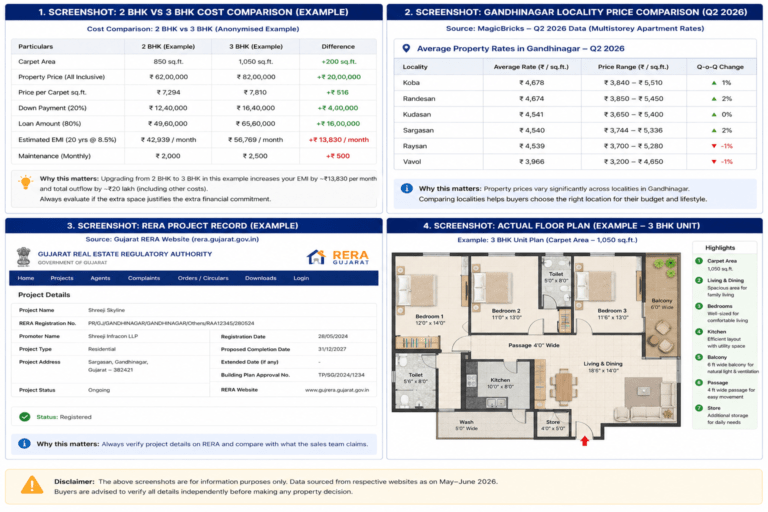
This is particularly important in Gandhinagar. Current Q2 2026 MagicBricks data shows that average apartment rates vary considerably between localities. For example:
Locality | Approx. Average Apartment Rate |
Gandhinagar | ₹4,182/sq ft |
Koba | ₹4,678/sq ft |
Kudasan | ₹4,541/sq ft |
Randesan | ₹4,674/sq ft |
Raysan | ₹4,539/sq ft |
Sargasan | ₹4,540/sq ft |
Vavol | ₹3,966/sq ft |
These are market indicators, not guaranteed transaction prices. Actual property prices vary according to project, floor, age, carpet area, specifications, possession status and other factors.
This creates an important buyer decision:
Would you rather have a smaller 3 BHK in a premium locality or a better-sized 2 BHK in a location that fits your lifestyle and budget better?
There is no universal answer.
Don't Let a Broker Turn the 3 BHK Upgrade Into an Emotional Decision
This is where buyers need to be particularly careful.
A sales conversation can easily become:
“Sir, just increase the budget by ₹10 lakh. You are buying for 10 years, so why compromise?”
The problem is that the broker doesn’t pay the additional EMI. You do. If the additional ₹10 lakh requires another ₹8,000–₹10,000 or more per month depending on your loan terms, you need to evaluate whether the additional space is actually worth that financial burden.
Before upgrading, calculate:
Additional property cost
- registration and transaction costs
- furnishing cost
- additional maintenance
- additional loan interest
= real cost of upgrading to 3 BHK
That number can be very different from the advertised ₹10 lakh difference.
Step-by-Step: Should You Move From 2 BHK to 3 BHK?
Step 1: Calculate Your Actual Family Requirement
Write down who will realistically live in the property.
For example:
Requirement | 2 BHK | 3 BHK |
Couple | ✓ | ✓ |
One child | ✓ | ✓ |
Two children | Maybe | ✓ |
Parents | Difficult | Better |
Home office | Limited | Better |
Guest room | Limited | ✓ |
Long-term flexibility | Moderate | Higher |
Don’t tick “3 BHK” simply because it looks better. Tick it because you genuinely need the space.
Step 2: Compare Total Cost, Not Just Property Price
Suppose:
2 BHK = ₹65 lakh
3 BHK = ₹82 lakh
Difference = ₹17 lakh.
Now calculate the impact of that ₹17 lakh on:
- Down payment
- Loan amount
- EMI
- Interest
- Registration
- Maintenance
- Interiors
If the 3 BHK forces you to empty your emergency savings, I would not recommend the upgrade. A larger home isn’t worth becoming financially vulnerable.
Step 3: Compare Carpet Area
Don’t compare:
1,400 sq ft 2 BHK vs 1,700 sq ft 3 BHK
until you understand whether those numbers represent the same measurement basis.
Instead compare:
₹/carpet sq ft
and actual carpet area.
For example:
Property | Carpet Area | Price | Approx. Price/Carpet Sq Ft |
2 BHK | 850 sq ft | ₹65 lakh | ₹7,647 |
3 BHK | 1,050 sq ft | ₹82 lakh | ₹7,810 |
Now the comparison becomes more meaningful.
Step 4: Inspect the Third Bedroom Properly
Don’t simply open the bedroom door and say:
“Yes, this is fine.”
Ask:
- Can a double bed fit?
- Is there space for a wardrobe?
- Is there a window?
- Is ventilation adequate?
- Can furniture actually be arranged?
- Does the room receive usable daylight?
- Is it practical as an office or children’s room?
If the third bedroom is barely usable, don’t pay a major premium for it.
Step 5: Check the Location Before the Floor Plan
A common mistake is choosing:
3 BHK in an inconvenient location
over:
well-planned 2 BHK in a better location.
Think about your daily routine:
- Office commute
- Schools
- Hospitals
- Grocery
- Public transport
- Main roads
- Family access
- Future infrastructure
- Traffic
For a family home, an extra bedroom cannot compensate for a daily 45-minute commute that you hate.
Step 6: Check RERA and Project Documents
For an under-construction property, verify the project independently through the official RERA record.
Check:
- Promoter
- Registration number
- Project address
- Approved details
- Declared completion date
- Construction status
- Any relevant disclosures
Do not rely entirely on a sales executive’s statement such as:
“Possession is next year.”
The official record and contractual documents matter more.
The Financial Test: When Is a 3 BHK Actually Affordable?
I prefer a simple rule:
Don’t ask:
“Can the bank approve my 3 BHK loan?”
Ask:
“Can I comfortably service this EMI even if my expenses increase?”
Bank eligibility is not the same as comfortable affordability.
A buyer may technically qualify for a ₹75 lakh loan but still find the monthly repayment uncomfortable after:
- School fees
- Car EMI
- Insurance
- Household expenses
- Investments
- Medical costs
- Travel
- Maintenance
Keep a buffer
Before committing, stress-test your finances.
Ask:
“Could I continue paying this EMI if one income temporarily stopped?”
If the answer is no, reconsider the purchase price.
Two Illustrative Buyer Cases
Case Study 1: Family Choosing 3 BHK
A family had:
- Combined household income: ₹1.65 lakh/month
- Budget: Around ₹80–85 lakh
- One child
- Parents likely to live with them
- Long-term ownership plan
They compared a ₹68 lakh 2 BHK with an ₹82 lakh 3 BHK. The 3 BHK had approximately 200 sq ft more carpet area and a genuinely usable third bedroom.
Decision
The family selected the 3 BHK because the additional room solved a foreseeable long-term requirement.
Lesson
The upgrade made sense because the additional space had a defined purpose.
Case Study 2: Buyer Who Should Have Stayed With 2 BHK
Another illustrative buyer had:
- Household income: ₹1.1 lakh/month
- Initial budget: ₹60–65 lakh
- No children yet
- No immediate requirement for parents to live with them
They were persuaded to stretch toward an ₹80 lakh 3 BHK. The additional room was nice but not essential.
My assessment
The 2 BHK would have been financially safer.
The buyer would have had more room for:
- Emergency savings
- Investments
- Travel
- Future family expenses
Lesson
Don’t buy extra space simply because you can obtain a bigger loan.
What About Investors?
For investors, the 2 BHK vs 3 BHK decision is different.
A larger unit may have:
- Higher purchase price
- Higher maintenance
- Larger capital requirement
- Potentially higher rent
But higher rent doesn’t automatically mean better rental yield.
Example
Suppose:
2 BHK
- Purchase price: ₹60 lakh
- Rent: ₹20,000/month
- Annual rent: ₹2.4 lakh
- Gross rental yield: 4%
3 BHK
- Purchase price: ₹85 lakh
- Rent: ₹26,000/month
- Annual rent: ₹3.12 lakh
- Gross rental yield: about 3.7%
The 3 BHK generates more rent in absolute terms but slightly lower gross yield. That’s why investors should calculate yield on total acquisition cost, not simply ask how much monthly rent the property generates.
What Buyers Often Get Wrong About 3 BHK Appreciation
I would strongly avoid the statement:
“3 BHK will definitely appreciate more.”
There is no such guarantee. A ₹90 lakh 3 BHK in a weak location can perform worse than a ₹65 lakh 2 BHK in a strong end-user location.
For appreciation, I would look at:
- Entry price
- Location
- Project quality
- Supply
- End-user demand
- Rental demand
- Resale liquidity
- Infrastructure
- Builder reputation
- Future competing projects
Configuration is only one variable.
Social Proof
If you publish testimonials on your website, don’t create fictional customer quotes and present them as genuine testimonials.
You can add:
- Buyer profile
- Locality
- Configuration
- Approximate purchase period
- Decision factor
This is far more credible than a perfectly written anonymous testimonial.
Screenshot
Who Should NOT Upgrade to a 3 BHK?
I would seriously reconsider the upgrade if:
- The additional EMI leaves no monthly savings
- You need to exhaust your emergency fund
- The third bedroom is extremely small
- You don’t actually need another room
- The project is significantly overpriced
- You are buying mainly because of broker pressure
- You expect to sell within a very short period
- The location compromises your daily lifestyle
In these situations, a well-planned 2 BHK may be the smarter purchase.
If I Were Buying Today
If I were choosing between a 2 BHK and 3 BHK in Gandhinagar today, I would not automatically choose the 3 BHK. I would first establish whether the third bedroom has a clear purpose.
If I had:
- Children
- Parents living with me
- Regular work-from-home requirements
- A 7–10 year ownership horizon
I would lean toward a well-planned 3 BHK. But I would rather buy a good 2 BHK in the right location than stretch financially for a mediocre 3 BHK.
I would negotiate hardest on:
- Total acquisition cost
- Parking
- Floor-rise charges
- Maintenance deposits
- Other miscellaneous charges
- Payment schedule
- Possession-related terms
And there is one red flag I would not ignore:
A large price premium for a third bedroom that is too small to function properly. If the third bedroom cannot comfortably accommodate the intended furniture and use, you’re paying for a number on a brochure rather than useful living space.
Conclusion
The movement from 2 BHK to 3 BHK is understandable. Families want more flexibility. Work patterns have changed. Parents may live with their children. Buyers are increasingly thinking about how their homes will work several years from now. But that doesn’t mean every buyer should upgrade.
The smartest decision is the one that balances:
space + location + affordability + layout + future needs + resale potential.
Current Gandhinagar data also reinforces the need to compare localities rather than treating the entire city as one market. Sargasan, Raysan and Kudasan, for example, are currently around the mid-₹4,500/sq-ft range in MagicBricks’ Q2 2026 apartment data, while Vavol is lower and Koba/Randesan higher.
So before moving from 2 BHK to 3 BHK, ask yourself one final question:
“Am I buying an extra bedroom—or am I buying a better life for my family?”
If the answer is genuinely the second one, the upgrade may be worth it. If the answer is simply “because everyone says 3 BHK is better,” keep your 2 BHK shortlist open.
Why Buyers Are Moving From 2 BHK to 3 BHK - faqs
1. Is a 3 BHK always better than a 2 BHK?
2. Is buying a 3 BHK a good investment?
3. Should a young couple buy a 3 BHK?
4. Is the third bedroom worth paying ₹15–20 lakh extra?
5. Which is easier to rent, 2 BHK or 3 BHK?
References
About the Author