
Finding a 3 BHK flat in Gandhinagar under 80 lakhs sounds straightforward until you actually start visiting projects.
One broker tells you, “Sir, this price is only for today.”
Another says, “₹78 lakh is the final price,” but the number changes when parking, maintenance, floor-rise charges, stamp duty and other costs are added.
Then you visit a project that looks excellent on paper but discover that the actual usable space is much smaller than expected. Another property is cheaper, but the location creates a 40-minute daily commute. A third one looks attractive as an investment but has weak rental demand.
This is where buyers make expensive mistakes. In my experience advising buyers in the Gandhinagar market, the biggest mistake is not necessarily paying ₹3–5 lakh more. It is buying the wrong property because the headline price looked attractive.
This guide is therefore not about finding the cheapest 3 BHK. It is about deciding whether a property advertised under ₹80 lakh is actually affordable, legally safe, appropriately located and worth buying.
Current market data also shows why buyers need to compare carefully. MagicBricks’ Q2 2026 data puts Gandhinagar’s average multistorey apartment rate at about ₹4,182/sq ft, while locality-level averages vary significantly—for example, around ₹4,540 in Sargasan, ₹4,541 in Kudasan, ₹4,674 in Randesan, ₹4,539 in Raysan and ₹3,966 in Vavol. That difference is important.
₹80 lakh does not buy the same kind of 3 BHK everywhere in Gandhinagar.
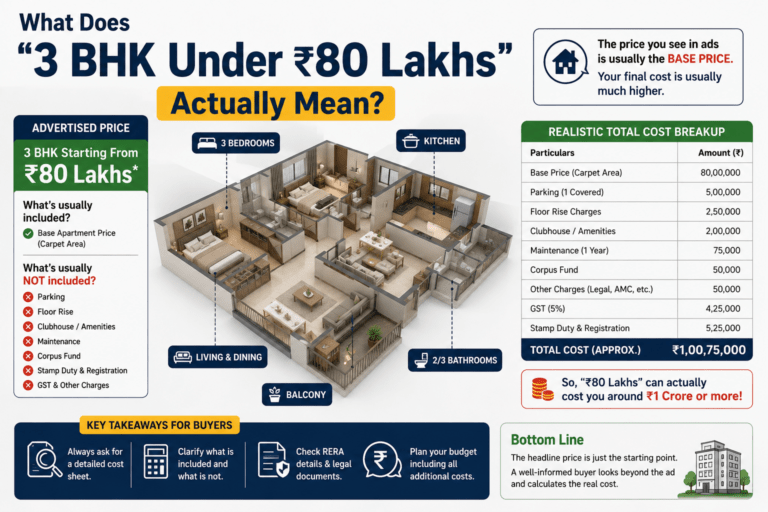
What Does “3 BHK Under ₹80 Lakhs” Actually Mean?
Before looking at locations, clarify what your ₹80 lakh budget represents.
There are two completely different interpretations:
Option A: ₹80 lakh is the advertised property price.
Option B: ₹80 lakh is your maximum all-in purchase budget.
These are not the same thing.
Suppose a flat is advertised at ₹76 lakh. You may still have to account for:
- Stamp duty and registration
- GST, where applicable
- Parking charges, if separately charged
- Maintenance or corpus fund
- Floor-rise charges
- Clubhouse or amenity charges
- Legal/documentation costs
- Brokerage
- Interior work
- Utility or connection charges
- Loan-related expenses
So if ₹80 lakh is your absolute financial ceiling, I would not start searching at ₹80 lakh. I would generally start around the ₹68–72 lakh property-price range, then calculate the complete acquisition cost before becoming emotionally attached to a particular flat. vThat buffer can save you from stretching your finances at the final stage.
The Real Problems Buyers Face in the ₹80 Lakh Segment
Price Confusion Is the First Trap
A common mistake is comparing properties only by their quoted price.
For example:
- Project A: ₹74 lakh
- Project B: ₹79 lakh
- Project C: ₹82 lakh
It looks obvious that Project A is cheapest. But suppose Project A has a smaller carpet area, additional charges and a less convenient location, while Project B includes parking and has substantially better usable space.
The ₹5 lakh difference may actually be justified. This is why I recommend comparing cost per carpet-area square foot, not simply the advertised flat price. Do not compare a 1,300 sq ft saleable-area apartment with a 1,100 sq ft apartment without understanding the carpet area.
My rule:
First compare carpet area. Then compare total cost. Then compare location. Only after that compare amenities.
The ₹80 Lakh Psychological Barrier
₹79.99 lakh feels very different from ₹80 lakh psychologically. Builders and brokers understand this.
A buyer may enter a sales office thinking:
“My budget is ₹80 lakh.”
The conversation then gradually becomes:
“This one is ₹82 lakh, but we can negotiate.”
Then:
“Just ₹3 lakh more for a better floor.”
Then:
“You can finance the difference.”
This is precisely how buyers end up purchasing a ₹90 lakh property when they initially planned an ₹80 lakh purchase. There is nothing wrong with spending more if you can genuinely afford it. The problem is stretching because you have already become emotionally attached to the property.
Can You Really Get a 3 BHK in Gandhinagar Under ₹80 Lakhs?
Yes, but your choices will depend heavily on location, age, project quality, size and whether the property is new or resale.
Current listing data demonstrates that 3 BHK flats in Gandhinagar under ₹80 lakh do exist within the market. For example, MagicBricks currently shows 3 BHK inventory in the ₹70–80 lakh band, including a ready-to-move 3 BHK in Kudasan listed around ₹75.9 lakh. Listing prices, however, are asking prices and should not automatically be treated as market transaction values.
Housing.com’s 2026 locality data also shows considerable price variation across Gandhinagar: Vavol is listed around ₹3,892/sq ft, while Sargasan is around ₹4,940, Kudasan around ₹5,247, Randesan around ₹5,016 and Koba around ₹5,107. These portal figures are useful for comparison, but they are not substitutes for property-specific valuation.
Areas I would investigate first for this budget
Area | Why I would consider it | What I would watch |
Vavol | Relatively lower entry pricing | Project quality and resale liquidity |
Kudasan | Established demand and connectivity | Premium pricing in newer projects |
Raysan | Good residential demand and GIFT City proximity | Don’t overpay for “future growth” |
Sargasan | Established residential ecosystem | Newer projects can cross ₹80 lakh |
Koba | Strong connectivity and GIFT City/Ahmedabad access | Premium projects can quickly exceed budget |
Randesan | Attractive for some end-users and professionals | Check actual transaction value carefully |
The important point is that I would not choose an area simply because its average price is lower. A cheaper apartment in the wrong location can be more expensive over 10 years than a slightly costlier apartment in the right location.
Step-by-Step Buyer Action Plan
Step 1: Choose the Location Before Choosing the Project
This is one of the most important decisions.
Do not begin by asking:
“Which builder has the best 3 BHK?”
Begin by asking:
“Where will my family actually live comfortably for the next 7–10 years?”
For an end-user, evaluate:
- Daily office commute
- School distance
- Hospital access
- Grocery and essential services
- Road connectivity
- Public transport
- Traffic at peak hours
- Future construction around the project
- Water and drainage infrastructure
- Noise levels
- Neighbourhood quality
If you work in or around GIFT City, for example, proximity can matter significantly. But do not pay a large “GIFT City premium” merely because a broker says the area will appreciate. Infrastructure can support demand, but infrastructure announcements are not guaranteed investment returns.
Gandhinagar’s metro connectivity is a genuine infrastructure factor worth considering. GMRC’s 2026 service information confirms regular services on the Motera Stadium–Mahatma Mandir corridor.
Mistake to avoid
Do not visit a property only at 11 AM on a Sunday.
Visit:
- Morning peak hour
- Evening peak hour
- Weekday
- Weekend
- After dark, if possible
A location can look completely different at 8 AM on a working day.
My practical tip
Drive from the project to your workplace during your actual office hours.
Don’t trust the broker’s statement that it is “only 15 minutes away.”
Step 2: Validate the Budget and Actual Price
Create your own property-cost sheet before negotiating.
Services Offered:
- SEO & Content Marketing
- Social Media Marketing & Influencer Campaigns
- Website Design & UI/UX Development
- Branding & Graphic Design
- Marketing Automation & CRM Integration E-commerce Marketing
Example
Suppose:
Advertised price: ₹74 lakh
Then calculate separately:
Cost | Amount |
Basic property price | ₹74 lakh |
Registration/stamp-duty-related costs | Verify separately |
GST, if applicable | Verify based on property status |
Parking | Verify |
Maintenance/corpus | Verify |
Other builder charges | Verify |
Brokerage | Verify |
Interiors | ₹4–8 lakh+ depending on requirement |
Actual cash requirement | Calculate before booking |
The exact statutory charges depend on the transaction and property circumstances, so do not rely on a broker’s verbal estimate.
Why this matters
A ₹74 lakh flat that becomes ₹83 lakh after additional costs is not really an “under ₹80 lakh” purchase if ₹80 lakh is your total budget.
Mistake to avoid
Never pay a token amount before you have received a written cost sheet.
Step 3: Verify the Builder and RERA Details
For an under-construction property, this step is non-negotiable.
Ask for:
- Gujarat RERA registration number
- Approved project details
- Promoter details
- Completion/possession timeline
- Registered project address
- Unit details
- Development permissions
- Construction status
- Any disclosed litigation or encumbrance information
- Agreement documents
Do not accept:
“RERA approval is in process.”
or
“Sir, registration number is not important because our builder is reputed.”
Reputation does not replace verification.
Search the project independently on the Gujarat RERA system and make sure the project, promoter, location and proposed completion details match what you are being told.
For completed or resale properties, the verification process changes. You should also examine the property’s title documents, previous sale deed, society documentation, tax records and applicable completion/occupancy documentation.
Step 4: Use the Site Visit to Test the Property, Not the Sales Pitch
A site visit should be an inspection. It should not feel like a showroom tour.
Check the actual apartment
Look at:
- Carpet area
- Room dimensions
- Window placement
- Natural light
- Ventilation
- Balcony usability
- Bathroom ventilation
- Kitchen layout
- Storage
- AC outdoor-unit location
- Electrical points
- Plumbing points
- Lift access
- Fire-safety provisions
- Parking location
Then inspect the building
Check:
- Lift count
- Generator backup
- Water supply
- Security
- Visitor parking
- Garbage disposal
- Common-area maintenance
- Construction quality
- Leakage signs
- Basement condition
- Approach road
Then inspect the surroundings
Walk outside.
Look for:
- Empty plots
- Construction activity
- High-tension lines
- Drainage channels
- Industrial activity
- Traffic bottlenecks
- Road widening possibilities
- Commercial activity
- Sewage/water infrastructure
- Noise sources
The mistake I see frequently
Buyers spend 45 minutes looking at the modular kitchen and 5 minutes looking at the neighbourhood. Reverse that. You can change your kitchen. You cannot easily change your location.
Step 5: Complete Legal and Registry Checks
This is where a buyer should stop relying on the builder’s salesperson. For a resale property, ask a qualified property lawyer to review the documents.
Depending on the property, checks may include:
- Title chain
- Previous sale deeds
- Encumbrance
- Land ownership
- Development permissions
- Building approvals
- Completion/occupancy documentation
- Society records
- Property tax
- Maintenance dues
- Loan/NOC status
- Seller identity
- Power of attorney, if applicable
- Any litigation or dispute
Gandhinagar’s building-permission documentation itself shows why development and site details matter: official development-permission forms include items such as survey details, town-planning information, road width, zoning, water supply and drainage.
Step 6: Negotiate Like a Buyer, Not Like a Fan
The strongest negotiating position is not:
“Please give me ₹5 lakh discount.”
It is:
“I have compared three similar properties, and this is the price at which I am comfortable proceeding.”
Before negotiating, collect:
- 3–5 comparable properties
- Carpet areas
- Age of property
- Floor
- Parking
- Maintenance
- Possession status
- Actual condition
- Asking prices
- Any known transaction evidence
What I would negotiate hardest
For a new property:
- Base price
- Parking
- Floor-rise charges
- Club/amenity charges
- Maintenance/corpus
- Payment schedule
- Additional inclusions
For resale:
- Purchase price
- Pending dues
- Repairs
- Fixtures/furniture
- Possession date
- Parking rights
- Documentation issues
Red flag
If the seller says:
“You must pay the token today or the price will increase tomorrow.”
Slow down. Urgency is not proof of value. If the property is genuinely good, it should survive a 24–48 hour due-diligence period.
Read More:– 3 BHK Flats In Gandhinagar Under 1 Crore
Realistic Buyer Case Studies
Case Study 1: End-User Family
Situation
A family with two children had a total housing budget of approximately ₹80 lakh. They initially wanted a brand-new 3 BHK in a premium locality. The first property they liked was around ₹79 lakh, but the final cost after additional charges and interiors would have pushed their requirement significantly higher. Instead of stretching, they looked at a slightly older ready-to-move property.
Purchase
- Property type: 3 BHK resale
- Location: Established Gandhinagar residential area
- Purchase price: approximately ₹72 lakh
- Interior/repairs: approximately ₹5 lakh
- Total property-related outlay: approximately ₹77 lakh before transaction-specific statutory costs
- Holding period assumed: several years
A hypothetical later market value of approximately ₹85–90 lakh would represent moderate appreciation rather than a spectacular investment return.
Case Study 2: Investor
Consider a hypothetical investor who buys a 3 BHK for ₹74 lakh.
Suppose the property generates approximately ₹25,000 per month in rent.
Annual gross rent:
₹25,000 × 12 = ₹3 lakh
Gross rental yield:
₹3 lakh ÷ ₹74 lakh × 100 ≈ 4.05%
That looks reasonable at first glance.
But the investor still has to account for:
- Vacancy
- Maintenance
- Property tax where applicable
- Repairs
- Brokerage on tenant changes
- Loan interest, if financed
- Capital expenditure
So the actual net yield can be meaningfully lower. Now suppose the property reaches ₹88 lakh after several years. The investor has made capital appreciation, but that does not mean the investment automatically outperformed every alternative.
What worked?
- Reasonable entry price
- Existing rental demand
- Long holding period
- No dependence on immediate resale
What did not work?
If the investor had bought at ₹85–90 lakh purely because someone promised:
“This area will double soon.”
the investment would have had a much weaker margin of safety.
My view
I would rather buy an investment property at a sensible price with boring rental demand than an expensive property based on an exciting future story.
Buyer Feedback: What Realistic Buyers Commonly Say
I would not publish invented customer testimonials as if they were real people. Instead, if you have genuine client reviews, publish them with permission and identify them accurately.
Until then, these are illustrative examples of the type of feedback buyers commonly give after making a disciplined purchase:
“I initially wanted a new project because it looked better. After comparing carpet areas and total costs, I realised the resale option gave us more usable space without stretching our EMI.”
— Illustrative end-user scenario
“The biggest lesson for me was not to calculate only the property price. Once I added interiors, registration-related expenses and other costs, my original budget looked very different.”
— Illustrative salaried-buyer scenario
“I was focused on appreciation. Then I checked actual rental demand and realised the property wasn’t as attractive for an investor as the broker made it sound.”
— Illustrative investor scenario
For your website, replace these with genuine, consented buyer testimonials whenever available. That is much stronger for trust than manufactured social proof.
What Does the 2026 Gandhinagar Market Tell Us?
There is no single “Gandhinagar price.”
Different data platforms currently show different averages because they measure different sets of properties and listing data. MagicBricks reports an average multistorey apartment rate of approximately ₹4,182/sq ft for Gandhinagar in Q2 2026, with the market showing roughly 1% quarter-on-quarter movement. Its locality data also shows meaningful differences between areas.
Housing.com’s current 2026 data reports a considerably higher overall Gandhinagar figure of approximately ₹6,857/sq ft, while locality-level figures vary substantially. This difference is exactly why buyers should not use one portal’s headline average to decide what an individual flat is worth.
This is one of the most important lessons in property research:
Online property-rate numbers are indicators, not property valuations.
A 3 BHK at ₹4,500/sq ft and another at ₹5,000/sq ft may both be correctly priced if their:
- Carpet areas differ
- Building ages differ
- Locations differ
- Floors differ
- Specifications differ
- Parking differs
- Views differ
- Construction quality differs
Interest Rates Also Matter
As of August 2026, the RBI’s published policy rates show the policy repo rate at 5.25%.
For a homebuyer, the important question is not simply:
“Are interest rates low?”
The better question is:
“Can I comfortably service this loan if rates or household expenses change?”
Do not purchase a ₹90 lakh property just because a bank is willing to approve the loan.Loan eligibility is not the same thing as affordability.
The ₹80 Lakh Buyer Should Understand Carpet Area
Suppose two flats are both advertised around ₹78 lakh.
Flat A
- Saleable area: 1,650 sq ft
- Carpet area: 1,150 sq ft
Flat B
- Saleable area: 1,500 sq ft
- Carpet area: 1,200 sq ft
A casual buyer may choose Flat A because the advertised area looks larger. I would probably investigate Flat B first.
Why?
Because the usable area is what your family actually experiences.
Ask these five questions
- What is the RERA carpet area?
- What is the balcony area?
- What is the total saleable/super built-up area?
- Which spaces are included in the quoted price?
- What exactly is excluded?
Never allow the salesperson to switch between carpet, built-up and saleable area during the discussion without explaining the difference.
Who Should NOT Buy a 3 BHK Under ₹80 Lakhs?
This guide is not for everyone.
You should reconsider buying if:
1. You are using almost all your savings for the down payment
A home should not leave you financially helpless after registration.
Maintain a separate emergency reserve.
2. Your EMI would consume too much of your monthly income
A bank may approve the loan.
That does not mean your household budget will enjoy it.
3. You expect to sell within 1–2 years
Property transaction costs, brokerage, market liquidity and negotiation spreads can make short-term flipping difficult.
4. You are buying only because prices “will definitely rise”
Nobody can guarantee that.
5. You are buying because the broker says the project is “almost sold out”
Ask for evidence.
6. Your job/location is likely to change soon
Renting for another year may be financially and practically smarter than buying the wrong property today.
Who May Be Better Off Renting?
If you are uncertain about:
- Your employment location
- Family requirements
- School location
- Future marriage/family size
- Expected income
- Ability to maintain the EMI
- Whether you will stay in Gandhinagar long term
Then renting may be the better decision. There is nothing financially embarrassing about waiting. A wrong ₹75 lakh property is not better than a good ₹25,000–₹35,000 monthly rental arrangement. Rent gives you flexibility. Buying gives you ownership—but also responsibility, transaction costs and reduced liquidity.
If I Were Buying This Property Today
If I Were Buying a 3 BHK Flat in Gandhinagar Under ₹80 Lakhs Today
I would not rush to buy simply because the property falls below ₹80 lakh. I would first establish whether ₹80 lakh is my total budget or only the property-price ceiling. If ₹80 lakh were my all-in ceiling, I would target properties priced comfortably below that level.
My first preference
For an end-use purchase, I would prefer:
A ready-to-move or established resale 3 BHK in a proven residential location with good carpet area, clean documentation and reasonable maintenance.
I would not pay a huge premium just for:
- Clubhouse
- Decorative entrance
- Artificial landscaping
- “Luxury” branding
- A future appreciation promise
What I would negotiate hardest
I would negotiate the total acquisition cost, not just the base price. If the seller reduces ₹2 lakh but adds ₹3 lakh elsewhere, that is not a negotiation win. I would want every charge written down.
One red flag I would never ignore
If the salesperson says one completion date and the official record says another, I stop.
If the promised carpet area doesn’t match the documents, I stop.
If ownership or approval documentation is unclear, I stop.
If I am repeatedly pressured to pay before documentation is reviewed, I stop.
There are always more properties. There is no shortage of flats. There is a shortage of good decisions.
screenshot
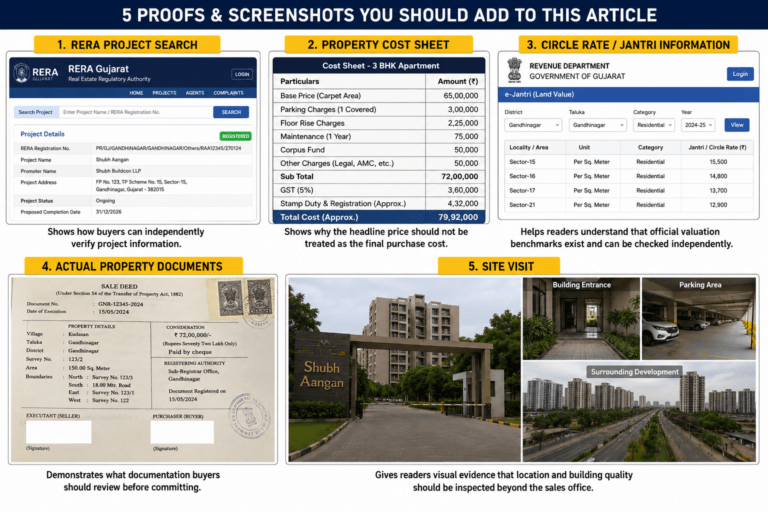
What I Would Check Before Paying Even ₹1 Token
Before making a booking payment, I would want answers to these questions:
- What exactly is the carpet area?
- What is the complete cost?
- Is parking included?
- Is the project RERA registered where applicable?
- What is the possession status?
- What approvals are available?
- Who owns the property?
- Are there outstanding dues?
- Is there an existing loan?
- What is the cancellation/refund policy?
- What is the payment schedule?
- What documents will be provided before registration?
- What is the actual reason the seller is selling?
- What are comparable properties selling for?
- Can my lawyer review the documents before commitment?
If the seller refuses reasonable due diligence, walk away.
What This Guide Will NOT Help You With
This guide is not designed to help you:
- Flip a property in six months
- Chase rumours
- Predict the next “hotspot”
- Buy purely because a broker claims prices will double
- Find insider deals
- Speculate on future infrastructure announcements
- Maximise leverage at any cost
Real estate works best when the purchase makes sense even if appreciation is slower than expected. That is the test I would use.
Ask yourself:
“If prices remain almost flat for the next three years, would I still be happy owning this property?”
If the answer is no, reconsider the purchase.
Final Verdict: Should You Buy a 3 BHK Flat in Gandhinagar Under ₹80 Lakhs?
Yes—provided you buy the property, not the marketing story.
There are legitimate opportunities in and around the ₹80 lakh segment, but buyers need to accept that the market is highly location- and property-specific.
Current 2026 data shows meaningful differences between Gandhinagar localities, while available listings demonstrate that 3 BHK properties can still appear around the ₹70–80 lakh range. But I would not call every ₹78 lakh flat a bargain.
A good purchase should satisfy four conditions:
1. The location works for your actual life
Not your broker’s future prediction.
2. The total cost fits your finances
Not just the brochure price.
3. The property and documents pass independent verification
Not just the sales team’s explanation.
4. The price makes sense against comparable properties
Not against an artificially inflated “original price.”
If all four work, buying can make sense. If even one major area fails,waiting is often better than forcing the purchase.
A Final Word for Buyers
Buying a 3 BHK in Gandhinagar under ₹80 lakh should not be a race. You do not win because you booked before someone else.
You win when, five or ten years later, you can look back and say:
“I understood what I was buying, I paid a sensible price, and I did not ignore the warning signs.”
That is the standard I would use. If you are comparing properties yourself, create a simple three-column comparison of total cost, carpet area and location quality before visiting the sales office for a second time. And if a property cannot survive that comparison, you probably should not buy it.
Conclusion
Buying a 3 BHK flat in Gandhinagar under ₹80 lakh in 2026 is possible, but the right property is not necessarily the cheapest one you find. The real challenge is balancing location, carpet area, construction quality, legal safety, total purchase cost and future resale potential.
Before booking, verify the RERA details, complete cost sheet, Jantri/valuation information, property documents and actual site conditions. Never let a broker’s urgency or a limited-time offer replace proper due diligence.
If your ₹80 lakh budget is strict, I would personally avoid stretching to the absolute limit. A slightly older 3 BHK in a well-established location with better usable space and clean documentation can be a smarter choice than a new project that looks impressive but leaves you financially stretched.
Most importantly, do not buy because someone says prices will rise. Buy because the property makes sense for your life and finances even if appreciation is slower than expected. A good real estate decision is not the one that looks exciting on booking day. It is the one you still feel confident about years later.
3 BHK Flat in Gandhinagar Under 80 Lakhs - faqs
1.Is ₹80 lakh enough for a good 3 BHK in Gandhinagar in 2026?
2.Which area is best for a 3 BHK under ₹80 lakh?
3. New or resale property?
4.Is buying near GIFT City automatically a good investment?
5.Should I wait for prices to fall?
references
About the Author