
Buying a flat in Gandhinagar can look straightforward when a builder or property listing shows a price such as ₹50 lakh or ₹70 lakh.
But that number is rarely the amount you should keep in your bank account.
A buyer may start with the property price and later discover additional expenses related to registration, taxes, parking, maintenance, documentation, finance, interiors and other charges. The difference can be large enough to disturb the original budget.
For example, a buyer considering a ₹60 lakh apartment should not automatically assume that ₹60 lakh is the complete purchase amount. The final ownership cost depends on the property type, transaction structure, applicable government charges, builder terms, loan arrangement and the condition of the flat.
That is why the right question is not:
“What is the price of the flat?”
It is:
“How much money will I actually spend before I can comfortably own and use this home?”
Current market listings also show why Gandhinagar cannot be treated as one uniform property market. In Q2 2026, Magicbricks reported an average multistorey apartment rate of about ₹4,182 per sq. ft. for Gandhinagar, while locality-level rates varied considerably. Housing.com also shows significant differences between locations such as Sargasan, Kudasan, Randesan, Raysan and Vavol.
So, before deciding whether a flat is affordable, you need to understand the entire cost structure.
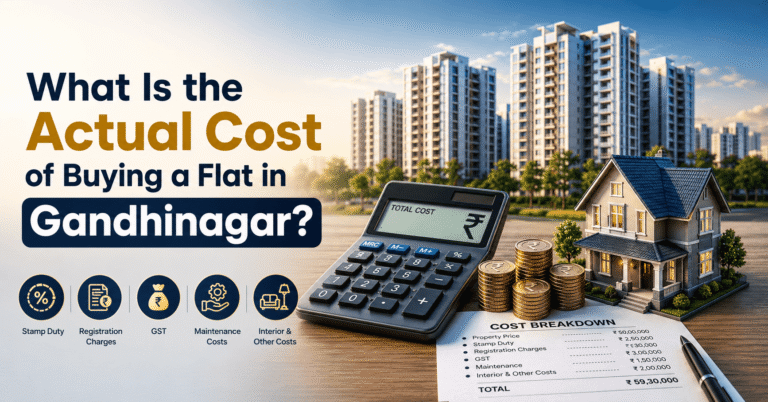
What Is the Actual Cost of Buying a Flat in Gandhinagar?
The actual cost can be divided into several layers:
- Basic property price
- Government charges
- Builder or developer charges
- Finance and loan expenses
- Legal and documentation expenses
- Parking and maintenance-related expenses
- Interior and furnishing expenses
- Moving and utility expenses
- Future ownership expenses
A simple way to think about it is:
Actual Cost = Property Price + Purchase Charges + Financing Costs + Setup Costs + Other Applicable Expenses
The exact amount differs from one apartment to another, so buyers should obtain a complete written cost sheet before making a payment.
1. Start With the Advertised Price — But Don't Stop There
Suppose you see a flat advertised at ₹60 lakh.
Your first instinct may be:
“My budget is ₹60 lakh, so this property fits.”
That can be a dangerous assumption.
The advertised price may relate to a particular area calculation or may exclude some charges. Depending on the project and transaction, you may encounter costs connected with:
- Parking
- Maintenance
- Documentation
- Government charges
- Registration
- Taxes
- Floor or location preferences
- Amenities
- Loan processing
- Interiors
- Utility connections
The first thing I would ask the builder or seller is:
“Please give me the complete all-inclusive cost sheet in writing.”
Do not rely only on a verbal quotation from a salesperson or broker.
Ask for these numbers separately
- Base property price
- Carpet area
- Built-up area
- Super built-up area
- Applicable taxes
- Government charges
- Parking
- Maintenance deposit
- Society-related charges
- Documentation charges
- Other builder charges
- Registration-related expenses
- Total amount payable
This makes it much easier to compare two apartments honestly.
2. Understand Carpet Area Before Comparing Prices
One of the biggest mistakes buyers make is comparing two flats purely on their quoted square feet price.
The area mentioned in a property conversation may refer to different measurements.
Carpet area
This is the most useful measurement for understanding the usable internal space of the home.
Built-up area
This generally includes the carpet area along with certain structural and wall-related areas.
Super built-up area
This can include the apartment’s proportionate share of common areas.
Therefore, two flats advertised at the same price per square foot may provide very different amounts of usable space.
Example
Imagine:
Flat A: ₹4,500 per sq. ft. on a larger quoted area
Flat B: ₹4,800 per sq. ft. on a smaller quoted area
At first glance, Flat A may appear cheaper.
But if its carpet area is significantly smaller relative to the quoted area, the comparison changes.
My advice: compare the total purchase price against usable carpet area, not just the headline rate.
3. Government Charges Can Change Your Budget
Government-related expenses are an important part of the purchase.
Depending on the transaction, buyers may have to account for applicable:
- Stamp duty
- Registration charges
- GST where applicable
- Other statutory charges
The exact calculation should be confirmed for the specific property and transaction because the treatment can differ between a ready-to-move property, an under-construction property and a resale transaction.
For this reason, don’t calculate these charges from an old blog post or a random property website.
Check the applicable government rules and obtain the current calculation before paying a significant amount.
Important distinction
Stamp duty and registration are not the same thing.
Stamp duty relates to the applicable duty on the property transaction/document, while registration involves recording the document with the appropriate authority.
A buyer should therefore ask:
“How much stamp duty applies?”
and separately:
“How much registration expense should I budget for?”
4. GST: Don't Assume Every Flat Has the Same Treatment
GST is another area where buyers can become confused.
The GST treatment depends on factors such as whether the property is under construction and whether the transaction qualifies for an applicable exemption or treatment.
For example, a ready-to-move property where the completion certificate has been issued can have a different GST treatment from an under-construction property.
So don’t simply add a fixed GST percentage to every apartment.
Ask the builder:
- Is GST applicable?
- At what rate?
- What component is taxable?
- Is the quoted price GST-inclusive?
- Is there written documentation showing the calculation?
This is particularly important when comparing a ready-to-move apartment with an under-construction apartment.
5. Builder Charges You Need to Check
Understanding the Home Buying Costs in Gandhinagar is important because the developer may quote a base price, but the final cost can include several additional components. Depending on the project, buyers should ask whether the quotation includes parking, floor-related charges, preferential location charges, club or amenity charges, maintenance deposits, infrastructure charges, documentation charges, and other project-specific expenses.
Never assume that a facility shown in the brochure is automatically included in the base price. What appears to be part of the package may be charged separately, which can significantly increase the final amount you need to pay.
A useful question to ask the developer
Instead of simply asking:
“Is everything included?”
Ask:
“Please list everything that I will have to pay from booking until possession.”
The second question forces the developer to provide a much clearer cost breakdown and helps you compare different properties on their actual total cost, rather than just the advertised base price.
6. Parking Can Become a Separate Expense
Parking is often treated as a minor issue until the final cost discussion.
For a family buying a home, however, parking can be an important practical requirement.
Before signing an agreement, clarify:
- Whether parking is included
- Whether it is separately charged
- What type of parking is provided
- Whether the parking location is fixed
- Whether the allotment is documented
- Whether visitor parking is available
Don’t pay a substantial amount based solely on a verbal promise that a preferred parking space will be available later.
7. Maintenance and Society Expenses
The purchase doesn’t end at possession.
Once you become an owner, there can be recurring expenses related to:
- Society maintenance
- Common-area maintenance
- Security
- Lifts
- Cleaning
- Water systems
- Common electricity
- Amenities
- Repairs
- Maintenance funds
Ask for the expected monthly or quarterly maintenance before buying.
A property that appears cheaper initially may become less attractive if its recurring ownership expenses are significantly higher.
8. Home Loan: Your Flat May Cost More Than Its Purchase Price
If you use finance, the cost of the flat doesn’t stop at the property’s purchase amount.
Your financial cost may include:
- Down payment
- Loan processing fee
- Interest
- Documentation-related charges
- Valuation charges where applicable
- Insurance or other loan-related expenses
- Monthly EMI
The biggest cost is normally the interest paid over the life of the loan.
Example
Suppose a buyer purchases a ₹60 lakh flat and finances a substantial portion through a home loan.
The buyer shouldn’t ask only:
“Can I afford the EMI?”
They should also ask:
“Can I comfortably afford the EMI even if my expenses increase or my income temporarily falls?”
A property that technically fits your loan eligibility may still be financially uncomfortable.
9. Don't Use Your Entire Savings for the Down Payment
This is one of the most important buyer decisions.
Suppose you have ₹20 lakh in savings and decide to use almost all of it for the down payment.
You may successfully purchase the property but then struggle with:
- Registration expenses
- Moving
- Furniture
- Interiors
- Medical or family emergencies
- EMI payments
- Job changes
- Unexpected repairs
A home should improve your financial stability, not destroy your emergency buffer.
My rule for buyers
Don’t calculate:
Savings − Down Payment = ₹0
Try to maintain a reasonable financial reserve after the transaction.
The correct amount depends on your income, existing liabilities, family responsibilities and job stability.
10. Legal and Documentation Costs Matter
A flat is one of the largest purchases most people make.
Yet some buyers spend hours comparing the interior and only a few minutes checking the documentation.
That is the wrong priority.
Before purchasing, consider professional verification of relevant documents, including:
- Ownership/title documents
- Sale agreement
- Previous transaction documents for resale property
- Project approvals where applicable
- RERA information
- Encumbrance-related records where applicable
- Property tax records
- Building and development permissions where relevant
For a new project, verify the project and promoter information through the applicable GujRERA records before relying on sales claims.
Why this matters
A beautiful apartment with weak documentation is not a good purchase.
A slightly less attractive apartment with clean documentation can be the safer decision.
11. Location Is Part of the Cost
The cheapest flat isn’t necessarily the cheapest home.
Why?
Because location affects your ongoing expenses and lifestyle.
Consider:
- Daily commute
- Road connectivity
- Public transport
- Metro access
- Schools
- Hospitals
- Shopping
- Employment centres
- Infrastructure
- Future development
- Noise
- Traffic
- Water availability
- Surrounding construction
Gandhinagar has different residential micro-markets, and current online price data shows meaningful variation among localities.
For example, Magicbricks’ Q2 2026 data placed average apartment rates around ₹4,540/sq. ft. in Sargasan and ₹4,541 in Kudasan, while Vavol was around ₹3,966 and Gandhinagar overall around ₹4,182.
Housing.com’s current figures similarly show different average asking levels for Sargasan, Kudasan, Randesan, Raysan and Vavol.
These figures are useful for comparison, but they should not be treated as the exact market value of a specific apartment.
The actual value depends on the project, age, floor, carpet area, construction quality, amenities, location and transaction conditions.
12. Gandhinagar Is Not One Single Property Market
This is something buyers frequently overlook.
A flat in:
- Sargasan
- Kudasan
- Raysan
- Randesan
- Vavol
- Koba
- GIFT City surroundings
should not automatically be compared using one citywide rate.
Different areas have different:
- Price levels
- Infrastructure
- Connectivity
- Rental demand
- Buyer profiles
- Construction activity
- Future development
- Resale demand
For example, current property portals show GIFT City at a substantially higher average price level than many surrounding Gandhinagar residential areas.
That doesn’t automatically mean the more expensive location is a better investment.
It means you need to understand what you are paying for.
13. Ready-to-Move vs Under-Construction Flat
This decision can significantly affect your actual cost.
Ready-to-move
Potential advantages:
- You can inspect the completed apartment
- You can assess the actual construction
- You can see the surrounding area
- You may move in quickly
- There is less construction uncertainty
Potential disadvantages:
- Higher upfront requirement in some cases
- Older project may have less modern specifications
- Limited choice of units
Under-construction
Potential advantages:
- More choice of floor and configuration
- Potentially newer amenities
- Staged payment structure may help some buyers
Potential disadvantages:
- Possession risk
- Construction delays
- Future cost uncertainty
- Area around the project may still be developing
- You are buying something you cannot fully inspect yet
Don’t choose under-construction simply because a salesperson says:
“The price will definitely increase after possession.”
Nobody can guarantee that.
14. Step-by-Step Buyer Action Plan
Step 1: Select the Location
Visit the area at different times.
Don’t judge a location only during a Sunday afternoon site visit.
Check:
- Morning traffic
- Evening traffic
- Road conditions
- Noise
- Public transport
- Nearby construction
- Schools
- Hospitals
- Shops
- Daily commute
Mistake to avoid
Buying because the project is attractive while ignoring your daily travel.
Step 2: Validate the Budget and Price
Create a complete budget containing:
Property price + government charges + loan expenses + parking + maintenance + interiors + emergency reserve
Then compare similar properties in the same micro-market.
Don’t compare a premium new project against an older resale apartment simply by looking at the headline rate.
Step 3: Verify the Builder and RERA Details
Check the project’s applicable RERA information.
Compare:
- Promised possession
- Registered project information
- Promoter information
- Project details
- Unit details
- Disclosures
Don’t rely exclusively on the brochure.
Step 4: Conduct a Proper Site Visit
During the visit, check:
- Actual carpet area
- Natural light
- Ventilation
- Water pressure
- Lift operation
- Parking
- Common areas
- Construction quality
- Road access
- Surrounding buildings
- Mobile network
- Noise
- Drainage
- Nearby development
Take photographs and notes.
If you are spending ₹50 lakh, ₹70 lakh or ₹1 crore, spending an extra hour inspecting the property is a small investment.
Step 5: Complete Legal and Registry Checks
For a resale property, pay particular attention to ownership history and outstanding obligations.
For a new property, verify the project documentation and relevant approvals.
Don’t allow pressure from a broker to replace legal verification.
Red flag
If someone says:
“Don’t worry about the documents; everyone is buying.”
That is exactly when you should slow down.
Step 6: Negotiate the Total Cost, Not Just the Rate
Instead of negotiating only:
“Can you reduce ₹100 per sq. ft.?”
ask about the complete package.
You may have more room to negotiate:
- Parking
- Floor charges
- Additional charges
- Maintenance
- Payment schedule
- Furnishing
- Other project-specific components
The best negotiation isn’t always getting the lowest quoted rate.
It is getting the best overall value with acceptable risk.
A Practical Example: What a ₹60 Lakh Flat Could Really Require
Let’s use an illustrative example, not a quotation for any particular Gandhinagar project.
Suppose:
Advertised property price: ₹60 lakh
The buyer may then need to budget separately for applicable:
- Government charges
- Registration
- Applicable tax
- Parking
- Maintenance deposit
- Legal/documentation expenses
- Loan-related expenses
- Interiors
- Furniture
- Moving
- Utility setup
The final amount can therefore be meaningfully higher than ₹60 lakh.
The important lesson
Don’t ask:
“Can I afford a ₹60 lakh flat?”
Ask:
“Can I comfortably afford the complete ownership cost of this flat?”
That change in thinking can prevent a major financial mistake.
Realistic Case Study: Family Buyer
Case Study 1 — Illustrative Example
A family has a household budget of around ₹75 lakh.
They initially consider a ₹70 lakh apartment because the property fits their desired configuration.
After preparing a complete cost sheet, they realise the transaction and setup expenses will push the required cash outlay above their original plan.
Instead of stretching the loan, they consider a slightly smaller flat at a lower purchase price.
Outcome
The family gives up some space but maintains:
- Emergency savings
- Manageable EMI
- Budget for interiors
- Financial flexibility
Lesson
A slightly smaller home that you can comfortably afford is often better than a larger home that controls your finances for the next 15–20 years.
Case Study 2 — Illustrative Example
An investor considers a ₹55 lakh apartment primarily for rental income.
The expected rent looks attractive initially.
But after calculating:
- Maintenance
- Vacancy
- Property-related expenses
- Loan interest
- Brokerage during tenant changes
- Future repairs
the actual rental return is much less impressive than the original sales pitch.
The investor decides not to purchase purely for short-term appreciation.
Lesson
Rental income should be calculated after realistic expenses, not from the advertised monthly rent alone.
Do not buy an apartment simply because someone says:
“This area will double in price.”
Appreciation is possible, but it is never guaranteed.
Testimonials: Don't Trust Anonymous Success Stories
Many property websites publish testimonials saying things like:
“I bought this property and doubled my money.”
That isn’t enough evidence.
A trustworthy buyer guide should identify whether a testimonial is independently verifiable and should not manufacture customer stories.
If your website has genuine customer experiences, you can add them here with:
- Buyer type
- Area
- Property type
- Purchase year
- Main challenge
- Decision made
- Outcome
Do not publish invented testimonials as real customer experiences.
How to Verify the Price Before Buying
Online property portals are useful for understanding the market, but asking prices are not necessarily transaction prices.
Current portals show different estimates for Gandhinagar. For example, Magicbricks reported a Q2 2026 apartment average of approximately ₹4,182/sq. ft., while Housing.com reported a broader Gandhinagar average of ₹6,857/sq. ft. and significantly different locality-level figures.
That difference itself is a warning:
Don’t treat one website’s average as the “correct” price of your flat.
Instead, compare:
- Similar flats in the same project
- Similar projects nearby
- Similar carpet areas
- Similar building age
- Similar floor
- Similar amenities
- Recent transaction evidence where available
- Government valuation/reference information where applicable
Screenshot and Proof
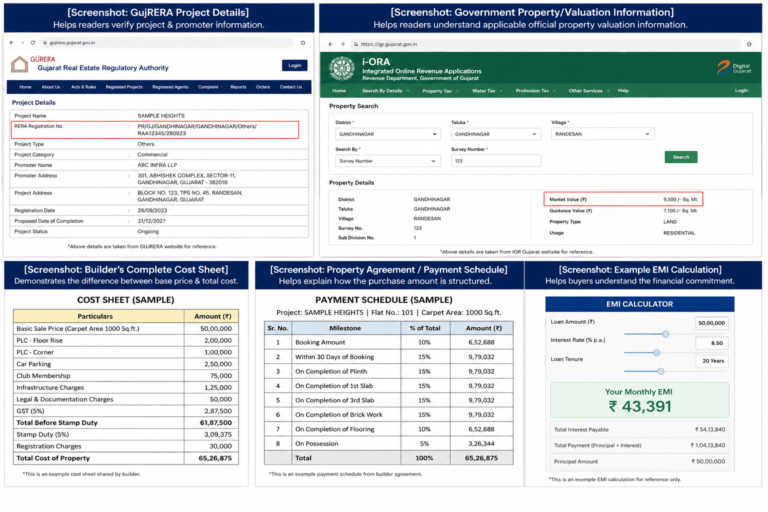
Who Should NOT Buy a Flat Yet?
Buying property isn’t automatically the right decision.
You should consider waiting if:
- Your income is unstable
- You have significant existing debt
- The EMI would consume too much of your monthly income
- You have almost no emergency savings
- You are buying only because of broker pressure
- You haven’t verified the documents
- You haven’t compared alternative properties
- You expect a guaranteed short-term profit
- You may relocate soon
- You are unsure whether you actually need to own the property
Renting may be better when:
You expect to move within a few years and buying would create a large transaction cost and loan burden.
There is nothing wrong with renting while you build your savings and understand the market.
If I Were Buying a Flat in Gandhinagar Today
This is where I would be particularly careful.
I would not buy simply because a builder says prices are going up.
I would first shortlist three or four comparable properties in the same area.
Then I would compare:
- Total purchase price
- Carpet area
- Builder reputation
- Project documentation
- Location
- Connectivity
- Construction quality
- Maintenance
- Parking
- Rental demand
- Resale potential
- EMI burden
I would negotiate the total cost, rather than becoming obsessed with reducing the headline rate by a small amount.
The configuration I would choose
For an end-user, I would choose the smallest configuration that comfortably meets the family’s needs.
I would rather buy a well-located, legally clean and financially comfortable 2 BHK than stretch into an oversized 3 BHK simply for status.
What I would negotiate hardest
The complete cost sheet.
I want every charge clearly documented before I commit.
One red flag I would never ignore
Pressure to pay before proper verification.
If someone repeatedly tells me:
“Book today or you will lose the deal.”
I would slow down, not speed up.
A good property should survive a few hours or days of sensible due diligence.
This is where I would be particularly careful.
I would not buy simply because a builder says prices are going up.
I would first shortlist three or four comparable properties in the same area.
Then I would compare:
- Total purchase price
- Carpet area
- Builder reputation
- Project documentation
- Location
- Connectivity
- Construction quality
- Maintenance
- Parking
- Rental demand
- Resale potential
- EMI burden
I would negotiate the total cost, rather than becoming obsessed with reducing the headline rate by a small amount.
The configuration I would choose
For an end-user, I would choose the smallest configuration that comfortably meets the family’s needs.
I would rather buy a well-located, legally clean and financially comfortable 2 BHK than stretch into an oversized 3 BHK simply for status.
What I would negotiate hardest
The complete cost sheet.
I want every charge clearly documented before I commit.
One red flag I would never ignore
Pressure to pay before proper verification.
If someone repeatedly tells me:
“Book today or you will lose the deal.”
I would slow down, not speed up.
A good property should survive a few hours or days of sensible due diligence.