
A buyer recently told me something that sounds increasingly common around Gandhinagar: “Every broker is telling me to buy because of GIFT City. But I don’t know whether I am buying a property or simply buying the GIFT City story.”
That is exactly the right question.
GIFT City has undoubtedly changed the residential property conversation around Gandhinagar. But proximity to a major business district does not automatically make every nearby apartment a good investment.
The real question is more practical:
Is GIFT City creating genuine housing demand, and if it is, which properties are actually positioned to benefit from it?
That distinction matters because buyers can easily overpay for a flat simply because a sales brochure mentions GIFT City five times.
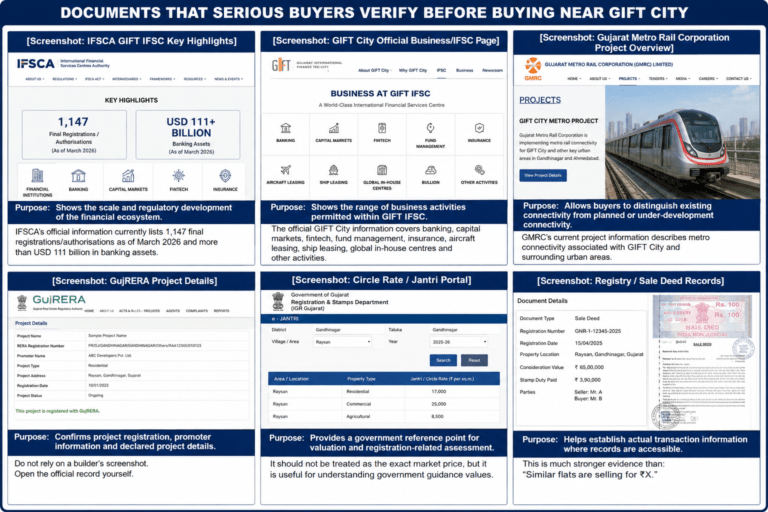
GIFT City is not merely a proposed development anymore. The International Financial Services Centres Authority (IFSCA) reported 1,147 final registrations/authorisations in GIFT IFSC as of March 2026, along with more than USD 111 billion in banking assets. Its ecosystem covers banking, fund management, capital markets, insurance, fintech, aircraft leasing, ship leasing and other financial activities.
That growing commercial ecosystem creates a logical residential effect:
Businesses create jobs → jobs create a workforce → workers need housing → housing creates residential demand.
But there is another side to the story.
Prices can rise faster than rents. Developers can use future infrastructure to justify today’s pricing. Investors can confuse appreciation with guaranteed returns. And buyers can choose a locality that looks attractive on a map but is inconvenient for everyday life.
This guide looks at the real relationship between GIFT City and residential property demand — without assuming that every property near GIFT City is automatically a good purchase.
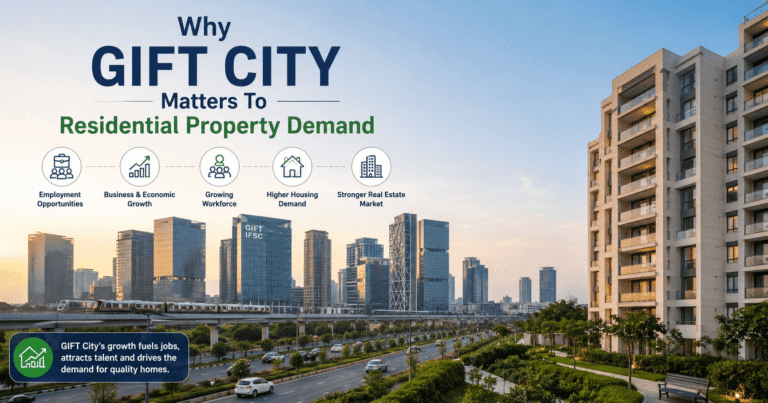
Why GIFT City Matters To Residential Property Demand
The strongest reason GIFT City influences housing demand is not the skyline.
It is economic activity.
A residential market becomes stronger when people have a reason to live nearby.
GIFT City has been developed as an international financial and business centre, with the IFSC ecosystem supporting banking, finance, technology, insurance, fund management, capital markets and other businesses. IFSCA’s current data shows the scale of activity developing inside the IFSC.
That matters to residential property because businesses require:
- Employees
- Managers
- Professionals
- Consultants
- Service providers
- Entrepreneurs
- Support staff
- Families
All of these people contribute to potential housing demand.
The important point for a buyer is that this is different from purely speculative demand.
A person buying a flat because they expect its price to rise is an investor.
A person renting or purchasing a home because their workplace is nearby is an end-user.
A healthy residential market ideally has both.
1. Employment Is The Real Engine Behind Housing Demand
If you want to understand why GIFT City can influence residential property, start with employment, not property prices.
A new office building by itself does not create sustainable residential demand.
People working inside that office do.
As businesses expand, the workforce connected to GIFT City can increase. Different financial, banking, technology and professional-service activities attract different categories of employees.
IFSCA’s ecosystem currently includes banking, fund management, capital markets, insurance, fintech, global in-house centres, aircraft leasing, ship leasing and other activities.
This creates a wider economic ecosystem rather than a single-employer housing market.
For residential property, that distinction is important.
If one company closes an office, a neighbourhood dependent entirely on that company can suffer.
But when an area has multiple businesses, multiple employers and multiple industries, housing demand can become more diversified.
What this means for buyers
Don’t simply ask:
“How close is the property to GIFT City?”
Ask:
“Who is likely to live here?”
If the answer includes financial professionals, IT employees, corporate workers, business owners and other professionals working across the GIFT City–Gandhinagar–Ahmedabad corridor, the demand story becomes more credible.
2. Workforce Growth Can Increase Rental Demand
The second connection is straightforward.
More jobs can mean more people looking for accommodation.
Not every employee immediately buys a property.
Many initially rent.
That creates rental demand before it necessarily creates ownership demand.
This is particularly relevant for:
- Young professionals
- Employees relocating from another city
- Newly married couples
- Professionals testing a new job
- Employees who do not yet want a long-term mortgage
- People waiting to understand their work location
For investors, this creates an important distinction.
A property may have good occupancy potential without having spectacular capital appreciation.
Those are two different returns.
A flat purchased for ₹80 lakh that rents for ₹25,000 per month has an approximate gross annual rental yield of 3.75% before maintenance, vacancy, taxes and other expenses.
The calculation is:
₹25,000 × 12 ÷ ₹80,00,000 × 100 = 3.75%
That is useful.
But it is not a reason to assume the property will automatically appreciate 10–15% every year.
A serious investor should evaluate rent, tenancy, vacancy and yield separately from expected appreciation.
3. Why Nearby Areas Can Benefit More Than Buyers Expect
GIFT City itself is only one part of the residential equation.
Employees don’t necessarily want to live inside their workplace district.
They may prefer surrounding residential areas because of:
- Larger apartments
- Existing housing
- Schools
- Daily shopping
- Healthcare
- Restaurants
- Family-oriented amenities
- Better residential environments
- Different pricing
- More apartment choices
This is why the broader Gandhinagar market matters.
Areas such as Kudasan, Raysan, Randesan, Sargasan and nearby residential corridors are frequently considered by buyers looking for access to GIFT City while retaining a conventional residential environment.
The market should not, however, be treated as one uniform zone.
Different localities have different:
- Pricing
- Infrastructure
- Construction quality
- Accessibility
- Rental demand
- Amenities
- Traffic conditions
- Supply
- Resale liquidity
A property five kilometres away from GIFT City can sometimes be a better end-user purchase than one closer to it.
Why?
Because livability matters.
4. Connectivity Makes The Residential Story Stronger
A business district only creates meaningful residential demand if people can reach it conveniently.
That is where connectivity becomes important.
Gujarat Metro Rail Corporation’s current project information identifies the Ahmedabad–Gandhinagar metro network and ongoing/upcoming connectivity related to GIFT City. Its Phase 2B information describes a 3.33 km elevated extension between GIFT City and Shahpur with three stations, intended to improve access to GIFT City and nearby urban, educational, residential and commercial areas.
The wider metro system also includes stations such as Randesan, Raysan and PDEU, with multimodal facilities designed around pedestrian, bus, parking and other first/last-mile connections.
For a buyer, this matters for one simple reason:
Time has economic value.
A professional who saves 30–40 minutes every day may value a home differently from an investor who only looks at price per square foot.
But there is a warning here.
Never pay today’s premium solely for tomorrow’s infrastructure.
Check:
- Current road access
- Current public transport
- Actual commute time
- Peak-hour traffic
- Metro station distance
- Future infrastructure status
- Whether the infrastructure is operational, under construction or merely proposed
A proposed road is not the same as a completed road.
A planned metro station is not the same as a functioning station.
5. GIFT City Can Influence Property Appreciation — But It Does Not Guarantee It
This is where buyers need to be particularly careful.
Appreciation is one of the most attractive parts of the GIFT City property narrative.
Commercial development can increase interest in surrounding residential areas.
But the relationship is not automatic.
Property valuation depends on several factors:
- Location
- Land value
- Construction quality
- Builder reputation
- Supply
- Demand
- Configuration
- Floor
- View
- Parking
- Amenities
- Possession
- Financing conditions
- Resale liquidity
A premium location can still contain an overpriced project.
A cheaper property can still be difficult to resell.
And a beautiful apartment can still be a poor investment if the entry price is too high.
Current online market-rate data from Magicbricks, for example, showed an average advertised residential apartment rate in GIFT City of about ₹10,617 per sq ft in Q2 2026, with a reported range across the locality. Such portal figures are useful as market indicators, but they should not be treated as substitutes for actual transaction or project-level valuation.
This distinction is critical.
Asking price ≠ transaction price.
6. Why Pricing Discipline Matters More Than The GIFT City Story
When evaluating residential property near GIFT City, buyers should be careful not to assume that proximity to a major business district automatically means higher returns. Suppose a salesperson says, “This property will appreciate because GIFT City is expanding.” That statement may be directionally reasonable, but it doesn’t answer the buyer’s most important question: “Am I paying a fair price today?”
Imagine two apartments. Property A costs ₹75 lakh, has a good location, an established neighbourhood, existing rental demand, and moderate future growth potential. Property B costs ₹95 lakh, is a new project with strong GIFT City branding, future infrastructure nearby, higher maintenance costs, and limited rental history. Property B may eventually outperform, but it may also be overpriced.
Before making a decision, buyers should compare price per usable square foot, total acquisition cost, rental income, resale demand, and project risk rather than focusing only on the advertised base price. GIFT City can support long-term residential demand, but the property’s actual value still depends on whether the price makes financial sense today.
7. Housing Demand Does Not Mean Every Configuration Will Perform Equally
One of the most overlooked issues is housing configuration.
Different buyers create different demand.
A young professional may prefer a 1 or 2 BHK.
A married couple may prefer a 2 BHK.
A family with children may want a 3 BHK.
An investor may prefer a smaller unit if rental affordability is stronger.
Therefore, an investor should not automatically assume that the largest apartment is the best property investment.
A ₹1.5 crore apartment does not automatically have better returns than an ₹80 lakh apartment.
The key is:
Who is the future buyer or tenant?
If the local workforce mainly wants affordable rental housing, an expensive luxury apartment may have a narrower tenant pool.
That affects:
- Tenancy
- Occupancy
- Rent
- Resale
- Liquidity
8. Infrastructure Is Valuable — But Only When It Improves Daily Life
The word infrastructure gets used excessively in real estate marketing.
Roads, metro, business districts, schools and commercial development are valuable.
But the buyer should ask:
“What changes for me?”
A new road that reduces your daily commute has practical value.
A metro station that makes employment centres accessible has practical value.
A nearby school reduces family travel.
A healthcare facility improves convenience.
Retail and commerce improve everyday accessibility.
This is how infrastructure should be evaluated.
Not:
“How impressive is the announcement?”
But:
“How much does this reduce my daily friction?”
That is the difference between infrastructure-driven value and brochure-driven hype.
9. Commerce Creates A More Complete Residential Ecosystem
A residential market becomes more sustainable when it develops alongside:
- Commerce
- Businesses
- Retail
- Healthcare
- Education
- Restaurants
- Financial services
- Technology
- Public transport
This is why GIFT City’s development is relevant beyond offices.
IFSCA’s official ecosystem includes a broad range of financial and technology-related activities. The authority also continues to publish new regulatory developments and industry initiatives, indicating that the IFSC ecosystem is still evolving rather than being a finished development.
Recent activity also illustrates the continuing commercial build-out. For example, Wipro inaugurated a new office at GIFT City in March 2026, while state officials discussed enhancing residential facilities for staff as part of the broader “Working and Living in GIFT City” approach.
For residential buyers, this is more meaningful than another tower announcement.
It suggests an ecosystem gradually developing around employment.
10. The Biggest Mistake: Confusing GIFT City Growth With Guaranteed Returns
This is the point where I would be most cautious.
GIFT City may continue to grow.
The surrounding residential property market may benefit.
But neither statement means:
“Buy any flat today and you will make a large profit.”
Real estate has cycles.
There can be periods of:
- Strong demand
- Price stability
- Excess supply
- Slow resale
- Higher interest rates
- Lower affordability
- Construction delays
- Rental stagnation
Gujarat’s broader real estate market itself showed signs of greater caution in FY2026, with new project registrations falling to 1,610 according to GujRERA data reported by the Times of India. That does not mean Gandhinagar or GIFT City residential property is weak; it is simply a reminder that the real estate market is cyclical and developers do not launch projects at the same pace indefinitely.
A smart buyer should therefore separate:
GIFT City’s growth story
from
the price being asked for a particular apartment.
Step-by-Step Buyer Action Plan
Step 1: Location Selection
Do not start with the builder.
Start with the map.
Visit the property during:
- Morning peak hours
- Evening peak hours
- Weekend
- Rainy conditions if possible
Check:
- Actual commute to GIFT City
- Road quality
- Public transport
- Metro accessibility
- Schools
- Healthcare
- Grocery stores
- Restaurants
- Parking
- Neighbourhood development
- Noise
- Traffic
Mistake to avoid
Buying because the broker says:
“Only 10 minutes from GIFT City.”
Ask:
10 minutes at what time?
A 10-minute Sunday drive is not the same as a 10-minute weekday commute.
Step 2: Budget & Price Validation
Your budget should include more than the apartment price.
Consider:
- Down payment
- Home loan
- Registration
- Stamp duty
- GST where applicable
- Brokerage
- Parking
- Maintenance deposit
- Interior work
- Furnishing
- Moving expenses
- Emergency reserve
Then calculate the EMI.
Do not buy a ₹1 crore property simply because the bank is willing to lend you ₹80 lakh.
Loan eligibility is not affordability.
For investment property, calculate expected rent and realistic vacancy.
Do not assume 12 months of rent.
A prudent calculation should include periods without a tenant, maintenance and other ownership costs.
Step 3: Builder & RERA Verification
Before paying a booking amount, verify the project independently.
Check the Gujarat RERA record for:
- Registration
- Promoter details
- Project status
- Approved information
- Completion timeline
- Unit details
- Disclosures
- Any relevant updates
Do not rely entirely on a sales representative’s WhatsApp PDF.
The official record is more important than the brochure.
Red flag
If the salesperson becomes uncomfortable when you say:
“I want to verify the project myself before paying.”
Slow down.
A genuine project should survive basic due diligence.
Step 4: Site Visit Checklist
Never buy based only on a sample apartment.
Inspect the actual construction.
Look at:
- Building structure
- Waterproofing
- Common areas
- Lift installation
- Parking
- Ventilation
- Natural light
- Drainage
- Road access
- Construction quality
- Fire-safety provisions
- Water supply
- Power backup
- Surrounding development
A sample apartment is a marketing product.
Your actual apartment is the investment.
Step 5: Legal & Registry Checks
Before registration, verify the documentation through appropriate legal professionals.
Depending on the property, this can include:
- Title documents
- Sale deed
- Encumbrance-related checks
- Approved plans
- RERA details
- Building permissions
- Property tax records
- Possession documentation
- Society or association documents
- Loan or mortgage-related records where relevant
For resale properties, ask what the previous owner actually paid and examine available transaction documentation.
A buyer should never treat a broker’s verbal statement about valuation as legal evidence.
Step 6: Negotiation Strategy
Do not negotiate only on the base price.
Negotiate the complete acquisition cost.
Ask about:
- Parking
- Floor-rise charges
- Maintenance deposits
- Club charges
- Other charges
- Payment schedule
- Furnishing
- Possession-related terms
- Documentation charges
- Any promotional benefits
A ₹3 lakh discount can be meaningless if ₹5 lakh of additional costs appear elsewhere.
My preferred approach
Get the all-inclusive written cost first.
Then negotiate.
Two Illustrative Buyer Case Studies
The following examples are illustrative scenarios, not claims about identifiable clients.
Case Study 1: End-User Family
A family has a combined household income of approximately ₹1.8 lakh per month.
They have ₹25 lakh available for the initial purchase and are considering a ₹75 lakh 3 BHK near the GIFT City corridor.
Instead of choosing the closest property, they compare three projects.
Project A
- Price: ₹72 lakh
- Older development
- Established neighbourhood
- Good road access
- Existing occupancy
Project B
- Price: ₹78 lakh
- New construction
- Better amenities
- Longer commute
Project C
- Price: ₹85 lakh
- Premium project
- Strong GIFT City positioning
- Higher maintenance
The family chooses Project A.
The reason is not maximum appreciation.
It is affordability and daily convenience.
If their objective is to live in the property for 8–10 years, the family benefits more from manageable EMI, established amenities, reliable accessibility and practical livability than from paying an additional ₹13 lakh simply for a premium brand.
Lesson
For an end-user, quality of life can be more important than theoretical appreciation.
Case Study 2: Investor
Consider an illustrative investor purchasing a 2 BHK for ₹80 lakh.
Assume:
- Purchase price: ₹80 lakh
- Rent: ₹25,000/month
- Gross annual rent: ₹3 lakh
- Gross rental yield: 3.75%
Now assume the property appreciates to ₹92 lakh after several years.
The investor has made capital appreciation, but the actual return is not simply ₹12 lakh.
They must account for:
- Purchase costs
- Loan interest
- Maintenance
- Vacancy
- Taxes
- Brokerage
- Selling costs
- Time value of money
What worked?
The property had:
- A reasonable entry price
- A genuine tenant pool
- Good connectivity
- Practical configuration
What did not work?
The investor initially assumed that GIFT City proximity would guarantee rapid appreciation.
It didn’t.
The lesson is simple:
A good investment needs a good entry price.
Realistic Buyer Voices
IT Professional — Rahul Mehta
“I initially focused only on being close to GIFT City. After comparing commute time, rent and the neighbourhood, I realised that being five minutes closer wasn’t worth paying a huge premium.”
PSU Employee — Amit Patel
“The broker kept talking about future appreciation. I instead checked the project documents and total cost. That changed the property I was considering.”
NRI Investor — Neha Shah
“I wanted GIFT City exposure, but I didn’t want to buy blindly. Rental demand and resale liquidity mattered more to me than a projected return.”
Note: The names and testimonials above are illustrative examples and should not be presented as verified client testimonials unless you have permission and supporting records.
What Evidence Should Buyers Actually Check?
Who Should NOT Buy Simply Because Of GIFT City?
This guide is not for buyers who want:
- A guaranteed short-term profit
- A property to flip in a few months
- A “sure-shot” appreciation story
- An investment based on broker rumours
- A property they cannot comfortably afford
- A highly leveraged speculative purchase
- A project they have not independently verified
If your entire investment thesis is:
“GIFT City will grow, therefore my flat must rise,”
your analysis is incomplete.
Who Should Consider Waiting?
You should consider delaying the purchase if:
Your EMI would strain your household budget
A property should not consume so much monthly income that you have no financial flexibility.
You have not decided whether you are an end-user or investor
These are different decisions.
You have not compared at least several properties
One sales office should not determine your entire market view.
You have not checked the legal documentation
Never rush this step.
You are buying only because of fear
Statements such as:
- “Last unit”
- “Price increases tomorrow”
- “Only two flats left”
- “Everyone is buying”
- “You will never get this price again”
are sales techniques, not investment analysis.
Is GIFT City Residential Demand Sustainable?
My view is yes, the underlying demand story is credible — but individual property returns will vary considerably.
The reason is that GIFT City has something many speculative development zones lack:
an actual employment and financial ecosystem.
IFSCA’s current activity indicators demonstrate that the IFSC has developed meaningful scale across financial and related sectors.
At the same time, the residential market surrounding it must continue to absorb new supply.
That creates a balancing act.
Demand must grow faster than competing supply.
If thousands of new apartments enter the market at the same time as employment grows, rental and resale markets may remain healthy.
If residential supply grows much faster than actual households, investors may struggle to achieve their expected rental yield or exit price.
Therefore, watch both:
Demand + Supply
not demand alone.
The Role of Technology And Modern Employment
The combination of technology, finance and global business is particularly relevant.
Modern financial centres increasingly depend on:
- Technology
- Fintech
- Data
- Digital services
- Global operations
- Professional services
- Compliance
- Risk management
- Investment management
GIFT City’s official ecosystem includes fintech and technology-related activities alongside traditional financial services.
This broadens the potential workforce.
It also changes what residents may expect from housing.
Today’s professional may value:
- High-speed connectivity
- Work-from-home space
- Reliable electricity
- Good mobile coverage
- Cafes
- Fitness facilities
- Transportation
- Nearby services
Residential amenities are therefore becoming part of the employment ecosystem.
GIFT City And The Long-Term Expansion Of Gandhinagar
The broader story is not just GIFT City.
It is the gradual expansion of the Ahmedabad–Gandhinagar urban economy.
As commercial activity, transportation and residential development interact, previously peripheral areas can become more integrated with the wider city.
That process can support:
- Population growth
- Migration
- Housing
- Employment
- Commerce
- Construction
- Infrastructure
- Businesses
- Residential projects
But urbanization does not happen evenly.
One road can develop rapidly while another remains underdeveloped.
One project can have strong occupancy while another struggles.
That is why micro-location matters.
The Affordability Problem Buyers Should Not Ignore
There is a point where property pricing becomes disconnected from local household affordability.
Suppose property prices rise 30%, but local salaries rise only 10%.
Demand can eventually weaken.
This does not mean prices must fall.
It can simply mean:
- Buyers wait longer
- Apartment sizes become smaller
- Loan dependence increases
- Rental demand becomes more important
- Resale takes longer
This is why affordability should remain central to your decision.
A property is not cheap because the broker says:
“It is still cheaper than Ahmedabad.”
Compare it with:
- Your income
- Your EMI
- Comparable properties
- Rent
- Usable area
- Total purchase cost
- Resale market
Sustainability And Livability Matter More Over Time
The strongest residential markets eventually need more than investment.
They need livability.
People need:
- Housing
- Employment
- Education
- Healthcare
- Retail
- Recreation
- Transportation
- Safety
- Green spaces
- Community
GIFT City and surrounding Gandhinagar areas are developing within this broader urban context.
The more complete that ecosystem becomes, the stronger the potential foundation for long-term residential demand.
But buyers should judge what exists today separately from what is promised for the future.
If I Were Buying This Property Today
If I were buying a residential property because of the GIFT City growth story today, I would not buy simply because it is marketed as a GIFT City property.
I would first establish whether the property works without an aggressive appreciation assumption.
My order of priority would be:
1. Location
I would want a practical commute to GIFT City and good access to daily necessities.
2. Price
I would compare the property’s effective price with comparable properties rather than accepting the builder’s headline price.
3. Configuration
I would choose a configuration with a deep end-user and rental market rather than simply buying the largest apartment.
4. Builder
I would investigate delivery history, documentation and project execution.
5. Rental potential
If I were investing, I would calculate conservative rental income before buying.
6. Resale
I would ask:
“Who will buy this from me five years from now?”
That question is often more valuable than:
“How much will it appreciate?”
What would I negotiate hardest?
The effective all-in purchase price.
Not just the advertised rate.
One red flag I would not ignore
A large gap between the project’s marketing story and its actual documents, construction progress, transaction evidence or rental demand.
If the sales pitch is excellent but the paperwork is weak, I walk away.
Conlcusion:
GIFT City is becoming an important driver of residential property demand because its expanding business, finance, technology, and employment ecosystem is creating genuine housing requirements around Gandhinagar. Better connectivity, infrastructure, commercial development, and workforce growth can continue supporting demand for well-located residential properties.
However, GIFT City growth does not automatically make every nearby property a good investment. Buyers still need to evaluate the location, pricing, rental potential, builder reputation, RERA records, construction quality, legal documents, and resale demand before making a decision.
If you are buying for your family, focus on livability, affordability, connectivity, and long-term suitability. If you are investing, focus on rental yield, occupancy, entry valuation, supply, and exit potential rather than relying only on expected appreciation.
The safest approach is simple: don’t buy because someone says GIFT City will make your property expensive. Buy only when the property makes financial and practical sense even without an unrealistic appreciation assumption.
GIFT City can be a strong long-term demand driver, but your final decision should be based on the property—not just the story surrounding it.
Why GIFT City Continues To Boost Residential Property Demand :FAQs
1. Why does GIFT City increase residential property demand?
2. Is buying property near GIFT City a good investment?
3. Will GIFT City guarantee property appreciation?
4. Which areas benefit from GIFT City development?
5. Is rental demand strong near GIFT City?
Reference:
About the Author

Mitesh Vyas
Hello My Name is Mitesh Vyas i am a Real Estate content writer and Property Market Enthusiast I shares practical insights on buying, selling, investing, and understanding real estate trends. With a strong focus on residential and commercial properties, My aims to help readers make informed property decisions through clear, research-based, and easy-to-understand content.