
Last month, I met a young IT professional looking for his first home in Gandhinagar. He had visited nearly ten residential projects over six weekends. Every builder’s sales team gave him the same message:
“Prices will increase next month.”
“Only two units are left.”
“Book today or lose the offer.”
After hearing similar statements repeatedly, he became convinced that waiting even a month would be a mistake. Yet when we compared actual transaction values, checked recent registrations, and reviewed RERA project timelines, a different picture emerged. Some projects had remained at nearly the same price for months, while others offered better negotiation opportunities than the advertised discounts suggested.
This experience is common. Many buyers believe the biggest risk is waiting too long. In reality, the bigger risk is buying too quickly without understanding the market.
Most online articles simplify the decision into “buy now because prices always rise” or “wait because prices may fall.” Neither approach reflects how real estate works. Property decisions depend on your financial position, the specific locality, available inventory, financing costs, infrastructure development, and your long-term goals.
In my experience advising buyers in Gandhinagar, the right answer is rarely a simple “buy” or “wait.” It is about identifying the right property at the right valuation, with the right documentation, and at a price that fits your budget—not acting out of fear.
If you’re considering buying a flat in Gandhinagar today, this guide will help you evaluate the market like a buyer, not like a salesperson.

Why This Question Matters More Than Ever
The Gandhinagar residential market has changed significantly over the past few years.
Several factors now influence buying decisions:
- Continued infrastructure development around GIFT City and major road corridors
- Expanding employment opportunities
- New residential townships entering the market
- Increasing supply in certain localities
- Higher construction costs
- Changes in mortgage interest rates
- Buyers becoming more cautious about project quality and possession timelines
These changes mean that timing alone no longer determines whether a purchase becomes a good investment. A well-priced property in a growing locality can outperform an overpriced apartment purchased during a market boom.
The Biggest Mistake Buyers Make
Many people compare only the advertised property price.
That is rarely enough.
A buyer should compare:
- Market valuation
- Total ownership cost
- Stamp duty
- Registration charges
- Home loan processing fees
- Interior expenses
- Maintenance deposits
- Parking costs
- Future resale potential
- Rental yield
- Infrastructure growth
Ignoring these factors often leads to a purchase that looks affordable initially but becomes financially stressful later.
Understanding Gandhinagar's Current Real Estate Market
Gandhinagar is no longer viewed only as an administrative city. It has evolved into a residential destination for professionals, government employees, business owners, and families seeking a planned urban environment.
Several localities have experienced noticeable development due to improved connectivity and commercial expansion.
Examples include:
- Raysan
- Kudasan
- Randesan
- Koba
- Sargasan
- PDPU Road
- Gift City influence zone
Each locality offers different advantages.
Some are suitable for end-users prioritizing daily convenience.
Others appeal more to investors seeking long-term capital gain.
Choosing the wrong locality because of marketing hype can delay appreciation and reduce future liquidity.
Current Market Reality: Buyer's Market or Seller's Market?
Many buyers assume prices are rising everywhere.
That isn’t always true.
Different projects experience different levels of demand.
For example:
A newly launched township with high inventory may offer better negotiation opportunities than a nearly sold-out ready-to-move project.
Likewise, two apartments located within two kilometers of each other may have completely different resale performance because of:
- Builder reputation
- Construction quality
- Accessibility
- Neighborhood development
- Nearby commercial growth
- Planned infrastructure
This is why understanding local supply and demand matters more than following headlines.
Should You Buy Only Because Prices Might Increase?
No.
Price appreciation should never be the only reason to purchase a home.
Ask yourself:
- Will this property suit my family for at least seven years?
- Is the monthly EMI comfortable?
- Do I have enough savings after the down payment?
- Is the builder financially stable?
- Is the project registered under RERA?
- Can I comfortably manage maintenance costs?
- Does the locality have long-term development potential?
If the answer to several of these questions is “no,” waiting may be wiser than rushing into ownership.
Buying a home should improve your financial stability—not create unnecessary pressure.
Signs That Waiting May Actually Be the Better Decision
Many people believe delaying a purchase always means missing out.
Sometimes the opposite is true.
You should consider waiting if:
- You haven’t finalized your employment location.
- Your down payment depends on borrowing from relatives.
- Your emergency fund will be exhausted after buying.
- You’re unsure whether you’ll remain in Gandhinagar for the next few years.
- The project has unresolved legal or documentation issues.
- The builder has a poor possession history.
- Your mortgage approval is uncertain.
- You’re purchasing only because everyone else is buying.
Waiting for greater financial clarity can reduce risk and improve your future negotiating position.
When Buying Today Can Make Sense
Determining the best time to buy a flat in Gandhinagar depends less on predicting short-term market fluctuations and more on your financial readiness and the quality of the property you choose. While market trends can influence prices, a well-planned purchase backed by careful research is often a smarter strategy than waiting for the “perfect” moment.
Buying now may be the right decision if:
- Your finances are stable.
- Your budget comfortably supports the EMI.
- You have researched multiple projects.
- The property’s valuation aligns with recent market transactions.
- The locality has improving infrastructure.
- The builder has a strong delivery record.
- The documentation has been independently verified.
- The apartment matches your long-term needs.
When these factors are in place, delaying your purchase simply to time the market rarely delivers significant benefits. Instead, focusing on a high-quality property, choosing a promising location, and ensuring your financial planning is strong can have a far greater impact on your long-term investment than trying to predict short-term price movements.
Read More:- Property Registration Charges In Gujarat 2026
Real Buyer Problems Nobody Talks About
After working with many homebuyers, I’ve noticed that the same issues arise repeatedly—yet they are rarely discussed in promotional brochures.
1. Price Confusion
The quoted price is often only the starting point. Buyers later discover additional costs for parking, club membership, maintenance deposits, GST (where applicable), and registration.
2. Hidden Cost Traps
A flat advertised within your budget can exceed it once all mandatory charges are included. Without calculating the full cost of ownership, affordability becomes misleading.
3. Fake Urgency
Statements like “last unit available” or “price revision tonight” are frequently used to pressure buyers. Unless you verify actual inventory and market demand, such claims should be treated cautiously.
4. Builder Trust
A glossy sample flat does not guarantee timely possession or quality construction. Always assess the developer’s completed projects, financial stability, and RERA compliance.
5. Investment vs. End-Use Confusion
Many buyers purchase an apartment expecting rapid ROI without considering rental demand, resale liquidity, or neighborhood development. An investor and an end-user often need very different selection criteria.
Step 1: Location Selection – The Decision That Shapes Everything
The first and most important decision isn’t choosing a project—it’s choosing the right locality.
A good apartment in the wrong location can underperform for years, while an average apartment in a well-connected, growing neighborhood may offer better livability and stronger long-term value.
When evaluating a locality, focus on:
- Infrastructure improvements and planned development
- Road connectivity and daily accessibility
- Public transport options
- Schools, hospitals, and shopping facilities
- Employment hubs and commercial activity
- Future development plans
- Neighborhood safety and overall livability
- Availability of essential amenities
- Current demand and future supply
Don’t choose a location based solely on a builder’s marketing presentation. Visit the area during weekdays, weekends, and peak traffic hours to understand how it functions in real life.
Experience Tip: If your daily commute adds an extra hour because you prioritized a speculative location over practical accessibility, that hidden cost will affect your quality of life long after the purchase.
Step 2: Budget Planning and Price Validation
A realistic budget goes far beyond the apartment’s listed price.
Before making any commitment, calculate:
- Property price
- Down payment
- Mortgage eligibility
- Estimated EMI
- Stamp duty
- Registration charges
- Legal verification costs
- Interior and furnishing expenses
- Moving costs
- Annual maintenance
- Emergency reserve after purchase
The goal is not to stretch your finances to buy the biggest apartment. The goal is to purchase a home that supports long-term financial stability.
A practical rule is to ensure that your monthly housing expenses remain manageable even if interest rates, inflation, or personal circumstances change.
Mistakes to Avoid
- Using all your savings for the down payment
- Ignoring future maintenance costs
- Assuming appreciation will solve affordability issues
- Taking the maximum loan offered without considering repayment comfort
- Comparing projects only by the base sale price
Pro Tip
Before negotiating with any builder, compare the property’s valuation with recent registrations in the area and similar completed projects. A fair market price gives you a stronger position during negotiations than relying on advertised discounts.
Step 3: Builder & RERA Verification
The builder you choose is just as important as the flat itself.
A spacious apartment in a poorly managed project can become a financial burden if construction is delayed, quality is compromised, or promised amenities never materialize.
Many buyers spend hours comparing floor plans but only a few minutes researching the developer. That imbalance often leads to regret.
What to Verify Before Booking
Before paying a booking amount, check:
- RERA registration status
- Project completion timeline
- Builder’s completed projects
- Delivery history
- Pending legal disputes
- Customer reviews from actual residents
- Financial stability of the developer
- Construction quality in completed projects
- Occupancy status of previous developments
A builder with a strong delivery record deserves more consideration than one offering aggressive discounts but lacking proven execution.
Why RERA Matters
RERA has improved transparency in the real estate sector, but many buyers misunderstand its role.
RERA registration does not guarantee that a project is the best investment.
It helps ensure that:
- Project details are officially registered.
- Construction timelines are declared.
- Approved plans are disclosed.
- Buyers have access to regulatory information.
- Certain buyer protections are available under the applicable law.
Think of RERA as an important verification tool—not as a substitute for independent due diligence.
Step 4: Site Visit Checklist
One site visit can reveal more than ten online videos.
Yet many buyers spend more time looking at brochures than inspecting the actual construction site.
Never purchase a flat based only on:
- Sample apartments
- 3D renders
- Virtual walkthroughs
- Sales presentations
These are designed to showcase the project at its best—not necessarily its current construction quality.
What You Should Observe
Construction Quality
Walk around the project.
Look for:
- Wall finishing
- Structural alignment
- Waterproofing quality
- Basement condition
- Staircase finishing
- Parking layout
- Fire safety installations
Ventilation and Natural Light
Visit during daytime.
Check:
- Sunlight entering the apartment
- Cross ventilation
- Balcony usability
- Privacy from neighboring buildings
A beautifully designed flat with poor ventilation becomes uncomfortable regardless of its price.
Common Areas
Inspect:
- Lift quality
- Security arrangements
- Clubhouse progress
- Children’s play area
- Internal roads
- Landscaping work
- Visitor parking
Many buyers underestimate common areas until they begin living there.
Neighborhood Reality
Walk outside the project.
Observe:
- Traffic conditions
- Nearby shops
- Schools
- Hospitals
- Noise levels
- Drainage
- Street lighting
- Public transport
- Future construction nearby
A great apartment in a weak neighborhood may struggle with resale and rental demand.
Visit More Than Once
I recommend visiting:
- Morning
- Evening
- Weekend
- Weekday
The same locality can feel completely different depending on the time.
Peak-hour traffic alone can change your daily experience.
Sample Flats Can Be Misleading
A professionally decorated sample apartment is designed to create an emotional response.
It does not confirm:
- Construction quality
- Sound insulation
- Waterproofing
- Electrical workmanship
- Plumbing quality
- Actual room dimensions
- Finishing standards
Always compare the sample flat with the actual construction.
Step 5: Legal Verification, Documentation & Registration
Legal mistakes can become far more expensive than paying a slightly higher purchase price.
Many buyers assume their bank has verified everything.
Banks perform their own assessment for lending purposes, but you should still conduct independent due diligence.
Essential Documents to Verify
Check:
- Title documents
- Sale deed history
- Land ownership records
- Development permissions
- Building approvals
- RERA registration
- Approved layout plans
- Encumbrance details (where applicable)
- Occupancy or completion-related documents (as relevant to the project stage)
If anything appears inconsistent, seek clarification before proceeding.
Why Registration Matters
Property registration creates the legal record of ownership.
Before registration, verify:
- Buyer’s name
- Property dimensions
- Parking allocation
- Carpet area
- Payment schedule
- Stamp duty calculation
- Registration charges
- Agreement terms
Never assume that minor errors can be corrected easily later.
Stamp Duty Is Not Just Another Expense
Many first-time buyers view stamp duty as merely a government fee.
In reality, it forms part of your total acquisition cost and should be factored into your budget from the beginning.
Ignoring these expenses often causes last-minute financial pressure.
Independent Legal Review
One of the best investments during a property purchase is hiring an experienced property lawyer.
The cost is small compared with the financial consequences of overlooking title or contractual issues.
Legal verification is about reducing risk—not creating unnecessary delays.
Step 6: Negotiation Strategy
Many buyers believe property prices are fixed.
In practice, there is often room to negotiate—though not always in the way buyers expect.
Sometimes the best value comes through:
- Better payment terms
- Complimentary parking
- Reduced maintenance deposits
- Interior upgrades
- Flexible payment schedules
- Waived administrative charges
Focus on total value rather than just the headline price.
Before Negotiating
Know:
- Comparable projects nearby
- Current market inventory
- Builder’s sales progress
- Recent registrations
- Financing options
- Competing offers
The more informed you are, the stronger your negotiating position becomes.
Questions Worth Asking
Instead of asking only:
“Can you reduce the price?”
Ask:
- Can possession-linked payments be improved?
- Are there any additional charges that can be waived?
- Is covered parking included?
- Are maintenance charges fixed?
- What specifications are included?
- Can payment milestones be adjusted?
These questions often create more value than a small price reduction.
Mistakes During Negotiation
Avoid:
- Revealing your maximum budget too early
- Booking under pressure
- Comparing only brochure prices
- Ignoring hidden charges
- Believing verbal promises
- Skipping written confirmation
Everything agreed upon should be documented.
The Current Gandhinagar Market: What Buyers Should Understand
From what I’ve observed, the market is becoming more balanced than it was during periods of exceptionally strong demand.
Several localities now have a wider range of inventory across different price points.
That gives genuine buyers more choices—but only if they compare projects carefully instead of rushing toward the first attractive offer.
If interest rates, inflation, or broader economic conditions change, affordability may shift even when advertised prices remain stable.
This is another reason to evaluate the total cost of ownership, not just the apartment’s quoted price.
Experience Tip
I’ve seen buyers save several lakhs not because they found the cheapest project, but because they:
- compared multiple builders,
- verified documentation independently,
- negotiated intelligently,
- selected the right locality, and
- stayed within a sustainable budget.
The opposite is also true. Buyers who skipped due diligence often spent years dealing with avoidable issues that no discount could compensate for.
In the previous sections, we discussed market conditions, budgeting, builder verification, legal checks, and negotiation strategies. Now, let’s look at how these principles apply in real-world situations.
The following examples are illustrative but realistic, based on common buying scenarios in Gandhinagar’s residential market. Their purpose is to help you think like a buyer rather than focus only on property prices.
Real Case Study 1: End-User Family
Buyer Profile
- Family of four
- Government employee
- Combined monthly income: ₹1.55 lakh
- Purpose: Self-occupation
- Budget: ₹82 lakh
Initial Plan
The family initially wanted to purchase a flat near the GIFT City influence zone because they believed prices would appreciate faster.
After reviewing their daily routine, however, a different picture emerged.
Their children’s school, workplace, parents’ residence, and healthcare needs were all concentrated around central Gandhinagar.
Driving an additional 20–25 km every day would have increased both travel time and fuel costs.
Final Decision
Instead of chasing speculation, they selected a ready-to-move 3 BHK apartment in Kudasan.
Purchase Details
- Purchase Price: ₹79 lakh
- Registration & Stamp Duty: As applicable
- Down Payment: ₹19 lakh
- Mortgage: ₹60 lakh
- Monthly EMI: Within their planned budget
Two Years Later (Illustrative)
- Estimated Market Value: ₹87–89 lakh
- Moderate appreciation
- Comfortable daily commute
- Stable ownership costs
- No unexpected maintenance surprises
Biggest Lesson
They did not purchase the property with the highest appreciation potential.
They purchased the one that best suited their family’s long-term needs.
That decision reduced stress far more than chasing the highest possible ROI.
Real Case Study 2: Long-Term Investor
Buyer Profile
- IT Professional
- Age: 34
- Investment Purpose
- Holding Period Target: 8–10 years
Budget
₹95 lakh
Investment Strategy
Instead of selecting the newest launch, the buyer compared:
- Existing inventory
- Rental demand
- Infrastructure pipeline
- Builder history
- Future commercial development
- Property valuation
He eventually chose a project in Raysan, where road connectivity and commercial activity were steadily improving.
Investment Details
- Entry Price: ₹91 lakh
- Down Payment: ₹24 lakh
- Home Loan: ₹67 lakh
Rental Income (Illustrative)
Monthly Rent:
₹27,000–30,000
Approximate Rental Yield:
Around 3–4% annually (before expenses)
Current Position (Illustrative)
Estimated Value:
₹1.02–1.06 crore
What Worked
- Bought below his maximum budget
- Strong builder reputation
- Growing neighborhood
- Healthy rental demand
- Long investment horizon
What Didn’t
He expected faster appreciation during the first two years.
Instead, growth remained moderate.
Fortunately, rental income helped offset part of the ownership cost while the investment matured.
Key Lesson
Real estate rewards patience more often than perfect timing.
What These Two Buyers Did Right
Although their goals were different, both buyers followed the same principles.
They:
- Compared multiple projects
- Verified RERA details
- Checked documentation
- Stayed within budget
- Considered future infrastructure
- Ignored fake urgency
- Negotiated carefully
- Focused on long-term ownership
Neither buyer expected overnight profits.
Buyer Testimonials
Testimonial 1 – IT Professional (Rahul Shah)
Rahul Shah – IT Professional
Purchased a 3 BHK in Kudasan, Gandhinagar
“Initially, I thought waiting six more months would guarantee a better deal. After comparing actual registrations and understanding my finances, I realised I was delaying without a clear reason. Buying the right property mattered more than perfectly timing the market.”
Testimonial 2 – PSU Employee (Nilesh Patel)
Nilesh Patel – PSU Employee
Purchased a Flat in Raysan, Gandhinagar
“The biggest lesson for me was understanding the total ownership cost. The apartment price looked attractive, but registration charges, interiors, and maintenance changed the overall budget. Planning those expenses early prevented financial stress.”
Testimonial 3 – NRI Buyer (Priyanka Mehta)
Priyanka Mehta – NRI Buyer (Dubai)
Purchased a Flat in Sargasan, Gandhinagar
“Online listings showed beautiful apartments, but visiting the sites changed my opinion. Construction quality, neighborhood development, and accessibility were completely different from what the brochures
Market Context: What the Current Gandhinagar Market Indicates
No one can predict property prices with certainty.
However, several trends deserve attention.
Infrastructure Development
Road upgrades, commercial growth, and connectivity improvements continue to support residential demand in several parts of Gandhinagar.
Demand Remains Selective
Well-located projects with reliable builders generally attract stronger demand than projects relying mainly on promotional offers.
Supply Is Higher in Some Areas
Increasing inventory gives buyers more options and, in some cases, greater room for negotiation.
More choice is beneficial—but only if buyers compare projects objectively.
Financing Costs Matter
Mortgage interest rates directly affect affordability.
A slightly lower property price may not compensate for significantly higher financing costs over the life of the loan.
Always calculate the complete repayment amount before making a decision.
Inflation and Construction Costs
Construction costs have generally increased over time.
While this can influence new project pricing, it should not be used as a justification for overpaying.
Market valuation remains important.
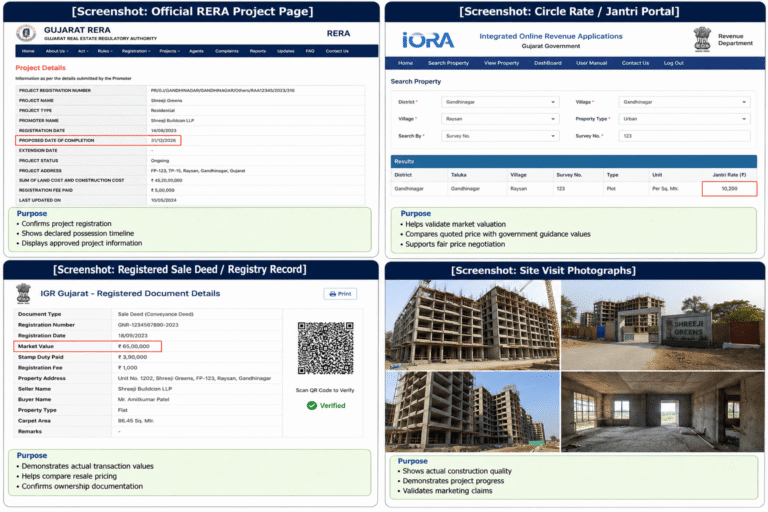
Screenshot
Who This Guide Is NOT For
This guide is intentionally written for buyers who want to make thoughtful, informed decisions.
It may not be suitable if you are:
- Looking for guaranteed short-term profits
- Buying solely because friends or relatives are purchasing
- Expecting property prices to double quickly
- Ignoring legal verification
- Unwilling to compare multiple projects
- Investing based on rumors or unverified tips
Conclusion:
The question isn’t simply whether you should buy a flat in Gandhinagar today.
The better question is:
Should you buy this particular property, at this price, from this builder, given your financial situation and long-term plans?
Real estate decisions involve much more than appreciation forecasts or market headlines.
By evaluating affordability, documentation, financing, neighborhood quality, infrastructure, demand, and future development, you improve your chances of making a decision you’ll be satisfied with years from now.
Whether you decide to buy now or wait, the goal should be the same: make a decision based on evidence, not pressure.
Should You Wait or Buy a Flat in Gandhinagar Today :FAQs
1. Is this the right time to buy a flat in Gandhinagar?
2. Should I buy an under-construction or ready-to-move flat?
3. How important is RERA registration?
4. Can I negotiate with the builder?
5. What should I verify before paying the booking amount?
Reference:
About the Author

Mitesh Vyas
Hello My Name is Mitesh Vyas i am a Real Estate content writer and Property Market Enthusiast I shares practical insights on buying, selling, investing, and understanding real estate trends. With a strong focus on residential and commercial properties, My aims to help readers make informed property decisions through clear, research-based, and easy-to-understand content.