
A few months ago, I met a young IT couple searching for their first home in Gandhinagar. They had already paid a booking amount for an under-construction apartment because the builder promised, “Prices will increase next week. Book today or regret it later.”
Everything sounded perfect.
- Premium amenities
- Attractive payment plan
- Assured appreciation
- Possession in two years
The sales office looked impressive.
The sample flat was beautifully designed.
The sales executive confidently claimed that nearly every unit had been sold.
Yet something didn’t feel right.
When I asked them one simple question—
“Did you verify the project’s RERA details and the builder’s previous delivery record?”
They looked at each other.
They hadn’t.
Neither had anyone advised them to do it.
After checking the documents, we discovered the developer had delayed two previous residential projects by more than two years. Several buyers were still waiting for possession.
That single verification saved them from making what could have become one of the biggest financial mistakes of their lives.

Why Most Articles Don't Help Real Buyers
Most online articles answer the question:
“Is buying an under-construction property safe?”
with a simple:
“Yes, if the builder is reputed.”
That advice is incomplete.
In my experience advising buyers around Sargasan, Kudasan, Raysan, Randesan, Koba, and Gift City, safety isn’t determined by whether a project is under construction.
It’s determined by whether you know how to verify it.
Some under-construction projects become excellent investments.
Others become years of stress, legal disputes, delayed possession, rising EMIs, and financial uncertainty.
The difference usually has nothing to do with glossy brochures.
It comes down to buyer decisions made before paying the booking amount.
This guide is written for buyers—not for builders, brokers, or search engines.
By the end, you’ll know:
- when buying under-construction property is actually safe,
- when you should walk away immediately,
- and how experienced buyers protect themselves before investing.
Why Buyers in Gandhinagar Prefer Under-Construction Homes
Over the last several years, Gandhinagar has experienced rapid residential development because of expanding infrastructure, employment hubs, and improving connectivity.
Areas such as:
- Sargasan
- Kudasan
- Raysan
- Randesan
- Koba
- PDPU Road
- Gift City influence zone
continue attracting first-time buyers and investors.
Most new inventory entering these locations is still under construction.
That naturally raises an important question:
“Should I wait until possession, or buy now?”
The answer depends on your goals—not on what the sales executive says.
Real Buyer Problems Nobody Talks About
Buying under-construction property isn’t difficult.
Buying the right under-construction property is.
Let’s look at the mistakes I repeatedly see buyers make.
Problem 1: Buyers Focus Only on Price
One builder offers a 3 BHK for ₹78 lakh.
Another quotes ₹84 lakh.
Naturally, many buyers assume the ₹78 lakh option is better.
But they rarely compare:
- construction quality
- delivery history
- legal approvals
- maintenance costs
- future resale demand
- surrounding infrastructure
Saving ₹6 lakh today can become a ₹20 lakh mistake later.
The cheapest property often becomes the most expensive one over time.
Problem 2: Fake Urgency
One of the oldest sales techniques still works surprisingly well.
You’ll hear statements like:
“Only three flats left.”
“Price revision tonight.”
“Book before Sunday.”
“Management has approved today’s offer only.”
Sometimes these statements are true.
Many times they aren’t.
A genuine project doesn’t become a bad investment because you took two extra days to verify documents.
Never let urgency replace due diligence.
Problem 3: Buyers Trust Sample Flats Too Much
Sample flats are marketing tools designed to help buyers visualize their future home, but they should never be the sole basis for buying an under-construction property. While they showcase layouts and interiors, they do not guarantee construction quality, waterproofing, electrical work, ventilation, structural finishing, or sound insulation. Always inspect the actual construction site, as the building under construction reveals far more about the project’s quality and progress than a furnished sample apartment ever can.
Problem 4: Builder Reputation Is Assumed, Not Verified
Many buyers assume:
“I’ve seen this builder’s advertisements everywhere.”
Advertising doesn’t prove credibility.
Verification does.
Ask questions like:
- How many projects has the builder completed?
- Were they delivered on time?
- How many complaints exist?
- What do previous buyers say?
- Have promised amenities actually been completed?
Marketing creates confidence.
History creates trust.
Problem 5: Location Selection Based on Emotion
A beautiful apartment cannot compensate for a poor location.
Many buyers choose projects because they liked:
- clubhouse
- swimming pool
- lobby
- interiors
But ignore:
- daily commuting time
- schools
- hospitals
- future infrastructure
- traffic
- rental demand
- resale demand
In Gandhinagar, two similar apartments can perform very differently over the next decade simply because one is located near future growth corridors while another remains isolated.
Location continues working long after the excitement of possession fades.
Problem 6: Investment and End-Use Are Mixed Together
This creates confusion.
Ask yourself first:
Why am I buying?
If you’re buying for your family:
- schools matter
- hospitals matter
- daily convenience matters
If you’re investing:
- rental demand
- future appreciation
- employment hubs
- infrastructure projects
become more important.
Trying to satisfy both goals often results in an average decision instead of an excellent one.
Read More:- Property Registration Charges In Gujarat 2026
Problem 7: Hidden Costs Surprise Buyers
Many advertisements promote:
“Starting at ₹75 lakh”
The actual payable amount may include:
- GST
- Stamp duty
- Registration
- Maintenance deposit
- Parking
- Clubhouse charges
- Legal charges
- Electricity deposit
- Corpus fund
Always calculate the complete acquisition cost, not just the base price.
What I've Personally Observed in Gandhinagar
After reviewing numerous residential projects across Gandhinagar, I’ve noticed one consistent pattern.
Successful buyers don’t necessarily purchase the cheapest property.
They purchase the property they understand the best.
They ask uncomfortable questions.
They request documents.
They visit multiple times.
They compare builders.
They speak with existing residents.
They verify everything independently.
Buyers who skip these steps often become dependent on promises rather than evidence.
Real estate rewards preparation.
Step-by-Step Buyer Action Plan
Step 1: Choose the Right Location Before Choosing the Project
This is where most buying decisions are won—or lost.
Many buyers first select a project and only later evaluate the surrounding area.
Reverse the process.
First choose the location.
Then compare projects within that location.
Why Location Matters More Than Amenities
Clubhouses can be built later.
Swimming pools can be renovated.
Interior finishes can be upgraded.
But location never changes.
That’s why experienced investors spend more time studying the neighborhood than the brochure.
What to Evaluate in Gandhinagar
When comparing locations, assess:
Connectivity
- SG Highway access
- Gift City connectivity
- Airport accessibility
- Public transport
- Future road widening
Social Infrastructure
Look for nearby:
- schools
- hospitals
- supermarkets
- parks
- banks
- pharmacies
- restaurants
Daily convenience directly influences resale demand.
Employment Drivers
Locations close to employment centers generally perform better over time.
Examples include areas benefiting from:
- Gift City expansion
- Government offices
- Educational institutions
- Corporate offices
Stable employment creates stable housing demand.
Future Infrastructure
Research upcoming:
- metro connectivity
- flyovers
- commercial development
- public facilities
- road projects
Future infrastructure often influences appreciation more than current appearance.
Mistakes to Avoid
Don’t choose a project because:
- the clubhouse impressed you
- the entrance gate looked luxurious
- the launch discount seemed attractive
- a friend invested there
Choose it because the location supports your long-term goals.
Pro Tip
Visit the area:
- during morning traffic
- during evening traffic
- on weekends
You’ll understand the locality far better than from any brochure.
Step 2: Validate Your Budget—Not Just Your Loan Eligibility
Many buyers assume:
“The bank approved my loan, so I can afford the property.”
Banks calculate lending capacity.
They don’t calculate financial comfort.
Those are completely different things.
A home loan should fit your lifestyle—not control it.
Before booking any under-construction property, prepare a realistic budget that includes both visible and hidden costs. Consider not only the property’s base price but also GST, registration charges, maintenance deposits, parking fees, interior work after possession, and the possibility of paying rent alongside EMI if construction is delayed.
A simple rule I often suggest is to keep a financial buffer for unexpected expenses. Construction timelines can shift, and buyers who stretch their finances too thin often face unnecessary stress later.
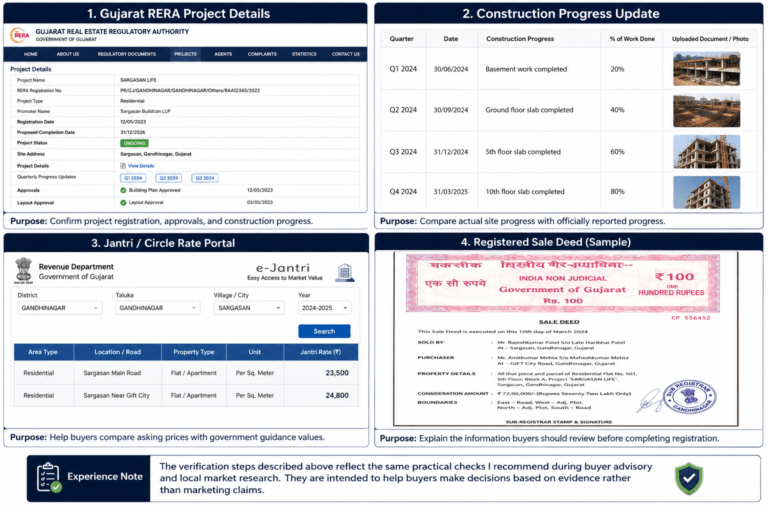
Step 3: Builder & RERA Verification
If there is one step that separates confident buyers from those who regret their purchase, it is this one.
Many buyers spend hours comparing floor plans, amenities, and payment offers but only a few minutes verifying the developer. That is backwards. A beautiful brochure cannot compensate for a builder with a history of delays or legal disputes.
In Gandhinagar’s growing residential market, new launches appear every year. Some are backed by experienced developers with a strong delivery record, while others are promoted aggressively despite limited experience. Before paying even a booking amount, verify the project independently.
Why This Matters
An under-construction property is a promise. Your investment depends on the developer’s ability to fulfill that promise on time and according to the approved plans.
A builder with a strong delivery history reduces risk, while one with repeated delays increases uncertainty, regardless of how attractive the project looks.
What to Verify
RERA Registration
Every eligible residential project should be registered with the state’s RERA authority.
Check:
- Project registration number
- Promoter details
- Approved plans
- Completion timeline
- Quarterly construction updates
- Legal approvals uploaded by the developer
Never rely solely on a sales executive saying, “The project is RERA approved.” Verify it yourself.
Builder’s Track Record
Research the developer’s previous projects.
Ask:
- Were earlier projects delivered on time?
- Were promised amenities completed?
- Are residents satisfied?
- Have buyers reported major construction issues?
- Does the builder respond to complaints?
Past performance is often the best indicator of future performance.
Financial Stability
A financially stable developer is generally better equipped to complete construction even during market slowdowns.
Warning signs include:
- Frequent project delays
- Multiple stalled developments
- Constant discount campaigns to generate cash flow
- Large numbers of unsold units without clear explanation
Customer Reviews
Don’t rely only on online ratings.
Visit completed projects and speak with residents.
Ask simple questions:
- Did possession happen on time?
- Were extra charges demanded?
- How quickly are maintenance issues resolved?
- Would they buy from the same builder again?
Real conversations provide more valuable insights than advertisements.
Mistakes Buyers Make
- Assuming a famous builder never delays projects.
- Believing every sales promise without documentation.
- Ignoring negative feedback because the project looks attractive.
- Not reading the Builder-Buyer Agreement before booking.
Pro Tip
If a developer refuses to provide approvals, RERA details, or legal documents for verification, consider it a serious warning sign.
A trustworthy builder welcomes informed buyers.
Step 4: Site Visit Checklist
Many buyers spend more time inspecting a new smartphone than a property worth several million rupees.
A site visit is not just about seeing the apartment.
It is about understanding how the project is actually progressing.
Visit More Than Once
A single visit rarely tells the complete story.
Visit:
- On a weekday
- During the weekend
- During working hours
- During evening traffic
Each visit reveals something different.
Observe Construction Progress
Compare actual work with the builder’s construction schedule.
Check:
- Number of completed floors
- External finishing
- Internal plastering
- Electrical work
- Plumbing progress
- Lift installation
- Landscaping
If progress appears significantly behind schedule, ask for a written explanation.
Inspect Construction Quality
Look carefully at:
- Wall alignment
- Concrete finishing
- Water seepage
- Staircase quality
- Parking layout
- Common areas
- Safety standards
Poor workmanship visible today may become expensive repairs tomorrow.
Evaluate the Neighborhood
A project’s surroundings matter as much as the building itself.
Observe:
- Road conditions
- Traffic congestion
- Water availability
- Drainage
- Nearby commercial activity
- Noise levels
- Future development
A premium apartment surrounded by poor infrastructure may struggle to appreciate.
Speak With Local Residents
Nearby residents often know:
- Construction delays
- Water supply issues
- Flooding history
- Builder reputation
- Planned infrastructure
Their opinions are usually more objective than those of a sales team.
Site Visit Checklist
- Construction matches the announced timeline.
- Access roads are practical.
- Utilities appear adequate.
- Structural work looks satisfactory.
- Surrounding area supports future growth.
- No obvious safety concerns.
- Builder representatives answer questions confidently.
- Common Mistakes
- Visiting only the sample flat.
- Ignoring nearby infrastructure.
- Never checking traffic during peak hours.
- Not taking photographs for comparison later.
Pro Tip
Carry a notebook or use your phone to record observations after each visit. Comparing multiple projects becomes much easier when your impressions are documented rather than remembered.
Step 5: Legal & Registry Checks
Legal verification is where many costly mistakes can be avoided.
Never assume that because a project is under construction, all approvals have already been completed.
Verify every important document independently.
Essential Documents
Before booking, ask to review:
- Land ownership documents
- Approved building plans
- RERA registration
- Development permissions
- Environmental approvals (where applicable)
- Builder-Buyer Agreement
- Payment schedule
Verify Property Title
A clear property title reduces the risk of future legal disputes.
Ensure there are no ownership conflicts or unresolved claims.
Understand the Agreement
Many buyers sign agreements without reading key clauses.
Pay special attention to:
- Possession date
- Delay compensation
- Cancellation policy
- Additional charges
- Force majeure clauses
Everything promised verbally should also appear in writing.
Registry & Government Records
Where possible, compare project information with publicly available registration records.
Confirm that:
- Project details match approvals.
- Land records are consistent.
- No major legal disputes are pending.
Hidden Costs
Request a complete cost sheet including:
- Base price
- GST
- Stamp duty
- Registration charges
- Parking
- Maintenance deposit
- Clubhouse fees
- Utility deposits
Ask whether any future charges are expected after possession.
Common Legal Mistakes
- Paying large booking amounts before verification.
- Signing incomplete documents.
- Depending only on verbal assurances.
- Ignoring legal advice to save money.
Pro Tip
Hiring an experienced property lawyer before finalizing the purchase usually costs far less than resolving a legal dispute after purchase.
Step 6: Negotiation Strategy
Many buyers think negotiation is only about reducing the property’s price.
Experienced buyers negotiate much more than that.
Sometimes improving contract terms creates more value than receiving a small discount.
What Can Be Negotiated?
Discuss:
- Base price
- Floor rise charges
- Parking
- Clubhouse membership
- Payment schedule
- Interior upgrades
- Registration support
- Possession commitments
Compare Competing Projects
If similar projects exist nearby, use those comparisons professionally.
Developers understand market competition.
A well-informed buyer often receives better terms.
Don’t Reveal Your Budget Too Early
Instead of saying,
“My budget is ₹90 lakh.”
Say,
“I’m comparing several projects before making a final decision.”
This keeps the negotiation balanced.
Everything Should Be Written
If the builder promises:
- free parking,
- modular kitchen,
- waiver of charges,
- possession incentives,
ensure these commitments appear in official documents.
Verbal promises disappear surprisingly quickly after booking.
Common Negotiation Mistakes
- Negotiating only the base price.
- Booking on the first visit.
- Accepting verbal offers.
- Feeling pressured by “today only” discounts.
Pro Tip
The strongest negotiating position belongs to the buyer who is prepared to walk away.
Never negotiate from fear of missing out.
Real Buyer Case Study 1 – Family Home Purchase
Buyer Profile
- Husband: Government employee
- Wife: School teacher
- Two children
Objective
Purchase a long-term family home in Gandhinagar.
Initial Budget
₹82 lakh
What Happened
The family initially shortlisted a newly launched project because it offered an attractive introductory price.
During verification they discovered:
- Construction had barely started.
- The developer had previously delayed two projects.
- Basic infrastructure around the project was still under development.
Instead of booking immediately, they compared three additional projects.
Eventually they selected another RERA-registered development in Sargasan.
Purchase Details
- Purchase Price: ₹86 lakh
- Possession Timeline: 30 months
- Larger carpet area
- Better school connectivity
- Established neighborhood
Outcome
Although they paid slightly more initially, they gained greater confidence in the builder’s delivery capability and chose a location with stronger long-term livability.
Lesson
The lowest price is not always the best value.
Real Buyer Case Study 2 – Investor
Buyer Profile
- Age: 35
- IT Professional
- Existing homeowner
Investment Goal
Capital appreciation and future rental income.
Entry Price
₹72 lakh
Strategy
Instead of chasing promotional discounts, the investor focused on:
- Upcoming infrastructure
- Employment growth
- Rental demand
- Builder credibility
- Future resale potential
Five Years Later (Illustrative Scenario)
- Estimated Property Value: ₹96 lakh
- Rental Yield: Stable
- Occupancy: Consistently rented
What Worked
- Strong location selection
- Verified developer history
- Realistic investment expectations
What Didn’t
Possession was delayed by several months, reinforcing the importance of maintaining an emergency financial buffer.
Buyer Testimonials
Rohit Sharma – IT Professional (Ahmedabad)
“I almost booked the first project I visited. Comparing builders instead of just prices completely changed my decision. Waiting a few extra weeks gave me much more confidence in my purchase.”
Nilesh Patel – PSU Employee (Gandhinagar)
“The RERA verification process looked complicated at first, but once I checked the documents myself, I felt far more comfortable investing in an under-construction apartment.”
Mehul Desai – NRI Buyer (Canada)
“Living overseas made independent verification even more important. Speaking with existing residents helped me avoid relying only on marketing material.”
Screenshot
If I Were Buying an Under-Construction Property Today
This is the advice I would follow myself if I were purchasing in Gandhinagar today.
Would I Buy Now?
Yes—but only after completing independent verification.
I would not postpone buying simply because someone predicts prices may fall or rise.
Instead, I would purchase only when:
- My finances are stable.
- I have an emergency fund.
- The builder has a proven delivery history.
- The project has clear legal approvals.
- The location supports long-term demand.
Market timing matters far less than buying the right property.
Which Property Would I Choose?
I would prioritize:
- Established residential locations
- Strong infrastructure
- Reliable developers
- Good connectivity
- Sustainable demand
Luxury amenities would be a lower priority than construction quality and location.
What Would I Negotiate the Hardest?
Instead of asking only for a price reduction, I would negotiate:
- Better payment schedule
- Waiver of unnecessary charges
- Parking inclusion
- Written possession commitments
- Clear specifications for finishing materials
Small contractual improvements often create more value than a modest discount.
One Red Flag I Would Never Ignore
If a builder hesitates to provide legal documents or discourages independent verification, I would walk away immediately.
There will always be another project.
There may not be another chance to recover from a poor buying decision.
Conclusion:
Buying an under-construction property is neither automatically safe nor automatically risky.
It depends on how carefully you evaluate the opportunity.
In Gandhinagar, many families have built long-term wealth by purchasing under-construction homes in well-located, legally compliant projects from reliable developers.
Others have faced years of stress because they relied on promises instead of evidence.
Take your time.
Verify every document.
Visit the site more than once.
Speak with existing buyers.
Compare multiple projects.
Most importantly, never allow urgency to replace good judgment.
A home is one of the largest financial commitments you’ll ever make. Treat the decision with the same level of care.