
Why is Gandhinagar Becoming a Real Estate Hotspot?: A few months ago, I met a software engineer from Ahmedabad who had spent nearly six months searching for a home. Every weekend, he visited new residential projects, spoke to different builders, compared prices, and watched dozens of YouTube videos. Yet he still couldn’t decide.
One builder insisted that prices would increase by ₹500 per square foot next week.
Another claimed that only two apartments remained.
A broker confidently told him that “everyone is buying in Gandhinagar.”
Naturally, he asked the question that many buyers are asking today:
“Is Gandhinagar genuinely becoming Gujarat’s next real estate hotspot, or is this just another marketing trend?”
It’s a fair question.
In my experience advising homebuyers and researching the Gandhinagar property market, I’ve seen many people rush into purchases simply because they feared missing out. Unfortunately, some bought in locations that appreciated slowly, while others overlooked better opportunities because they focused only on the advertised price.
Most blogs discussing Gandhinagar real estate repeat the same generic points:
- Smart City
- GIFT City
- Metro
- Infrastructure
- Investment potential
But very few explain how these developments actually affect your buying decision.
This guide is different.
Rather than convincing you to buy, the objective is to help you understand:
- Why demand is increasing
- Which developments genuinely influence property values
- Where buyers make expensive mistakes
- Whether buying now makes financial sense for your situation
If, by the end of this guide, the right decision for you is to wait rather than buy, that is exactly what you should do.
Real estate should solve a long-term problem—not create a new financial one.
Why Are More Buyers Looking at Gandhinagar Today?
Over the past decade, Gandhinagar has quietly transformed from a government administrative city into one of Gujarat’s fastest-growing residential and commercial destinations.
This transformation didn’t happen because of one mega project.
It happened because several long-term developments started working together.
These include:
- Better infrastructure
- Stronger road connectivity
- Metro expansion
- Employment growth
- Government investment
- Private developer interest
- Educational institutions
- Healthcare expansion
- Commercial development
Individually, these factors may seem ordinary.
Together, they significantly change housing demand.
Unlike speculative property markets that depend mainly on hype, Gandhinagar’s growth has largely been driven by actual urban development and increasing employment opportunities.
That distinction matters.
Understanding What Makes a Real Estate Hotspot
Many people assume that rising property prices automatically mean a location has become a hotspot.
That isn’t always true.
A genuine real estate hotspot typically demonstrates several characteristics:
- Growing population
- Increasing employment
- Better transportation
- Expanding commercial activity
- Improved public infrastructure
- Rising residential demand
- Consistent property appreciation over time
When these elements develop together, they create sustainable demand rather than short-term speculation.
This is one reason many investors have started paying closer attention to Gandhinagar.
However, sustainable growth doesn’t mean every project or every location within the city is equally attractive.
Location selection still determines whether your investment performs well.
The Biggest Mistake Buyers Make
One of the most common mistakes I notice is buyers assuming that all areas within Gandhinagar will appreciate at the same rate.
They won’t.
Buying property simply because it falls within Gandhinagar can become an expensive decision.
For example:
A residential project located near upcoming commercial activity may experience stronger long-term appreciation than another project only five kilometers away.
Likewise,
A property close to future metro connectivity may outperform another apartment offering larger amenities but weaker accessibility.
This is why understanding local market behavior matters much more than relying on city-wide headlines.
Infrastructure Is Changing the City's Future
One of the strongest reasons behind Gandhinagar’s increasing popularity is continuous infrastructure development.
Infrastructure is much more than roads.
It includes:
- Transportation
- Utilities
- Public services
- Connectivity
- Urban planning
- Civic facilities
- Commercial expansion
Every improvement makes a city more attractive for residents and businesses.
And when businesses arrive, housing demand usually follows.
This relationship has repeated itself across many successful Indian cities.
Better Road Connectivity
Improved road connectivity has significantly reduced travel time between Ahmedabad and Gandhinagar. For professionals working across both cities, this has made daily commuting far more practical than it was several years ago. Important transport corridors now improve accessibility between residential neighborhoods and business districts. This improved connectivity is also shaping the Future of real estate in Gandhinagar, as buyers increasingly value convenience, shorter commute times, and well-connected locations over simply purchasing the cheapest apartment available.
Metro Connectivity
The Ahmedabad-Gandhinagar Metro has become one of the most discussed developments among homebuyers.
While metro projects often receive significant media attention, buyers should understand how they actually affect real estate.
Metro stations generally improve:
- Accessibility
- Public transit options
- Rental demand
- Commercial activity
- Daily commuting convenience
However,
Not every project advertised as “near metro” truly offers walking-distance access.
Always verify the actual distance before making an investment decision.
Planned Urban Development
Unlike many rapidly expanding cities that struggle with unplanned growth, Gandhinagar has benefited from structured urban planning.
Wide roads, organized sectors, public gardens, green spaces, and civic infrastructure contribute to a higher quality of life.
For families purchasing homes for end use, these factors often become more valuable than luxury amenities inside the apartment complex.
Children grow up in healthier surroundings.
Traffic remains comparatively manageable.
Essential services become easier to access.
These everyday advantages often matter more than a rooftop swimming pool.
Employment Is Creating Genuine Housing Demand
A city cannot sustain long-term real estate growth without employment.
Fortunately, Gandhinagar has several demand drivers.
These include:
- Government employment
- IT companies
- Financial institutions
- Educational campuses
- Research organizations
- Start-up ecosystem
- Corporate offices
Employment growth creates two important outcomes.
First,
People relocate closer to work.
Second,
Rental demand increases.
This creates healthier market conditions than cities depending solely on speculative investors.
The Influence of GIFT City
One cannot discuss Gandhinagar’s property market without mentioning GIFT City.
Although not every residential project benefits equally, GIFT City has undoubtedly increased investor attention across nearby micro-markets.
Professionals working in finance, technology, consulting, and international business often prefer living within convenient commuting distance.
This has positively influenced demand in surrounding residential locations.
However,
Buyers should avoid assuming every project marketed as “near GIFT City” will automatically appreciate faster.
Distance, accessibility, developer reputation, and future supply all influence actual returns.
Residential Demand Continues to Increase
Several buyer groups now actively consider Gandhinagar.
These include:
First-Time Homebuyers
Many buyers find Gandhinagar more affordable than several premium Ahmedabad locations while still offering modern residential projects.
Families
Families often prioritize:
- Schools
- Healthcare
- Green spaces
- Safety
- Lower pollution
- Community living
Gandhinagar performs well across many of these factors.
Investors
Long-term investors generally look for:
- Capital appreciation
- Rental demand
- Infrastructure growth
- Commercial expansion
- Stable governance
The city offers several of these characteristics, although returns still depend heavily on choosing the right location.
Commercial Development Is Supporting Residential Growth
Residential growth rarely happens independently.
Commercial activity usually drives housing demand.
Across Gandhinagar, increasing commercial development has encouraged:
- Office spaces
- Retail establishments
- Restaurants
- Healthcare facilities
- Educational institutions
- Daily convenience services
When people can work, shop, study, and access healthcare within the same city, overall livability improves.
That makes residential property more attractive.
Why Buyers Should Still Remain Careful
Despite positive developments, Gandhinagar is not a market where every property guarantees success.
I would personally be cautious if I noticed any of the following:
- Extremely unrealistic appreciation promises
- Heavy discounts with unclear conditions
- Missing RERA registration details
- Delayed possession history
- Poor surrounding infrastructure
- Excessive future housing supply
- Weak builder reputation
- Projects launched primarily on marketing hype
Real estate rewards informed buyers—not emotional ones.
One wrong decision can take years to recover financially.
Areas That Are Seeing Strong Buyer Interest
Although demand exists across the city, certain micro-markets consistently attract more buyer attention because of their infrastructure, connectivity, and future development potential.
These include:
- Raysan
- Randesan
- Kudasan
- Koba
- Sargasan
- PDPU Road
- Gift City influence zone
- Infocity corridor
- New Vavol
Each location appeals to different buyer profiles.
Some are better suited for families seeking end-use homes, while others attract investors focused on long-term appreciation or rental demand.
Choosing the right locality is often more important than choosing the most luxurious apartment.
Knowing why Gandhinagar is growing is only half the equation.
The bigger question is:
How do you choose the right property without making a costly mistake?
I’ve seen buyers lose money not because the market was bad, but because they skipped basic due diligence. Some trusted glossy brochures, others booked apartments after a single visit, and many assumed that if a project was in Gandhinagar, it was automatically a good investment.
That’s not how successful property buying works.
The following framework is the same checklist I would use if I were evaluating a property for myself.
Step 1: Choose the Right Location Before Choosing the Project
This is the most important decision you’ll make.
Many buyers compare apartments first and locations later. That approach is backwards.
A great apartment in the wrong neighborhood usually performs worse than an average apartment in the right neighborhood.
What to Evaluate
Don’t just ask, “Is this a good project?”
Instead, ask:
- How will this area develop over the next 5–10 years?
- Is employment increasing nearby?
- Are schools and hospitals already operational?
- Is public transport improving?
- How much vacant land surrounds the project?
- Will future construction affect livability?
These questions reveal whether you’re buying into a growing neighborhood or one that may struggle with oversupply.
Compare Your Purpose
Your ideal location depends on why you’re buying.
Buyer Type | Priority |
Family | Schools, hospitals, safety, parks |
Working Professional | Office connectivity, metro, commute |
Investor | Rental demand, appreciation potential |
NRI | Builder reputation, maintenance quality |
Retired Couple | Peaceful environment, healthcare access |
One location cannot be the best for everyone.
Mistake to Avoid
Don’t buy simply because a broker says,
“This area will double in price.”
Ask instead:
- Why?
- What infrastructure supports that claim?
- What employment growth justifies future demand?
If the answer is vague, be cautious.
Pro Tip
Visit the locality:
- once during peak traffic,
- once at night,
- once on a weekend.
You’ll learn far more than any brochure can tell you.
Step 2: Validate Your Budget—Not Just Your Loan Eligibility
Banks decide how much they’re willing to lend.
That doesn’t mean you should borrow the maximum amount.
I’ve seen buyers stretch their finances only to struggle with EMIs, maintenance charges, school fees, and unexpected expenses.
Buying a home should improve your life—not reduce your financial flexibility.
Calculate the Real Cost
Many first-time buyers only compare the apartment’s base price.
But your actual investment includes:
- Property price
- GST (where applicable)
- Stamp duty
- Registration charges
- Parking charges
- Maintenance deposit
- Legal fees
- Interior work
- Furniture
- Moving expenses
Ignoring these costs can create a budget shortfall of several lakhs.
Maintain an Emergency Fund
Never invest every rupee into the purchase.
Ideally, retain savings that can cover at least:
- 6–12 months of EMIs
- Medical emergencies
- Job changes
- Unexpected family expenses
Property should provide security—not become a financial burden.
EMI Reality Check
Ask yourself honestly:
“Could I comfortably pay this EMI if interest rates increased?”
If the answer is no, reconsider your budget.
Common Buyer Mistake
Buying based on emotional excitement during the site visit.
Always review your finances again after returning home.
If the numbers only work “on paper,” they probably don’t work in real life.
Step 3: Verify the Builder Before Believing the Advertisement
A beautiful sample flat tells you almost nothing about the builder.
The builder’s track record tells you everything.
Check Previous Projects
Visit older developments by the same builder.
Observe:
- Building maintenance
- Lift condition
- Water supply
- Parking quality
- Resident satisfaction
- Structural condition
Current residents often provide more honest feedback than sales teams.
Verify RERA Registration
Every eligible project should be verified through the state’s RERA portal.
Check:
- Registration number
- Approved plans
- Completion timeline
- Litigation (if any)
- Construction progress
- Developer disclosures
Never rely solely on a salesperson’s verbal assurance.
Step 4: Conduct a Proper Site Visit
Many buyers spend more time inspecting a new car than a property worth crores.
A showroom apartment is designed to impress.
Your job is to inspect what isn’t highlighted.
Exterior Checklist
Look for:
- Road access
- Drainage
- Street lighting
- Waterlogging signs
- Nearby commercial activity
- Future construction nearby
The surrounding neighborhood affects both lifestyle and resale value.
Interior Checklist
Inspect:
- Ventilation
- Natural lighting
- Ceiling height
- Wall finishing
- Plumbing quality
- Electrical fittings
- Window placement
- Balcony usability
Don’t focus only on imported tiles or decorative lighting.
Good construction quality matters more.
Community Evaluation
Walk around the neighborhood.
Notice:
- Grocery stores
- Medical facilities
- Schools
- Public transport
- Noise levels
- Cleanliness
- Security
Imagine living there every day—not just visiting for thirty minutes.
Mistake Buyers Often Make
Booking immediately after visiting the sample flat.
Instead,
Visit multiple competing projects before making comparisons.
The differences become much clearer.
Step 5: Verify Every Legal Document
This is where many costly mistakes happen.
Never assume that because a project looks premium, all documentation is in order.
Even experienced investors hire legal professionals.
You should too.
Essential Documents
Verify:
- Title deed
- Land ownership
- NA permission (where applicable)
- Approved building plan
- RERA registration
- Encumbrance status
- Completion certificate (ready projects)
- Occupancy certificate
- Sale agreement draft
Never rely only on photocopies shown during meetings.
Registration Charges
Understand:
- Stamp duty
- Registration fees
- Government taxes
- Additional charges
Unexpected documentation costs often surprise first-time buyers.
Legal Advice
Hiring an independent property lawyer may seem like an extra expense.
In reality,
It is often the cheapest insurance you’ll ever buy.
Step 6: Learn How to Negotiate
Many buyers believe prices are fixed.
They’re often not.
Negotiation is about more than reducing the purchase price.
Negotiate These Items
Instead of asking only for discounts, negotiate:
- Floor rise charges
- Parking allocation
- Club membership
- Maintenance waiver
- Interior upgrades
- Payment schedule
- Possession timeline
- Registration support
Sometimes these savings exceed a direct price reduction.
Timing Matters
Builders may negotiate more during:
- Quarter-end
- Financial year-end
- Inventory clearance periods
- New project launches
Patience often improves bargaining power.
Don’t Reveal Your Maximum Budget
One mistake I repeatedly see is buyers saying:
“My budget is ₹1 crore.”
Now the negotiation starts at ₹1 crore.
Instead,
Discuss value before discussing your financial limit.
Understanding Property Appreciation
Many buyers expect prices to double quickly.
That expectation often leads to disappointment.
Healthy appreciation depends on:
- Infrastructure completion
- Employment growth
- Demand
- Supply
- Connectivity
- Commercial expansion
Real estate usually rewards patience—not speculation.
Rental Potential Matters Too
Even if you’re buying for self-use, consider rental demand.
Life changes.
Job transfers happen.
Families relocate.
A property with good rental demand offers additional flexibility.
Look for areas near:
- IT hubs
- Government offices
- Educational institutions
- GIFT City
- Metro connectivity
These generally attract stronger tenant demand.
Warning Signs I Personally Wouldn't Ignore
If I encountered any of these situations, I would pause immediately.
- Builder refuses documentation.
- Pressure to book “today only.”
- Price significantly below nearby projects.
- No clear construction timeline.
- Multiple legal disputes.
- Unclear land ownership.
- Poor online reputation from actual residents.
- Constant design changes during construction.
- Delayed previous projects.
- Unrealistic appreciation promises.
One red flag may not end the deal.
Several together should.
The Biggest Lesson I've Learned
Over the years, one pattern has remained consistent.
The buyers who are happiest five years later weren’t the ones who bought the cheapest apartment.
Nor were they the ones who bought the most luxurious one.
They were the buyers who:
- chose the right location,
- verified every document,
- researched the builder,
- bought within their budget,
- ignored artificial sales pressure,
- and planned for the long term.
That discipline usually matters far more than trying to “time the market.”
Illustrative Case Study 1: End-User Family
Note: The following case study is an illustrative example based on common buyer scenarios in the Gandhinagar market. It is not presented as a real client transaction.
Buyer Profile
- Family of four
- One child studying in school
- Both spouses employed in Ahmedabad
- Goal: Long-term residence
Budget
₹82 lakh (all-inclusive)
Preferred Location
Raysan
Property
3 BHK Apartment
Purchase Price
₹74 lakh + registration and interior expenses
Why They Chose This Area
Instead of selecting the cheapest apartment available, the family prioritized:
- Daily commute
- School accessibility
- Healthcare facilities
- Future infrastructure
- Community environment
The apartment itself wasn’t the largest they saw.
However, the location suited their lifestyle far better.
Five Years Later (Illustrative)
- Better daily commuting experience
- Improved neighborhood infrastructure
- Good resale demand
- Healthy capital appreciation (market-dependent)
Biggest Lesson
Buying the right location proved more valuable than buying the apartment with the biggest clubhouse.
Illustrative Case Study 2: Long-Term Investor
Illustrative example for educational purposes.
Investor Profile
- Age: 34
- IT Professional
- First investment property
Purchase Objective
Rental income combined with long-term appreciation.
Budget
₹68 lakh
Preferred Location
Near the GIFT City influence zone
Buying Strategy
Instead of chasing a project promising “double returns,” the investor evaluated:
- Employment growth
- Metro connectivity
- Builder reputation
- Rental demand
- Future commercial development
Result (Illustrative)
Over several years:
- Stable rental occupancy
- Moderate rental yield
- Healthy appreciation aligned with market conditions
Exit Strategy
Rather than selling quickly, the investor retained the property as a long-term asset.
Lesson Learned
Real estate generally rewards patience, not speculation.
Sample Buyer Testimonials
The following are representative examples based on common buyer feedback and are not endorsements from identifiable individuals.
Nilesh IT Professional
“I initially focused only on apartment amenities. After comparing neighborhoods instead, I realized location mattered much more than the gym or clubhouse.”
Harsh PSU Employee
“The legal verification checklist helped me identify missing approvals before paying the booking amount. Waiting a few weeks probably saved me a much bigger problem.”
Baithal Nilesh NRI Buyer
“I couldn’t visit multiple projects personally, so I relied on documentation, builder history, and local market research instead of promotional videos.”
Current Market Context
No property market moves in a straight line.
Even strong cities experience periods of:
- Stable pricing
- Faster appreciation
- Slower demand
- Inventory correction
- Changing interest rates
Today’s buyers should remember that property values depend on several factors:
- Infrastructure completion
- Employment growth
- Mortgage interest rates
- Housing supply
- Economic conditions
- Government policy
Buying purely because prices “will definitely increase” is rarely a sound strategy.
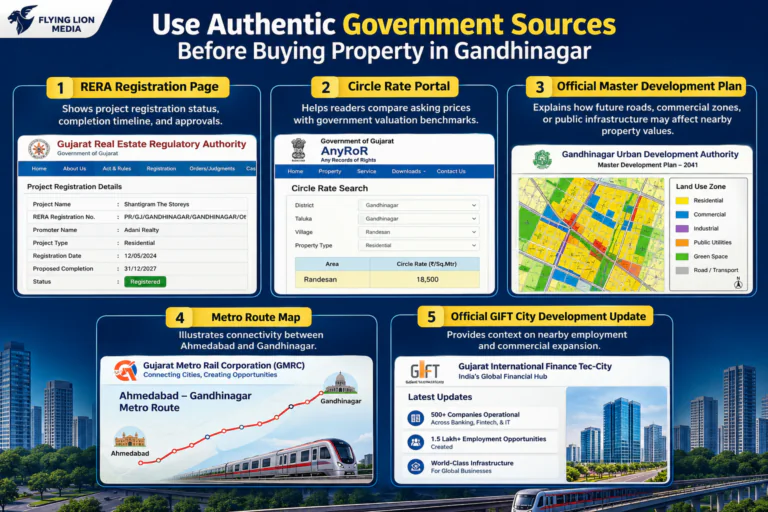
Verified Sources You Should Check Yourself
Before booking any property, independently verify information using trusted public sources.
These include:
- Gujarat RERA project registration
- Government circle rate information
- Sub-Registrar office records
- Approved development plans
- Local authority notifications
- Official GIFT City updates
Never rely only on:
- Sales presentations
- WhatsApp messages
- Social media videos
- Broker opinions
Independent verification protects your investment.
Screenshot
Who This Guide Is NOT For
This guide is intentionally written for long-term buyers.
It may not be suitable if you are:
Looking for Quick Profits
If your goal is to buy today and sell within six months, this guide won’t help.
Property markets don’t consistently reward short-term speculation.
Chasing Rumours
Buying because someone said,
“Prices will double next year,”
is not an investment strategy.
Ignoring Legal Due Diligence
If you aren’t willing to verify documents or seek legal advice, no guide can eliminate your risk.
Buying Beyond Your Financial Capacity
If the EMI would leave almost no room for savings or emergencies, waiting may be the wiser decision.
Expecting Guaranteed Returns
No responsible advisor can promise future appreciation.
Markets change.
Policies change.
Economic conditions change.
Conclusion
Gandhinagar’s emergence as a real estate hotspot is supported by genuine factors such as infrastructure expansion, planned urban development, employment growth, and improving connectivity.
These trends have increased interest from both homebuyers and investors.
But remember:
A growing city doesn’t automatically make every project a smart investment.
Successful property buying depends on asking the right questions, verifying the facts, and making decisions based on your financial goals—not market hype.
Whether you’re buying your first home or building a long-term investment portfolio, patience and careful research remain your strongest advantages.
Why is Gandhinagar Becoming a Real Estate Hotspot? :FAQs
Is Gandhinagar a good place to buy a home?
Is Gandhinagar better than Ahmedabad for investment?
Will property prices continue increasing?
Which buyers benefit most from Gandhinagar?
Is buying under-construction property risky?
Reference
About the Author

Mitesh Vyas
Hello My Name is Mitesh Vyas i am a Real Estate content writer and Property Market Enthusiast I shares practical insights on buying, selling, investing, and understanding real estate trends. With a strong focus on residential and commercial properties, My aims to help readers make informed property decisions through clear, research-based, and easy-to-understand content.