
Why Property Demand Is Increasing In Gandhinagar In 2026: Buying a home is one of the biggest financial decisions most families will ever make. Yet many people begin their property search by reading articles that all sound the same. They promise “the best investment,” predict prices will only rise, and encourage buyers to act quickly before opportunities disappear.
In my experience interacting with homebuyers and studying the Gandhinagar property market over the past few years, reality is very different.
Some buyers postpone their purchase for years because they fear paying too much. Others rush into a deal because a builder advertises “last few units remaining.” Many believe that every new residential project guarantees high returns. Unfortunately, these assumptions often lead to expensive mistakes.
The truth is that property demand in Gandhinagar is increasing in 2026, but understanding why it is increasing is far more important than simply knowing that it is.
If you understand the reasons behind the growing demand, you can make smarter decisions about:
- Choosing the right locality
- Selecting the right property type
- Negotiating confidently
- Avoiding overpriced projects
- Identifying areas with genuine long-term appreciation
This guide is not written to convince you to buy immediately.
Instead, it is designed to help you decide whether buying now makes sense for your financial situation and which factors truly matter before investing.
A Story That Many Buyers Will Recognize
Imagine a young couple working in Ahmedabad.
One partner works in the IT sector while the other has a government job. They’ve been saving for several years and have finally built enough funds for a down payment.
They begin looking at apartments across Ahmedabad.
Builders promote luxury amenities.
Agents insist prices will increase next month.
Friends recommend different localities.
Parents suggest buying closer to family.
Social media says Gandhinagar is becoming Gujarat’s next real estate hotspot.
After weeks of searching, the couple becomes even more confused than when they started.
Questions keep coming.
Is Gandhinagar really growing?
Will prices continue increasing?
Should they buy now or wait another year?
Which areas are actually worth considering?
Should they purchase for self-use or investment?
These are practical questions that deserve practical answers—not marketing promises.
Why This Topic Matters More Than Ever
The discussion about Gandhinagar has changed dramatically over the last few years.
Earlier, buyers mostly associated the city with government offices, planned sectors, and peaceful living.
Today, conversations include:
- New residential developments
- Better infrastructure
- Improved connectivity
- Growing commercial activity
- IT employment
- Educational institutions
- Lifestyle amenities
- Long-term investment potential
This change is attracting a wider range of buyers.
Instead of only local residents, today’s market includes:
- First-time homebuyers
- Government employees
- IT professionals
- Business owners
- Investors
- NRIs
- Families relocating from Ahmedabad
Naturally, increased buyer interest leads to increased property demand.
But demand alone should never be your reason for buying.
Understanding what creates that demand is far more valuable.
What Is Actually Driving Property Demand?
Many articles simply say:
“Demand is increasing because Gandhinagar is developing.”
That explanation is incomplete.
Demand rises only when multiple factors begin working together.
In 2026, Gandhinagar is benefiting from a combination of economic, residential, and infrastructure developments rather than a single event.
Some of the biggest contributors include:
- Better road connectivity
- Expansion of employment opportunities
- Residential township development
- Improved public facilities
- Educational growth
- Healthcare expansion
- Commercial investment
- Lifestyle improvements
- Long-term planning by government authorities
Each of these influences buyer behaviour differently.
A family purchasing a home values schools and hospitals.
An investor studies appreciation and rental demand.
A young professional focuses on accessibility and commuting time.
Understanding which category you belong to helps you evaluate properties more objectively.
The Biggest Mistake Buyers Make
One mistake appears repeatedly among buyers entering the Gandhinagar market.
They assume every new apartment is a good investment simply because it is located in Gandhinagar.
That is rarely true.
Even within the same city, property performance can differ significantly.
Two residential societies located only a few kilometres apart may experience very different growth.
Factors such as:
- Infrastructure completion
- Neighborhood development
- Commercial activity
- Public transport
- Schools
- Hospitals
- Future planning
- Road access
can influence long-term appreciation far more than attractive brochures.
This is why choosing the right locality often matters more than choosing the newest project.
Understanding Demand vs. Hype
Demand and hype are not the same.
Real demand usually develops slowly and is supported by measurable improvements such as:
- Population growth
- Employment generation
- Infrastructure expansion
- Residential occupancy
- Business activity
- Public investment
Hype, on the other hand, spreads quickly through advertisements and sales campaigns.
Experienced buyers learn to separate the two.
Whenever someone claims:
“Prices will double next year.”
Ask yourself:
- What evidence supports that claim?
- Has infrastructure actually improved?
- Are families moving there?
- Are businesses expanding nearby?
- Is rental demand increasing?
- Is the locality developing steadily?
If the answers are unclear, the claim deserves careful scrutiny.
Why Families Are Choosing Gandhinagar
One noticeable shift in recent years is that many buyers are no longer comparing Gandhinagar only with other government cities.
Instead, they compare it with fast-growing residential areas around Ahmedabad.
Several practical reasons explain this trend.
Many families appreciate:
- Better planned sectors
- Cleaner surroundings
- Lower traffic congestion
- Wider roads
- Greenery
- Open spaces
- Community-focused residential societies
- Safer neighborhoods
- Better quality of life
These factors may not appear in advertisements, but they significantly influence long-term satisfaction after purchasing a home.
A property should improve your daily life—not simply serve as an investment.
Why Investors Are Paying More Attention
Investors evaluate cities differently than end-users.
Instead of focusing primarily on schools or nearby supermarkets, they look at:
- Capital appreciation
- Rental demand
- Infrastructure projects
- Population movement
- Employment hubs
- Commercial expansion
- Future urban development
Gandhinagar has gradually started attracting this category of investors because several long-term growth indicators are moving in the same direction.
However, experienced investors rarely purchase based only on future expectations.
They verify:
- Current pricing
- Supply pipeline
- Builder reputation
- Transaction history
- Infrastructure timelines
- Legal approvals
Patience often produces better investment outcomes than urgency.
The Locality Matters More Than the City
Another important lesson buyers often discover too late is that buying in the right city does not automatically mean buying in the right location.
Every locality develops at its own pace.
Some neighborhoods benefit from:
- Better connectivity
- Commercial development
- Educational institutions
- Future road expansion
- Public transportation
- Employment centres
Others may remain relatively unchanged for years.
This is why experienced buyers spend more time researching neighborhoods than comparing apartment brochures.
A good property in the wrong locality may underperform.
An average apartment in a high-growth locality can often become a stronger long-term asset.
In the first part, we discussed why property demand in Gandhinagar is rising and why buyers should understand the reasons behind the growth instead of following market excitement.
Now comes the practical part.
Whether you’re buying your first apartment, upgrading to a larger home, or investing for the future, these three steps can help you make a more informed decision.
Step 1: Choose the Right Location Before Choosing the Property
One of the biggest mistakes buyers make is falling in love with an apartment before evaluating its location.
A beautiful flat can lose its appeal if daily commuting becomes difficult, essential services are far away, or the surrounding area develops slowly.
In my experience, buyers who spend more time researching the locality usually make better long-term decisions than those who compare only carpet area, floor plans, or amenities.
Ask Yourself Why You Are Buying
Before comparing projects, be clear about your purpose.
If You’re Buying for Your Family
Your priorities should include:
- Good schools
- Hospitals within easy reach
- Safe residential society
- Green spaces
- Daily shopping facilities
- Public transport
- Peaceful neighborhood
- Community lifestyle
These factors directly affect everyday living.
If You’re Buying as an Investor
Focus on:
- Future infrastructure
- Commercial development
- Employment growth
- Rental demand
- Property appreciation
- Planned road expansion
- Connectivity to major business zones
- Long-term urban development
Investment decisions should be based on facts rather than assumptions.
Study the Locality During Different Times
Many buyers visit a project only once.
That is rarely enough.
Visit:
- Morning
- Afternoon
- Evening
- Weekend
Observe:
- Traffic conditions
- Parking availability
- Noise levels
- Street lighting
- Public activity
- Nearby businesses
- Construction work
- Safety
A locality can look completely different on a Sunday morning compared to a weekday evening.
Evaluate Daily Convenience
Ask yourself practical questions.
How long will it take to reach work?
Where is the nearest hospital?
Can children safely travel to school?
Are grocery stores nearby?
Is there reliable public transportation?
Can elderly family members comfortably access medical facilities?
Convenience is often more valuable than luxury amenities.
Don’t Ignore Future Development
One reason demand is increasing in Gandhinagar is continuous infrastructure development.
However, buyers should distinguish between:
“Planned”
and
“Actually progressing.”
Always verify:
- Road construction
- Metro developments (where applicable)
- Government infrastructure projects
- Commercial expansion
- Public facilities
- Utility availability
Never rely solely on sales presentations.
Common Location Mistakes
Avoid these mistakes:
- Buying only because prices seem lower
- Assuming every developing area will appreciate equally
- Ignoring future traffic issues
- Purchasing without visiting the surrounding neighborhood
- Trusting only builder marketing material
Pro Tip
If I had only one day to evaluate a project, I would spend more time exploring the surrounding locality than the sample flat.
You can renovate an apartment.
You cannot relocate the neighborhood.
Step 2: Validate Your Budget and Property Price
Many buyers determine their budget based only on loan eligibility. That approach can create financial stress because banks may approve a larger loan than what is comfortable for your monthly finances. If you’re planning to benefit from Residential property growth in Gandhinagar, your purchase should be based on long-term affordability rather than the maximum loan amount you qualify for. The better approach is to begin with affordability.
Calculate the Complete Purchase Cost
Many first-time buyers focus only on the property’s quoted price.
In reality, additional costs can significantly increase the final amount.
Include:
- Registration charges
- Stamp duty
- GST (where applicable)
- Maintenance deposit
- Parking charges
- Clubhouse membership
- Legal documentation
- Interior work
- Furniture
- Utility setup
- Moving expenses
A property advertised at ₹80 lakh may ultimately cost considerably more after all associated expenses.
Compare Multiple Projects
Never compare only one project.
Shortlist at least three to five residential developments.
Compare:
- Price per square foot
- Carpet area
- Construction quality
- Amenities
- Maintenance charges
- Builder reputation
- Location advantages
- Future appreciation potential
The cheapest apartment isn’t always the best value.
Similarly, the most expensive property isn’t automatically superior.
Understand Why Prices Differ
Two apartments may appear similar but have different prices because of:
- Better connectivity
- Larger open spaces
- Premium construction quality
- Higher demand
- Better infrastructure
- Stronger builder reputation
- More developed surroundings
Price differences should have logical reasons.
If they don’t, ask questions.
Check Recent Transactions
One of the most useful ways to understand market value is by reviewing recent registrations in the same locality.
This helps answer questions like:
Are buyers actually paying the quoted prices?
How much negotiation is common?
Are asking prices significantly above transaction values?
Public registry records often provide a more realistic picture than advertisements.
Think Beyond Today's Price
Buying property is generally a long-term decision.
Instead of asking,
“Can I afford this today?”
also ask,
“Will I still be comfortable paying for this five years from now?”
Unexpected expenses happen.
Financial flexibility is valuable.
Budget Mistakes to Avoid
Avoid:
- Spending your entire savings on the down payment
- Ignoring emergency funds
- Taking the maximum possible loan
- Underestimating maintenance costs
- Assuming property prices always increase
Pro Tip
Leave enough savings after purchasing.
Owning a home should provide stability—not constant financial pressure.
Step 3: Verify the Builder Before Trusting the Brochure
Beautiful brochures don’t guarantee successful projects.
Builder credibility matters far more than attractive marketing.
In my experience, buyers who research the developer thoroughly usually avoid many future problems.
Start With RERA Verification
Before making any commitment:
Verify the project’s registration.
Check:
- Registration status
- Project completion timeline
- Approved plans
- Legal disclosures
- Developer information
If important information is unavailable or inconsistent, investigate further before proceeding.
Study Previous Projects
Ask:
Has the builder completed earlier projects on time?
Were promised amenities delivered?
How is the construction quality after several years?
Do residents appear satisfied?
Past performance often provides valuable insight into future reliability.
Visit Older Developments
This step is frequently overlooked.
Instead of only visiting the new sample apartment, also visit a project completed by the same builder several years ago.
Observe:
- Building maintenance
- Common areas
- Parking condition
- Landscaping
- Lift maintenance
- Water supply
- Security arrangements
Time reveals construction quality better than brochures.
Speak With Existing Residents
Residents usually provide more balanced information than sales teams.
Ask about:
- Construction quality
- Water availability
- Maintenance charges
- Society management
- Builder support after possession
- Hidden issues
Their experiences can reveal details that marketing materials never mention.
Understand Construction Status
If purchasing an under-construction property:
Verify:
- Current construction progress
- Completion schedule
- Financing status
- Approval status
- Infrastructure readiness
Never assume every delay is temporary.
Understand the reasons behind any revised timelines.
Don’t Be Pressured by Limited-Time Offers
Statements such as:
“Last two units left.”
“Price increasing tomorrow.”
“Offer valid only today.”
should encourage you to verify facts rather than rush.
A property purchase deserves careful consideration.
Missing one opportunity is usually better than making a decision you’ll regret.
Builder Verification Checklist
Before booking any property, confirm:
- RERA registration
- Approved plans
- Construction progress
- Previous completed projects
- Resident feedback
- Legal approvals
- Builder reputation
- Financial transparency
- Clear payment schedule
- Possession history
Pro Tip
A trustworthy builder welcomes informed questions.
If reasonable questions are avoided or answered vaguely, treat that as a warning sign rather than an inconvenience.
By now, you understand why demand is increasing in Gandhinagar and how to shortlist the right locality, validate pricing, and verify the builder.
The next three steps are often where buyers either protect themselves—or make expensive mistakes.
I’ve seen buyers spend months comparing projects, only to overlook legal documents, skip a proper site inspection, or accept the first quoted price without negotiation. These errors can cost far more than the time saved.
Step 4: Visit the Site Like a Buyer, Not Like a Visitor
Most builders have professionally designed sample flats.
They are clean, well-lit, beautifully furnished, and intended to create a strong first impression. While there’s nothing wrong with appreciating the design, remember that the sample flat is a marketing tool—not the property you’ll actually receive.
A smart buyer spends more time outside the sample flat than inside it.
Start With the Surrounding Area
Before entering the sales office, take a walk around the project.
Notice:
- Road conditions
- Traffic movement
- Drainage system
- Street lighting
- Noise levels
- Nearby commercial activity
- Cleanliness
- Waterlogging signs during monsoon
- Accessibility for emergency vehicles
These are factors you’ll live with every day.
Check the Actual Construction Quality
If the project is under construction, observe the workmanship.
Look at:
- Wall finishing
- Concrete quality
- Alignment of columns
- Brickwork
- Safety practices on site
- Material storage
- Waterproofing work (if visible)
Poor construction practices today can lead to expensive repairs later.
Evaluate Common Amenities
Amenities add value only if they are practical and properly maintained.
Inspect areas planned for:
- Clubhouse
- Children’s play area
- Garden
- Walking track
- Gymnasium
- Community hall
- Visitor parking
- Security cabin
- Fire safety systems
Ask whether these amenities are included in the agreement or merely proposed.
Understand the Apartment Layout
Don’t judge only by square footage.
A well-planned apartment often feels more spacious than a larger but poorly designed one.
Pay attention to:
- Natural light
- Cross ventilation
- Privacy
- Balcony usability
- Kitchen workflow
- Storage space
- Bedroom dimensions
- Washroom layout
Practical design matters more than decorative interiors.
Speak to Existing Residents
If the project is partially occupied or the builder has nearby developments, spend a few minutes talking with residents.
Ask questions like:
- Is water available throughout the year?
- How responsive is maintenance?
- Are there any recurring issues?
- Is parking sufficient?
- Are promised facilities operational?
These conversations often reveal information unavailable in brochures.
Site Visit Checklist
Before leaving the project, ensure you’ve checked:
- Road connectivity
- Nearby schools and hospitals
- Shopping and supermarkets
- Public transport access
- Parking arrangement
- Security provisions
- Lift quality
- Water supply
- Power backup
- Open spaces
- Greenery
- Construction quality
- Future development nearby
Pro Tip
Take photographs and notes during every site visit.
After visiting four or five projects, details begin to blur. A simple notebook or mobile notes app can help you compare projects objectively rather than relying on memory.
Step 5: Complete Legal & Registry Checks Before Paying a Booking Amount
Many buyers believe legal verification begins after booking a property.
It should begin much earlier.
No matter how attractive a project looks, never skip document verification.
Verify Ownership
Confirm that the land ownership is clear and legally documented.
Request copies of relevant ownership documents and verify whether the seller has the legal authority to sell the property.
Check Project Approvals
Ensure the project has the required approvals from the appropriate authorities.
These typically include:
- Building plan approval
- Land use permissions
- Environmental clearances (where applicable)
- Fire safety approvals
- Utility approvals
If approvals are still pending, understand the risks before proceeding.
Review the Agreement Carefully
Never sign documents on the same day they are presented.
Read every clause.
Pay special attention to:
- Possession date
- Payment schedule
- Delay compensation
- Maintenance charges
- Cancellation terms
- Carpet area definition
- Additional charges
- Common area allocation
If anything is unclear, seek professional legal advice.
Understand Registration Costs
Many buyers underestimate expenses beyond the property price.
Apart from the purchase price, calculate:
- Stamp duty
- Registration charges
- Legal fees
- Society formation charges
- Utility connection charges
Knowing the complete financial picture prevents unpleasant surprises later.
Don’t Ignore the Fine Print
Marketing brochures often highlight premium amenities and attractive features.
The registered agreement, however, defines your legal rights.
If something appears in promotional material but not in the agreement, ask for clarification before making any payment.
Legal Verification Checklist
Before booking, confirm:
- Title verification
- RERA registration
- Approved building plans
- Encumbrance status
- Possession timeline
- Payment schedule
- Carpet area details
- Additional charges
- Registry process
- Legal documentation
Pro Tip
Spending a small amount on independent legal verification is often far less expensive than resolving legal disputes after purchase.
Step 6: Negotiate Like an Informed Buyer
One of the biggest misconceptions in real estate is that prices are fixed.
In reality, negotiation is common—but only when supported by research.
Research Before Negotiating
Don’t begin by asking for a discount.
Instead, understand:
- Comparable project pricing
- Recent registry values
- Current market demand
- Unsold inventory
- Builder’s previous offers
- Payment plans
Knowledge creates stronger negotiating power.
Negotiate More Than Just Price
Sometimes builders cannot reduce the quoted price significantly.
Instead, negotiate benefits such as:
- Parking inclusion
- Floor rise waiver
- Clubhouse charges
- Maintenance period
- Flexible payment schedule
- Interior upgrades
- Registration assistance
The overall savings can be substantial.
Avoid Emotional Decisions
Buyers sometimes negotiate aggressively, then immediately agree because they fear losing the property.
Take your time.
A well-informed decision usually leads to better long-term satisfaction than an impulsive purchase.
Recognize Genuine Opportunities
Developers occasionally introduce promotional pricing during launches or festive periods.
However, verify whether the discount is genuine by comparing historical pricing and nearby projects.
A reduced price is valuable only if the original price was realistic.
Negotiation Mistakes to Avoid
Avoid:
- Revealing your maximum budget immediately
- Booking under pressure
- Comparing only advertisements
- Ignoring hidden costs
Assuming every offer expires today
Pro Tip
The strongest negotiating position belongs to the buyer who is willing to walk away.
Patience often leads to better pricing than urgency.
Real Buyer Case Study 1 – A Family Purchasing Their First Home
Buyer Profile
- Husband: Government employee
- Wife: School teacher
- Family: Two children
Budget
₹95 lakh
Goal
Purchase a long-term residence with good schools and healthcare nearby.
Shortlisted Areas
Three residential localities in Gandhinagar.
Final Decision
They selected a well-established residential society rather than a newly launched project.
Purchase Price
₹91 lakh
Why They Chose It
- Better connectivity
- Reputed schools nearby
- Established community
- Reliable water supply
- Strong security
- Daily shopping within walking distance
Current Situation
After nearly two years:
- Property value has appreciated steadily.
- Children commute comfortably to school.
- Daily travel time has reduced.
- The family has no immediate plans to relocate.
Key Lesson
They prioritized daily quality of life over luxury marketing features—and that decision has served them well.
Real Buyer Case Study 2 – Long-Term Investor
Buyer Profile
Self-employed business owner.
Investment Goal
Capital appreciation and rental income.
Entry Price
₹72 lakh
Strategy
Selected a property near emerging commercial development and improving connectivity.
Holding Period
Five years (planned).
Rental Yield
Approximately 3–4% annually.
Appreciation
The property has seen steady value growth as surrounding infrastructure developed.
Exit Plan
Retain unless market conditions indicate a significantly better investment opportunity.
What Worked
- Careful location research
- Verified builder credentials
- Competitive purchase price
- Long-term investment mindset
What Didn’t
Initial rental demand was slower than expected, reinforcing the importance of having realistic expectations.
Key Lesson
Successful property investment often rewards patience more than speculation.
Real Buyer Experiences
Yatin Testimonial 1 – IT Professional
“I almost booked the first project I visited. After comparing multiple locations and speaking with residents, I chose a different society that better suited my family’s daily routine. I’m glad I didn’t rush.”
Jatin Testimonial 2 – PSU Employee
“The builder’s brochure looked impressive, but visiting one of their older projects gave me much more confidence. Seeing how the property was maintained helped me make my decision.”
Sam Testimonial 3 – NRI Buyer
“Being overseas made verification difficult. I relied on independent legal checks and local market research instead of advertisements. That extra effort gave me peace of mind before investing.”
You now understand why property demand is growing in Gandhinagar and how to evaluate projects more carefully through location research, budget planning, builder verification, legal checks, and negotiation.
The final question is the most important one:
Should you buy property in Gandhinagar in 2026?
The answer depends on your financial situation, your purpose for buying, and the specific property you’re considering—not on headlines or market excitement.
Market Context Every Buyer Should Understand
The Gandhinagar property market has changed noticeably over the past few years.
Growth is being supported by several long-term factors, including infrastructure improvements, expanding employment hubs, planned urban development, and better connectivity with Ahmedabad and nearby economic corridors. Property registrations and stamp-duty collections across Gujarat have also increased, indicating continued activity in the real estate market, although higher values do not automatically mean every project is fairly priced.
At the same time, experienced buyers should remember that:
- Demand does not eliminate negotiation opportunities.
- Every locality performs differently.
- Premium pricing should always be supported by actual location advantages.
- Future appreciation is never guaranteed.
Buy because the property fits your long-term financial goals—not because someone predicts prices will rise.
Use Verified Sources Before Making Any Decision
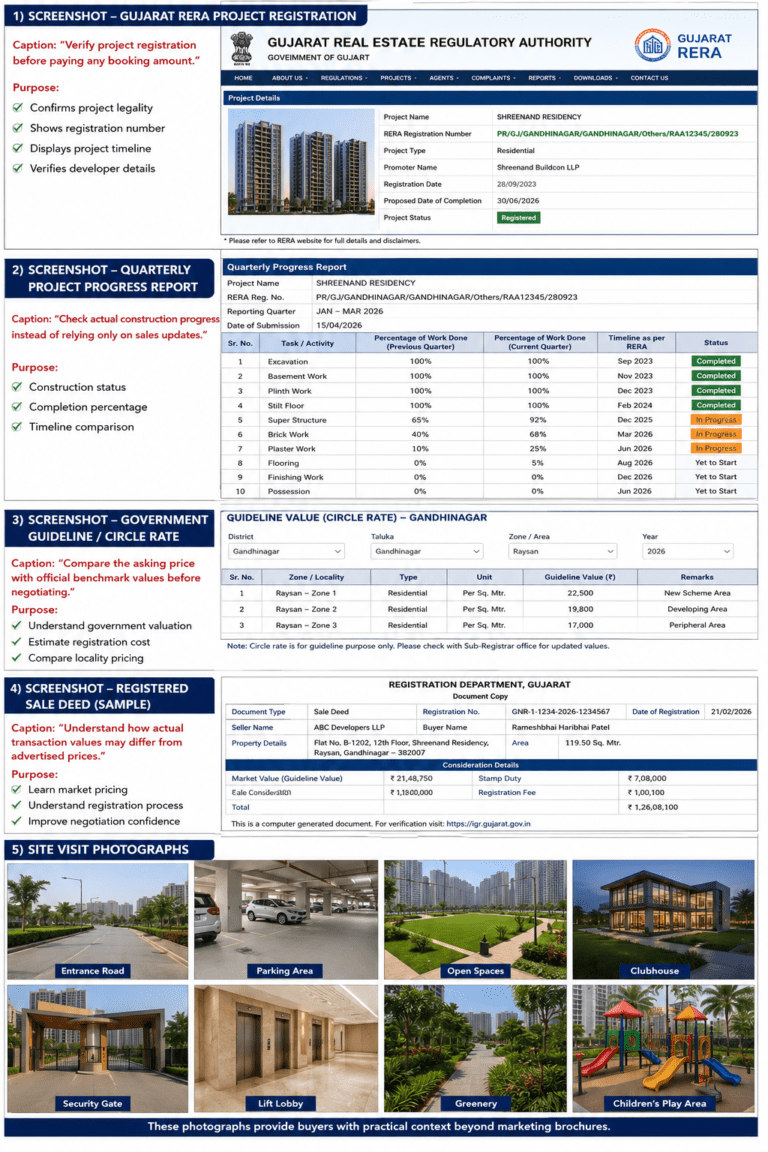
Whenever you’re evaluating a residential property, verify information using official or authoritative sources instead of relying only on marketing material.
Useful sources include:
- Gujarat RERA project registration and quarterly progress reports
- Government guideline values and circle-rate information
- Registered sale deed and sub-registrar records
- Approved development plans
- Municipal authority approvals
- Builder documentation
- Independent legal verification
Official project disclosures under Gujarat RERA help buyers confirm registration details, construction progress, timelines, and regulatory compliance.
Who Should NOT Buy Property in Gandhinagar in 2026
This may be the most valuable section of the guide.
Not everyone should purchase property today.
You should seriously consider waiting if:
1. Your Emergency Savings Are Limited
If buying a home leaves you with no financial cushion, delaying the purchase may be the wiser decision.
2. You Plan to Sell Within One or Two Years
Real estate generally rewards long-term ownership more than short-term speculation.
3. You’re Buying Only Because Friends Are Buying
Personal financial decisions should never be driven by social pressure.
4. Your Employment Situation Is Uncertain
A stable income is just as important as a good property.
5. You’re Depending on Unrealistic Appreciation
No advisor can guarantee that prices will double within a short period.
Treat such claims with caution.
6. You Haven’t Compared Multiple Projects
Buying the first property you visit often results in regret.
7. You Haven’t Verified Legal Documents
Never compromise on due diligence simply because the project appears attractive.
This Guide Is NOT Designed For
This guide is not intended for buyers who are looking for:
- Overnight profits
- Rumour-based investing
- Speculative land deals
- Short-term property flipping
- Purchasing solely because of social media trends
It is written for buyers seeking informed, long-term decisions.
If I Were Buying Property in Gandhinagar Today
This is my personal approach—not a universal recommendation.
If I were purchasing in 2026:
I Would Buy If
- I planned to stay for at least seven to ten years.
- The property met my family’s actual needs.
- The builder had a strong delivery record.
- All legal documents were verified.
- The pricing was supported by comparable projects.
I Would Wait If
- Prices appeared disconnected from actual market conditions.
- My employment was uncertain.
- I had insufficient savings after the purchase.
- I felt pressured to book immediately.
I Would Negotiate Hardest On
- Total purchase cost
- Additional charges
- Parking
- Payment schedule
- Maintenance fees
- Possession commitments
One Red Flag I Would Never Ignore
If a builder avoids providing documents or discourages independent legal verification, I would walk away—regardless of the project’s appearance.
Conclsuion
Property demand in Gandhinagar is increasing in 2026 for several genuine reasons, including infrastructure development, improved connectivity, employment growth, and expanding residential communities.
However, increasing demand alone should never be your reason for buying.
A successful purchase depends on choosing the right locality, verifying the builder, understanding the legal process, comparing market prices, and buying within your financial comfort.
A good property is not simply the one with the biggest discount or the most luxurious clubhouse.
It is the one that continues to meet your family’s needs five, ten, and fifteen years after purchase.
Take your time.
Visit multiple projects.
Ask difficult questions.
Verify every important document.
And remember:
The goal isn’t to buy quickly.
The goal is to buy wisely.