
Most buyers looking at Koba today are not confused because there are too few options. They are confused because everybody is saying something different.
One broker says:
“Prices here will double in five years.”
A builder says:
“Last few units left.”
A YouTube investor says:
“Koba is the next SG Highway.”
And meanwhile, the buyer is sitting with one real question:
“If I put ₹70 lakh to ₹1.5 crore here, am I making a smart long-term decision or walking into an overpriced market cycle?”
In my experience advising buyers across Gandhinagar micro-markets, this is exactly where people make costly mistakes. Not because they lack money — but because they lack clarity.
Most online blogs about property appreciation in Koba Gandhinagar are useless for actual buyers. They repeat generic phrases like:
- “Excellent connectivity”
- “High ROI”
- “Premium location”
- “Future growth corridor”
But they rarely answer:
- Which pockets are genuinely appreciating?
- Which builders are overpricing future promises?
- What type of buyer should avoid Koba completely?
- Is appreciation still realistic at current pricing?
- What risks are people ignoring?
This guide is written to answer those questions honestly.
Most buyers looking at Koba today are not confused because there are too few options. They are confused because everybody is saying something different.
One broker says:
“Prices here will double in five years.”
A builder says:
“Last few units left.”
A YouTube investor says:
“Koba is the next SG Highway.”
And meanwhile, the buyer is sitting with one real question:
“If I put ₹70 lakh to ₹1.5 crore here, am I making a smart long-term decision or walking into an overpriced market cycle?”
In my experience advising buyers across Gandhinagar micro-markets, this is exactly where people make costly mistakes. Not because they lack money — but because they lack clarity.
Most online blogs about property appreciation in Koba Gandhinagar are useless for actual buyers. They repeat generic phrases like:
- “Excellent connectivity”
- “High ROI”
- “Premium location”
- “Future growth corridor”
But they rarely answer:
- Which pockets are genuinely appreciating?
- Which builders are overpricing future promises?
- What type of buyer should avoid Koba completely?
- Is appreciation still realistic at current pricing?
- What risks are people ignoring?
This guide is written to answer those questions honestly.
Not to sell Koba.
Not to scare buyers.
But to help you avoid a wrong decision.
Understanding Property Appreciation In Koba Gandhinagar
Koba sits in a strategically important stretch between Ahmedabad and Gandhinagar. Because of its connectivity, institutional presence, expanding infrastructure, and proximity to key government and commercial zones, the area has seen gradual real estate appreciation over the last decade, which is clearly reflected in the evolving property value trends in Koba Gandhinagar.
But here is the important part most buyers miss:
Not every appreciation story is healthy appreciation.
Some price growth comes from:
- Genuine residential demand
- Infrastructure improvement
- End-user movement
- Better liveability
And some comes from:
- Investor hype
- Artificial scarcity
- Builder-led pricing inflation
- Speculative future promises
Koba currently has a mix of both.
That is why buyer judgment matters more than market excitement.
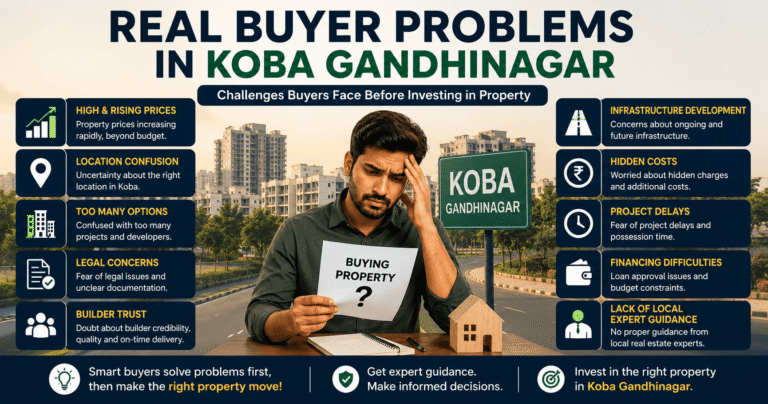
Real Buyer Problems In Koba Gandhinagar
1. Price Confusion Is Massive
One project quotes ₹5,200/sq.ft.
Another nearby quotes ₹7,400/sq.ft.
Yet on-ground quality difference may be minimal.
Many buyers assume:
“Higher price means better appreciation.”
That is not always true.
In several cases I’ve personally seen, buyers overpaid because:
- clubhouse amenities looked premium
- sample flats were heavily staged
- builders used “luxury branding”
- launch pricing created artificial urgency
Meanwhile, resale movement remained weak.
2. Buyers Ignore Total Acquisition Cost
A flat advertised at ₹85 lakh may actually cost:
- GST
- Maintenance deposit
- Parking
- Floor rise
- Legal charges
- Stamp duty
- Registration
- Interior costs
Final outflow can cross ₹1 crore quickly.
This matters because future property appreciation depends heavily on your entry price. Overpaying reduces real ROI significantly.
3. Builder Reputation Risk Is Real
Koba has good projects.
It also has projects where:- possession timelines slipped
- construction pace slowed
- promised amenities changed
- maintenance quality deteriorated later
Many buyers still do not properly verify:
- RERA filings
- financial strength
- litigation history
- previous delivery track record
They trust marketing instead of documentation.
That is dangerous.
4. End-Users And Investors Need Different Strategies
This is one of the biggest mistakes in the Gandhinagar market.
A good end-user property is not always a good investment property.
For example:
- A family may value peaceful surroundings and school access.
- An investor may care more about rental demand and liquidity.
I’ve seen buyers purchase oversized premium units expecting strong appreciation, only to realize resale demand was limited because the ticket size became too high for local buyers.

Step-By-Step Buyer Action Plan
Step 1: Location Selection
What To Do
Do not evaluate Koba as one single market.
Study:
- connectivity to Ahmedabad
- access to Gandhinagar offices
- nearby infrastructure
- future road expansion
- social ecosystem
- daily commute practicality
Micro-location matters more than project branding.
Why It Matters
Two projects within 2–3 km can behave very differently in appreciation.
One may attract:
- end-users
- professionals
- long-term residents
Another may become heavily investor-driven with weak occupancy.
Investor-heavy societies often struggle with:
- low community development
- weak resale absorption
- unstable rental ecosystem
Mistakes To Avoid
- Buying only because “metro may come”
- Trusting future promises without approvals
- Ignoring traffic bottlenecks
- Underestimating daily commute fatigue
Pro Tip From Experience
Visit the location:
- weekday morning
- weekday evening
- Sunday afternoon
The market looks completely different during actual living hours.
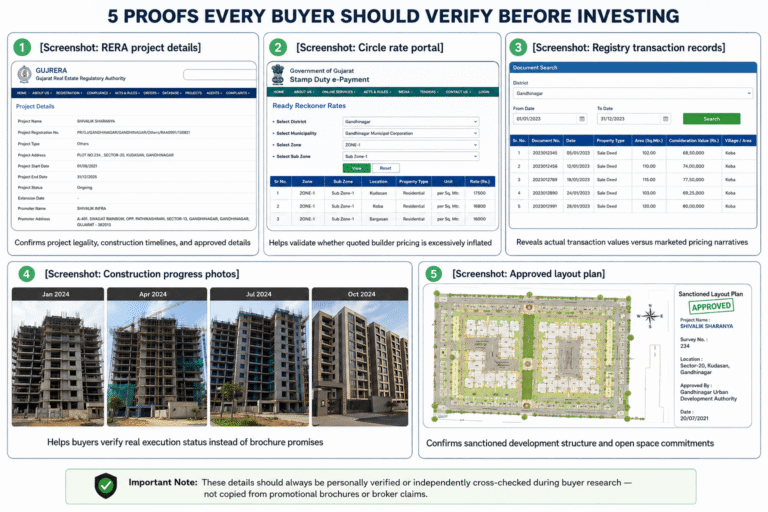
Step 2: Budget & Price Validation
What To Do
Cross-check:
- actual registry transactions
- nearby resale rates
- circle rate benchmarks
- unsold inventory pressure
Do not depend only on quoted builder pricing.
Why It Matters
Real estate appreciation depends heavily on buying below or near fair value.
If the market already prices in “future growth,” upside becomes limited.
Mistakes To Avoid
- Buying emotionally after visiting sample flats
- Taking maximum loan eligibility
- Ignoring maintenance burden
- Assuming appreciation will solve affordability issues
Pro Tip From Experience
Sometimes slightly older resale properties in Koba provide:
- better carpet efficiency
- lower entry price
- faster occupancy ecosystem
- stronger real value
New launches are not automatically smarter investments.
Step 3: Builder & RERA Verification
What To Do
Verify:
- RERA registration
- construction updates
- litigation records
- previous delivery timelines
- occupancy certificates
Why It Matters
A delayed project destroys both:
- financial planning
- appreciation potential
Markets reward trust over marketing in the long run.
Mistakes To Avoid
- Believing verbal promises
- Ignoring clause details
- Assuming all branded builders are financially stable
Pro Tip From Experience
Talk to residents of the builder’s previous projects.
Not salespeople.
Actual residents.
That gives more truth in 20 minutes than most brochures.
Step 4: Site Visit Checklist
What To Do
During site visits, inspect:
- natural light
- ventilation
- waterlogging signs
- construction quality
- parking practicality
- nearby noise sources
- road access
Why It Matters
Properties appreciate sustainably when people genuinely want to live there.
Livability affects:
- resale demand
- rental stability
- long-term value
Mistakes To Avoid
- Visiting only sample flats
- Ignoring surrounding land use
- Not checking actual unit orientation
Pro Tip From Experience
Stand silently on the balcony for five minutes.
You’ll notice:
- highway noise
- drainage smell
- dust exposure
- traffic stress
These factors affect resale more than buyers realize.
Step 5: Legal & Registry Checks
What To Do
Verify:
- title clarity
- NA permissions
- sanctioned plans
- registry records
- mortgage status
Why It Matters
Even strong appreciation potential becomes meaningless if legal issues emerge later.
Mistakes To Avoid
- Using builder-appointed lawyers blindly
- Skipping independent legal verification
- Ignoring deviation risks
Pro Tip From Experience
Registry transaction analysis often reveals whether quoted market prices are realistic or inflated.
Step 6: Negotiation Strategy
What To Do
Negotiate based on:
- inventory pressure
- payment schedule
- possession timeline
- competing nearby projects
Why It Matters
In many Koba projects, actual deal prices differ substantially from quoted prices.
Mistakes To Avoid
- Negotiating only on base price
- Ignoring hidden charges
- Rushing because of “last unit” pressure
Pro Tip From Experience
Quarter-end periods often improve negotiation flexibility because sales teams target closures.
Real Case Studies
Case Study 1: End-User Family
Profile
Government employee family relocating from Ahmedabad.
Purchase Details
- Location: Koba
- Configuration: 3 BHK
- Purchase Year: 2020
- Purchase Price: ₹78 lakh all-inclusive
Current Situation
Estimated resale value in 2026:
₹1.02–1.08 crore range depending on furnishing and tower positioning.
What Worked
- Chose occupancy-ready project
- Prioritized connectivity over luxury branding
- Bought during slower market sentiment
Lesson Learned
Steady appreciation usually comes from buying practical properties at reasonable pricing — not chasing hype.
Case Study 2: Investor
Profile
NRI investor seeking long-term capital growth.
Purchase Details
- Entry Price: ₹1.18 crore
- Luxury segment apartment
- Bought during aggressive launch marketing cycle
Rental Yield
Approximate rental return remained around 2.4–2.8% annually.
Appreciation Outcome
Property value appreciated modestly, but liquidity remained weak due to high ticket size.
Exit Challenge
Finding end-user buyers became difficult because:
- pricing moved beyond local affordability
- multiple competing luxury inventories entered market
What Worked
Premium construction quality retained interest.
What Didn’t
Expectation of rapid appreciation was unrealistic.
Social Proof From Real Buyers
“We almost booked a bigger flat emotionally. After reviewing loan pressure and maintenance cost properly, we chose a smaller unit in Koba. Financially, that decision gave us far more peace.”
— IT professional, Ahmedabad
“I delayed buying for eight months instead of rushing during launch hype. Eventually negotiated nearly ₹6 lakh lower including parking benefits.”
— PSU employee, Gandhinagar
“As an NRI, I assumed luxury inventory always appreciates faster. But rental demand taught me that practicality matters more than branding.”
— NRI investor, UAE
Market Context & Property Appreciation Trends In Koba Gandhinagar
Koba’s appreciation story is closely tied to:
- Ahmedabad–Gandhinagar connectivity
- institutional development
- government ecosystem expansion
- infrastructure growth
- premium residential migration
However, the market is also entering a more mature phase.
That means:
- explosive appreciation becomes harder
- buyers must focus more on entry price discipline
- overpaying becomes riskier
Interest rate cycles, construction costs, and inventory supply also influence appreciation potential significantly.
This is not a guaranteed “property boom” market anymore.
It is increasingly becoming a market where smart selection matters more than blind optimism.
Proofs & Screenshot Placements
Who This Guide Is NOT For
This guide is probably not useful for:
- short-term flippers
- speculative traders
- buyers chasing “double money quickly”
- people buying purely because relatives pressured them
- investors depending entirely on future hype
You should strongly reconsider buying now if:
- your job stability is uncertain
- EMI will stretch finances dangerously
- you are relying fully on future appreciation for financial safety
- you may relocate within 3–4 years
In some cases, renting may genuinely be smarter than buying.
Especially if:
- lifestyle flexibility matters
- prices feel overheated
- emotional pressure is driving the purchase
This guide will also NOT help with:
- insider deals
- rumor-based investing
- guaranteed ROI expectations
- unrealistic appreciation projections
If I Were Buying This Property Today
Would I Buy Now Or Wait?
I would buy only if:
- pricing felt reasonable compared to actual registry trends
- the builder had proven delivery credibility
- the property solved a genuine long-term need
I would avoid emotionally driven luxury launches with aggressive appreciation promises.
Which Configuration Would I Choose?
Personally, I would focus on:
- efficient 2 BHK or practical 3 BHK units
- strong livability
- manageable maintenance
- broader resale demand
Not oversized premium inventory.
What Would I Negotiate Hardest?
- parking charges
- floor rise
- possession-linked payments
- hidden fees
- interior upgrade promises
Most buyers negotiate too late.
One Red Flag I Would Never Ignore
Artificial urgency.
Whenever somebody says:
“Prices are increasing tomorrow.”
“Only one unit left.”
“Investor quota closing.”
I slow down immediately.
Pressure is often used where clarity is weak.
Conclusion
Property appreciation in Koba Gandhinagar is real — but it is not automatic.
The buyers who usually benefit are the ones who:
- enter at sensible pricing
- verify legal and builder credibility properly
- choose livability over hype
- stay financially disciplined
- think long-term
The people who struggle are usually the ones who:
- overpay emotionally
- chase future promises blindly
- ignore total cost burden
- confuse marketing with market reality
A good property decision should improve your financial stability and quality of life — not create stress disguised as investment.
If you are evaluating Koba seriously, create a proper checklist before committing:
- pricing validation
- builder verification
- registry analysis
- loan stress testing
- resale practicality
That process alone can save lakhs.
If you still have doubts, speak with someone who will challenge your assumptions honestly — not just push inventory.
Property Appreciation In Koba Gandhinagar (FAQs)
Q1. Is Koba still a good investment destination?
Q2. Will property prices in Koba double soon?
Q3. Are luxury projects safer for appreciation?
Q4. Should I buy for self-use or investment?
Q5. What matters more: location or builder?
References
About the Author