
Long Term Vs Short Term Property Investment In Gandhinagar last month, I sat with a buyer from Ahmedabad who had ₹80–90 lakh ready.
He was stuck between two completely different paths:
- Hold a 2BHK in Gandhinagar for 7–10 years
- Or flip a “fast-growing” project in 2–3 years for profit
Meanwhile, two brokers had already told him:
“Sir, Raysan side le lo — prices double ho jayega.”
“Pre-launch entry lo, 2 saal me exit guaranteed.”
This is exactly where most investors go wrong.
Because in my experience advising investors in Gandhinagar, the problem is not choosing a property — it’s choosing the wrong strategy for the market.
Most blogs will talk about ROI, appreciation %, rental yield…
But they don’t tell you:
What actually works in Gandhinagar’s ground reality
Where investors get stuck
Why many “smart” investments don’t exit
This guide is not theory.
This is what I’ve seen working — and failing — on the ground.

REAL INVESTOR PROBLEMS
Let’s be blunt.
Most property investors in Gandhinagar don’t lose money because the market crashes.
They lose because:
They enter with the wrong expectations.
Problem 1: Unrealistic Appreciation Expectations
Many buyers believe:
- “Metro aa raha hai”
- “GIFT City ke paas hai”
- “Capital city hai — growth guaranteed”
Reality:
Appreciation is slow and uneven, not explosive.
Problem 2: Liquidity Crisis
This is the truth no one tells you:
Selling property in Gandhinagar is not easy.
Especially if:
- Your price is slightly above market
- Your project has too many similar units
- It’s investor-heavy inventory
I’ve seen investors stuck for 6–18 months trying to sell.
Problem 3: Oversupply in Key Areas
In areas like Raysan and Vavol, too many similar flats are available, but actual buyer demand is limited, especially when buyers are already exploring flats in Gandhinagar for every budget across different locations. This highlights the importance of understanding property investment duration in Gandhinagar, as it directly impacts returns. As a result, this leads to slow sales, heavy price negotiation, and weak resale performance for investors.
Areas like:
- Raysan
- Vavol
Have visible inventory pressure.
Meaning:
Too many similar flats, not enough serious buyers
Result:
- Price stagnation
- Negotiation-heavy resale
Problem 4: Rental Yield Myth
Expected:
- 4–5% returns
Actual
2–3% in most cases
And that too:
- With vacancy gaps
- Maintenance cost
- Tenant turnover
Problem 5: Builder Pricing Manipulation
Builders often:
- Launch high
- Offer “discounts” later
- Control perception of demand
So investors think:
“Prices increasing” But actual registry data tells a different story.
Problem 6: Wrong Entry Timing
Many investors:
- Buy during hype (launch phase)
- Expect quick appreciation
But:
Gandhinagar is not a hype-driven market
It is:
End-user driven, slow-moving, and price-sensitive
Area Behavior Reality (Critical)
- Raysan → Growing, but supply-heavy
- Kudasan → More stable, better end-user demand
- Vavol → Budget-friendly, but slower movement
Each behaves differently.
But investors treat them the same.

Why Most Investors Choose the Wrong Strategy
Because they:
- Follow broker narratives
- Ignore exit reality
- Assume appreciation = guaranteed
Instead of asking:
“Who will buy this from me later?”
Read More : Is Gandhinagar good for real estate investment?

LONG TERM vs SHORT TERM: CLEAR COMPARISON
Let’s get straight to the decision.
Long-Term Investment
What Actually Works
- End-user driven locations
- Properly priced entry
- Ready or near-ready properties
- Areas with livability, not just future promise
Where It Works in Gandhinagar
- Kudasan (more mature demand)
- Select pockets of Raysan (only well-located projects)
Realistic Appreciation
- 5–8% annual (not guaranteed every year)
- Compounded over time
No sudden jumps — steady growth
Risks
- Slow movement
- Opportunity cost vs other investments
- Requires patience
Verdict
Best suited for:
- End-use buyers
- Conservative investors
- NRIs looking for stability
Short-Term Investment
When It Works
- Underpriced distress deals
- Early entry in genuinely high-demand project
- Strong micro-location advantage
Where It Fails Most
- Pre-launch hype buying
- Oversupplied sectors
- Average builder projects
Major Risks
- No buyers at expected price
- Builder delays
- Market stagnation
- Forced selling at low margin or loss
Liquidity Reality
Gandhinagar is NOT a flipping market.
You are competing with:
- Builder inventory
- Other investors
Verdict
High risk, low predictability
Only for:
- Experienced investors
- Deep market knowledge
- Strong negotiation entry
FINAL VERDICT
If you’re a serious investor:
- Long-term holding works (with discipline)
- Short-term flipping mostly fails (for 80% buyers)

STEP-BY-STEP INVESTOR ACTION PLAN
Step 1: Define Investment Goal Clearly
What to do:
Decide: rental / appreciation / flipping
Why it matters:
Strategy decides location, budget, property type
Mistake:
“Dekhenge baad me” mindset
Pro Tip:
If you don’t define goal, market will define your loss
Step 2: Location Selection Based on Strategy
Choosing the right location depends on your investment goal, whether short-term gains or long-term appreciation. While exploring residential flats available in Gandhinagar, you’ll notice that areas with high supply may offer lower entry prices but slower returns, while developing locations can provide better growth potential over time. Evaluating demand, infrastructure, and future development is key to making a smart decision.
What to do:
Choose end-user driven areas
Why:
Liquidity depends on real buyers, not investors
Mistake:
Buying in “future growth” zones blindly
Pro Tip:
Schools, offices, connectivity > marketing brochures
Step 3: Price Validation
What to do:
Compare:
- Builder price
- Jantri (circle rate)
- Actual deal value
Why:
Overpaying kills your ROI before it starts
Mistake:
Trusting quoted price
Step 4: Builder & Project Selection
What to do:
Focus on demand, not brand
Why:
Liquidity > luxury
Mistake:
Buying premium project in low-demand area
Step 5: Exit Strategy Planning
Ask:
Who will buy this from me later?
Why:
Exit defines profit
Mistake:
Assuming demand will come
Step 6: Negotiation Strategy
What to do:
Negotiate like investor, not emotional buyer
Why:
Entry price = profit margin
Pro Tip:
Real deals happen quietly, not in brochures

REAL CASE STUDIES
Case 1: Long-Term Investor
- Bought in Kudasan (2016)
- Entry: ₹3,200/sq ft
- Holding: 8 years
- Current: ~₹5,200–5,500/sq ft
- Rental: ₹12–15K/month
Lesson:
Time + correct location + fair price = success
Case 2: Short-Term Investor
- Bought in Raysan (2021 launch phase)
- Entry: ₹4,800/sq ft
- Expected exit: ₹6,500
Reality:
- Current resale: ~₹4,700–5,000
- No buyers at expected price
Lesson:
Hype entry = trapped investment

SOCIAL PROOF
NRI Buyer
- Bought in Kudasan
- Strategy: Long-term hold
- Outcome: Stable appreciation + rental
Salaried IT Professional
- Bought in Raysan
- Strategy: Flip in 3 years
- Outcome: Still holding, no exit
Local Business Owner
- Bought plot instead of flat
- Strategy: Long-term
- Outcome: Better appreciation than flats

CREDIBILITY & MARKET CONTEXT
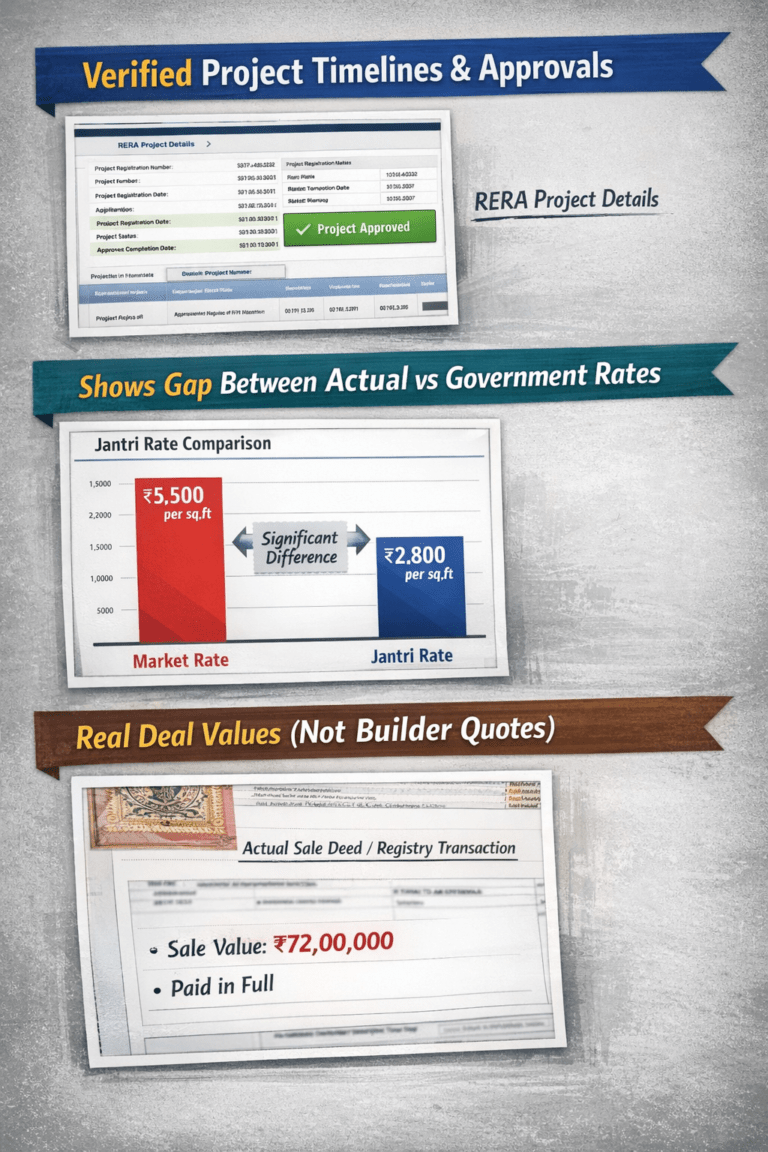
Verified from:
- Gujarat RERA
- Jantri rates
- Registry trends
Reality Check:
Gandhinagar is:
- Not speculative
- Not fast-flipping
It is:
- End-user driven
- Slow but stable

WHO THIS GUIDE IS NOT FOR
This is NOT for:
Quick profit seekers
People expecting 2x in 2–3 years
Blind investors following hype
Some buyers should honestly:
WAIT instead of investing
PROOFS & SCREENSHOT PLACEMENTS
CONCLUSION
Final Takeaway:
- Gandhinagar rewards patience, not speculation
- Entry price matters more than future promises
- Exit planning matters more than buying
If you’re confused between long-term vs short-term:
Choose clarity over hype.
Long Term vs Short Term Property Investment in Gandhinagar - FAq
1. Wait. What is WordPress?
2. How long do I get support?
3. Do I need to renew my license?
4. What if prices don’t increase?
5. Is now the right time?
References
About the Author