
Property Registration Process In Gandhinagar: A couple I advised last year had already paid 90% of their flat value in Kudasan. Everything looked “done.” Builder said:
“Sir, register next week. Just bring a check.”
But when we checked documents one last time, the sale deed draft had the wrong carpet area, and stamp duty was calculated on an inflated agreement value — not the actual negotiated price.
They were about to overpay ₹2.8 lakh extra in stamp + registration… and legally lock it forever. No refund. No correction.
Most online blogs will tell you:
- “Step 1: Prepare documents”
- “Step 2: Pay stamp duty”
- “Step 3: Register property”
That’s useless in real life. Because the real risk is not the process — it’s what goes wrong inside the process.
In my experience advising buyers in Gandhinagar, the biggest mistakes happen right before registration, when buyers feel “everything is done” and stop checking.
This guide is not to explain paperwork. It’s to help you not lose money or get stuck in a bad deal at the final step.

REAL BUYER PROBLEMS (GROUND REALITY IN GANDHINAGAR)
1. Stamp Duty Shock at the Last Moment
Buyers think:“We agreed at ₹60 lakh, so charges will be based on that.”
Reality:
- Stamp duty is calculated on higher of agreement value OR Jantri (circle rate)
- Many sectors in Gandhinagar have rising Jantri — especially around Raysan, Kudasan, Gift City influence zones
I’ve seen buyers forced to pay extra ₹1–4 lakh unexpectedly
2. Builder Pressure Before Registry
Common lines you’ll hear: “Sir, prices are increasing next week”, “If you delay, the unit will be given to someone else”, or “Loan approval may lapse.” This pressure is intentional. The truth is, at the time of registration, you actually have the strongest leverage—not the builder. Yet most buyers panic at this stage and skip critical checks, without properly understanding the property registration process in Gandhinagar, which is where costly mistakes usually happen.
3. Hidden Clauses in Sale Deed
What buyers miss:
Parking not included legally
Many buyers assume parking is part of the deal because it’s verbally promised or shown during booking. But if it’s not clearly mentioned in the sale deed, you don’t have legal ownership or exclusive rights. This can lead to disputes later with the builder or society. Always ensure parking details (number, type, location) are documented.
Terrace rights unclear
Builders often market terrace access as a benefit, especially in top-floor units. However, if terrace rights are not explicitly defined in the agreement, it usually belongs to the society. You may lose access or face restrictions later. Never rely on verbal assurances—get it in writing.
Maintenance deposit clauses
Some agreements include large upfront maintenance deposits without clearly explaining how they’ll be used. Buyers often overlook these clauses in a hurry to register. This can lead to overpayment or disputes with the builder or society later. Always review how much you’re paying and what it covers.
Possession penalties missing
If the agreement does not clearly mention delay penalties, you have no strong legal ground if the builder delays possession. Many buyers assume RERA will protect them automatically, but weak clauses make enforcement harder. A clear penalty clause protects your time and money.
4. Cash Component & Under-reporting Risk
Still happens in some resale deals. Risk:
- Lower registry value = lower future resale profit calculation
- Legal complications later
5. Wrong Timing of Registration
Buyers rush registry:
- Before construction milestone clarity
- Before OC (Occupancy Certificate)
- Without checking possession readiness
This kills your negotiation power completely.

STEP-BY-STEP BUYER ACTION PLAN
Step 1: Location Selection (Before Even Thinking of Registration)
What to do:
Choose micro-location based on:
- Liveability (schools, commute)
- Future supply (too many projects = slow appreciation)
Why it matters:
Registration locks you into a location — exiting later is expensive.
Mistakes I see:
- Buying near hype zones (like GIFT influence areas) without real demand
- Ignoring resale liquidity
Pro tip
If you’re an end-user, prefer established sectors (21, 22, 23, Kudasan pockets) over speculative outskirts.
Step 2: Budget & Price Validation
What to do:
Check Jantri (circle rate)
Jantri is the government’s minimum value for a property, and stamp duty is calculated on whichever is higher—your deal price or the Jantri rate. Many buyers ignore this and get a surprise cost increase at the time of registration. Even if you negotiate a good deal, a higher Jantri means you still pay more in charges. Always check it yourself instead of relying on what the builder or broker tells you.
Compare last 3 registry transactions nearby
Looking at recent registry transactions helps you understand the actual prices people are paying, not just what sellers are quoting. Many buyers rely only on advertised rates and end up overpaying. By checking at least 2–3 recent deals in the same area or project, you get a realistic benchmark. This simple step can save you from paying an inflated price.
Why it matters:
You avoid overpaying AND surprise stamp duty increase.
Mistakes I see:
Trusting builder pricing blindly.
Pro tip
If your deal price is lower than Jantri, expect higher stamp duty anyway.
Step 3: Builder & RERA Verification
What to do:
Check project status on RERA
Verify:
- Completion timeline
- Legal approvals
- Past delays
Why it matters:
- Registration = legal ownership
- But if the project is stuck, ownership ≠ usability.
Mistakes I see:
Thinking “RERA registered means safe”
Pro tip
Check actual progress vs promised timeline
Step 4: Site Visit Checklist (Before Final Payment)
What to do:
- Flat size vs promised layout
- Construction quality
- Amenities actually built
- Access roads (very important in Gandhinagar outskirts)
Mistakes I see:
Visiting only a sample flat.
Pro tip
Visit at different times of day — check real livability.
Step 5: Legal & Registry Checks (CRITICAL STEP)
What to do:
Verify:
- Title chain (last 20–30 years)
- NA status (Non-Agricultural land)
- Approved plans
- Loan bank approval (if any)
Cross-check:
- Sale deed draft
- Carpet area
- Undivided share (UDS)
Registration makes errors permanent.
- Signing without reading deed
- Ignoring annexures
Get independent lawyer review, not builder’s lawyer.

REAL CASE STUDIES
Case 1: End-User (Family Buyer)
- Budget: ₹65 lakh
- Location: Kudasan
- Purchase Price: ₹62 lakh (after negotiation)
- Stamp + Registration: ~₹4.2 lakh
- Current Value (2026): ₹68–70 lakh
Lesson:
Timing registry correctly saved money AND reduced risk
Case 2: Investor
- Entry Price: ₹48 lakh (Raysan outskirts)
- Holding Period: 3 years
- Rental Yield: ~2.5%
- Current Value: ₹52–54 lakh
Lesson:
Gandhinagar is not a fast-flip market

REALISTIC TESTIMONIALS
“Almost registered without checking Jantri. Would’ve paid extra ₹1.5 lakh. That check alone saved me.”
- IT Professional (Ahmedabad → Gandhinagar shift)
“The registry process looked simple, but deed clauses were confusing. Glad I reviewed it before signing.”
- PSU Employee (Sector 23 resale buyer)
“Builder pushed for an urgent registry. After delaying 2 weeks, I negotiated better terms.”
- NRI Buyer

CREDIBILITY & VERIFIED DATA
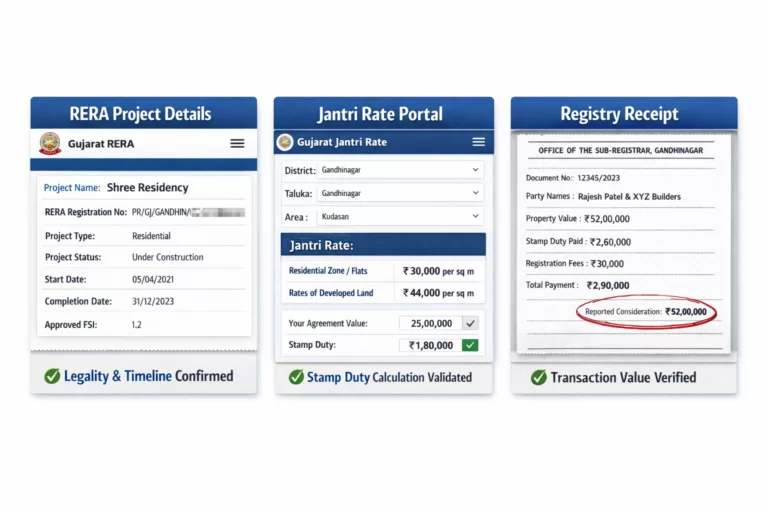
RERA project details
RERA gives you verified information about the project’s legal status, approvals, and promised completion timeline. Many buyers assume registration means safety, but delays and compliance issues still happen. Checking RERA helps you confirm whether the builder is actually following what was promised. It’s one of the few places where data is not controlled by the builder.
Jantri / circle rates
Jantri is the government’s benchmark value used to calculate stamp duty during registration. If the Jantri is higher than your deal price, you’ll still pay charges on that higher value. Buyers who ignore this often face unexpected extra costs at the last moment. It also helps you judge whether a deal is reasonably priced or artificially inflated.
Sub-registrar transaction values
These records show the actual prices at which nearby properties were registered, not just quoted rates. This is the closest you get to real market truth. Without checking this, buyers often rely on broker narratives and end up overpaying. Even a few recent transactions can reveal whether your deal is fair or overpriced.
Bank-approved project lists
If a reputed bank has approved a project for home loans, it means basic legal and technical checks have been done. While it’s not a guarantee of zero risk, it adds a layer of safety. Buyers who skip this may end up stuck in projects with legal or documentation issues. Always cross-check which banks are funding the project before proceeding.

WHO THIS GUIDE IS NOT FOR
This is important.
This guide is NOT for:
- People looking for quick flipping profits
- Buyers chasing “launch offers” blindly
- Anyone depending only on broker advice
You should WAIT if:
- You don’t understand total cost (including registry)
- You are stretching budget with loan pressure
- You’re buying only because “prices will increase”
Better to rent if:
- Your job/location is uncertain
- You’re buying only for investment without clear exit
PROOFS & SCREENSHOT
CONCLUSION
Property registration in Gandhinagar is not complicated. But it is dangerous if you assume it’s routine. Most buyers don’t lose money in buying. They lose it in the last 10% of the process — registration stage.
If you slow down, verify properly, and negotiate smartly, you can save lakhs and avoid long-term regret.
One mistake can cost:
- Lakhs in legal fixes
- Months of delay
- Or worse—ownership disputes
Use this as a checklist before signing anything.
Ask questions before trusting anyone.
Property Registration Process In Gandhinagar: FAQ
Q.1 Should I register property immediately after booking?
Q.2 Can I reduce stamp duty legally?
Q.3 Is the builder's lawyer enough?
Q.4 What if Jantri is higher than the deal price?
Q.5 Is Gandhinagar good for investment?
REFERENCES
About the Author