
Best Areas For Rental Housing in Gandhinagar: Last year, a PSU employee approached me after booking a flat in Gandhinagar purely because a broker said, “Rent will start immediately—don’t miss this.”
Six months later, the flat was vacant. No tenant. EMI running. Builder blaming the market.
Most blogs told him where prices may rise.
None told him where tenants actually want to live.
In my experience advising buyers in Gandhinagar, rental success is less about future appreciation and more about boring, practical livability. This guide focuses on that reality—no sales talk.

Real Buyer Problems
Here’s what I repeatedly see buyers get wrong:
Confusing “investment zones” with rental zones
Appreciation areas ≠ rental demand areas.
Fake urgency by brokers
“PSU tenants coming soon” is often a lie.
Wrong tenant assumptions
Gandhinagar tenants are mostly PSU staff, government employees, students—not startup renters like Ahmedabad.
Builder trust issues
Delays kill rental ROI faster than price stagnation.
End-use vs investment confusion
Many buyers want rental income but choose layouts meant only for self-use.
Read More: Best Areas to Invest in Gandhinagar in 2026: High-Growth Locations for Smart Buyers

Step-by-Step Buyer Action Plan
Step 1: Location Selection
What to do:
Choose areas with daily-use convenience, not future hype.a
Why it matters:
Tenants don’t wait for infrastructure promises.
Mistakes to avoid:
Buying in under-occupied sectors.
Pro tip:
Walk the area at 8am & 8pm—check real activity.
Rental-relevant areas:
- Sector 21 Gandhinagar
- Sector 22 Gandhinagar
- Sector 7 Gandhinagar
- Sargasan
- Kudasan
Step 2: Budget & Price Validation
What to do:
Compare asking price vs circle rate.
Why it matters:
Overpaying kills yield.
Mistakes to avoid:
Believing “rent will cover EMI.”
Pro tip:
Target 3–4% gross yield—not more.
Step 3: Builder & RERA Verification
What to do:
Verify project on Gujarat RERA.
Why:
Delays = zero rent.
Red flag:
Applied for RERA” projects.
Step 4: Site Visit Checklist
Lift working?
Confirm if the lift is operational daily and backed by power supply. Ask about maintenance frequency and downtime history.
Water pressure?
Check pressure during peak hours like mornings and evenings. Also verify if water comes from municipal supply, borewell, or tanker.
Parking usability?
Ensure the parking slot is usable, not blocked or tandem-based. Ask if guests’ parking is allowed or frequently misused.
Nearby shops?
Daily-need shops should be walkable within 300–500 meters. Confirm access to grocery, pharmacy, and milk vendors.
Step 5: Legal & Registry Checks
Cross-check:
Registry value
Verify the registered value matches the actual transaction amount. Cross-check with circle rate to avoid future tax or legal issues.
Agreement clauses
Read exit, lock-in, and penalty clauses carefully. Ensure verbal promises are written into the agreement.
Maintenance clarity
Confirm monthly charges and what they include upfront. Ask how increases are decided and billed.
Step 6: Negotiation Strategy
Negotiate on:
Floor premium
Higher floors often cost more due to views and ventilation. Confirm whether the premium is justified and officially documented.
Parking
Check if parking is allotted, exclusive, or shared. Verify its location, size, and ease of entry before committing.
Payment milestones
Ensure payments are linked to construction progress, not dates. Avoid front-loaded schedules that increase risk.
Read More: Residential Areas in Gandhinagar: A Local Buyer’s Ground-Reality Guide (2026)
Real Case Studies
Case 1: End-User + Partial Rental
- Location: Sector 21
- Budget: ₹68 lakh
- Rent: ₹16,000/month
- Lesson: Stability > speculation
Case 2: Investor
- Location: Sargasan
- Entry: ₹52 lakh
- Rent: ₹14,000/month
- Yield: ~3.2%
- Exit: Long-term hold
- What worked: Tenant demand
- What didn’t: Slow appreciation

Social Proof
- PSU Officer, Sector 22:
“Nikunj, No rent jump, but zero vacancy in 3 years.” - Private School Teacher, Kudasan:
“Akshay, Broker promise vs reality was very different—this guide helped.”

Credibility, Data & Market Context
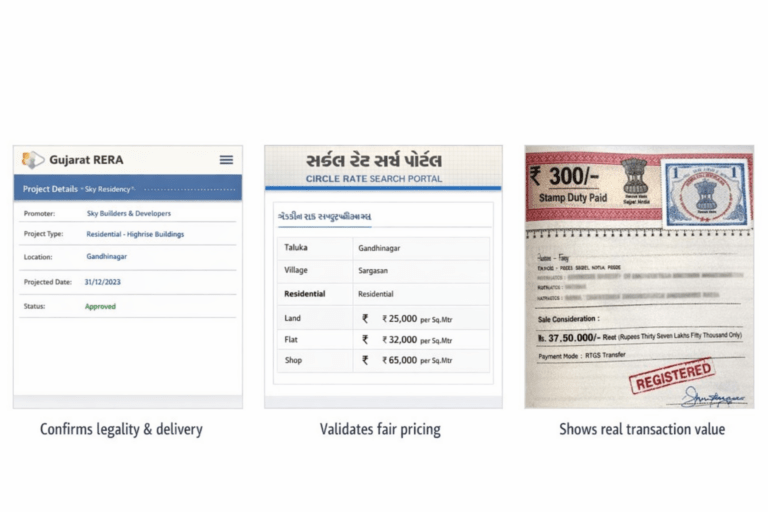
Verified using:
Gujarat RERA
Verify the project’s registration number and approved details online. This confirms legal status, timelines, and declared pricing.
Circle rate data (sub-registrar)
Check the official circle rate for the property location. It sets the minimum registry value accepted by authorities.
Actual registry comparisons
Compare recent registered deals in the same area. This reveals the real transaction range beyond quoted prices.
Current reality:
Prices are stable, demand is end-user driven, and interest rates affect affordability more than stamp duty.
Proofs & Screenshot Placements
Who This Guide Is NOT For
This guide is not for:
Short-term flippers
They buy with the intent to resell quickly for profit. Returns depend heavily on timing, not fundamentals.
Speculative “metro-spillover” buyers
They assume demand will shift from nearby metros. Decisions are driven by future expectations rather than current usage.
Rumor-based investors
They act on unverified news or hype. Risk is high due to lack of data-backed planning.
You should wait or rent if:
- EMI > 40% income
- You need quick liquidity
- You’re buying purely on appreciation stories
If I Were Buying Today
I would buy—but cautiously.
- I’d choose Sector 21 resale 2BHK
- Negotiate hard on price & parking
- Avoid any project without occupancy evidence
One red flag I’d never ignore: Empty buildings with “ready possession” tags
Conclusion
Rental housing in Gandhinagar rewards patience, realism, and discipline—not hype.
If you want:
Evaluate rent potential, tenant demand, maintenance costs, and vacancy risk together. This prevents emotional buying based only on price.
Understand who rents in each area—families, students, or professionals. Demand type directly impacts rent stability and tenant quality.
Best areas for rental housing in gandhinagar - FAQs
Q1: Is Gandhinagar good for rental income?
Q2: Should I buy new or resale?
Q3: 1BHK or 2BHK?
Q4: Will gift city change rental demand?
Q5: Is now a bad time to buy?
References
About the Author