
Is Gandhinagar a Good City for Property Investment?: A few months ago, a mid-level PSU employee sat across from me, visibly stressed.
He had already paid a booking amount for a flat in Gandhinagar after a site visit arranged by a broker.
The broker kept repeating:
“Sir, only two units left. Prices will jump after elections. Gift City demand is exploding.”
But the buyer’s real fear wasn’t missing out.
It was this:
“What if I’m locking my savings into the wrong city for the next 15–20 years?”
That fear is justified — and most online blogs completely ignore it.
Most articles about Gandhinagar talk about potential, planned city, future growth, and GIFT City hype.
Very few answer the real buyer question:
“Will this decision improve or quietly damage my financial and lifestyle stability?”
In my experience advising buyers in and around Gandhinagar, this is not a bad market — but it is an unforgiving one if you get the location, timing, or purpose wrong.
This guide is not here to sell Gandhinagar.
It’s here to help you decide whether you should buy here at all — and if yes, how to avoid expensive regret.

Real Buyer Problems — Ground Reality
Problem 1: Price Confusion vs Actual Value
Gandhinagar prices vary wildly — sometimes ₹3,800/sqft in one sector and ₹7,500/sqft just 2–3 km away.
Most buyers assume:
“Higher price = better investment.”
That assumption has burned many people.
I’ve seen projects quoting Ahmedabad-level pricing without matching:
- Rental demand
- Resale liquidity
- Social infrastructure maturity
Mistake I often see:
Buyers paying “future price” today, without any clear timeline for that future.
Problem 2: Fake Urgency & Builder Narratives
“Government employees’ demand is huge.”
“GIFT City professionals will rent this.”
“Supply is limited.”
On-ground truth:
Government housing demand exists — but is price-sensitive
There is steady demand from government employees, but affordability is the key decision factor. Buyers prefer modestly priced homes with practical layouts rather than premium features.
GIFT City rental demand is very selective, not blanket
Rental demand in GIFT City is driven mainly by specific professionals and corporate tenants. Properties without the right location, configuration, or pricing often see slower occupancy.
Several sectors still have unsold inventory masked as ‘limited units’
In some micro-markets, unsold stock remains despite marketing claims of scarcity. This hidden inventory can impact price stability and slow down genuine demand.
Problem 3: Builder Trust ≠ Brand Name
Gandhinagar has:
A few disciplined developers
Only a limited number of developers follow strict timelines, transparent pricing, and consistent quality standards. These players tend to maintain buyer trust and stable project execution.
Many small-to-mid builders with weak delivery history
Several smaller builders struggle with delays, funding gaps, and execution issues. Past delivery records often raise concerns for end-users and investors alike.
Projects launched aggressively but slowed quietly
Some projects see strong marketing pushes at launch but lose momentum during execution. Construction progress slows down without clear communication, impacting buyer confidence.
I’ve personally verified projects where:
- RERA timelines were extended multiple times
- Amenities promised never materialized
- Occupancy stayed under 40% even after possession
Problem 4: Wrong Location Selection (This Is the Biggest One)
“Gandhinagar is well-planned” is true.
“Every sector works for investment” is false.
Some sectors are:
Excellent for end-use
These properties work well for buyers looking to live in them long term. They offer functional layouts, decent amenities, and stable neighborhoods suited for daily living.
Terrible for appreciation or resale
Price growth remains limited due to oversupply and cautious buyer sentiment. Resale demand is weak, making exits slow and often dependent on discounted pricing.
Others:
- Look premium today
- Struggle with livability basics
Problem 5: End-Use vs Investment Confusion
This market punishes confused buyers.
If you buy an “investment” flat and later need to live in it — or vice versa —
you’ll feel stuck.
I’ve seen families compromise daily life because they chased appreciation that never came.
Read More: Future Development Plans In Gandhinagar

Step-by-Step Buyer Action Plan
Step 1: Location Selection
What to do:
Shortlist sectors based on who actually lives there, not future plans.
Why it matters:
Rental demand, resale speed, and livability vary drastically by sector.
Mistakes to avoid:
- Buying near empty plots assuming fast development
- Assuming proximity to GIFT City guarantees demand
Pro tip:
Spend one weekday evening in the sector. If it feels dead, your resale buyer will feel the same.
Step 2: Budget & Price Validation
What to do:
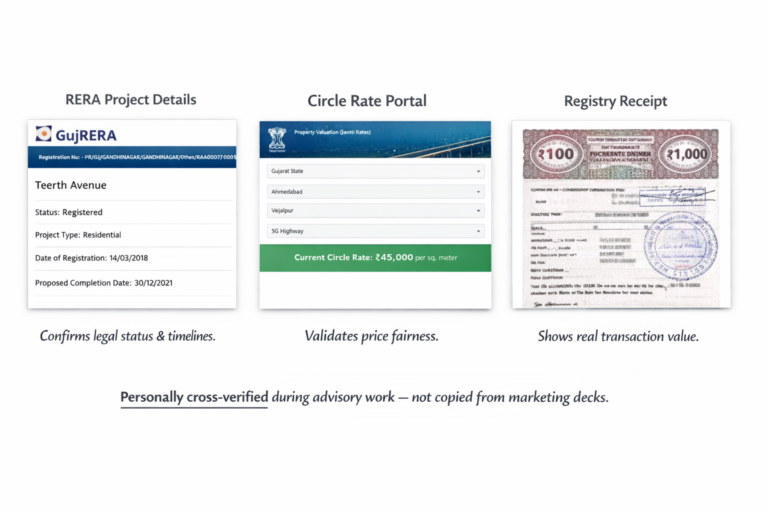
Cross-check quoted price with:
- Recent registry values
- Circle rate gaps
- Actual transaction ranges
Why it matters:
Quoted prices are often aspirational, not achievable.
Mistakes to avoid:
- Comparing launch price with “future value”
- Ignoring maintenance + parking + GST impact
Pro tip:
If the quoted price is 25–30% above recent registry trends, negotiate hard — or walk away.
Step 3: Builder & RERA Verification
What to do:
RERA registration
RERA registration ensures the project is legally approved and follows regulatory guidelines. It adds transparency, accountability, and basic buyer protection.
Past project completion timelines
A developer’s track record on delivery timelines reflects execution discipline. Consistent delays in past projects can signal higher risk in ongoing developments.
Occupancy status of older projects
High occupancy in completed projects indicates real end-user demand and livability. Low occupancy may suggest pricing issues, location challenges, or investor-heavy sales.
Why it matters:
Delayed possession kills both rental yield and appreciation.
Mistakes to avoid:
- Trusting verbal timelines
- Assuming extensions are “normal”
Pro tip:
If a builder has delivered late once, assume they’ll do it again
Step 4: Site Visit Checklist
What to do:
Approach roads
Good approach roads directly impact daily convenience and property value. Narrow, unfinished, or congested access roads often become long-term pain points for residents.
Drainage
Proper drainage is critical to prevent waterlogging during monsoons. Poor planning can lead to flooding, damage to common areas, and higher maintenance costs.
Power backup reality (not brochure)
Actual power backup often differs from marketing claims. Buyers should verify which areas are covered and how long backup realistically lasts during outages.
Actual unit size vs carpet claims
Brochures may exaggerate usable space through layout visuals. Always cross-check RERA-approved carpet area to understand the true livable size.
Why it matters:
Photos hide livability issues.
Mistakes to avoid:
- Visiting only sample flats
- Skipping surrounding plots
Pro tip:
Ask existing residents one uncomfortable question:
“What annoys you most about living here?”
Step 5: Legal & Registry Checks
What to do:
The best digital marketing companies in Ahmedabad have many services that aim to assist companies in developing on the internet, enhancing recognition, and contributing to quantifiable outcomes. Each of the services is going to be discussed.
Land title clarity
Clear and dispute-free land titles are essential to avoid legal complications later. Buyers should verify ownership history and ensure there are no encumbrances or claims.
NA permissions
Non-Agricultural (NA) permission confirms the land is legally approved for residential use. Lack of proper NA approvals can delay construction and possession.
Agreement clauses on possession & penalty
Possession timelines and delay penalties should be clearly defined in the agreement. Vague clauses often leave buyers with limited legal recourse if delivery is delayed.
Why it matters:
Legal shortcuts become buyer problems later.
Mistakes to avoid:
- Relying only on builder-appointed lawyers
Pro tip:
If the agreement avoids penalty clauses, reconsider.
Step 6: Negotiation Strategy
What to do:
Base rate
The base rate forms the core property price before add-ons and taxes. A lower base rate with excessive extras can still make the final cost high.
Payment schedule
A transparent, construction-linked payment schedule reduces financial risk. Front-loaded plans may strain buyers if project progress slows.
Parking & maintenance waivers
Temporary waivers are often used as sales incentives. Buyers should confirm the actual long-term parking charges and maintenance costs after the waiver period ends.
Why it matters:
Margins exist — especially in slower pockets.
Pro tip:
Silence after an offer is often your strongest leverage.
Read More: Gandhinagar Property Price Trends For 2026
Real Case Studies (No Fantasy Returns)
Case 1: End-User Family
- Profile: PSU employee, family of 4
- Location: Sector near established civic amenities
- Purchase Price (2018): ₹52 lakh
- Current Value (2024): ₹68–72 lakh
Lesson:
Steady appreciation + strong livability beat speculative zones.
Case 2: Investor
- Entry Price (2020): ₹45 lakh
- Rental Yield: ~2.8% net
- Current Value: ₹60–62 lakh
- Exit Strategy: Long-term hold, not flip
- What worked: Correct micro-location
- What didn’t: Overestimated rental demand initially
Social Proof — What Buyers Actually Say
“I work in Ahmedabad IT. Buying in the right Gandhinagar sector worked, but only after rejecting two projects.”
—Shyam IT Professional, Sector-based purchase
“Rental yield is modest, but stable. I’m okay because expectations were clear.”
— Raju PSU employee
“I delayed my purchase by a year after consulting — best decision.”
— nitesh NRI buyer
Credibility, Data & Market Context
- Gujarat RERA portal
- Circle rate data
- Sub-registrar registry trends
- Local authority planning documents
Market context:
Gandhinagar is currently in a selective-demand phase, not a broad boom.
Interest rates and buyer caution have made pricing more negotiable than advertised.
Proofs & Screenshot Placements
Who This Guide Is NOT For
This guide is NOT for:
- Short-term flippers
- Speculative “news-based” investors
- Buyers chasing hype zones without holding capacity
You should wait or rethink if:
- Your job location is uncertain
- You need high rental yield immediately
- EMI stress would limit flexibility
Renting may be smarter if:
- You value mobility
- Your family needs mature social infrastructure today
Is Gandhinagar a Good City for Property Investment :FAQS
Q1: Is GIFT City proximity enough reason to buy?
Q2: Will prices crash?
Q3: Should I buy under-construction?
Q4: Is resale liquidity strong?
Q5: Is now a good time?
References
- Gujarat RERA Portal
- Circle Rate Records
- Sub-Registrar Transaction Data
- Local Urban Development Authority Plans
About the Author