
Last month, a mid-level PSU employee sat across the table from me, visibly confused and uneasy. A broker had just told him:
“Sir, buy now in Gandhinagar. Development is coming. Prices will double in 3 years.”
He had already paid a token amount. No clarity on what development, where, or when.
This is the most common trap I see in Gandhinagar.
Most online blogs talk about “smart city”, “future growth”, “upcoming infrastructure” — but they never explain how that actually helps a buyer choose the right sector, project, or timing. In my experience advising buyers in the Gandhinagar market, future development is the most misused and misunderstood selling hook. This guide exists to fix that — with clarity, not hype.
No sales talk. No builder propaganda. Just practical judgment so you don’t make a costly mistake.

REAL BUYER PROBLEMS — THE GROUND REALITY
Problem 1: “Development” Is Used as a Blanket Excuse for High Prices
Premium pricing in sectors with no real demand drivers
Many projects are priced like mature neighborhoods despite lacking jobs, schools, hospitals, or daily livability. Buyers end up paying a “future premium” without any present-day usage demand to support it.
Projects quoting future appreciation without infrastructure timelines
Appreciation is often promised based on vague announcements, not approved budgets or execution schedules. Without clear timelines, buyers risk waiting years with stagnant prices and poor livability.
Buyers paying today’s price for tomorrow’s promise
When future growth is already baked into today’s price, the upside disappears. Buyers carry the risk, while developers secure profits upfront—often leaving little room for real appreciation later.
Problem 2: Fake Urgency & Misleading Offers
Last inventory
This phrase is commonly used to create artificial urgency. In reality, similar units or fresh inventory often reappear once a buyer hesitates or walks away.
Government expansion coming soon
Such claims are frequently based on proposals, not approved or funded projects. Without official notifications or timelines, these statements should be treated as speculation, not fact.
Prices increasing next month
Price hike warnings are often internal sales tactics, not demand-driven moves. Genuine price increases usually follow sustained sales velocity—not calendar deadlines.
Inventory exists
Despite claims of scarcity, unsold units are common across most projects. Stock often resurfaces quietly once buyer pressure reduces.
Projects take years to absorb
Residential projects rarely sell out quickly unless demand is exceptionally strong. Most developments require multiple years to achieve healthy occupancy and resale activity.
Price hikes are often artificial, not demand-driven
Many price increases are sales-led decisions, not market-led outcomes. Without genuine buyer demand, these hikes struggle to sustain in the resale market.
Problem 3: Builder Trust & Delivery Risk
RERA-approved projects with poor execution
RERA approval confirms legal registration, not construction quality. Many projects meet paperwork norms but suffer from slow work, poor site management, and frequent deadline extensions. Always assess on-ground progress, not just RERA status.
Layouts approved but internal infrastructure delayed
While layouts may be sanctioned, essential infrastructure like internal roads, drainage, water lines, and street lighting often lag behind. This delays livability and affects resale value, even after possession promises are made.
Buyers stuck paying EMIs + rent
Project delays force buyers to service home loan EMIs while continuing to pay rent. This double financial burden strains monthly budgets and long-term savings, especially for end-users planning immediate occupancy.
Problem 4: End-Use vs Investment Confusion
Self-use buyers chase appreciation stories
Many end-users get influenced by future price appreciation rather than present livability. This often leads to compromises on daily essentials like connectivity, schools, and maintenance. A home should first serve lifestyle needs, not just investment narratives.
Investors buy emotional locations with poor rental demand
Investors sometimes choose locations based on hype, prestige, or personal liking instead of rental fundamentals. Areas with weak tenant demand result in longer vacancy periods and lower yields. Rental viability should always guide investment decisions.
Read More: Gandhinagar Property Price Trends For 2026

STEP-BY-STEP BUYER ACTION PLAN
Step 1: Location Selection (Most Critical)
What to do:
Established residential sectors (Sector 11, 12, 21)
These sectors offer mature infrastructure, wide roads, greenery, and strong civic amenities. Demand remains steady due to proven livability and limited new supply. Ideal for end-users seeking long-term stability and reliable resale value.
Institutional & PSU-driven zones
Areas around PSU offices and government institutions see consistent housing demand from employees. Price volatility is lower, and rental occupancy remains stable. These zones are preferred for predictable returns rather than speculative gains.
Peripheral expansion belts (towards GIFT City, Sargasan, Raysan)
These belts are growth-driven markets backed by infrastructure expansion and future employment hubs. Prices are relatively affordable today but come with execution and timeline risks. Best suited for buyers with a longer investment horizon.
Why it matters:
Future development works only when it aligns with real usage demand — offices, education, healthcare, connectivity.
Mistakes to avoid:
- Buying purely because land is cheap
- Assuming proximity to Gift City guarantees appreciation
Pro tip:
Ask: “Who will live here daily in 5 years?”
If there’s no clear answer — walk away.
Step 2: Budget & Price Validation
What to do:
Quoted price vs circle rate
Always compare the builder’s quoted price with the government circle rate. A large gap may indicate overpricing or future negotiation scope. Circle rates provide a reliable baseline for fair market value assessment.
Recent registry values in the same sector
Check recent sale deeds registered in the same sector to understand actual transaction prices. These figures reflect real buyer behavior, not advertised rates. This data is crucial for effective price negotiation.
Similar ready-to-move inventory
Compare prices of ready-to-move flats with similar size and specifications nearby. Ready units often offer better leverage, no GST, and immediate possession. Use these listings to benchmark under-construction pricing.
Why it matters:
Future development does not justify overpaying today.
Mistakes to avoid:
- Accepting builder “future premium”
- Ignoring maintenance and holding costs
Pro tip:
If price is already higher than comparable developed sectors — the upside is limited.
Step 3: Builder & RERA Verification
What to do:
RERA registration status
Verify the project’s RERA registration number and approved timelines on the official portal. This confirms legal compliance, declared possession dates, and project details. It also offers a formal grievance mechanism if delays occur.
Past delivery record
Review the developer’s track record across completed projects in Gandhinagar and nearby markets. Consistent on-time delivery reflects execution strength, not just marketing claims. Site visits to older projects reveal true build quality.
Phase-wise completion history
For large projects, check whether earlier phases were completed and delivered as promised. Delays in initial phases often signal future timeline risks. Phase-wise performance is a strong indicator of overall project reliability.
Why it matters:
Future plans fail when execution fails.
Mistakes to avoid:
- Assuming RERA approval = delivery guarantee
- Ignoring delays in previous phases
Pro tip:
Always verify actual handover dates, not promised ones
Step 4: Site Visit Checklist
What to check physically:
Drainage & utilities
Check the quality of stormwater drainage, sewage lines, water supply, and power connections on-site. Poor utility planning often leads to flooding, water shortages, and frequent maintenance issues. These basics directly affect daily comfort.
Surrounding habitation
Observe whether nearby buildings are occupied or largely vacant. Active habitation indicates reliable civic services, safety, and better social infrastructure. Empty surroundings may signal delayed development or weak demand.
Construction progress
Assess actual site progress against the promised construction stage. Look for completed structural work, finishing quality, and workforce presence. Visual progress is more reliable than brochure timelines.
Why it matters:
Development on paper often looks very different on the ground.
Mistakes to avoid:
- Visiting only sample flats
- Skipping the surrounding area
Pro tip:
Visit once on a weekday afternoon — you’ll see reality.
Step 5: Legal & Registry Checks
What to verify:
Land title
Ensure the land title is clear, marketable, and free from ownership disputes. Verify the chain of ownership through past sale deeds. Clear title is the foundation of a safe property transaction.
NA status
Confirm that the land has valid Non-Agricultural (NA) permission for residential use. Without NA status, construction and registration can face legal hurdles. This approval is mandatory before buying a flat.
Approved layout
Check that the project layout is sanctioned by the competent authority (AUDA or local body). Approved layouts ensure proper planning of roads, open spaces, and amenities. Avoid projects selling on provisional approvals.
Encumbrance certificate
Obtain an encumbrance certificate to confirm the property is free from loans, legal dues, or claims. It reflects registered financial and legal liabilities. A clean certificate reduces future ownership risks.
Why it matters:
Future infrastructure cannot fix legal problems.
Mistakes to avoid:
- Relying only on builder lawyer
- Skipping independent verification
Step 6: Negotiation Strategy
What to negotiate hardest:
Base rate (not freebies)
Focus negotiations on the base per-sq-ft rate rather than bundled freebies. Discounts on parking or furnishings often mask higher core pricing. A lower base rate improves long-term value and resale prospects.
Payment schedule
Review the construction-linked payment plan carefully before committing. Aggressive upfront demands increase buyer risk if delays occur. Balanced, milestone-based schedules offer better financial safety.
Possession penalty clause
Check for a clearly defined penalty clause in case of delayed possession. Ensure it specifies compensation amount and timeline. This clause protects buyers from prolonged delivery overruns.
Why it matters:
Margins exist — especially in under-absorbed locations.
Pro tip:
Silence is a negotiation tool. Never appear rushed.

REAL CASE STUDIES (BELIEVABLE, NOT EXAGGERATED)
Case 1: End-User Family
- Buyer: PSU employee
- Location: Sector 21
- Budget: ₹75 lakh
- Purchase Price (2021): ₹72 lakh
- Current Value (2025): ₹85–88 lakh
- Outcome: Stable appreciation, strong livability
Lesson:
Moderate growth + daily convenience beats speculative appreciation.
Case 2: Investor
- Entry Location: Near Sargasan
- Purchase Price (2020): ₹48 lakh
- Rental Yield: ~3.2%
- Current Value: ₹62–65 lakh
- Exit Strategy: 7–8 year horizon

SOCIAL PROOF — REALISTIC TESTIMONIALS
“We ignored hype areas and chose a liveable sector. That advice saved us years of stress.”
— Amit Shah, IT Professional, Sector 11“As an investor, I learned not all future development converts into rent.”
— Rakesh Mehta, Ahmedabad-based Business Owner“The biggest help was being told when NOT to buy.”
— Nilesh Patel, NRI Buyer

VERIFIED DATA & MARKET CONTEXT
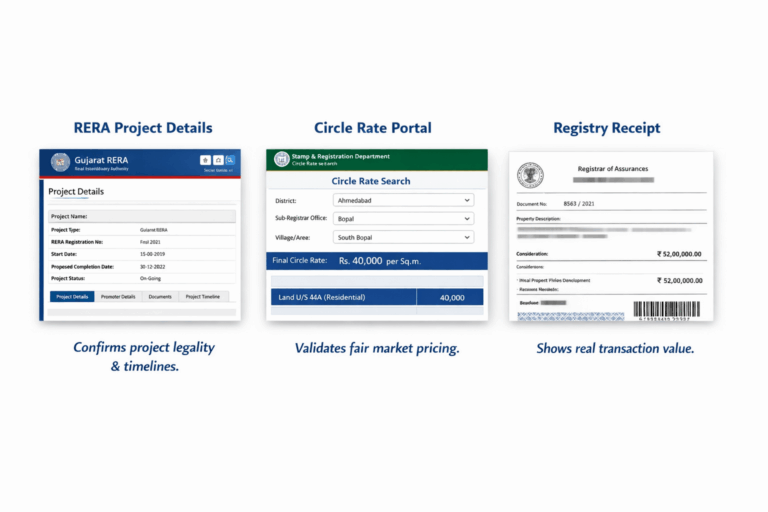
Gujarat RERA portal
The Gujarat RERA portal is the primary source to verify project registration, approved plans, timelines, and developer disclosures. It helps buyers track possession dates and phase-wise details. Complaint and update records also indicate past delay patterns. Always cross-check the RERA number before booking.
Circle rate data (Stamp & Registration Dept.)
Circle rates published by the Stamp & Registration Department reflect the government’s minimum property valuation. They help identify under- or over-pricing in a given sector. While not market prices, they act as a strong benchmark during negotiations. Sudden revisions often signal future price movements.
Sub-registrar transaction values
Sub-registrar offices record actual registered transaction values in a locality. These figures show what buyers are really paying, beyond advertised prices. Reviewing recent registrations provides realistic price expectations. This data is highly useful for final deal negotiations.
Local planning authority notifications
Notifications from local planning authorities (such as AUDA) reveal zoning changes, road expansions, and infrastructure approvals. These directly impact future livability and property value. Tracking official notices helps separate genuine development from marketing hype.
PROOFS & SCREENSHOT PLACEMENTS

WHO THIS GUIDE IS NOT FOR (MANDATORY)
This guide is NOT for:
Short-term flippers
These buyers aim to exit quickly, often before project completion. In slower markets, liquidity dries up and exit timelines stretch. Without strong end-user demand, short-term flipping becomes risky.
Speculative “double money” seekers
This segment relies on aggressive appreciation assumptions rather than fundamentals. Such expectations ignore execution delays, supply additions, and market cycles. Outcomes rarely match the promised hype.
Buyers chasing rumors or insider tips
Decisions based on unverified tips often overlook legal, pricing, and demand realities. Many “inside stories” never materialize into real development. Verified data always beats hearsay in property buying.
CONCLUSION
Future development in Gandhinagar is real — but uneven. The mistake is assuming every project will benefit equally.
Smart buyers:
- Separate facts from promises
- Buy usability, not stories
- Respect timing and cycles
If you want:
- A free location-fit checklist
- Project-level risk review
- Or clarity on whether to buy or wait
You can ask — no obligation, no selling.
Future Development Plans In Gandhinagar : Faqs
Q1. Should I buy now or wait for more development?
Q2. Will Gift City automatically increase prices everywhere?
Q3. Is under-construction safer or ready property better?
Q4. What if prices rise after I wait?
Q5. Is Gandhinagar better than Ahmedabad for end-use?
References
About the Author