
In early 2025, a family contacted me after booking a 3 BHK in Koba purely because “prices will rise once Gift City expands.” Six months later, they realised the quoted price was far higher than nearby registry rates—and the project had limited livability for daily family life.
This is the problem with most online articles. They talk about future potential but don’t help buyers avoid real, costly mistakes.
If you’re planning on buying a 3 BHK in Koba Gandhinagar in 2026, this guide will give you clear, ground-level clarity—pricing, risks, and smart decision logic.

PROBLEM EXPLANATION: WHAT BUYERS STRUGGLE WITH IN KOBA
From my on-site work in Koba, buyers usually face:
Price Confusion
- New projects quoting ₹6,200–₹7,200/sq ft
- Nearby resale flats registering much lower
Builder Trust Issues
- RERA registered projects with weak delivery history
- Heavy marketing, limited transparency
Location Misjudgment
- Confusing Koba’s future potential with present livability
- Ignoring internal road access and amenities
Living vs Investment Confusion
- End-users buying investor-centric inventory
- Investors expecting immediate rentals
Read More: Koba or Vavol: Best Locality to Buy a 3 BHK Flat?

STEP-BY-STEP SOLUTION: BUYER GUIDE FOR KOBA (2026)
Step 1: Location Selection
What to do
Choose Koba only if:
You’re Comfortable With Gradual Development
This suits buyers who understand that infrastructure, amenities, and community life will improve over time—not immediately. From on-ground experience in Koba, patience is rewarded, but only if expectations are realistic from day one. That’s exactly why many investors ask, is Koba a good location for 3 BHK investment?, because long-term appreciation depends on planned development, connectivity growth, and sustained residential demand rather than short-term hype.
Investing With a 4–6 Year Horizon
Koba works best for investors who can hold the property through development cycles. Appreciation and rental stability here are driven by future connectivity and occupancy growth, not short-term gains or quick exits.
Why it matters
- Koba is growth-oriented, not fully matured
Mistakes to avoid
- Buying deep interior projects without access roads
Pro Tip
I prefer projects closer to main SP Ring Road connectivity.
Step 2: Budget & Price Validation
What to do
- Compare:
Quoted Price
This is the price asked by the builder or seller and often includes marketing premiums or future-growth assumptions. In real transactions, it should always be treated as a starting point for validation and negotiation—not the final value.
Circle Rate
The circle rate is the government-defined minimum value used for stamp duty and registration. Buyers use it as a baseline to detect over-pricing or under-reporting, but it does not represent true market demand or livability.
Recent Registry Values
Registry values show the actual prices at which similar flats were legally sold in the same area. From on-ground experience, this data is the most reliable indicator of fair market value and realistic negotiation scope.
Why it matters
Prevents paying future pricing today
Mistakes
Assuming all Koba projects will match Gift City pricing
Pro Tip
Registry data is your strongest negotiation tool.
Step 3: Builder & RERA Verification
What to do
Verify Project on Gujarat RERA Portal
Before booking, always verify the project on the Gujarat RERA portal to confirm it is legally registered and compliant. This helps you check approved plans, promoter details, and the officially committed possession date.
Check Possession Extensions
Review whether the builder has taken possession extensions in the past. From real buyer cases, repeated or long extensions are a strong warning sign of execution delays, even if the project remains RERA-compliant.
Why it matters
Many Koba projects are execution-dependent
Mistakes
Trusting only brand names
Pro Tip
Past delivery history predicts future performance.
Step 4: Site Visit Checklist
Check:
- Actual flat, not brochure
- Sunlight & ventilation
- Construction finish
Pro Tip
Visit during peak afternoon hours to judge heat & airflow.
Step 5: Legal & Registry Checks
Verify:
Title Clearance
Title clearance confirms that the land and property have a clean, dispute-free ownership history. In practical terms, it ensures the seller has full legal rights to sell and protects buyers from future legal claims or transfer issues.
NA Status
NA (Non-Agricultural) status means the land is legally approved for residential construction. From experience, missing or conditional NA status often leads to loan rejection, registration delays, and uncertainty in possession timelines.
OC / BU Commitment
The Occupancy Certificate (OC) or Building Use (BU) commitment confirms the builder’s obligation to obtain legal permission for occupation. Flats without a clear OC/BU timeline carry higher risks related to utilities, resale, and legal compliance.
Pro Tip
Always review the draft agreement clause-by-clause.
Step 6: Negotiation Tips
Negotiate Floor Premium
Floor premiums are often presented as fixed, but in practice they are negotiable—especially in projects with unsold inventory. From real negotiations, questioning the value versus benefit (view, light, ventilation) often leads to partial or full waiver.
Ask for Flexible Payment Plans
Flexible or construction-linked payment plans reduce upfront risk and cash pressure. Buyers who negotiate payment timing rather than headline price often gain better financial control without increasing total cost.
Seek Stamp Duty Support
Builders sometimes offer stamp duty or registration cost support instead of price cuts. While subtle, this benefit directly reduces your out-of-pocket expense and is often easier to secure near closing periods.
Pro Tip
Year-end inventory often unlocks better pricing.

REAL CASE STUDIES (KOBA)
End-User Family
- Bought at: ₹72L (3 BHK)
- Nearby registry avg: ₹68–70L
- Decision: Self-use, long-term
- Outcome: Stable living, low stress
In this dynamic and fast-paced world, partnering with a professional digital marketing agency in Ahmedabad is essential. It is no longer necessary but is vital for sustained development.
Lesson:
Buy for lifestyle, not hype.
Investor
- Bought at: ₹58L
- Current rent: ₹17,000/month
- Yield: ~3.5%
- Appreciation (3 yrs): ~18%
Lesson:
Entry price matters more than promises.

TESTIMONIALS
“RERA verification saved us from a delayed project.”
— Rohit Patel, IT Professional
“Your registry comparison helped us negotiate ₹4L.”
— Sanjay Mehta, Investor

VERIFIED FACTS & CREDIBILITY
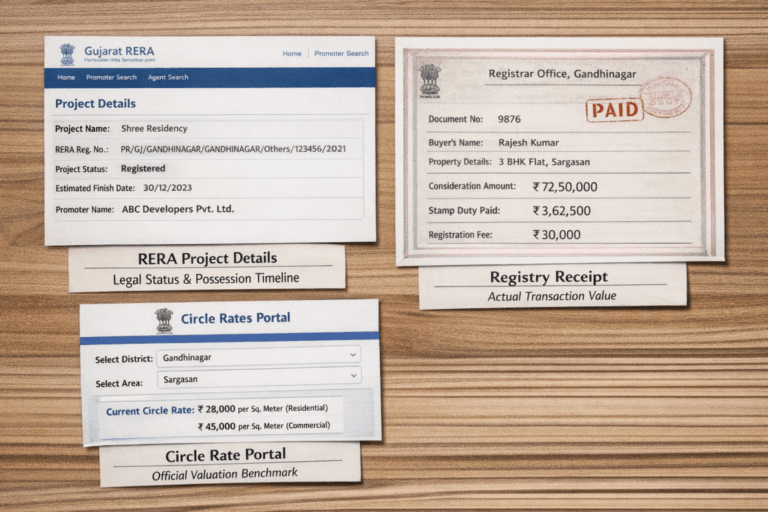
Gujarat RERA Portal
This is the primary source to confirm whether a project is legally registered and allowed to be sold. Buyers use it to verify builder details, approved plans, possession timelines, and any history of extensions before paying a booking amount.
Gandhinagar Sub-Registrar Data
Sub-Registrar records show the actual prices at which properties were legally registered in Gandhinagar. From on-ground experience, this data gives the most accurate picture of true market value and negotiation scope.
Circle Rate Portal
The circle rate portal provides the government-declared minimum value used for stamp duty and registration. Buyers use it as a baseline to spot over-pricing or under-reporting, not as the final market rate.
Local Development Authority Plans
These plans outline approved roads, zoning, and future infrastructure. Reviewing them helps buyers separate genuine growth backed by approvals from marketing claims that have no official timeline.
PROOFS & SCREENSHOT
CONCLUSION
Buying a 3 BHK in Koba Gandhinagar in 2026 can be smart—if you buy with data, not hype.
👉 Want a Koba price check or verified project list? Comment below or request a buyer checklist.