
Buying a 2 BHK in Gandhinagar can look simple on paper.
You find a project. The broker tells you the price. The sales executive shows you a sample flat. You hear that only “two units are left.” Then comes the familiar line:
“Sir, if you want this price, you need to book today.”
This is exactly where many buyers make their first mistake.
The problem is not always that the property is bad. The problem is that buyers often make a large financial decision before asking the right questions.
A ₹50–70 lakh home is not something you should buy because a salesperson created urgency. You need to know what you are actually paying for, whether the location works for your daily life, whether the builder and project documents are clean, and whether the property will still make sense if your circumstances change.
In my experience reviewing residential property decisions, the strongest buyer is not the person who negotiates ₹50,000 off the price.
It is the person who knows when to walk away.
This guide focuses on the questions to ask before buying a 2 BHK flat in Gandhinagar, particularly if you are considering areas such as Sargasan, Kudasan, Raysan, Randesan, Koba, Vavol, Zundal and nearby residential corridors.
Why Buying a 2 BHK in Gandhinagar Is Not Just About the Price
A buyer will usually ask:
“What is the price of the 2 BHK?”
That is the wrong first question.
The better question is:
“What will this property actually cost me, and what am I getting for that money?”
Two apartments can both be advertised at ₹55 lakh but be completely different purchases.
One may have:
- Better usable carpet area
- Better road access
- Established surrounding development
- Stronger resale demand
- Better maintenance
- Cleaner documentation
The other may have:
- Large loading factor
- Expensive amenities
- Poor access roads
- Future construction blocking the view
- High maintenance
- Weak rental demand
- Unclear development around the project
The headline price doesn’t reveal these differences.
Current property portals also show substantial variation across Gandhinagar’s micro-markets. For example, October 2026 data from MagicBricks shows indicative apartment averages around ₹4,302/sq ft for Gandhinagar overall, with different figures for areas such as Kudasan, Sargasan, Raysan, Randesan and Koba. These portal figures are useful for comparison, but they should not be treated as the final transaction value of a specific project or flat.
That distinction matters.
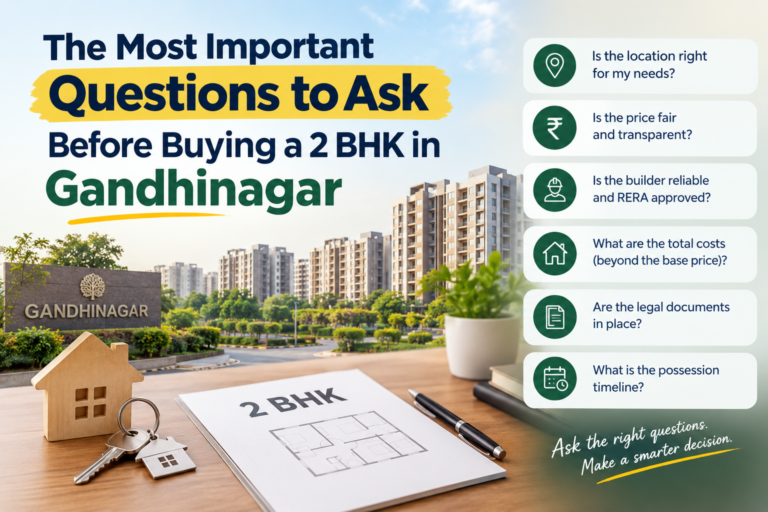
The Most Important Questions to Ask Before Buying a 2 BHK in Gandhinagar
Before you visit a project, save these questions on your phone.
Question 1: What is the actual carpet area?
Do not stop at:
“It is a 2 BHK of 1,250 sq ft.”
Ask:
“What is the RERA carpet area?”
Then ask for the floor plan.
A large super built-up number can make a flat sound much bigger than the space you will actually use.
Ask the builder:
- What is the RERA carpet area?
- What is the balcony/utility area?
- What is the built-up area?
- What is the super built-up area?
- How much loading is involved?
- Is the quoted price based on carpet area or saleable area?
Why this matters
You live inside the usable apartment—not inside the brochure’s super built-up calculation.
A cheaper flat with a significantly smaller usable area may not actually be cheaper.
What Is the Complete Cost of the Flat?
One of the biggest mistakes buyers make is comparing only the base price.
Suppose the advertised price is:
₹52 lakh
That does not automatically mean your cheque requirement is ₹52 lakh.
Ask for a complete written cost sheet.
It should clearly identify:
| Cost Component | Ask Before Booking |
|---|---|
| Base Property Price | Yes |
| Floor-Rise Charges | Yes |
| Parking | Yes |
| Clubhouse/Amenities | Yes |
| Maintenance Deposit | Yes |
| Infrastructure Charges | Yes |
| Legal/Document Charges | Yes |
| GST, If Applicable | Yes |
| Registration/Stamp-Related Costs | Yes |
| Other Miscellaneous Charges | Yes |
The exact applicability of taxes and charges depends on the transaction and property status, so don’t rely on a broker’s verbal estimate.
The question I would ask
“If I pay today, what is my estimated all-in acquisition cost, excluding my loan interest?”
Then ask for it in writing.
Is the Price Actually Reasonable for That Location?
This is where buyers often get manipulated.
A broker may say:
“This is the going rate.”
That statement means very little unless you know which comparable properties they are referring to.
Instead, compare at least:
- 3 nearby projects
- Similar construction age
- Similar carpet area
- Similar possession status
- Similar amenities
- Similar road accessibility
- Similar builder reputation
Don’t compare a new premium project with a 10-year-old apartment and conclude that one is overpriced simply because its quoted rate is higher.
A better calculation
Instead of asking:
“What is the rate per sq ft?”
calculate:
Total acquisition cost ÷ RERA carpet area
Then compare comparable properties using the same method.
That gives you a much more useful picture.
Is This Location Good for My Life?
This is one of the most important questions before buying a 2 BHK in Gandhinagar.
A location can be excellent for investment but inconvenient for your family.
Before booking, ask:
For end-use buyers
- How long is my daily commute?
- Is public transport practical?
- Are schools accessible?
- Are hospitals nearby?
- Are grocery stores and pharmacies easily accessible?
- Is the approach road usable during peak hours?
- What happens during monsoon?
- Is the neighbourhood already occupied?
- Will elderly parents be comfortable here?
- Is the area dependent on future infrastructure that has not arrived yet?
Gandhinagar’s planned development pattern means that two properties that look geographically close can still offer very different day-to-day convenience.
The city’s planning environment also includes multiple town-planning schemes covering areas such as Koba, Kudasan, Sargasan, Raysan, Vavol and surrounding growth corridors. That makes it important to understand not only the existing road but also the planning context around the property.
Should I Buy in an Established Area or an Upcoming Area?
Established location
Advantages
- Existing residents
- Existing shops
- Better understanding of traffic
- Established social infrastructure
- Easier end-use decision
Disadvantages
- Higher entry price in some pockets
- Less scope for dramatic appreciation
- Older buildings may require maintenance
Upcoming location
Advantages
- Potentially lower entry price
- Newer projects
- Future infrastructure possibilities
- More modern apartment layouts
Risks
- Construction may continue for years
- Roads may not be fully developed
- Schools/shops may still be developing
- Future supply can be high
- Appreciation is not guaranteed
The mistake is paying today’s premium for tomorrow’s promise.
If the project is being sold mainly on:
“This area will become the next big thing,”
ask:
“What part of that future development is already funded, approved or under execution?”
Is the Builder Reliable?
Don’t judge a builder only from:
- Office appearance
- Sample flat
- Social media
- Google reviews
- Large advertisements
- Celebrity endorsements
Check the project’s documentation and the builder’s actual delivery history.
Questions to ask
- How many projects has the builder completed?
- Were they delivered on time?
- Are there completed projects you can physically visit?
- What is the condition of those societies today?
- Are owners satisfied with maintenance?
- Are there major disputes?
- Are there delayed projects?
- Does the current project’s RERA information match the sales pitch?
Gujarat RERA provides a public search facility where buyers can review registered projects, agents and professionals without logging in. The portal also provides project monitoring and complaint-related information.
Do not treat RERA registration as a guarantee that the project is a good investment.
It is a regulatory verification step—not a substitute for your own due diligence.
What Should I Check on Gujarat RERA?
Before paying a substantial booking amount, search the project on the official Gujarat RERA portal.
Check:
- Project registration number
- Promoter name
- Project address
- Approved project details
- Proposed completion date
- Construction progress
- Quarterly/project updates where available
- Litigation/complaint information where relevant
- Uploaded documents
- Changes/extensions
- Phase details
The most important question
“Does what the salesperson promised me match what the official project records say?”
If the brochure says one possession date but official documentation indicates something materially different, stop and investigate.
What About Building Permission and BU Permission?
This is an area buyers often ignore until possession.
Don’t simply ask:
“Is everything approved?”
Ask for specific documents.
Depending on the property and stage, these can include:
- Development permission
- Sanctioned plans
- Building Use Permission
- Fire-safety documentation where applicable
- Completion-related documents
- Other authority approvals relevant to the project
Gandhinagar Municipal Corporation publishes development-permission and building-use-related forms and documentation under the applicable development regulations. Its town-planning resources also provide access to relevant TP schemes and building-permission schedules, which are useful Things to check before buying a 2 BHK to understand the property’s planning and approval status.
For a ready or near-ready property, do not assume that physical completion automatically means every required permission is in place.
Is the Land and Title Clear?
For a resale property, this becomes especially important.
Ask your property lawyer to examine:
- Title documents
- Previous sale deeds
- Encumbrances
- Land records
- Mutation entries where relevant
- Property card/record of rights where applicable
- Development permissions
- Society documents
- Outstanding dues
- Any litigation or charge
For new projects, legal due diligence should cover the underlying land and development rights—not merely the apartment brochure.
The Gujarat Revenue Department provides online services relating to document registration, Jantri rates, property cards and land records.
Golden rule
If the seller says:
“Everything is clear; don’t worry.”
Your response should be:
“Please give the documents to my lawyer.”
How Do I Check Whether the Quoted Price Is Too High?
Use several reference points rather than one.
Check:
1. Recent comparable transactions
What are similar properties actually selling for
2. Jantri/value information
Gujarat’s Revenue Department provides official access to Jantri and related registration services. Jantri represents an indexed base market-value framework determined by the state and should not automatically be treated as the exact market price.
3. Current competing inventory
If five similar projects are offering unsold units, you have more negotiating leverage.
4. Resale apartments
Sometimes a 3–8-year-old apartment in a mature neighbourhood can provide a much better comparison than another new launch.
Should I Buy a New 2 BHK or Resale 2 BHK?
This is one of the most useful comparisons buyers can make.
New property
You generally get:
- New construction
- Modern amenities
- Fresh interiors
- Newer services
- Potentially better initial maintenance
But you may pay a premium for:
- Branding
- Amenities
- New-launch positioning
- Future-development expectations
Resale property
You can inspect:
- Actual society
- Actual neighbours
- Actual water supply
- Actual maintenance
- Actual lift
- Actual parking
- Actual traffic
This is a major advantage.
For some end-users, a well-maintained resale 2 BHK in an established Gandhinagar neighbourhood can be a smarter purchase than an expensive new launch.
What Should I Check During the Site Visit?
Don’t visit only once.
Ideally visit:
Visit 1 — Daytime
Check:
- Natural light
- Ventilation
- Road access
- Construction quality
- Apartment layout
- Common areas
Visit 2 — Evening
Check:
- Traffic
- Noise
- Parking pressure
- Security
- Street lighting
- Actual neighbourhood activity
Visit 3 — Weekend
Check:
- Visitor parking
- Society crowd
- Noise
- Amenity usage
- Road congestion
And talk to residents.
Ask them:
“If you were buying this flat again today, would you?”
This question can reveal more than 30 minutes inside a sample flat.
What Should I Check Inside the Actual 2 BHK?
Do not get distracted by furniture.
Check:
- Bedroom dimensions
- Wardrobe space
- Kitchen usability
- Storage
- Bathroom ventilation
- Window placement
- Electrical points
- AC outdoor-unit location
- Washing-machine location
- Utility area
- Balcony usability
- Ceiling height
- Water pressure
- Drainage
- Seepage
- Wall cracks
- Door quality
- Flooring
- Plumbing
And most importantly:
Stand in the rooms with the furniture you actually own in mind.
A beautiful sample flat can hide an impractical layout.
What About Parking?
Parking is not a minor issue.
Ask:
- Is parking allotted or open?
- Is it exclusive?
- What are the dimensions?
- Can a normal SUV fit?
- Is the parking mechanically dependent?
- Is visitor parking sufficient?
- Is parking included in the quoted price?
- What exactly does the agreement say?
A family can tolerate a slightly smaller balcony.
They usually cannot tolerate a daily parking fight for years.
What About Maintenance Charges?
This is another overlooked cost.
Ask:
“What will my monthly maintenance bill approximately be after possession?”
Then ask:
- What is included?
- Security?
- Lift maintenance?
- Clubhouse?
- Swimming pool?
- Landscaping?
- Generator?
- Water?
- Common electricity?
- Major repairs?
- Sinking fund?
A project with impressive amenities may also have higher recurring expenses.
Don’t buy facilities you won’t use simply because they look good in a brochure.
Should I Buy for End Use or Investment?
If you are buying for your family
Prioritize:
- Location
- Commute
- Layout
- Safety
- Daily convenience
- School/hospital access
- Society quality
- Resale flexibility
If you are buying as an investor
Prioritize:
- Entry price
- Rental demand
- Tenant profile
- Vacancy risk
- Maintenance
- Liquidity
- Resale demand
- Realistic appreciation potential
Don’t buy an end-user property and call it an investment after the purchase simply because the salesperson says:
“Sir, Gandhinagar prices will double.”
Nobody can guarantee that.
What Is a Realistic Rental Yield?
Suppose you purchase a 2 BHK for:
₹55 lakh
and receive:
₹18,000/month rent
Annual rent:
₹18,000 × 12 = ₹2.16 lakh
Gross rental yield:
₹2.16 lakh ÷ ₹55 lakh × 100 = approximately 3.9%
But your actual net yield will be lower after considering:
- Vacancy
- Maintenance
- Repairs
- Brokerage
- Property tax where applicable
- Furnishing
- Other ownership expenses
That is why an investor should not say:
“Rent is ₹18,000, so I’m getting almost 4%.”
The relevant question is:
“What is my net return on the total money invested?”
How Much Should I Negotiate?
Don’t negotiate randomly.
First calculate your maximum acceptable purchase price.
Suppose:
- Property price = ₹55 lakh
- Other acquisition costs = ₹4 lakh
- Immediate furnishing/repair = ₹2 lakh
Your effective acquisition cost is around:
₹61 lakh
If another comparable property is available at an effective ₹57–58 lakh, the negotiation becomes much more meaningful.
Negotiate on more than price
Ask for value through:
- Parking
- Floor-rise waiver
- Maintenance waiver
- Better payment schedule
- Furnishing
- Certain charges
- Registration-related assistance where legitimately applicable
- Upgrade options
But get every promised concession in writing.
Beware of Fake Urgency
These statements should make you slow down:
“Only one flat is left.”
“Price increases tonight.”
“Another customer is waiting.”
“Book now and documentation can be checked later.”
“Don’t worry about the agreement.”
“RERA is there, so everything is automatically safe.”
Urgency is not evidence.
A genuine property can survive 24 hours while you verify documents.
If a seller cannot tolerate basic due diligence, that itself is information.
Step-by-Step Buyer Action Plan
Step 1: Select the Location
What to do
Shortlist 2–3 micro-markets rather than searching all of Gandhinagar.
Why it matters
A good apartment in the wrong location is still the wrong purchase.
Mistake to avoid
Choosing based entirely on future infrastructure promises.
Practical tip
Drive the actual route from the project to your workplace during peak hours.
Step 2: Validate the Budget and Price
What to do
Create an all-in cost sheet.
Why it matters
The advertised price is rarely the complete financial commitment.
Mistake to avoid
Using your maximum loan eligibility as your maximum property budget.
Practical tip
Keep a separate emergency reserve after the down payment and transaction costs.
If buying the flat leaves you with almost no liquid savings, I would seriously reconsider the purchase.
Step 3: Verify Builder and RERA
What to do
Check the project on Gujarat RERA and examine the builder’s completed projects.
Why it matters
A polished sales office does not prove delivery capability.
Mistake to avoid
Relying on verbal assurances.
Practical tip
Compare the RERA information with the sales brochure.
If they don’t match, ask why.
Step 4: Conduct a Proper Site Visit
What to do
Visit multiple times.
Why it matters
A project can look completely different at 11 AM and 8 PM.
Mistake to avoid
Visiting only the sample flat.
Practical tip
Talk to existing residents.
Step 5: Complete Legal and Registry Checks
What to do
Use an independent property lawyer.
Why it matters
A broker’s job is to facilitate the transaction. Your lawyer’s job is to protect your legal interests.
Mistake to avoid
Using only the builder’s recommended legal representative without independent review.
Practical tip
Don’t pay a large non-refundable amount before basic due diligence.
Step 6: Negotiate
What to do
Negotiate after understanding the property’s fair value.
Why it matters
You cannot negotiate intelligently if you don’t know the alternatives.
Mistake to avoid
Getting emotionally attached before negotiating.
Practical tip
Keep another comparable property alive until your documentation is satisfactory.
Realistic Case Study: End-User Family
The situation
A family with two children wanted a 2 BHK in the Gandhinagar region.
Budget: ₹55–60 lakh
They initially preferred a new project because the sample flat looked better.
They shortlisted a new apartment at approximately:
₹57 lakh
But during comparison they found a resale 2 BHK in a more established neighbourhood for approximately:
₹53 lakh
The resale property had:
- Smaller amenity package
- Older construction
- Established residents
- Existing shops nearby
- Known parking arrangement
- Immediate usability
What they eventually chose
The family preferred the resale property after comparing:
- Actual commute
- Carpet area
- Society maintenance
- Parking
- Neighbourhood
- Total acquisition cost
Lesson
The new property wasn’t necessarily bad.
It simply wasn’t the best fit for their priorities.
This is an important distinction:
A good property is not automatically a good purchase for you.
Realistic Case Study: Investor
Again, this is an illustrative scenario rather than a claim about a specific investor.
An investor purchased a 2 BHK for approximately:
₹48 lakh
The property generated around:
₹16,000/month rent
Annual gross rent:
₹1.92 lakh
Gross rental yield:
4%
After maintenance, vacancy and other costs, the effective yield was lower.
Over several years, the property appreciated moderately rather than dramatically.
The investor eventually sold because:
- Rental yield was no longer particularly attractive
- Better investment opportunities became available
- The resale market was sufficiently liquid
What worked?
The investor had entered at a reasonable price.
What didn’t work?
The original assumption that rent would increase rapidly did not happen.
Lesson
For residential property, entry price often matters more than a beautiful appreciation story.
Current Gandhinagar Market Context
Gandhinagar should not be treated as one single property market.
Micro-markets behave differently.
Current portal data shows meaningful differences between locations such as:
- Gandhinagar
- Kudasan
- Sargasan
- Raysan
- Randesan
- Koba
- Vavol
- Zundal
- GIFT City
For example, MagicBricks’ Q3 2026 figures put its indicative average apartment price around ₹4,302/sq ft for Gandhinagar, with Kudasan around ₹4,541, Sargasan around ₹4,600, Raysan around ₹4,658 and Randesan around ₹4,837. These are portal asking/market-trend indicators, not verified registered transaction prices, so they should be used as one reference point rather than as proof of what your particular flat is worth.
Housing.com’s 2026 data also shows variation between localities, reinforcing the point that a citywide average is too crude for valuing an individual 2 BHK.
Interest rates also matter because home-loan affordability can change even when property prices do not. RBI’s published data in 2026 showed a policy repo rate of 5.25% at the time of its July rate snapshot; actual home-loan pricing depends on the lender, borrower profile and loan terms.
So don’t make a purchase decision based on:
“Rates are low/high, therefore property must rise/fall.”
Real estate is local, slow-moving and highly dependent on the specific asset.
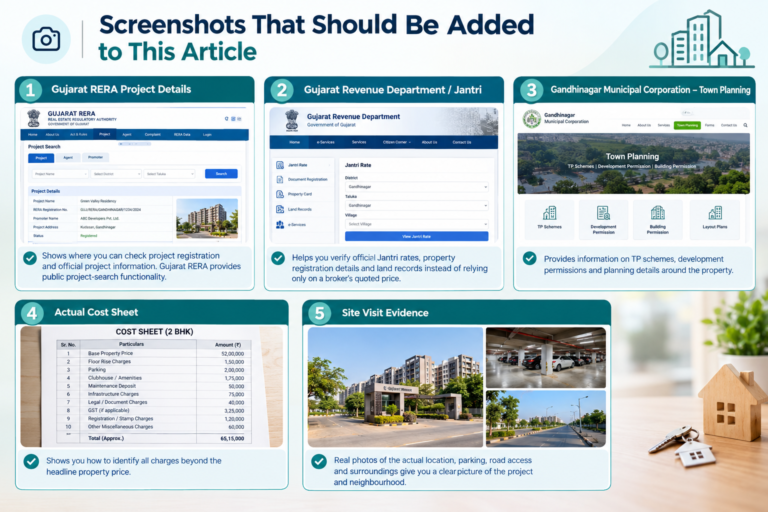
Screenshots That Should Be Added to This Article
Who This Guide Is NOT For
This guide is not designed for someone looking for:
- A quick flip
- A guaranteed 20–30% return
- Insider property rumours
- “Next hot area” tips
- Unverified builder gossip
- Speculative land/property bets
- A property purchase based entirely on future infrastructure
It is also not for buyers who have already decided:
“I love this project, now tell me why I should buy it.”
That approach reverses the decision-making process.
Who should consider waiting?
I would strongly consider waiting if:
- Your emergency fund would disappear after the purchase
- Your EMI would make your monthly budget uncomfortable
- Your job situation is uncertain
- You may relocate within a few years
- The property requires major compromises
- The documentation is incomplete
- The builder is pressuring you to book before verification
- You are buying only because prices “might increase”
Renting for another year is not failure.
Sometimes rent is cheaper than making a ₹50–70 lakh mistake.
If I Were Buying This Property Today
This is where I would be deliberately opinionated.
If I were buying a 2 BHK in Gandhinagar today, I would not rush into a new project simply because of a launch offer or limited-unit message.
I would shortlist both:
- A good-quality new project, and
- A well-maintained resale apartment in an established micro-market.
Then I would compare them using total acquisition cost, carpet area, location, society quality, parking, maintenance and resale liquidity.
The configuration I would choose
For an end-user family, I would prefer a practical 2 BHK with a strong layout and usable carpet area over a larger advertised super built-up area filled with inefficient circulation.
I would rather have:
- Good bedrooms
- Proper storage
- Functional kitchen
- Natural light
- Usable balcony
- Good ventilation
than an impressive brochure with a poor floor plan.
What would I negotiate hardest?
I would negotiate the all-in price, not just the headline discount.
A ₹2 lakh discount on one component means little if several additional charges remain.
I would also negotiate based on comparable properties rather than saying:
“Give me your best price.”
One red flag I would not ignore
Pressure to pay a substantial amount before I can independently verify the documents.
That would make me step back.
A property worth buying should survive a proper due-diligence process.
Conclusion:
Buying a 2 BHK in Gandhinagar should not begin with:
“Which project is cheapest?”
It should begin with:
“Which property creates the least chance of a costly mistake?”
Check the carpet area.
Check the complete cost.
Check the location at different times.
Check comparable properties.
Check Gujarat RERA.
Check planning and permissions.
Check title documents.
Talk to residents.
Understand rent realistically.
And most importantly, be willing to walk away.
The best property decision is sometimes a purchase.
Sometimes it is negotiating a better price.
And sometimes it is saying:
“This isn’t right for me.”
That is not losing the deal.
That is making the decision correctly.
FAQs :- Before Buying 2 BHK Flats in Gandhinagar
1. What should I check before buying a 2 BHK flat in Gandhinagar?
2. What is the difference between carpet area and built-up area in a 2 BHK?
3. Which areas in Gandhinagar are suitable for buying a 2 BHK flat?
4. What additional costs should I budget for when buying a 2 BHK?
5. Is a ready-to-move 2 BHK better than an under-construction flat?
References
About the Author