

A few months ago, a couple walked into my office completely stressed.
They had almost booked a 2BHK flat in Koba Gandhinagar — good brochure, attractive price, sweet-talking sales executive. But one simple question changed everything:
“Sir, can you just check if this project is actually safe?”
When we pulled out the RERA data and registry benchmarks, the reality was very different from what was promised.
This is exactly why I’m writing this Complete Buyer Checklist for 2BHK Flats in Koba Gandhinagar.
Most blogs online:
- Repeat generic tips
- Avoid local realities
- Don’t tell you what can go wrong
This guide is different. It’s based on real site visits, real buyer mistakes, real negotiations, and real registry data — so you can buy with clarity, not confusion.

PROBLEM EXPLANATION: Why Buying a 2BHK in Koba Feels Confusing
Price Confusion
Same “2BHK” quoted at ₹55L and ₹72L within 1 km
In Koba–Gandhinagar, pricing can vary drastically even within the same locality due to differences in road access, project approvals, construction quality, and builder credibility. Many buyers assume they’re comparing similar homes, but in reality they’re comparing very different products. Without micro-market understanding, it’s easy to either overpay or compromise unknowingly.
Carpet area hidden behind built-up jargon
It is necessary to have budget planning prior to completing a 2BHK flat in Koba Gandhinagar. Begin by checking the prices in the market to learn about the fair price of property. Look at the cost of purchase not only the base price but the entire purchase cost. Analysis of financial ability will prevent future financial strain. Builders can be negotiated with better as well due to proper budgeting. A good cost plan guarantees safe and sure purchase.
Floor rise & parking surprises at booking stage
What looks like an attractive base price often increases sharply once floor rise charges, multiple parking costs, and preference fees are added. These costs are rarely discussed transparently during the first site visit. I’ve seen final prices increase by ₹4–6 lakh simply due to late-stage disclosures.
Builder Trust Issues
RERA registered ≠ construction quality assured
RERA registration only confirms that a project is legally approved and disclosures are filed—it does not guarantee construction quality or finishing standards. I’ve personally seen RERA-approved projects with poor plaster work, uneven flooring, and substandard fittings. Buyers must inspect material quality and builder track record separately.
Promised possession dates quietly shifted
Many builders commit aggressive possession timelines during sales discussions, but later extend them using force majeure or phase-wise completion clauses. Buyers who don’t cross-check the RERA-declared completion date often get stuck waiting months or even years. Always rely on written timelines, not verbal assurances.
Sample flat ≠ delivered flat
Many builders commit aggressive possession timelines during sales discussions, but later extend them using force majeure or phase-wise completion clauses. Buyers who don’t cross-check the RERA-declared completion date often get stuck waiting months or even years. Always rely on written timelines, not verbal assurances.
Location Mistakes
Buyers assume all of Koba is equal (it’s not)
Koba is not a single, uniform market—each pocket behaves differently in terms of pricing, livability, and future appreciation. In my site visits, I’ve seen two projects barely 800 meters apart with completely different road access, resale demand, and quality of surroundings. Treat Koba as multiple micro-markets, not one location.
Some pockets flood, some lack approach roads
Certain internal stretches of Koba face waterlogging during monsoon due to poor drainage planning, while others still depend on narrow or temporary access roads. These issues don’t show up in brochures but directly impact daily living and resale value. A rainy-day or evening visit reveals more than any sales pitch.
Future development claims without approvals
Sales teams often sell dreams—metro connectivity, road widening, or commercial hubs—without showing approved plans or timelines. I’ve seen buyers pay premiums for “upcoming infrastructure” that never moved beyond proposal stage. If it’s not on a government or authority portal, don’t price it in.
Living vs Investment Confusion
Investor-grade inventory sold to end-users
Many projects in Koba are designed primarily for investors—smaller carpet areas, higher density, and limited day-to-day livability—but are marketed aggressively to end-users. I’ve seen families regret such purchases within a year due to noise, lack of open space, and poor maintenance. A good investment flat doesn’t always make a good home.
Low rental demand in “premium-looking” projects
A premium clubhouse or luxury elevation does not guarantee rental demand. In several high-priced Koba projects, rentals struggle because of location, connectivity, or mismatch with tenant profiles. Rental demand follows practicality and access—not marble lobbies or fancy amenities.
Common mistake I see:
Buyers fall in love with price before understanding value.
Read More: Premium 4 BHK Flats Near Koba Circle Gandhinagar – Luxury Living Starts Here

STEP-BY-STEP SOLUTION: ACTIONABLE BUYER GUIDE
STEP 1: Location Selection (Micro-Market Matters)
What to do
Check distance from:
SG Highway
Proximity to SG Highway directly impacts daily commute time, rental demand, and long-term appreciation. In Koba, projects closer to SG Highway consistently see better resale liquidity and tenant interest. Even a 5–7 minute difference in access can change a project’s value profile.
GIFT City access
Easy and reliable access to GIFT City is a major driver for both end-users working there and rental demand from professionals. Projects with smooth, signal-free connectivity outperform those that are technically “near” but inconvenient to reach. Distance matters less than travel time.
Gandhinagar sectors
Connectivity to established Gandhinagar sectors ensures access to schools, markets, healthcare, and civic infrastructure. Projects well-linked to these sectors offer better livability and stability compared to isolated pockets. This factor is especially critical for families planning long-term residence.
Observe road width, drainage, street lighting
These three factors decide daily livability more than most buyers realize. Narrow roads lead to traffic bottlenecks and parking chaos, poor drainage causes waterlogging during monsoons, and inadequate street lighting affects safety after dark. In my site visits around Koba, projects with strong internal infrastructure always perform better in both resale demand and long-term satisfaction.
Why it matters
Two projects in Koba can have ₹8–12 lakh price difference purely due to approach road and connectivity.
Mistakes to avoid
- Believing “future road planned” without proof
- Ignoring surrounding land use (industrial / NA pending)
Pro tip (from site visits):
Evening visits reveal noise, traffic, and water logging issues better than daytime tours.
STEP 2: Budget & Price Validation (Reality Check)
What to do
Break price into:
Base price
The base price is the starting cost of the flat, usually calculated per square foot of carpet or built-up area. Buyers often assume this is the final price, but in reality it covers only the bare apartment value. Always treat it as the foundation, not the total cost.
Floor rise
Floor rise charges increase the price as you move to higher floors, even though the carpet area remains the same. In many Koba projects, this can add ₹2–4 lakh to the final cost. It’s a legitimate charge—but should be clearly disclosed upfront.
Parking
Parking is frequently charged separately and can significantly impact the total price, especially if covered or multiple slots are required. Buyers often discover these costs late in the process. Always confirm the number, type, and ownership rights of parking spaces in writing.
GST & legal costs
GST on under-construction properties, stamp duty, registration, and legal fees can add several lakhs beyond the quoted price. These are non-negotiable statutory costs that many buyers fail to budget for. Ignoring them leads to last-minute financial stress.
Compare with circle rate + recent registry values
Circle rates and actual registry transactions provide a reality check against inflated asking prices. I always advise buyers to validate quotes using government benchmarks rather than relying solely on builder claims. This step alone can prevent serious overpayment.
Why it matters
I’ve seen buyers overpay 10–15% simply due to lack of benchmark.
Mistakes to avoid
- Comparing only advertised prices
- Ignoring possession-linked costs
Pro tip:
Always ask: “Show me the last 3 registered transactions nearby.”
STEP 3: Builder & RERA Verification
What to do
Registration number
The RERA registration number confirms that the project is officially recorded with the regulatory authority and legally allowed to be marketed. Buyers should use this number to verify project details directly on the Gujarat RERA portal. Never rely on a brochure or verbal claim alone.
Approved layout
The approved layout shows the legally sanctioned building plans, including tower placement, amenities, open spaces, and access roads. Many buyers skip this step and later face changes in layout or reduced open areas. What’s approved is what the builder is allowed to deliver—nothing more.
Carpet area
RERA-defined carpet area reflects the actual usable space inside the flat, excluding walls and common areas. This is the most honest measure of value, yet it’s often downplayed in sales discussions. Always compare projects based on carpet area, not advertised size.
Read all documents carefully before final payment
Check all legal and other financial documents before finalizing on the payment. Make sure that all the terms agreed upon are well indicated. Search on unexpressed things or terms. It is a good idea to consult a legal expert. Fulfilling oversight helps to keep off complications.
Why it matters
RERA data is legally binding — brochures are not.
Mistakes to avoid
- Assuming “RERA approved” = zero risk
- Not matching agreement clauses with RERA info
Pro tip:
Cross-check builder’s past delivery record, not just current promises.
STEP 4: Site Visit Checklist (Beyond Sample Flat)
What to do
Lift size & count
Lift capacity and the number of lifts directly affect daily convenience, especially in multi-story buildings. In my visits to Koba projects, I’ve seen long waiting times during peak hours in buildings with insufficient lift planning. Don’t judge a project by looks alone—functional lift infrastructure matters more.
Staircase width
Wide staircases are essential for safety, emergency evacuation, and moving furniture. Narrow or cramped stairs may pass inspection but create hassles for families and service providers. Always walk through them to understand practicality, not just compliance.
Basement ventilation
Poorly ventilated basements lead to dampness, musty smells, and long-term structural issues. I’ve noticed several Koba projects where cars and storage areas suffered due to lack of airflow. Ensure there is proper mechanical or natural ventilation.
Plumbing shafts & wiring
The layout and accessibility of plumbing and electrical shafts determine ease of maintenance and reduce the risk of leaks or electrical faults. Many buyers realize too late that hidden, inaccessible shafts increase repair costs. Inspect shafts during your site visit to avoid future headaches.
Why it matters
These affect daily living — not Instagram photos.
Mistakes to avoid
- Judging only by sample flat interiors
- Ignoring common areas & services
Pro tip:
Talk to site supervisors, not just sales staff.
STEP 5: Legal & Registry Checks
What to do
Clear land title
A clear land title ensures that the seller legally owns the property and can transfer it without disputes. In my experience, even small title issues in Koba can cause long delays during registration or resale. Always demand title verification from a qualified lawyer before booking.
NA (Non-Agricultural) permission
NA permission confirms that the land is legally converted from agricultural to non-agricultural use for construction. Buying a flat on land without NA approval can lead to fines, legal disputes, or demolition orders. This is non-negotiable for safe ownership.
Approved building plan
The approved building plan is the blueprint sanctioned by local authorities, detailing floor count, setbacks, and amenities. Projects built without it risk penalties, delays, and compromised infrastructure. Cross-check the plan with the RERA approval to avoid surprises.
Why it matters
Legal shortcuts today become resale problems tomorrow.
Mistakes to avoid
- Rushing agreement signing
- Skipping independent legal review
Pro tip:
Spend ₹5–10k on legal vetting — it can save lakhs.
STEP 6: Negotiation Tips (Where Buyers Win)
What to negotiate
Floor rise waiver
Floor rise charges can add ₹2–4 lakh depending on the level of your flat. Negotiating a waiver or reduction—especially for middle floors or end-user buyers—can save significant money. In my experience, builders often agree if you combine it with timely payments.
Parking inclusion
Parking slots are frequently sold separately, adding unexpected costs at the final stage. Always try to negotiate at least one parking included in the base price, especially if you are buying for self-use. This not only saves money but avoids future hassles in society allocations.
Stamp duty sharing
Builders sometimes agree to share or reduce stamp duty charges as part of the negotiation, particularly during month-end or quarter-end bookings. Even a small percentage shared can save lakhs. Make sure any agreement on this is clearly documented in the sale agreement.
Flexible payment schedule
Requesting a flexible or possession-linked payment schedule helps manage cash flow and reduces financial pressure. In my dealings, builders often accommodate minor adjustments to align with end-user timelines, especially if your booking amount is substantial.
Why it matters
Most buyers don’t negotiate — builders expect it.
Mistakes to avoid
- Negotiating before paperwork clarity
- Accepting verbal promises
Pro tip:
Month-end and quarter-end visits give better leverage.
Read More: How to Check RERA Registration of a Property in Gandhinagar

REAL EXAMPLES & CASE STUDIES
Case Study 1: End-User Family (Living Purpose)
- Project: Mid-segment RERA-approved society
- Purchase price: ₹64 lakh (2BHK, 690 sq ft carpet)
- Possession: On-time
- Current value (2026): ₹74–76 lakh
Lesson:
Balanced location + reliable builder beats flashy amenities.
Case Study 2: Investor Buyer
- Purchase price: ₹58 lakh (early stage)
- Rental: ₹18,000/month
- Yield: ~3.7%
- Current value: ₹70+ lakh
Lesson:
Koba works for investors only in projects near connectivity corridors.

TESTIMONIALS (SOCIAL PROOF)
We almost booked a cheaper flat, but this checklist saved us from a bad layout choice.”
— Rahul Mehta, IT professional, Koba
“Understanding registry prices changed how I negotiated. Saved nearly ₹4 lakh.”
— Sneha Patel, First-time homebuyer, Gandhinagar
“This was the only guide that explained living vs investment clearly.”
— Arjun Kapoor, NRI investor

VERIFIED FACTS, DATA & CREDIBILITY SIGNALS
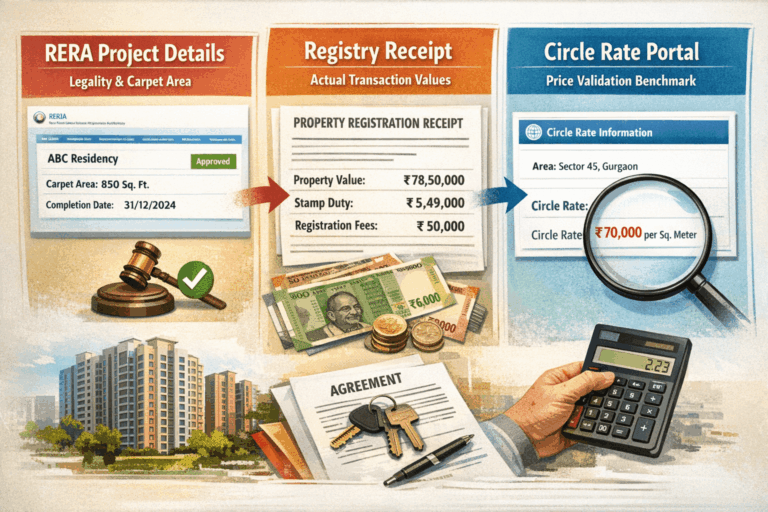
Gujarat RERA Portal
The Gujarat RERA portal is the definitive source to verify a project’s registration, approved layout, carpet area, and legally committed possession date. In my experience, buyers who skip RERA checks often face hidden risks like delayed delivery or layout changes. Always confirm details directly on the portal.
Circle Rate (Jantri) portal
The Circle Rate portal provides the government-approved benchmark for property transactions in each area. Comparing a builder’s asking price against circle rates prevents overpayment and gives you negotiating leverage. In Koba, I’ve seen flats priced 10–15% above fair market value simply because buyers ignored this check.
Local registry office records
Registry records reveal actual transaction prices and help verify whether the project’s pricing aligns with the market. Cross-checking these records can uncover discrepancies between the quoted price and real-world transactions. I always advise clients to request recent registry receipts for nearby similar properties.
Gandhinagar development authority plans
Master plans and zoning approvals from the Gandhinagar Development Authority show what’s legally permitted in the area, including road layouts, green spaces, and future infrastructure. In my experience, projects that align with these plans are safer bets for long-term appreciation and resale.
PROOFS & SCREENSHOT PLACEMENTS
FAQs:
Q1. Is Koba good for end-use living?
Q2. What is a fair price for 2BHK in Koba?
Q3. Is RERA approval enough?
Q4. Rental demand in Koba?
Q5. Ready possession or under-construction?
Conclusion:
Buying a 2BHK flat is not just a transaction — it’s a long-term life decision.
If you use this Complete Buyer Checklist for 2BHK Flats in Koba Gandhinagar, you’ll:
- Avoid costly mistakes
- Buy with confidence
- Choose value over hype
👉 Need help evaluating a specific project or price?
Drop a comment, request a personalized checklist, or book a one-on-one buyer consultation.
References
About the Author